
Essential Startup Valuation Insights: How Startup Valuation Works for Early-Stage Companies
A Practical Guide for Founders, Professionals, and Investors
Introduction to Essential Startup Valuation Insights: How Startup Valuation Works for Early-Stage Companies
The ability to value a startup is one of the most practically useful skills that can be developed by anybody in or around the entrepreneurial ecosystem. Whether you are a junior analyst on a deal team, a mid-level finance professional looking to make a pivot into VC, or a founder prepping for your first fundraise, the mechanics of early-stage business valuation can influence a lot of decisions that matter—like the amount of equity being sold, how investors value risk, and how growth is translated to dollars.
For small businesses, valuation is more to do with expectations than with past results. A seed-stage company may be under a few years old, and have no revenue to report, nor consistent margins, while a mature business will have years of audited revenue and consistent margins. This is a unique field of startup company valuation services, in which the quantitative modelling skills are mixed with the qualitative judgment of the markets, people, and timing.
This article explains the basic principles, techniques, and elements of startup valuation in simple terms. It encompasses aspects of pre-money mechanics, post-money mechanics, the role of intellectual property, intangible assets, employee equity, and brand value, not to mention how each of these can impact the pricing of a startup by an investor.
How Startup Valuation Works for Early-Stage Companies and Venture Investors | Essential Startup Valuation Insights
Valuation can be simply defined as determining the worth of something. An early-stage company’s estimation is always subject to speculation. No 10-year cash flows are available to discount; no similar, traded, listed entity exists with a known multiple, and often there’s no revenue at all. But investors continue to value these businesses every day, and that’s exactly what happens; it just happens with a large amount of guesswork.
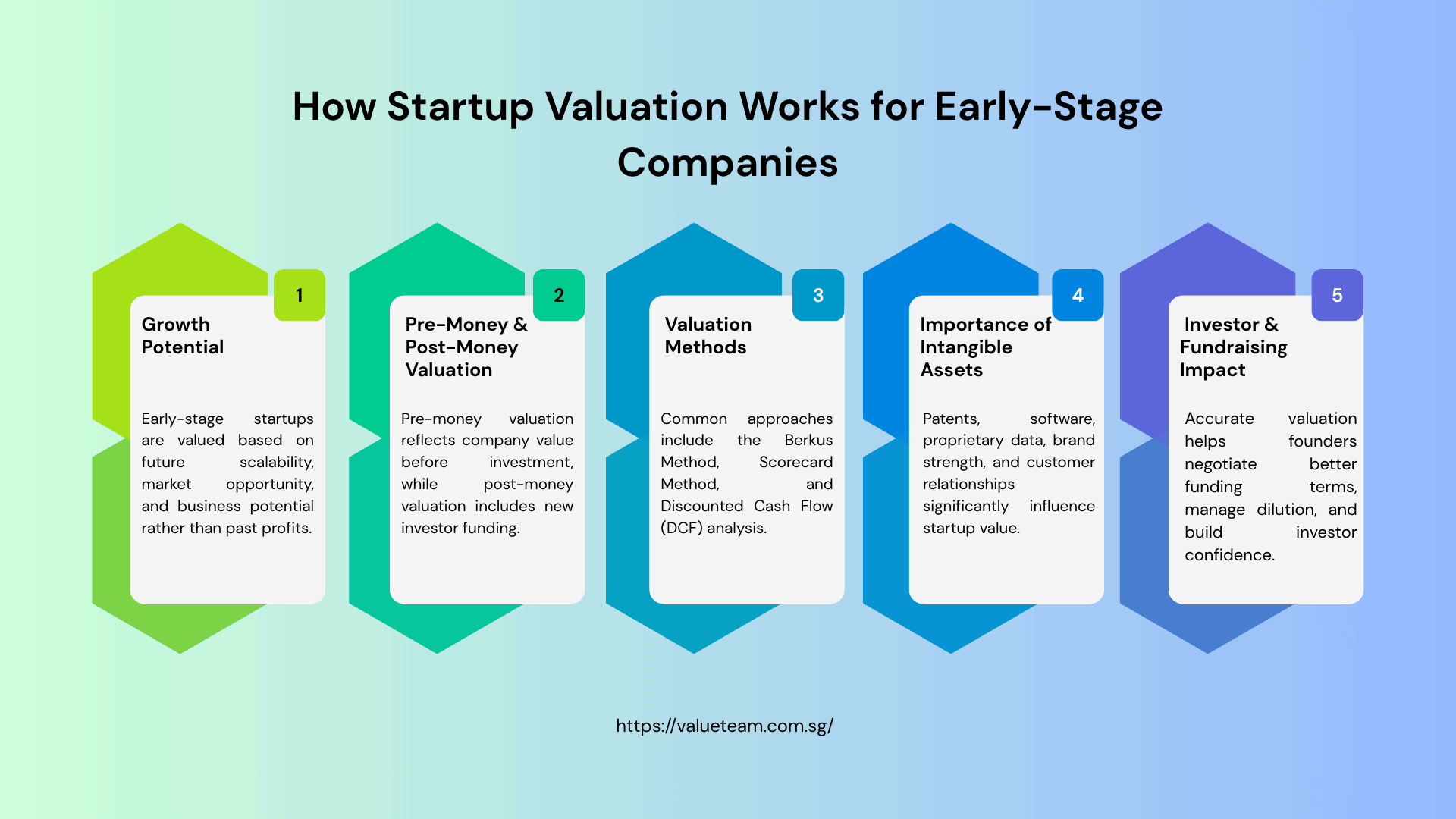
For most deals, the first step is to learn the difference between pre-money and post-money valuation. Pre-money valuation is the value of the company before any investment. The post-money valuation is only the pre-money amount added to the amount of investment. The post-money valuation is SGD 5 million, representing a 20-percent stake in the startup. For instance, if a startup is worth SGD 4 million pre-money, the investor invests SGD 1 million, the post-money valuation would be SGD 5 million, which means that the investor owns 20 percent of the startup. While this may appear simple, the real question is how they came up with SGD 4 million in the first place.
There are three major methods for early practice. The Berkus Method puts a dollar sign on qualitative milestones: a working prototype, a clear market, and a capable team. The Scorecard Method compares a startup to other funded startups that are similar in nature and adjusts accordingly based on their relative strengths. The Discounted Cash Flow method forecasts future revenue and then discounts it back to the present value at a risk-adjusted rate (this is very sensitive at the seed stage). Both methods have their own merits, and usually, a startup financial valuation consultant will use more than one approach to arrive at a defensible and balanced valuation figure.
Startup Fundraising Valuation Strategies for Seed and Series A Companies | Essential Startup Valuation Insights
Fundraising for a startup is almost always in rounds, starting with the pre-seed round, then the seed round, Series A, Series B, and so forth. The company will have de-risked itself at each step—from idea to prototype to paying customers to repeatable growth. The valuation of a startup during a round of fundraising is very different than the valuation in the previous round, not only because the valuation itself is higher, but because there is more evidence to support the valuation.
VCs have a return model that they take into account when valuating a venture. One VC firm has to recoup the cost of the entire VC many times over, and so individual investments are valued, in part, based on exit possibilities. When looking for venture capital, valuation is in fact as much about realistic exit multiples and the market size as it is about current financial performance. If a firm thinks that after five years, they can get a SGD 200 million valuation for a startup, they will work backwards from the price to find out what price to pay now to get the desired returns.
Founders should know the reason behind this investor logic. While a higher valuation could be tempting in a seed round, it can also lead to a down round if the expectation is too high to be achieved in the Series A round. Business valuation for investors can help them set realistic expectations and help them and the investor negotiate a fair deal, while keeping the cap table situation under control.
IP Valuation and Intangible Asset Valuation for Technology Startups |Essential Startup Valuation Insights
For many emerging tech startups, it’s not the physical that’s most valuable. No factory, no fleet, and no real estate. Rather, the value is in the code, in the patents, in the proprietary algorithms, in the accumulated data, and in the relationships cultivated with the early customers. It is important for anyone who is involved in startup equity valuation methods, particularly when the value of the business is heavily dependent on the knowledge that it can offer, such as in fintech, healthtech, and enterprise software industries.
In a tech start-up, one of the most important sources of value is intellectual property. A technology startup valuation of IP focuses on what intellectual property the company has — registered patents, proprietary source code, trade secrets, or brand assets — and attempts to make a market valuation of that IP. For startups, patent valuation also considers the defensibility of the patent, patent term, and the commercial viability of the underlying technology. Investors might need a startup patent portfolio valuation during due diligence, and the company might need it when considering licensing agreements and/or planning an M&A transaction.
In addition to the patent surface, Software IP valuation services value any codebase, platform, or proprietary tools. Data and software asset valuation is a growing field in recognition of the potential for data, particularly structured, proprietary data, to be a competitive asset for businesses. The innovation and IP valuation consulting firms can play a role in helping companies to value these assets and to reflect them correctly in fundraising talks and on financial documents, providing clarity to investors and management teams as to where the value lies.
Other assets for startups that can be considered intangible asset valuation include customer contracts, non-compete agreements, proprietary business methodologies, and accumulated goodwill. The valuation of intangible assets, as would be required for a start-up company, is quite different from the valuation of physical assets and involves both income-based and market-based approaches to valuing the economic contribution of something that cannot be touched. Many companies are turning to intangible asset consultants for advice in starting out the process — and the quality of that service could make the difference in the way a startup is valued by sophisticated acquirers and institutional investors when it comes time for IPO, M&A, or regulatory requirements.
Notably, the valuation of digital business assets, such as domain names, user communities, digital libraries, and platform infrastructure, is still in its infancy. The value of the technological asset services should always be in line with the changes in the definition of valuable intellectual property. Five years ago, the valuation of intellectual capital was a niche topic for startups, but today, many verticals are now standardizing on it, and companies that become skillful in this early stage will have a significant edge.
ESOP Valuation and
Startup Equity
Compensation for Employee Share Ownership
The valuation of equity compensation directly impacts employees and is a growing topic of interest for those who are thinking about joining an early-stage startup. Valuation of employee stock options and related instruments by professionals is called Startup ESOP valuation services. This is not only good practice but also a requirement by law in Singapore and other jurisdictions for accounting and tax purposes.
An Employee Share Option Plan (ESOP) is a plan that provides team members the right to buy shares of the company at a predetermined price (the exercise price) at a later date. That depends on the value of those shares today, potential appreciation, and the amount of time until they vest, and a host of other inputs based on options pricing theory, such as Black-Scholes. For private companies without a public market, employee share option valuation is not just a simple matter of looking up the current share price, but there is a need to do a formal assessment of the underlying equity. Well-done startup stock option pricing makes it clear to both the company and the employees what that compensation is worth.
ESOP planning for startups is a strategy for founders and HR leaders. The number of options in a pool, the vesting schedule, the exercise price, and the treatment of unvested options on exit all make a difference in recruiting and retaining talent—and in investor perception of a startup’s cap table and valuation of an ESOP. If the ESOP is not laid out properly, it may have unintended consequences, such as misaligned incentives, making future funding rounds more difficult, or surprise tax treatments upon exercise. These structures can be built thoughtfully from the outset with the help of employee equity valuation consulting.
Valuation of share-based compensation is of practical importance to employees, especially the lower-level professionals on whom the value of equity options in job offers hinges. The headline figure (‘you’re getting options worth X’) will not mean a thing if the underlying valuation is incorrect, or the equity structure is not fair. An independent party needs to be involved in determining the fair market value of employee shares rather than the company’s own estimate. Startup equity compensation valuation done by a qualified third party. It’s important to know the composition of the group of employees who own a startup before you sign an offer.
Brand Valuation for Startups and Digital Business Growth Strategy | Essential Startup Valuation Insights
A startup valuation doesn’t have to be all about patents and software platforms. Brand is an actual source of economic value – what the company represents, how it is viewed, and how that view converts to preference and competitive power with customers. This is becoming more and more understood in the industry, and brand valuation services for startups are no longer limited to big consumer companies. Small companies with a strong brand identity should be given credit for that in their evaluations.
Building brand equity for a startup versus a Fortune 500 company is similar, but not the same: a strong brand can lower your customer acquisition cost, help you sell at a premium, foster word of mouth promotion, and build a level of brand loyalty that is hard for competitors to match. Brand equity valuation for startups is an attempt to measure these in monetary terms, usually in terms of excess earnings (the excess revenue generated by the brand) or relief from royalty (what it would cost to license the brand) or by market-based comparables. In a fundraising conversation, the valuation of a consumer startup can be meaningfully added to the enterprise value for a consumer-focused startup that has a great recognition in its segment.
Digital brand valuation consulting is more relevant in the digital economy. A startup’s market position can be measured by its online reputation, social proof, community engagement, and organic search visibility. One way to value startup brand assets is by measuring the economic contribution of these digital assets in the context of a broader startup assets valuation process, including the value of its email lists, SEO authority, content libraries, and partnership networks. If brand is an integral element of the startup’s business model, then brand-driven startup valuation can be an interesting story to share with investors.
Founders who are looking forward to a fundraising round must take the subject of brand value for fundraising seriously, as it isn’t a talking point anymore. Investors are getting more sophisticated in their understanding of the relationship between brand strength and growth longevity. If you have a clear, compelling brand for a start-up, one that is worth evaluating, it can stand out in a crowded market. The emerging brands’ valuation process is a new phenomenon, and companies have a systematic approach to this area and present investors with a credible and professionally supported number.
Why Startup Financial Valuation Consulting Matters for High-Growth Companies
Valuation is an abstract concept for many founders and early career professionals, and can seem like a number that investors set for their company, rather than it being something the company has some influence on. The reality is that this is not the case. Seed stage company valuation is a negotiation, and the companies that do the best in these negotiations are usually the ones who have done their own analytical homework and who can talk well about the assumptions that underlie their ask.
The value of an investment in the appropriate financial valuation of a startup prior to entering into a capital raising process is perhaps the highest return an entrepreneurial team can get. An independent valuation won’t only give them a defensible guideline for negotiating, it will also uncover some issues with the company’s financial model or cap table that make sense to address before they undergo investor due diligence. If your business has a substantial technology or brand portfolio, it is important to have a record of it to show how much it contributes to the pre-money valuation. If you have a big tech or brand portfolio, it’s important to have documentation to prove that you have a contribution from your technology or brand to the pre-money valuation.
High-growth startups are valued using a rare blend of rigor and creativity: the discipline to challenge and validate assumptions, and the creativity to describe a possible future that is not yet reflected in the numbers. At the core of the valuation process for high-growth startups is a probability-weighted story that is told based on market data, financial models, and the credibility of the team presenting the valuation. When executed properly, it establishes trust with investors, unites stakeholders around a shared perspective on value, and establishes the groundwork for enduring growth.
Startup valuation helps founders and investors estimate a company's worth for fundraising, equity allocation, strategic planning, and investment negotiations.
Key factors include market opportunity, revenue growth, customer traction, business model, management capability, intellectual property, and future scalability.
Common approaches include the Venture Capital Method, Scorecard Method, Berkus Method, Discounted Cash Flow (DCF), and Market Approach.
Startups often have limited financial history, requiring valuers to assess qualitative factors, growth potential, innovation, and future earnings expectations.
Professional valuation provides objective business value estimates that improve fundraising, investor confidence, and strategic decision-making.