
Business Valuation in Economic Uncertainty
Introduction to Business Valuation in Economic Uncertainty
Economic uncertainty is no new phenomenon in the modern markets – it is the typical condition that will be encountered by every serious finance professional at least several times during their career. No matter if it’s a geopolitical event, a change in interest rates, a pandemic, or a systemic financial shock, volatility means changes in how businesses are valued, how transactions are conducted, and how financial data is interpreted. As such, economic uncertainty valuation is not a specialism; it is a fundamental skill for anyone involved in finance, strategy, and business advisory.
The challenge is quite an involved one. Companies do not just lose value in the recession; the value of the company is what falls. It changes in nature. Risk premiums increase, liquidity discount increases, growth expectations come crashing down, and the ability to rely on similar transactions reduces. Business valuation methods that are effective in a strong market – strong market projections, tight discount rates, and plenty of transaction data – can be very misleading in a weak market. If practitioners do not tailor their frameworks, they risk giving advice that is in form right but in substance wrong.
This article will delve into the most critical aspects of business valuation in times of economic turmoil, such as when a company is considering an acquisition, how to account for transactions in a volatile market, what to consider when valuing intangible assets, and why brand equity is such a permanent part of business valuation. It has been designed for junior to mid-level professionals who wish to develop a “high level” appreciation of the adjustment of valuation practice when the economic foundation moves beneath them. Throughout, a mention is made of the types of specialist services companies turn to,, where rigour and independence are most crucial, like ValueTeam.
Rethinking Valuation Fundamentals When Markets Turn Volatile
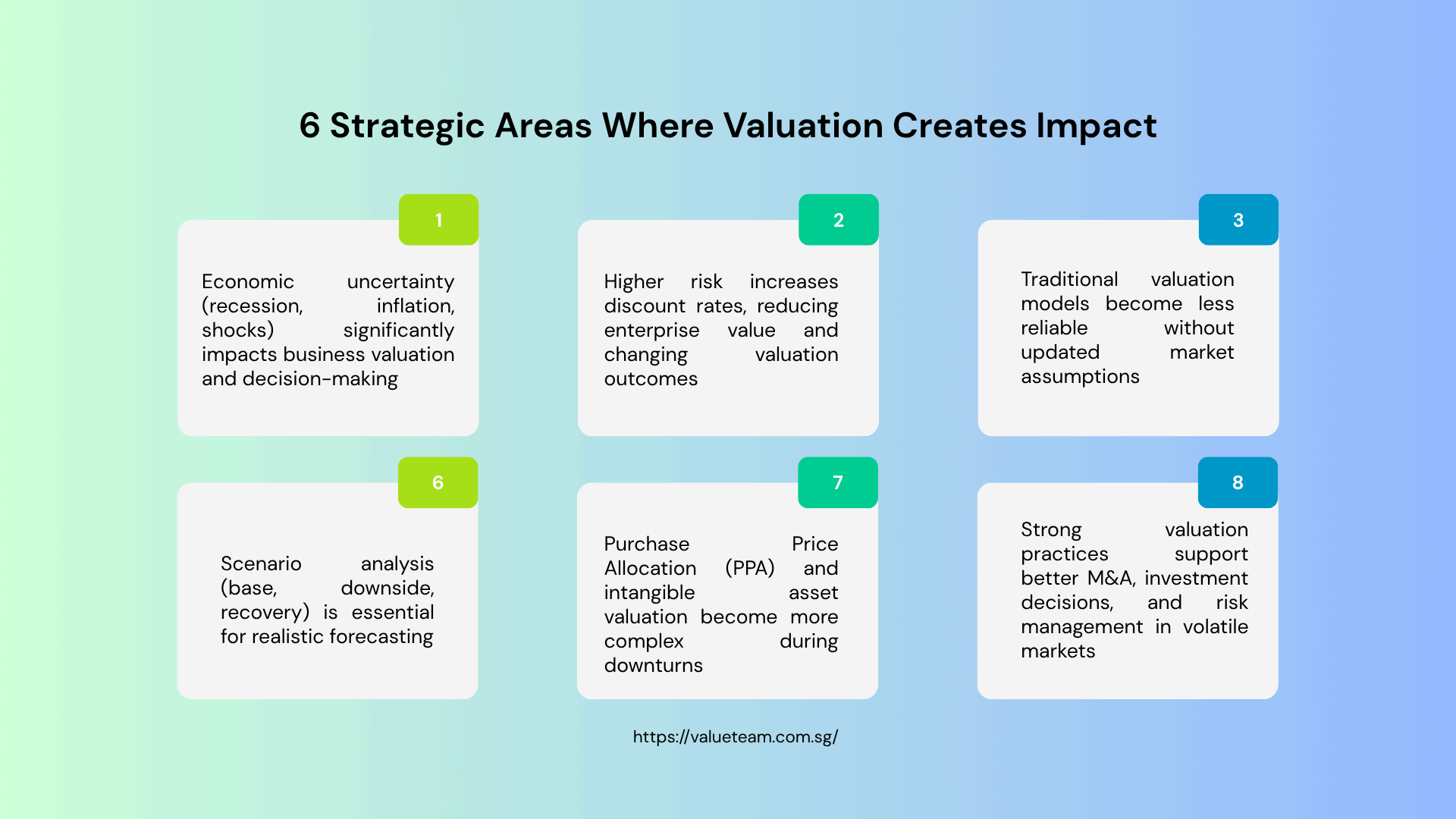
The core dilemma of the valuation of market volatility is the issue of risk/reward. The discount rates employed in discounted cash flow valuations are fixed in stable markets to the use of observable benchmarks, such as risk-free rates, equity risk premiums, company-specific betas, etc., derived from trading data. These inputs are unstable when the volatility increases. The equity risk premiums become very large. Beta numbers based on past data might not be representative of the present riskiness of a business entity. This causes discount rates to fluctuate by a few percentage points over a short time frame, which leads to potentially huge swings in estimated enterprise value over a few months.
These circumstances make the company’s worth analysis more complicated and demand that the practitioner make clearly documented and explicit selections of inputs. A long-run average equity risk premium is stable, but may be low. A spot estimate is a snapshot of the situation, but it could overestimate the permanent change in risk appetite. Most of those who have practiced this method also use some of the current market data and longer-term averages, and they also provide sensitivity analyses to demonstrate how the value changes over a range of discount rate assumptions. This transparency is not only good practice but is critical to gaining the trust of a client, a board, and counterparties who are also uncertain.
This is also a challenging treatment for cash flow projections. In a world of uncertainty in economies, practitioners of business forecasting must go beyond just one point and seriously consider scenario analysis. A base case, a downside case, and a recovery case, each with its own set of revenue, margin, and capex assumptions, provide a much fuller picture to decision makers than can be gained from any one case. Enterprise value investing in periods of downturn needs to explicitly factor in credit tightening, increased competition, and a possible period of slowdown. Companies that do not factor these into their valuation models could end up with a problem when their forecasts are compared to reality in the context of fundraising, litigation, or due diligence by regulators.
Valuation During Recessions: Acquisition Accounting and Purchase Price Allocation
Mergers and acquisitions continue throughout recessions, and in times of economic hardship, they can present the best opportunities for a well-capitalised acquirer to make an acquisition. However, during a recession, there are certain technical challenges that present themselves, which are different than pre-deal due diligence. The acquirer will recognize goodwill as a residual amount if the purchase price is more than the net value of the identifiable net assets acquired. The exercise, called purchase price allocation or PPA, is at its best a difficult and complex process, and is even more contentious. It’s much more complicated when times are tough.
During an economic downturn, financial risk valuation is an important aspect of PPA. The fair value of assets and liabilities acquired shall reflect circumstances at the date of acquisition, which can be during a recession, and may result in write-downs of inventory, reconsideration of the recoverability of assets, and a significant reduction in the useful lives assumed for some assets. In addition, the treatment of contingent liabilities (deferred revenue obligations, restructuring provisions, and litigation exposures) is important in the strategic context of company valuation, and can be more challenging to quantify in an environment of changing economics. Whereas in the case of the acquiring companies, having a right PPA would not only be accounting formalities, but would also define the earnings profile of the combined business for years to come.
Purchase price allocation mechanics involve the identification and fair value of all acquired intangible assets, such as the customer relationship, technology, trade names, and non-compete agreements. The recession PPA valuation is compounded by market-derived inputs, too – royalty rates, attrition rates, and discount rates are all impacted by the recession. If the royalty rate has compressed in a recessionary price environment, it may be an overvaluation of an intangible asset that was valued at a higher rate based on a stable market. Likewise, fair value measurement of deferred revenue liabilities should consider the cost of meeting obligations in current (as opposed to pre-recession) cost structures. ValueTeam’s team of advisors can handle these changes with expertise thanks to their knowledge of the market and technical acumen.
The economic climate valuation has an impact on the way that acquirers make bids. In times of economic downturn, earn-outs arise as a means for the buyer to pass the risk back to the seller and become more prevalent. Option pricing models or scenario weighted probability models are needed to value these earn-outs. Conducting an acquisition value strategy when the economy is soft needs to take into account a decline in the ability to meet the targets in the earn-out. If these instruments are properly structured and independently valued, then the risk of expensive disputes later on can be avoided.
Impairment Testing and Fair Value in Uncertain Markets
Impairment testing is one of the most challenging valuation technical issues in today’s fluctuating economy. If there are signs that the carrying values of goodwill and certain other assets may not be recoverable, then companies are obligated to test them for impairment under IFRS and US GAAP. Financial crisis valuation involves assessing impairment for an industry as a whole, which happens when market capitalisation drops, cash flow projections decline, and the discount rates increase; often, the recoverable amounts on goodwill and intangible assets are below their book values.
In times of market downturn, it is the volatile market PPA and the goodwill generated that are especially vulnerable. By definition, goodwill includes the amount paid above the fair value of the net identifiable assets, which is based on synergy expectations, growth prospects, and strategic rationale – all of which may be very different in the future, 12 or even 24 months after the transaction is completed. Impairments involving valuation based on the test of value in use involve the preparation of a value in use model or an estimate of fair value less costs of disposal for each of the cash-generating units. Both methods involve making defensible assumptions on future cash flows and discount rates, which are especially argued during times of a not-so-solid economy PPA review.
For the finance teams and their advisors, it’s a big deal. While not cash, impairment charges have real implications; they lower reported equity, may cause breaches of debt covenants, and demonstrate to investors that the previous acquisition strategy hasn’t paid off. Well-handling the impairment testing process – from engaging independent valuers at the outset, through to the strict documentation of assumptions and clear audit trails – is thus a strategic and technical priority. Specialists, including ValueTeam’s advisory team, offer companies and their auditors the independent, scientifically valid analysis they need to take on this process with confidence, through Uncertain economy PPA reviews.
Intangible Asset Valuation When Economic Conditions Shift
Intangible assets now make up a significant percentage of the enterprise value of contemporary businesses, and there’s no particular trend that this is more the case in the recovery phase of the business than in the growth phase; the value of the intangibles does change, however. In the uncertain economic environment that exists today, the assumptions of practitioners regarding the useful life of assets, the reliability of royalty rates, customer attrition, and discount rates to be applied to future economic benefits need to be rethought. The interpretation of a reasonable assumption in a stable market may be materially incorrect in a rapidly changing market.
One of the most apparent symptoms of this issue is the goodwill impairment analysis. If the recoverable amount of a business unit is less than its carrying amount, the amount by which it is overstated must be written off, which must be documented and supported by independent evidence. In addition to goodwill, customer lists, distribution deals, and licence portfolios could be a missed opportunity to revalue assets during an economic downturn. Relationships that are expected to be durable under normal circumstances can have higher rates of attrition in a recession and result in a lower estimated useful life and fair value of the intangible asset. The estimates of fair value of intangibles should reflect these changed dynamics, as opposed to rolling forward the previous-period estimates.
The strategic planning aspect of the issue is also affected by the uncertainty of market valuations of intangibles. In times of downturn, companies consider their asset portfolios and determine which assets have intangible value that can be sold, licensed, or divested to free up cash. Clearly defining these decisions by applying an intangible asset strategy with respect to current fair value estimates helps management to make the right decision and not the wrong one based on guesswork. Crisis asset valuation is therefore not just about compliance – it is a strategic element in capital allocation decisions. Conversely, an evaluation of intellectual assets could also show that some assets are more important than their book value would indicate, so that management may consider secured loans for those assets or even discuss partnerships that they would not have considered before.
There’s another layer to risk analysis, intangible. There are some intangibles that include certain regulatory approvals, exclusive supply arrangements, and reliance on key persons, which in times of economic stress can have risks compounded. The value of an agreement for distribution with a financially distressed counterparty could be less than the par value. If an investment is required to sustain a patent’s commercial importance, it might not survive a capital freeze. The comprehensive economic uncertainty assets review must, therefore, reflect genuine uncertainty around both the income and income-generating potential of intangibles, and include estimates of the range of outcomes, not just one rosy one.
Brand Equity and Consumer Trust as Strategic Value Anchors
In the world of intangible assets, brand is likely the least understood and most impactful in times of economic downturn. Over the last 20 years, brand valuation has come a long way, changing from the basic cost-based to more complex income-based and market-based techniques that reflect the overall economic value of a brand to its parent company. During times of downturn, brand equity can serve as a solid shield—helping to preserve revenue, bolster pricing power, and retain customers while peers race to the bottom to stay alive.
There is a lot of empirical support for the notion of recession brand value. Studies have been carried out for years that show that brands with high awareness, positive emotional attachment, and trust draw in customers disproportionately during economic downturns. This is of direct value. When conducting a brand equity analysis in a recession, one must look not only at the brand’s contribution to earnings, but also how the brand will perform when the economy gets tough; how much of a premium is likely to be realized on the brand; how sticky customer relationships will be; and how quickly the brand’s preference will be regained once the economy turns better. The myriad factors can make a significant difference in the valuation of two companies with similar financials and characteristics.
Economic uncertainty branding makes strategic decisions for management. Brands that sustain their visibility and safeguard service levels during economic slowdowns, as well as engaging in appropriate communications with customers, tend to find themselves in a better competitive position when the recession is over than those that simply slash marketing expenses in the same manner. Therefore, from a valuation point of view, it is crucial to incorporate not only the present value of the brand but also the direction that management is taking with its brand decisions. A company with a strong brand that has protected and invested in its brand during a downturn might have a materially higher intangible value than its near-term financials may suggest.
Since the financial crisis, consumer trust valuation has become a unique aspect of brand analysis. It takes a lot of money and time to win back lost trust, which makes it a real asset. The companies that are transparent with customers, committed to doing so when it will cost them more, and don’t take advantage of customers’ vulnerabilities when it comes to pricing, tend to better hold on to brand worth assessment than the ones that only focus on margin maximisation. Practitioners who are now assessing brand volatility should include consumer trust scores (NPS, C-SAT, and social listening scores) in the brand valuation model for a more thorough and sustainable measurement of brand value.
When analyzing the brand strategy in times of economic uncertainty, it is important to take into account the competitive environment. In relative terms, a good brand may be eroding its position, even if it is doing a good job in overall terms, if the overall brand position is deteriorating in comparison to the brand’s competitors. The intangible brand value is always a relative, as well as an absolute value: it is the premium the business can capture over a non-branded equivalent, and this value can be reduced, not just by the mistakes of the brand, but by the success of another competitor. For markets with uncertainty, comprehensive brand valuation, therefore, needs to take into account the competitive dynamics as well as the performance of the brand under evaluation. Companies like ValueTeam incorporate such strategic elements in their brand value analysis and provide analyses that are not mechanical but rather commercially relevant.
Business Valuation in Economic Uncertainty: Conclusion
Economic uncertainty is not a time to be ignored; it’s a situation that calls for active and sophisticated involvement from finance professionals and from the businesses they serve. The value that is created in those moments matters on more than one level: it can inform acquisition motivations, disclosures of impairment, strategic investment choices, and the perceptions of stakeholders of the resilience and potential of a business.
The competency of economic uncertainty valuation for junior and mid-level professionals is a step beyond just the technical aspects of any particular valuation technique. It involves an appreciation of the inter-relationship of valuation in the light of market volatility, company value during a recession, and the inter-relationship of impairment testing valuation with the other areas of the analysis, and the ramifications of assumptions made in one area to conclusions reached in the other areas. It involves making sound judgments and communicating a range of outcomes honestly, documenting assumptions clearly, and giving sound and honest advice to clients and colleagues.
From purchase price allocation to intangible asset valuation, goodwill impairment analysis, or brand equity analysis, the companies and individuals best suited to deal with economic uncertainty are the ones that invest in depth of method and an independent point of view. ValueTeam offers this expertise—specializing in business valuation strategy, fair value assessment, crisis asset valuation, and strategic brand analysis to satisfy the needs of the most difficult markets. When times are uncertain, independent valuation expertise is not a luxury; it’s a necessity.
Business valuation helps organisations understand how changing market conditions, economic risks, and financial performance affect their overall business value.
Cash flow stability, liquidity, operational resilience, industry outlook, customer demand, and risk management become increasingly important valuation considerations.
Valuers may adjust growth projections, discount rates, market multiples, and future cash flow estimates to reflect increased business and market risks.
Business owners, investors, lenders, management teams, and financial advisors benefit from updated valuations when making strategic decisions.
Professional valuation provides objective analysis using current market data, helping businesses make informed financial, investment, and restructuring decisions.