
Step-by-Step Guide to Valuing a Company Before Selling the Business
A practical guide for finance and M&A professionals navigating the valuation process
Introduction to Guide to Valuing a Company Before Selling the Business
The sale of a business can be among the most important and significant financial decisions that a business owner will make. Founders planning to exit, CFOs advising on corporate divestment, and mid-level analysts assisting with a transaction should know what company valuation is before they sit across the table from a buyer—otherwise, they could end up with a lot of money left on the table.
The valuation of a business is as much an art as it is a science and does not begin and end with a single figure. It is a formalized methodology of collecting financial information, using accepted methods, and testing assumptions, to arrive at a number that is economically realistic. If you are new to this field, it might appear to be a technical process and seem daunting. However, when simplified down to the day-to-day tasks (from preparing historical financials to accounting for intangibles, goodwill, and post-deal accounting it becomes a lot simpler.
This is a step-by-step explanation of the important steps of valuing a company before it is sold. It is intended for individuals who wish to develop the technical fluency, rather than just the superficial understanding. We will also discuss key issues including assessment of enterprise value, valuation of intangible assets, purchase price allocation and the increasing importance of ESG issues in pricing. No longer are these issues niche—they are at the heart of how advanced buyers look at the target these days.
Understanding Business Value Before Selling a Company
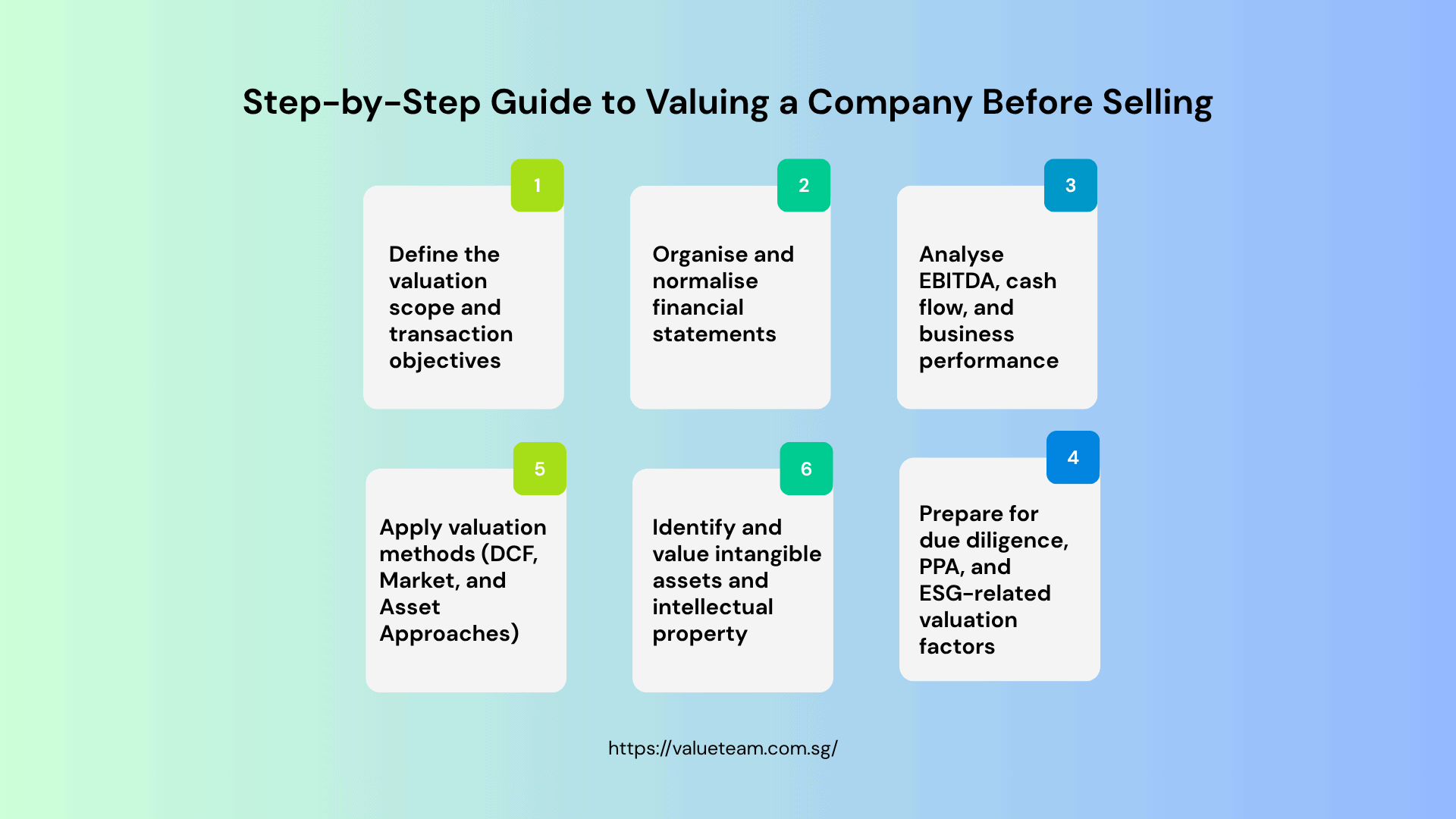
It’s essential to know what and why you’re valuing before opening any spreadsheet. The first step in company worth analysis is scope – valuing 100 percent of the equity? A controlling interest? A minority stake? Every scenario has different implications for the applicable discount rates, methodologies, and, in the end, the number at which the final discount comes out. Professional valuation services will always make a clear distinction at the start, as the objective of the valuation, whether it’s a negotiated sale, tax filing, regulatory reporting, or court proceedings, will dictate the standard value applied.
The majority of business sale deals will use enterprise value as the measure, which is the value of the business as a whole before the debt is subtracted and cash is added back. Then, the equity value is calculated. As it’s the most basic starting point, it’s important to understand the relationship between enterprise value assessment and equity value, since buyers and sellers often talk over one another when one refers to enterprise value and the other to equity value. This splitting of the difference can be helpful to junior professionals to prevent expensive missteps.
Another factor to consider is that the same company can have different valuations from different valuers. A strategic buyer, who is in the same or the related business area, might give a premium since they expect to get synergy from the purchase. In the case of a financial buyer, like a private equity house, they tend to use a much more conservative lens that’s geared towards standalone cash flow. When buyers are a combination of trade acquirers and financial sponsors, as is typical in the business valuation arena of SMEs, this is something they need to be aware of from the outset and helps guide the realistic price expectations.
How to Prepare Financial Statements for Accurate Company Valuation
Good, well-structured financial information is the basis of any sound business appraisal. This involves collecting at least 3 to 5 years of audited or reviewed financial statements and then normalising earnings to reflect the business’s economic performance. Normalisation means removing some one-off items, such as a litigation settlement, a one-off asset sale or an above-market owner’s salary, that wouldn’t be likely to be attributed to new ownership. This is a crucial stage for financial valuation analysis as buyers will closely review all of the adjustments and raise any questions they may have about items that seem aggressive and unsupported.
After normalised earnings, the most frequently used basis for valuation is earnings before interest, taxes, depreciation and amortisation (EBITDA). It is this figure that is used to calculate the valuation multiple and is a proxy for operating cash flow. It will depend on the industry, growth rate, customer concentration and markets. Multiples are likely to be higher for businesses that have recurring revenues and a diversified customer base. A comprehensive company that is worthy of analysis will also include a working capital needs analysis and an analysis of capital expenditure requirements, as these will impact the free cash flow the business generates.
It is also the point at which businesses in regulated environments or those with complex revenue recognition policies need extra attention. Providing corporate valuation services requires a close working partnership with the management team in order to be able to reconstruct the financials from raw data, especially in businesses that haven’t always chosen to report in a manner consistent with a transaction process. It’s a huge deal to get this right — one of the most frequent causes of deals to get slow during due diligence is a lack of preparation on the financial data room side.
Best Business Valuation Methods for M&A and Company Sales
In business valuation, there are three main methods: income approach, market approach, and asset approach. In practice, several methods have been used at the same time, and the final result was considered to be a weighted average of the results. The income approach (typically used as a discounted cash flow (DCF) analysis) is based on estimating future free cash flows and discounting them to their present value, using a discount rate appropriate to the cash flows’ risk. This can be particularly effective for companies that have consistent cash flows, and can be an effective method for computing the value of a business, but it comes with a caveat as it relies heavily on the assumptions used for cash flow growth rates, margins, and terminal value calculations.
The market approach uses information from comparable companies and comparable transactions to create a range of valuations. This is usually done by comparing publicly traded comparable companies and their trading multiples and by looking at transactions that have taken place in the same industry. Deal data may be limited in the context of a Singapore company valuation, so practitioners must use regional and global deal data, while accounting for size, liquidity and maturity of the markets. The “sanity check” value derived from the market multiples is useful for comparison with the value derived from the DCF, and is frequently the basis for negotiations.
The asset approach would be most applicable when a business has considerable tangible assets, for example, property-based businesses or where the business is to be wound down instead of sold as a going concern. From a going-concern perspective, knowledge of underlying asset values is significant, however, especially in the context of identifying and quantifying intangible assets that can constitute a significant part of enterprise value. This is the next essential component of the valuation process.
Intangible Asset and Intellectual Property Valuation for Business Sales
The identification and quantification of intangible assets are one of the most technically challenging (and often overlooked) areas of pre-sale valuation. Many contemporary enterprises, especially in technology, consumer brands, and professional services, have most of their enterprise value in their intellectual property, customer base, brand, and processes. The intangible asset valuation becomes a central topic—it can be the true basis of value, and the area where sellers miss out can be a lot of money if they don’t do the work first.
IP valuation includes a diverse array of assets, such as patents for key technology, trademarks for brand identity, proprietary software systems, and trade secrets tied to operational expertise. Typically, patent valuation services will employ a relief from royalty method, which involves calculating the amount of royalties that would be payable if the IP had been licensed instead of owned. A cost approach is also used in software IP valuation, which involves estimating the costs required to develop the software from the ground up, usually with internal systems. Valuation of a trademark is based on brand revenue contribution and comparable licensing rates. If a business has value to IP, it is worthwhile to have specialist advice at the early stages to ensure that these assets are well documented and defended during the due diligence process.
Intellectual property aside, a company may also have embedded asset valuation opportunities, such as customer relationship valuation (the economic value of long-term customer contracts, contract renewals, customer lifetime value). Technology asset valuation can also include the value of digital infrastructure, algorithms, and data assets that are not recorded on the balance sheet. Favourable supply arrangements, non-compete agreements, and workforce-in-place should also be taken into account for business intangible analysis. Singapore IP valuation specialists are increasingly being engaged to document and substantiate these assets before proceeding into a transaction process, and the extent of preparation plays a significant role in the confidence of buyers and the pricing.
Understanding Purchase Price Allocation and Post-Transaction Accounting
The pre-sale valuation obligation is the process of determining a fair enterprise value, but the buyer also has an equally significant valuation obligation, if not more so, after closing. This is the purchase price allocation process for a business combination, as required by accounting standards such as IFRS 3 and ASC 805. Knowing what the seller expects can be important as it can help the buyer to think through what assets and liabilities the seller is buying and how this may affect their pricing and structuring of the transaction.
Purchase price allocation involves allocating the total purchase consideration to all identifiable assets and liabilities acquired at fair value, and any purchase consideration not allocated to these assets and liabilities is recognised as goodwill. The allocation of fair value is not a straightforward process and involves independent valuation of individual asset classes, such as property, plant and equipment, inventory, contingent liabilities, and every asset class of intangible assets mentioned above. Acquisition accounting valuation is also related closely to the intangible asset work discussed in the prior section; and firms that have been able to define these assets in a pre-sale environment facilitate a more successful PPA process for the acquiring firm, thereby helping to ensure a smoother and faster transaction.
In the context of financial reporting valuation practice under IFRS, the PPA exercises need to be performed within the measurement period (the first 12 months after the acquisition is made) and the values derived from the PPA exercise need to be reported in the financial statements. PPA reporting compliance is open to audit review and will be audited for errors and omissions that may lead to restatements. Valuation engagements in Singapore are mostly arranged by independent valuation firms to meet auditor independence requirements. Valuation in business combination is one of the more complex areas of corporate finance and is a high-value area of focus for junior to mid-level professionals seeking to pursue specialist expertise.
Purchase Price Allocation (PPA) and Acquisition Accounting Explained
With the development of valuation practice, three further aspects have gained importance in the valuation of businesses in the context of a sale: the valuation of employee share ownership plans, the valuation of brands, and the valuation of environmental, social, and governance aspects. All these affect the quantum of value, or the risk profile that buyers assign to a target, and professionals involved in any part of the transaction process need to be familiar with these.
ESOP is relevant both pre- and post-transactions. When a business issues employee share options or other equity-based compensation, it should be aware of the dilutive effect on equity value prior to a sale. Accounting for share-based compensation involves valuing those instruments (such as stock options, where valuation methods include Black-Scholes and/or Monte Carlo simulations) for fair value accounting purposes and for negotiating the treatment of unvested equity at close. The valuation of a startup ESOP is especially complex because of the fact that it is in a private equity market and doesn’t have a public market reference. The compliance reporting requirements under ESOP also include the need for recurring independent valuations, and fair value determinations under ESOP need to be defensible to the tax authorities or regulators. This can be a valuable consideration of the deal structure for companies that have a substantial equity compensation valuation component.
The value of the brand is important and has grown in significance as brand equity has become important to the acquirers who have come to understand that brand equity can provide a significant and enduring competitive advantage. Corporate brand valuation measures the differential in value of a brand’s revenues compared to that of an unbranded product, and strategic brand valuation is the value of a brand’s future income stream. The value of brand assets also directly influences brand valuation (PPA) and goodwill calculations and can also include databases, loyalty programmes, and digital channels as standalone value drivers for marketing asset valuation. Brands have become a critical asset for businesses planning transactions, and Singapore brand valuation is becoming a more popular choice, as buyers, especially foreign buyers, need independent verification of their brand worth assessment claims.
Last, and most significantly, the current sustainability agenda is making an impact on the valuation of companies in M&A transactions, with investors and lenders looking at every company they are considering with regard to its environmental risk analysis, supply chain management, governance, and social impact score. The impact of ESG valuation is also becoming evident in the discount rates applied to the cash flows: companies with good ESG governance framework scores could see lower risk premiums or even price adjustments or earn-out structures that shift the risk to the seller because of material ESG governance framework consulting gaps. Sustainability reporting advisory professionals are now collaborating with traditional valuation teams to facilitate documentation of the corporate sustainability strategy and outcomes of the ESG performance assessment, in a way that sophisticated buyers could evaluate. In certain sectors with high transition risk, such as energy, manufacturing, real estate, and other industries, the assessment of ESG performance may become a crucial determinant in pricing decisions while navigating the deal. In industries with high transition risk, including energy, manufacturing, real estate, and others, the assessment of ESG performance may be a key factor in how deals are priced.
Complete Guide to Business Valuation Before Selling Company
Valuation before a sale is not one activity, but a series of activities that start long before any sale is initiated, that include negotiation, due diligence, and post-close accounting. Fluency in the entire suite of valuation disciplines is a skill that will enable professionals in the junior to mid-level part of their careers to contribute the most value at each phase of the transaction, whether they are working on an enterprise value assessment, asset allocation analysis, intangible asset reporting, or assessing ESG performance.
The lesson to be learned is that preparation is really vital. Companies that invest time in knowing how much prior to putting themselves on the market will be more equipped to assert their price, conduct efficient due diligence, and head off the questions buyers will have. It could be through hiring valuation professionals to value the intangible asset, having a brand equity analysis carried out, or working with an ESG consultant to document sustainability credentials, but this is the work that happens before the sale that influences the result.
With Singapore as the hub for cross-border transactions in Southeast Asia, the need for thorough, well-documented business valuations will only continue to grow. Those who develop their analytical skills and develop an understanding of the interplay between the various components of value will be even more in demand in an advisory market that values analytical rigour and commercial acumen.
A business valuation helps owners understand the company's fair market value, supporting realistic pricing and stronger negotiation during the sale process.
Financial performance, profitability, cash flow, customer base, market position, growth potential, and industry conditions all influence business value.
Professionals commonly apply the Income Approach, Market Approach, and Asset-Based Approach depending on the business and transaction.
Owners can strengthen financial performance, improve operational efficiency, maintain accurate records, reduce unnecessary risks, and demonstrate sustainable growth.
Professional valuation provides an independent assessment that supports negotiations, improves buyer confidence, and helps achieve a fair transaction price.