
How DCF Valuation Works for Modern Businesses
A practical guide for junior to mid-level finance professionals
Introduction to How DCF Valuation Works for Modern Businesses
With capital and business models changing at an ever-accelerating pace, it would be more useful than ever to be able to precisely calculate the value of a business or asset. Knowing how to value a business using DCF is one of the most useful and valuable skills that can be picked up by any junior analyst or finance associate, making the transition to advisory or even a professional changing career into corporate development.
Discounted Cash Flow or DCF is a core principle of today’s valuation methods. In principle, the approach is straightforward; money now is worth more than money later; you need to “discount” the money to the present in order to find out what its worth is. From enterprise value analysis and investment valuation models to valuation services for ESOP valuation, brand valuation analysis, and valuation of intangible assets in complex transactions, all of these are based on this fundamental principle.
The beauty of DCF is that it makes the analyst explicitly think about the future: revenue growth, cost structures, requirements for capital, and risks. It’s not just a set of formulas, but a system of how to communicate a business or asset’s financial story. This article explains what DCF is, what it is part of, and how it is used in various situations that you may face in your career.
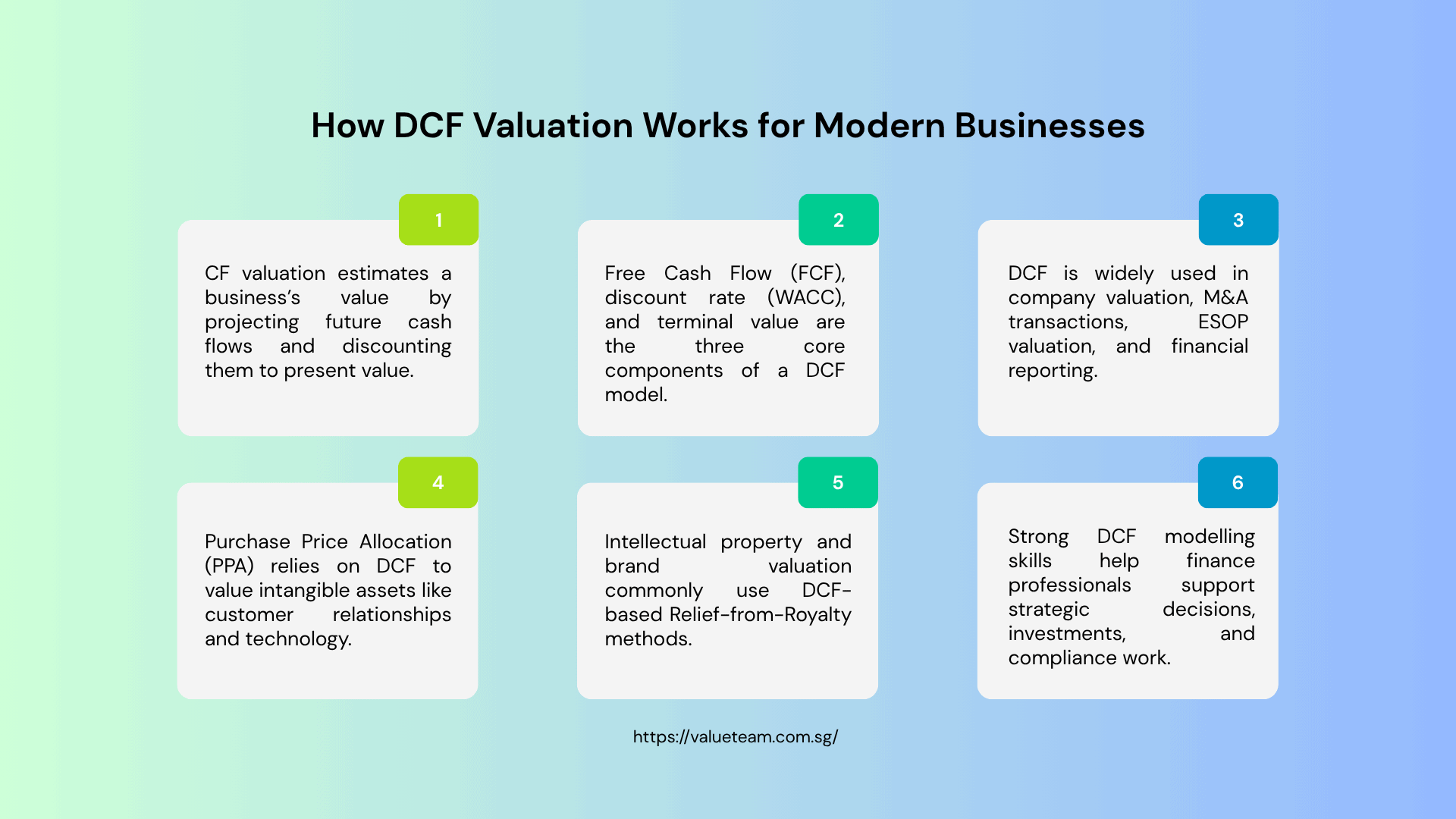
Understanding the Core Components of a DCF Valuation Model
The first, basic, but essential question in creating a DCF model is: What cash flows will this business or asset produce, and when? In DCF business valuation, the analyst estimates free cash flow, which is defined as cash after operating expenses and capital investment, for a specific number of years (usually 5 to 10). The projections are based on the historical performance, industry benchmarking, management guidance, and macroeconomic assumptions. How well you develop this forecasting step affects the believability of the rest of the forecast.
After the cash flows have been estimated, each cash flow needs to be discounted back to today, using the Weighted Average Cost of Capital (WACC) or another appropriate discount rate. WACC combines the cost of debt and equity in the capital structure based on their respective percentages, which can be used in corporate valuation or equity valuation analysis. The discount rate is not fixed but rather is based on the riskiness of the cash flows being modeled. Because a startup business has variable cash flow, its discount rate is much higher than that of a mature industrial business that has evidence of stable contracts. It is common to apply extra care when determining the risk premiums that are not found in publicly traded companies when valuing a private company.
The last element is the sum of all cash flows after the forecast period, called the Terminal Value. In most good models, this is made up of 60-80% of the total value and is usually calculated using either a perpetuity growth model or an exit multiple. This high level of value concentration in the terminal year is exactly why small variations in growth rates and/or discount rate assumptions have a significant effect on the output. This sensitivity is not a purely technical issue — it’s one of the most important things that sets analysts apart from those who simply put together models. This is a mechanical foundation that enables more specific use in applications such as financial forecasting, valuation, asset value estimation, and DCF asset valuation within complex deals.
How DCF Supports M&A Transactions and Purchase Price Allocation
The most challenging and complex use of DCF is in M&A transactions, specifically purchase price allocation. Accounting principles (IFRS 3 and ASC 805) state that the purchase price be allocated to all the identifiable assets and liabilities at fair value when one company acquires another. This is called PPA valuation methods (or acquisition accounting valuation), and not only is it about the opening balance sheet of the combined entity, but it’s also about the future amortisation charges, impairment tests, and earnings profile that investors and analysts will be examining for years to come after the deal closes.
The heart of any financial reporting PPA exercise is the valuation of the business’s intangible assets – such as customer relationships, developed technology, trade names, non-compete agreements, and order backlogs. These assets do not normally show up on the seller’s balance sheet, but can actually constitute a substantial portion of the economic value being purchased. The above method of intangible asset allocation involves the use of DCF-based techniques like the Multi-Period Excess Earnings Method (MPEEM) or the Relief-from-Royalty Method to assign the fair value to each identifiable asset. In the absence of sound DCF PPA analysis, the balance sheet that is created will reflect the wrong economics of the transaction, and it may lead stakeholders to believe in a different return on their investment in the company.
Professionals in transaction services, valuations advisory, or corporate development must grasp what post-acquisition valuation entails. But once recognised at fair value on day one, they have to be tested for impairment on a regular basis. Typically, a goodwill impairment test is performed each year under both IFRS and US GAAP by performing a fresh DCF of the cash-generating unit or reporting segment to which goodwill is allocated. This indicates the skills employed when developing the deal model pre-close are directly applicable to the asset impairment analysis work performed in future reporting periods. Companies that provide PPA valuation services are thus offering a long tail service: one that isn’t a day one service but the analytical framework that dictates financial reporting for the life of the acquired assets. For further details on the structure of these services, please refer to our detailed PPA and acquisition accounting pages on the ValueTeam website.
Applying DCF to Intellectual Property and Technology Valuation
The modern economy is fueled by ideas. Today, software platforms, pharmaceutical patents, consumer brands, in-house algorithms, and creative content catalogues rank among the most valuable assets in the world — and are far from easy to value using traditional methods. One of the fastest-growing sub-disciplines of the valuation profession is intellectual property valuation, which is supported by the DCF method, among other valuation procedures and tools, including patent valuation methods, trademark valuation analysis, and software IP valuation.
The Relief from Royalty Method is generally applied for IP asset valuation. The concept is simple: With a business having a patent or trademark, they don’t have to pay a royalty to use the patent or trademark. The present value of the royalties that the IP had been “relieved” from paying for, is therefore the value of the IP. This method is applicable to DCF IP valuation in various settings such as transfer pricing, licensing agreements, IP monetization plans, and litigation. The pricing of intellectual assets of this kind is a sensitive issue that demands all the analytical precision in determining the appropriate tax-affected discount rate, the useful economic life, and the royalty rate; all areas where the difference between a credible opinion and a challenged opinion can make a difference.
More general uses of technology asset valuation occur when a business is sold for its proprietary systems and/or platforms. Commercial IP analysis in these cases will take into account other aspects, such as customer relations or staff competence, as well as the contribution of the technology. The process of valuing intellectual assets in a tech acquisition setting has also become a more complex one, taking into account the cost of reproducing the asset, the revenue it can generate, and the useful life of the asset in a market in which obsolescence can be fast. It is far from a compliance task when accounting for a technology-focused target in a business combination; it is a strategic imperative that will have an impact on the way the business combination is perceived and how results are measured over time.
Using DCF for ESOP and Employee Share Valuation
ESOPs are a common method to recruit and retain staff at all business sizes. The establishment of an ESOP is not straightforward, however, since it must go through a thorough and sound valuation procedure that meets regulatory standards and employees’ reasonable expectations. ESOP valuation services lie at the crossroads of corporate finance, tax law, and employment policy, and DCF is at the heart of creating valuations that drive them.
The issue is especially critical for startup valuations of an ESOP. Early-stage businesses generally lack financial records, have income that is not guaranteed, and have no widely available market price. In these scenarios, equity compensation valuation calls for sound judgment regarding growth outcomes, milestones, and scenario-weighted exit possibilities. However, DCF ESOP analysis should be used in conjunction with option pricing models and, in many jurisdictions, should comply with the requirements of 409A (US) and other regulatory models around the world. The outcome provides a fair market share determination, which can then be used to establish exercise prices, communicate equity value to employees, and provide for financial reporting for an ESOP per applicable accounting standards.
Compliance valuation for an ESOP is more complex for established companies or those that need to update valuations more often to ensure that option grants are issued at fair market value. Share option valuation requires the use of Black-Scholes or binomial models, but supercharges an equity value calculated using DCF or other company analysis. In-house capabilities to decipher these models is needed by employee equity planning teams within fast-growing companies, and not just for reporting purposes, but to make smart decisions on equity structuring and allocation. Companies are looking for the expertise developed at the start of these professionals’ careers. To learn more about how ValueTeam helps with these engagements, check out our ESOP valuation resources and employee equity planning resources.
How DCF Helps Measure Brand and Intangible Asset Value
A brand is one of the most talked about and least comprehended assets. For brands, consumers love them, and competitors are terrified of them, but for marketers, it’s about measuring them; for finance, it’s about measuring them. The way in which brand value is analyzed has changed dramatically in the last 20 years, and today, most credible brand equity measurement frameworks that are utilized in brand transactions, financial reporting, and strategic planning are built using the DCF approach.
The most popular DCF-based valuation of a brand is the Relief from Royalty Method, which is an estimation of the present value of the royalties that the business would have to pay for the license of the brand if it did not have it. The DCF brand valuation is applied in various situations, including M&A transactions, where the trade name is included in the purchase, business combination accounting, where the trade name is recognised separately from goodwill, and goodwill valuation methods, where the contribution of the trade name to goodwill must be isolated and quantified. Another way to measure corporate brand values is by taking an earnings-split method, which deducts a part of the company’s earnings associated with the brand and then discounts the earnings to determine an “on its own” brand value.
Brand financial analysis is not only a reporting tool, but it’s also a decision-making tool. Marketing departments would like to understand whether a rebranding programme is justifiable in terms of finances. Boards are interested in knowing the value of the brand investment compared to any other investments of capital. Licensors and franchisors must have a viable brand to counter with when making decisions regarding licensing or franchising. When valuing the strategic brand (and not to comply with the laws), the analyst must make predictions about the brand’s future growth, what the risks are that could negatively impact the brand, and how competitive forces might impact the brand’s contribution to earnings over time. Valuing a brand for growth requires not only technical expertise but also a solid business acumen. Our brand valuation and brand equity services provide an in-depth methodology-driven approach, rooted in the DCF principles for organisations wishing to build or benchmark their brand value.
Why DCF Valuation Remains Essential for Modern Finance Professionals
DCF valuation is not a single technique but a family of techniques — with the correct application, it can shed light on the value of any business, either as a whole, or on a partial level, such as an intellectual property, a brand, a share option, or a package of intangibles that were purchased. Learning to perform DCF is one of the best investments one can make in the financial profession as well as advance their analytical skills.
The use of the valuation methods discussed in this article, including PPA valuation methods, acquisition accounting valuation, DCF ESOP analysis, brand valuation analysis, and intellectual property valuation, is not just an abstract concept. They are seen every day by executives, from financial advisors to corporate development and auditors, and investment professionals globally. The knowledge of how these applications correlate with each other, related to the same underlying DCF logic, allows you to seamlessly move from one application to another, adding value wherever you are deployed.
Our efforts at ValueTeam are focused on the entire spectrum of business valuation services, financial forecasting, valuation, enterprise value analysis, goodwill impairment testing, intangible asset assessment, and IP monetization strategies. If you’re a client looking for a deeply customized valuation opinion or a professional creating your own knowledge of advanced valuation methods, we invite you to check out the valuation service pages throughout our website to learn how these techniques are applied in actual engagements.
DCF (Discounted Cash Flow) valuation is a method used to estimate the value of a business based on its expected future cash flows. By discounting those future cash flows to their present value, businesses and investors can assess the intrinsic worth of a company. This approach is widely used because it focuses on a company’s ability to generate future earnings rather than relying solely on historical performance or market comparisons.
DCF valuation calculates a company’s value by forecasting future cash flows over a specific period and applying a discount rate that reflects the risk associated with those cash flows. The present value of the forecasted cash flows, together with the terminal value representing long-term business performance, forms the estimated enterprise value of the company.
The accuracy of a DCF valuation depends on several assumptions, including projected revenue growth, operating margins, capital expenditures, working capital requirements, and the chosen discount rate. Since small changes in these assumptions can significantly impact the valuation result, it is important to use realistic forecasts and conduct sensitivity analyses.
DCF valuation is commonly used during mergers and acquisitions, fundraising activities, shareholder transactions, strategic planning exercises, and investment analysis. It is particularly useful for businesses with predictable cash flow patterns, as it provides a detailed assessment of long-term value creation potential.
Unlike market-based valuation methods that rely on comparable company multiples or precedent transactions, DCF valuation focuses on the company’s own future cash-generating ability. This makes it a more forward-looking approach and allows businesses to capture unique growth opportunities, operational improvements, and long-term strategic initiatives that may not be reflected in market comparisons.