
8 Benefits of Independent Valuation Services for Companies
Introduction to 8 Benefits of Independent Valuation Services for Companies
In the initial conversations about hiring an outside valuation adviser, the focus usually is on compliance: An audit calls for it, a transaction necessitates it, or a regulatory submission makes it imperative. These are good arguments for an independent expert opinion. However, these aren’t the most significant ones.
The stronger argument for independence is based on a more basic, fundamental fact: that a valuation that is created without an interest in the outcome will have a more solid structure than a valuation created with an interest in the outcome. It’s not a comment on integrity; it’s just a description of the way motivated reasoning works and how auditors, investors and counterparties look at numbers that come their way. An independent analysis is authoritative if the independent analysis was done carelessly, whereas an internal analysis is not if done carelessly.
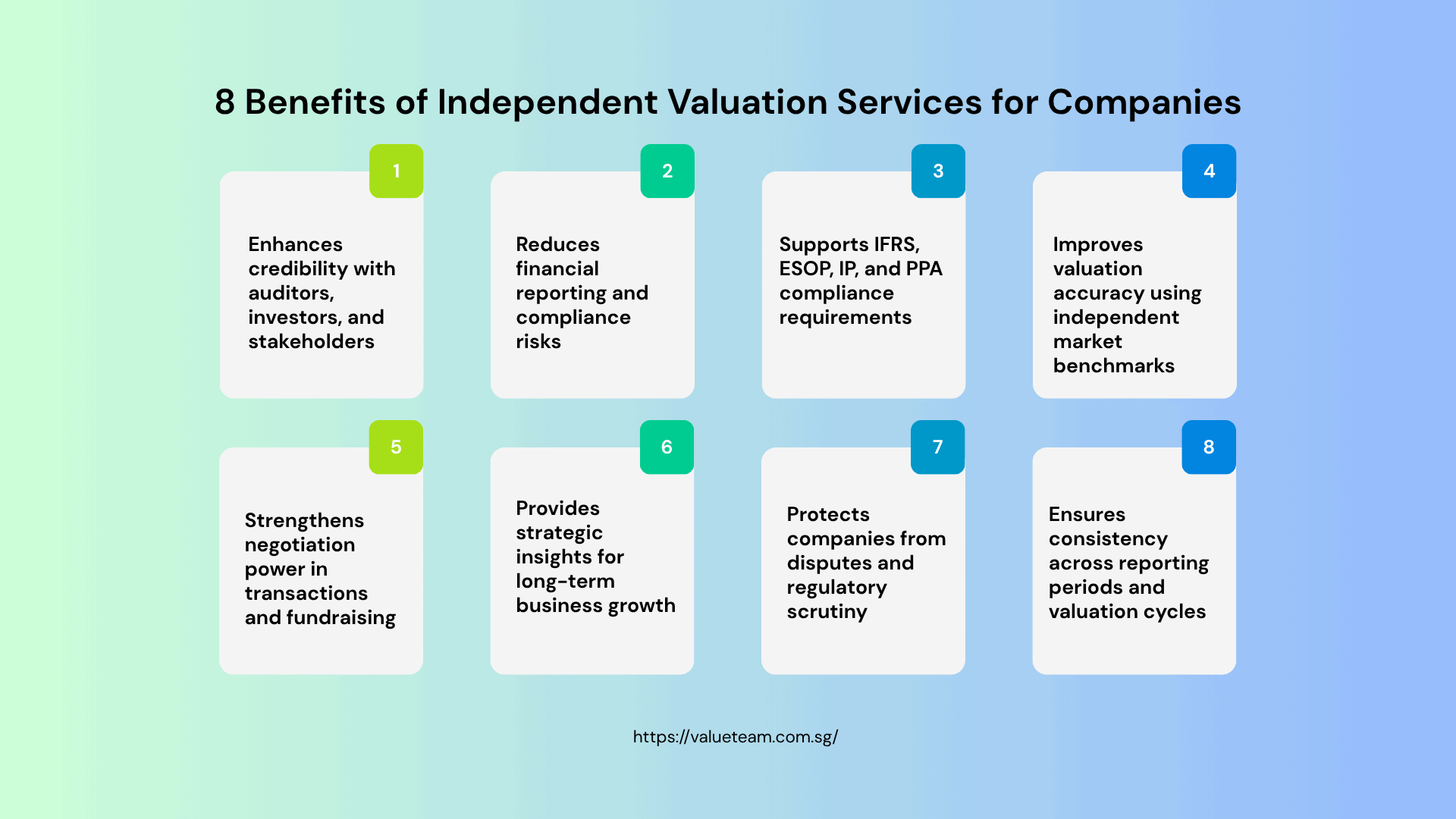
The 8 benefits discussed in this article are applicable to the entire spectrum of valuations, from the measurement of employee equity awards annually, to the complicated intangible asset identification that follows a large acquisition. Every benefit is tangible, impactful and accessible to any business that intends to view valuation as a business strategy instead of an administrative duty.
1. Enhanced Credibility Through Independent Valuation Services
The most obvious and obvious reason for independent valuation is the fact that it provides more credibility to its output. A report drafted by a qualified, independent specialist is of evidentiary value that cannot be matched with internal prepared analysis, and the specialist must have no financial interest in the result, and have no management relationship with the company in which the specialist is preparing the report. This is important in all situations where the valuation is subject to another person’s scrutiny besides its creator.
The difference is important to auditors because it affects their work. An auditor tasked with testing a significant estimate in a financial statement may try to recreate the analysis on his or her own or may delegate this work to an expert. The latter is much more efficient, and much more reliable, provided of course the expert is an expert with independence of mind and the work is rigorous. Audit quality valuation reports prepared by the independent companies take a lot of the time and hassle from the audit process and minimize the risk of the auditor coming up with a different conclusion that may need to be restated or disclosed.
Independent brand valuation, independent IP valuation and independent intangible valuation reports are a sign for investors/counterparties that the company has sought independent analysis of its assets, which in turn is a step toward an increase of trust and transparency. If the numbers the company enters into a transaction are independently verified, they will be in a much better position than if the numbers the company enters are based on management estimates, and the other party is willing to accept them.
Boards and Audit Committees have a responsibility to ensure that the governance duties are discharged appropriately, and that they have accepted what management has reported rather than been satisfied with management’s report. Independent PPA valuation and independent ESOP valuation reports are a means of providing the evidence that this is the case. In a world that is becoming more and more a world of regulatory oversight and personal liability for directors, this is more than many boards are aware.
2. Stronger Risk Reduction with Professional Independent Valuation
Valuation risk is one of the more insidious types of financial reporting risk, since this risk builds up slowly and then surfaces at an inconvenient time to be restated, disclosed or responded to by the regulators. Professional valuation services and professional IP services by a qualified and independent professional service firm minimize this risk in a systematic way across all the periods in which the valuation judgements are rendered in the financial statements.
The risk reduction takes place via a number of channels. Independent analysis is subject to internal quality control processes which are not available to management prepared work, such as peer review, methodology sign-off and challenge from the senior advisers who have encountered the same issues in other contexts. Second, independent advisers would not want to let their conclusions be taken as gospel unchallenged: their reputation would be on the line and they need to be prepared to withstand subsequent challenges. Thirdly, an independent valuation risk analysis and IP risk analysis normally involves sensitivity analysis and scenario modelling, which provide a transparency of the range of reasonable outcomes, making the financial statements immune from attacks from any source.
The ESOP risk management and brand risk analysis functions within a sound and robust independent valuation programme provide a history of consistency and documentation that is hard to argue with, and provides clear evidence of sound governance over time for companies that require repeating valuations (such as annual goodwill impairment testing, periodic IP and brand measurement, etc.) and employee equity awards. If there is a question, the answer is provided in the file.
3. Greater IFRS Compliance Confidence with Independent Valuation
IFRS standards contain valuation requirements with specific and very technical requirements and the implications of failing to comply are all significant – audit qualifications and restatements, regulatory attention and reputation. The measurement objectives, recognition and disclosure requirements of each of the services are distinct when it comes to the ESOP compliance valuation, PPA compliance services and intangible compliance services including IAS 38 and IAS 36. It’s really challenging to get them all correct at the same time, and without expert assistance.
Independent advisers specializing in financial reporting valuation are up-to-date with the standard setters’ guidance, the expectations of the auditing profession and the market practice that has emerged for the more judgemental aspects of each standard. This currency is important: the requirements of IFRS change over time through the process of amendments, interpretations and changes in practice which may not be fully promoted but which can have significant repercussions on the way a valuation should be structured. A trusted PPA advisory firm that is working in this area will bring these events to the fore in the regular engagement process, rather than as an extra cost of research for which they are not aware.
The coexistence of accounting requirements and transfer pricing requirements adds extra layers of complexity in the context of brand compliance services and IP compliance valuation, respectively. The fair value of a trade mark or patent for IFRS purposes should be based on the perspective of a market participant, while the arm’s-length price for transfer pricing purposes would be based on the framework of a comparable uncontrolled transaction. They are not the same analysis, but there are some assumptions that must be consistent — and the only way to get them to be consistent is to take a coordinated approach which most companies can’t do without the help of a specialist.
The advantage of the financial reporting and financial reporting work for PPA’s and ESOP’s that an independent specialist prepares is that not only does it satisfy the standard at the time of its preparation, but it is also set up to satisfy the standard going forward, whether that’s from acquisitions, restructurings, new equity grants, or changes in the expectations for asset valuation that arise with each reporting period.
4. Higher Valuation Accuracy for Businesses and Intangible Assets
The accurate valuation can’t be just a matter of effort or technical ability, but both are important. It also relies on access to appropriate data and knowledge, familiarity with methodologies that the courts, regulators, and auditors deem appropriate, and discipline in their application across the board – even when the results are unwanted. These are the things that a professional valuation advisory firm is designed to deliver and most finance teams no matter how effective, simply don’t have the resources to do it.
Last but not least, one of the most important factors for an accurate ESOP valuation is the input of expected volatility, the most sensitive of all of the parameters in the majority of option pricing models and the most one-sidedly estimated when prepared in-house. An independent adviser will compare how volatile the company is, with a peer group of listed companies that it has carefully chosen, record the reasons for the choice and provide a variety of estimates that are supported. This is a difference that can be significant, and one that auditors know how to distinguish between an internal estimate based on the figure that is convenient and using this method.
The equivalent challenge in the case of accurate brand valuation and in the case of accurate intangible valuation is the royalty rate. The method of relief from royalty means that royalty rates have to be gleaned from similar licensing agreements, not estimated from first principles or from an adjoining industry where the brand features are significantly different. Your brand advisory firm has the analytics skills and the databases of licensing transactions to uncover the true, meaningful comparisons, factor in differences and argue your chosen premium should stand the test of scrutiny.
Access to market data, transaction comparables, sector-specific knowledge that can be hard to keep up and other factors are also important to accurate PPA valuation and accurate IP valuation. Each of the three approaches to customer relationships, relief-from-royalty and the with-and-without approach for non-compete agreements has its own benchmarks that outside parties are able to find through a variety of customer relationships. The more tasks they perform, the more it is going to be accurate in the market evidence database.
5. Support for Business Transactions and Negotiations
A valuation lies at the heart of every important business transaction, to some extent. The parties to either side of the negotiating table will each develop an opinion as to value whether in the context of a sale, a fundraise, a merger, a licensing agreement or a shareholder dispute, and the robustness of the analysis on which each side bases its opinion will be the basis for the negotiating advantage. In this regard, reliable company valuation, prepared by an independent specialist, isn’t simply a compliance deliverable, it’s a negotiating asset.
The benefit of having a transaction entered with a well documented independently derived valuation is that the burden of proof is placed on the other party. If the management doesn’t have an independent basis for a number, then a slick counterparty’s advisors will ask questions until they uncover any weaknesses, which they are paid to do. If the management provides a reliable brand valuation or reliable PPA analysis by a recognised independent entity then the counterparty must look at this analysis in its own merit and not just dismiss it as ‘management’ talk. Good documentation makes for a successful conversation.
In the case of M&A deals, as long as asset valuations are reliable on the entire intangible asset spectrum — from customer relationships, technology, brand, IP, to assembled workforce — then the acquirers and their advisers will have a good idea of what they are paying for and what assumptions must be met for the transaction to create value. This clarity mitigates the lack of information about the risk of most acquisitions and sets the stage for a more effective negotiation process with fewer post closing negotiations about what was known and what was not.
Businesses involved in licensing negotiations benefit from the knowledge of a sound and sustainable IP valuation as well as fair patent assessment for both parties to establish a commercially sound royalty rate. It is hard to argue a rate that is not supported by independent analysis, although it may appear to be a reasonable rate, with a counterparty that has conducted its own analysis, and even harder with a tax authority that will eventually review the arrangement.
6. Deeper Strategic Business Insights from Independent Valuation
The first measurable value of independent valuation is compliance, which is a matter of satisfying, giving, or meeting requirements with an auditor, a transaction or a reporting requirement. But the most lasting gains are strategic: and these tend to mount up over time in ways which may be less quantifiable but are nonetheless real. A trusted valuation advisory partner will continuously develop a stronger understanding of where value exists in a company and what’s creating it — and not just when external pressure demands it.
This clarity can be applied directly to the applications. Capital allocation benefits can also apply to the business valuation: When management is considering whether to re-invest in the business, buy a competitor or return capital to shareholders, they can analyze whether it will create more value from each dollar invested by adopting the knowledge of the enterprise value multiple and the assumptions behind it. Brand valuation also impacts brand investment decisions: When you know the value of a brand based on a certain level of marketing investment, you can move the conversation from a cost-control discussion with marketing to a value-creation discussion.
As with the income statement entry, following are some additional benefits of the ESOP valuation. Management can gain insight into the current fair value of awarded awards, the dilution economics of the existing scheme and the equity value/option exercise threshold relationship to design future awards that are truly motivating and not just compliant but hollow in commercial terms. When the information is trusted at this level, it enhances the alignment of equity compensation with the objectives the scheme was created to achieve: it can inform the design of the scheme, selection of vesting conditions, and communication to employees.
As firms deal with substantial IP portfolios, IP valuation can reveal value and strategic options for licensing and divesting that can be more obvious from an IP perspective than a financial perspective. A full intellectual asset valuation analysis of a patent portfolio may, for instance, show that some assets are not currently producing revenues, but rather are being maintained at an expense – and that this would be better achieved through a licensing or sale. This type of insight will be a byproduct of a strong independent analysis – not a compliance engagement.
7. Better Protection Against Regulatory and Valuation Disputes
One of the most costly and convoluted financial occurrences in a corporation is a valuation clash. They appear in shareholder disputes, disputes with tax authorities, regulatory enquiries, earn out negotiations and post-acquisition warranty disputes, and they have a common denominator — they are nearly always significantly more difficult to resolve where the original valuation was not done independently and professionally documented.
Exactly what level of dispute protection professional ESOP services (or professional brand services ) offer is both an analysis issue and a paperwork issue. A document that outlines the methodology is clearly visible, compares useful assumptions to market realities, recognizes the possibilities of how the negotiations may unfold and is signed by a named professional who has the necessary credentials is a document that courts, regulators and arbitrators can review. Not an estimate prepared by the management.
The risk of dispute has a specific character when it comes to valuation of an ESOP. Subsequent adjustments to the grant-date fair value of employee awards can make a big difference to the income statement, at least — and an uncomfortable one with the auditor, too — as to why management’s methodology was inadequate. This risk is completely eliminated by fair ESOP assessment done by an independent adviser from the start, from which the answer to any challenges to the methodology will be present in the file:
The dispute risk may become apparent when conducting PPA risk assessment and intangible risk analysis, typically in an impairment testing cycle. When the business’ performance falls short of expectations, a company that did not allocate enough value to customer relationships at the time of acquisition (i.e., in goodwill) may face an audit inquiry as to whether the initial allocation was well done and whether carrying value of the intangibles are supported. The best way to avoid this scenario is to ensure the fair value allocation is done with diligence and independence at the time of acquisition and documented.
8. Long-Term Consistency in Financial and Valuation Reporting
One good valuation report is worth more! If a series is made regularly over a period of time by an adviser who has an intimate knowledge of the company, its history etc., it is far more valuable. One of the most overlooked characteristics of a professional valuation advisory relationship is consistency of method, assumption-setting and documentation over time — something that can only be achieved in a long-term relationship with an independent advisor.
When using consistency in intangible financial reporting, assumptions for the current period must be directly comparable to assumptions for previous periods — and if they are not, the auditor and investor should be able to see how and why the changes were made and what the impact will be. A consistent methodology over a number of years minimises the risk of the assumptions that individuals can make, which collectively could result in a picture which no longer reflects economic reality.
Consistency in the royalty rate benchmark and brand strength assessment framework helps to track the brand value’s trajectory over time — whether it is going up or down in economic terms and what is influencing the shift in brand value — particularly for brand financial reporting and reliable brand valuation over time for management and investors. This can only be gained by a brand assessment once, in isolation, but can be gained as a by-product of a brand assessment that is undertaken recurrently, and can be undertaken independently.
The same goes for patent and software portfolios, where the value of each asset constantly changes as the market conditions change over time, and it is important to re-evaluate each asset’s value using new market evidence. The financial reporting discipline of PPA is completely the same as those for other financial reporting.The financial reporting discipline of PPA is identical to that of other financial reporting, such as the annual test of goodwill and the review of carrying values of intangible assets against recoverable amounts. An adviser who participated in the initial acquisition accounting exercise has a depth of knowledge regarding the assumptions made, the supporting evidence and the events that might lead to a review of the assumptions. That information is hard to come by – and valuable – when a new adviser is hired from the ground up.
8 Benefits of Independent Valuation Services for Companies: Long-Term Value from Independent Valuation
The 8 benefits mentioned in this article are not stand-alone. Credibility is the basis for good transactions. Lower risk means lower cost of the capital. Proper compliance confidence is the avoidance of unpleasant surprises. With accuracy, better decisions on strategy. Accurate analysis helps to build better negotiating leverage. The creation of value is through strategic insight. By mitigating the risk of litigation, dispute protection lessens exposure. All of the above is then compounded over time.
As they lead a case to be made that independent valuation is not a cost to be cut here, but a skill to be trained. Companies that grasp this distinction, and those that maintain ongoing relationships with trusted valuation advisory companies as opposed to requesting one-off reports when they feel the need for one, always find that they’ve invested in an asset which will pay them back many times over.
Independent valuation services provide unbiased assessments of business, asset, or financial instrument values using recognised valuation methodologies and professional judgement.
Independent valuations minimise conflicts of interest, improve objectivity, and provide greater confidence for investors, regulators, auditors, and business stakeholders.
Benefits include improved financial reporting, stronger regulatory compliance, fair transaction pricing, enhanced investor confidence, objective decision-making, and better risk management.
Business owners, investors, listed companies, financial institutions, auditors, legal professionals, and corporate finance teams regularly engage independent valuers.
Independent valuations strengthen transparency, improve stakeholder trust, support strategic decisions, and provide credible evidence for financial and commercial transactions.