
5 Challenges in Valuing Startups
Introduction to Challenges in Valuing Startups
Valuing a startup can be one of the most challenging processes in contemporary finance. Startups are worlds of uncertainty, speed, and potential—unlike companies that have been around for years, have audited financials, and have market benchmarks to compare. That makes the process of startup company valuation not only an art, but also a science, combining a lot of quantitative modelling, market sense, and good judgement. These obstacles are not just theoretical for any professional who is new to the field or interested in moving into new roles that involve investment, corporate finance, or strategic advisory. It is foundational.
The challenge starts right from the get-go. What pricing strategy can be used for a business without profits, an unfinished product, and a fledgling customer base? Early-stage valuation requires making assumptions when the data is scarce and the future is uncertain. The number that investors, founders, and advisors agree upon must be a prediction, a negotiation, and a statement of confidence that a business could be. The dichotomy between what is and what isn’t is at the very core of any startup valuation.
There is also increasing pressure from the regulators and commerce to get these numbers correct. From a business being ready for a funding round, issuing employee equity, getting ready for an acquisition, or making sure they are compliant with audits, a thorough business value assessment is no longer a luxury. Companies, such as ValueTeam, can specialize in giving unbiased, defensible valuations to assist startups in meeting these requirements with self-assurance. Valuation is difficult, and there are methods to overcome that challenge; knowing why and having that knowledge gives professionals the knowledge to ask the right questions, provide a better analysis, and make better recommendations.
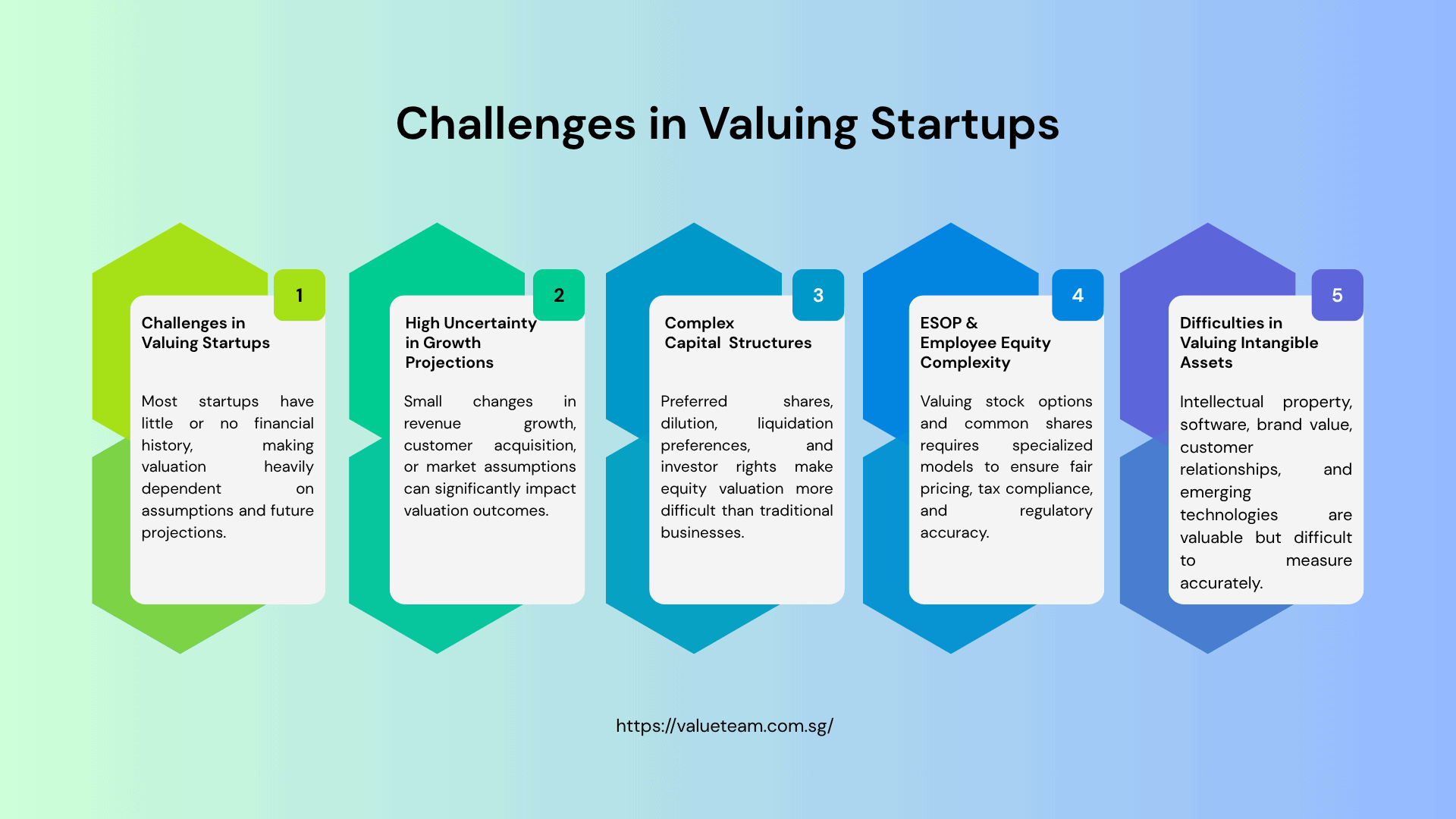
Challenges in Valuing Startups: Limited Financial History and Forecasting Uncertainty
The most obvious difficulty with startup valuation is the lack of any historical financial data. Business ratios and traditional business valuation are based on history – past profits, past trends in the balance sheet, past trends in sales and other revenue – and are used to predict the present value of a business. Most often, at the seed or series A stage, startups don’t have any of this. Their financial statements might extend over just a dozen or so months of activity, and the revenues earned during this period might not resemble what the business will look like in the long run.
This makes it difficult for analysts to do most of their work based on projections. Financial models with an explosive growth trajectory are commonplace for venture capital investors over the next five to 10 years and sometimes prior to commercial launch. Such projections are required to conduct the exercise but are only speculative. Projections for annual growth rates, customer acquisition costs, churn rates, and the like can make a huge difference in the number of dollars that translate to value. The number of dollars that translates to value can vary by tens of millions based on small changes in assumptions. Stress-testing these models and understanding their assumptions and how sensitive they are to these assumptions is a key skill for the junior analyst.
One of the related topics is the choice of a suitable valuation technique. One of the usual tools of startup financial valuation is discounted cash flow analysis, but it is easily broken in situations where the discount rate is high and the flows being discounted are of uncertain value. While useful as a guide, market multiples based on revenue or EBITDA that are based on comparable transactions can be difficult to find for an early-stage business operating in a niche market. Usually, practitioners do not use a single method, but use a mixture of methods or triangulate. It is important to recognize the constraints of each method as well as how to use them.
Understanding Investor Expectations and Startup Worth
Any startup that looks outside itself and reaches out to the outside world for funding goes into the venture capitalist world. Venture capital valuation is not like standard corporate finance. Investors who invest in early-stage companies are aware that most of their investments will not perform well or even be profitable; they discount the investments because they believe a small number of companies will make up for the others, with profits helping to cover the losses. This portfolio mentality affects how investors think about value; they’re not just looking at the chance that a company will survive, they’re looking at the chance that a company will grow in a way that’s extraordinary and redefines the market.
This is a reality for professionals who provide advice to start-ups seeking funding. For the venture context, enterprise value analysis is not only about determining the current value of the firm; it’s about building a viable story for the future value of the firm. The investor will be looking at these numbers, but also market size, competitive position, founder history, and product differentiation. If the valuation is technically sound but fails to take into account the market dynamics, it will be called into question very rapidly. On the other hand, a high valuation based on an explicit growth story can sustain weak financials.
There are also preferred equity structures to consider in the world of fundraising business valuation. The typical features of venture-backed startups’ participatory, anti-dilution preferred shares include liquidation preferences and participation rights. The features allow for a very different pre-money or post-money valuation than the actual economic value received by the founders or common shareholders. It is essential to have a clear understanding of how these instruments impact the business value analysis and dilution to anyone providing advice to startups during a funding process. Independent valuation firms, like ValueTeam’s startup valuation practice, bring to the founders’ and boards’ attention the effects of capital structure decisions on overall value.
Challenges in Valuing Startups: Growth Potential and Complex Equity Pricing
A key aspect of startup valuation is the assumption of high-growth valuation potential. Startups are not valued like mature businesses because they’re not expected to act like mature businesses. They should be able to scale quickly, beat the competition, and win disproportionate market share in a short period. That makes the valuation a tricky job for analysts because it is to a great extent dependent on the expectations for a future that has not yet occurred, and may not occur as expected.
This speculative aspect is particularly pronounced with startup equity valuation. Everyone who invested in the business, whether as a common shareholder, option holder, or preferred investor, has different rights to the business, and these rights are valued differently depending on the exit scenario. A business may have a modest exit value, but still provide a nice return for the preferred investors and a minimal return for common shareholders and employees. Value can be created in all share classes for a company that breaks out. The techniques used for modelling these scenarios, and assigning value to different equity holders, are complex, including the Option Pricing Method or the Probability-Weighted Expected Return Method.
Pre-revenue valuation is challenging for companies that haven’t yet made a profit. If there is no commercial success, the only indicators that analysts can use are non-financial ones: the size of the addressable market, the strength of the founding team, the stage of the product development, and the quality of the company’s intellectual property. These qualitative factors will need to be converted into a defensible quantitative estimate, which will require a certain analytical rigour and practical experience. The Berkus Method and the Scorecard Method are the two popular pre-revenue valuation frameworks, but each must be carefully adjusted to the particular situation of an enterprise being valued.
Challenges in Valuing Employee Stock Options
Equity compensation becomes a key method for recruiting and retaining talent as startups grow. ESOPs are now commonplace for high-growth technology and start-up companies. However, the value of such instruments is not so easy to determine. Valuing a startup for an ESOP involves a number of factors that determine the fair value of the company’s common shares at the time they are awarded to the employee, which in turn will impact the economic outcome of the employee and the company’s accounting requirements.
This is a two-part challenge. First, the employee stock valuation shall be based on the fair market value of the common shares in the company, valued as of the date of the valuation, which in a start-up will likely be less than the price that the investors paid for their preferred shares. This discount is due to the fact that in a liquidation, common shares are paid last, don’t have as many protective features, and aren’t as liquid as preferred shares. To arrive at a defensible common share value, a proper valuation must be performed by an independent appraiser in accordance with 409A rules or regulations (or their equivalent). Valuation of equity compensation in the absence of independence poses legal and tax risk for the company and its employees.
Second, there are complexities to startup option pricing. The Black-Scholes model used for pricing publicly-traded options requires substantial modification for private company situations where there is no reported market price, limited liquidity, and the volatility must be estimated using other public company values or industry averages. The expected exit time is also important in valuing startup options, which fluctuates significantly based on the stage, industry, and investor’s expectations of the company. Those who wish to specialize in this area should have an understanding of both the technical aspects of the input into these models and the regulatory requirements in their jurisdiction with regard to ESOP compliance services. ValueTeam’s equity valuation team helps companies through these requirements, providing compliant and defensible valuation of startups’ equity, stock option assessment, employee equity analysis, and startup equity planning.
The Role of Intellectual Property in Startup Valuation
For many startups, the most important assets on the balance sheet are those that are not even on the sheet. Intangible assets, such as intellectual property, proprietary technology, brand recognition, customer relationships, and assembled workforce, are a big part of a startup’s economic value in many cases. However, these assets are notoriously hard to measure, and the way they are reported in the financial statements varies. This dissonance between the accounting value of a business and the economic value of the business is a major issue in startup valuation.
Startup IP valuation is an emerging field that is becoming increasingly significant for tech and life science startups. Patents, proprietary algorithms, licensed software, and registered trademarks, among other assets, are all the tools that present future economic benefits and must be included in any full valuation. While patent relief from royalties and cost-based methods are commonplace, patent valuation services are more often based on income-based techniques, such as estimating the royalties the patent can generate or the cost savings it can deliver. A value assessment of a trademark is also dependent on the understanding of the brand equity: what is the extra margin or revenue that the trademark can generate over a non-branded version?
Artificial intelligence valuation also incorporates technology IP analysis and startup patent valuation for businesses that are primarily based on their protected technological edge. Some of the intangible factors that could be considered when valuing the innovation assets of a deep tech startup include the commercial readiness of the technology, the extent of patent coverage, and the potential for competitors to challenge the patents. Intellectual property for software adds some complexity to concepts of open-source licensing, ownership of the code, and the rate of technological obsolescence. All of these factors are taken into account in a comprehensive IP portfolio valuation, and the sum of the parts can be more than—or in some cases, less than—individual asset assessments indicate.
Beyond IP: Measuring Brand, Customers, and Innovation Value
In addition to intellectual property, startups have a variety of other intangible assets, just as hard to assess. Valuing emerging technology is even more difficult due to the lack of a market for the new technology, the changing competitive landscape, and the uncertain path from prototype to commercial product. The valuation of a company based on a large language model, new battery chemistry, or proprietary biomarker assay requires analysts who can bring domain expertise and financial modelling to the table, a skill set that is in short supply in the advisory market.
In addition to intangible asset valuations for assets like customer list, distribution network, and assembled workforce, startup intangible valuation also covers intangible assets. These are assets that require capital and time to develop and have a real value, even though they can’t be sold separately. Goodwill valuation for start-ups is the valuation of the business beyond all of its recognized assets; it is the overall value of the business that comes from the strength of its brand, customer loyalty, and operational excellence, and is not a standalone asset. Technology asset valuation can be a negotiation driver in acquisition cases, as buyers typically will be willing to pay a higher price simply for the intangible assets that the target has created.
One other aspect where startups significantly differ from established companies is their customer relationship valuation. A start-up’s customer base can either be small and very loyal, or large and shallow. Intellectual capital valuation takes it one step further and states that the tacit knowledge and expertise within a team can be the most valuable asset of the company, especially in fledgling businesses. It is hard to capture this in a formal model, but it needs to be included in any honest nonphysical asset valuation. Other factors that come into play here are startup software valuation – especially for a SaaS startup where software is the main product and startup trademark asset valuation – for consumer brands where recognition and reputation are the primary drivers of sales. Additionally, formal intangible impairment testing may need to be performed on the acquisition or impairment event, which can further complicate the valuation process. ValueTeam’s specialists are well-known for providing all these appraisals and enabling businesses and advisors to grasp the entire economic landscape.
Challenges in Valuing Startups: Conclusion
The value of a startup is difficult to determine. The short history, the speculative growth projections, the intricate capital structures, intangible-heavy asset bases, and ever-changing regulatory requirements make it a very real analytical challenge. Junior and mid-level professionals will need to become fluent in the technical tools, such as discounted cash flow, option pricing models, and comparable company analysis, and also have the judgment to use them in the right manner when data is limited and the stakes are high.
It is a valuable skill to acquire, and the benefits are great. The need for professionals who can understand the entire process of start-up company valuation, from early-stage valuation to business valuation during fundraising, start-up IP valuation to start-up ESOP valuation, will only further grow in the present times, as the start-up ecosystem is expanding across the globe. Anyone who is well-trained in methodology and has a good knowledge of the market will be at the heart of some of the most important decisions in business.
ValueTeam provides a comprehensive suite of valuation advisory services, including enterprise value analysis, equity compensation valuation, intellectual property valuation, intangible asset valuation, and more, for organisations requiring independent and expert advice on startup valuation on any given aspect. Clinically-endorsed by a team of seasoned professionals with a track record in Southeast Asia and beyond, ValueTeam offers the rigor, independence, and practical expertise critical for today’s startups and stakeholders.
Startup valuation is challenging because many early-stage businesses have limited financial history, uncertain cash flows, evolving business models, and high growth expectations.
Common challenges include limited historical data, uncertain future revenue, market volatility, difficulty selecting comparable companies, and assessing intangible assets.
Assets such as intellectual property, proprietary technology, brand value, and customer relationships can significantly influence a startup's overall value.
Yes. Economic conditions, investor sentiment, industry competition, and funding availability can substantially impact startup valuations.
Professional valuers apply recognised methodologies, balanced assumptions, and industry expertise to produce reliable and defensible valuation conclusions.