
Valuation for Better Business Decisions
The majority of the business valuation discussion starts when a transaction occurs, such as a fundraising, sale, audit, or merger. This is a logical timing, but it’s an important thing that’s missing. A well-considered and well-applied discipline that can be used as a planning and decision-making tool as well as a financial reporting requirement. It’s a way to bring to the surface the drivers of value, measure the return on strategic investments, and give a common language where conversations might otherwise stay unquantifiable and unresolved.
This is applicable to all businesses regardless of their scale and/or organisational form. A company valuation services engagement done in advance of a capital allocation decision will typically uncover information that will impact the decision, not because the numbers are shocking, but because the process of coming up with the numbers will make management face assumptions that were in the background without conscious thought. Likewise, a business valuation engagement for a business team seeking continuing strategic advice is not just a confirmation of a balance sheet number; it’s a way to assist a leadership team in comprehending the economic results of the decisions they might be able to make.
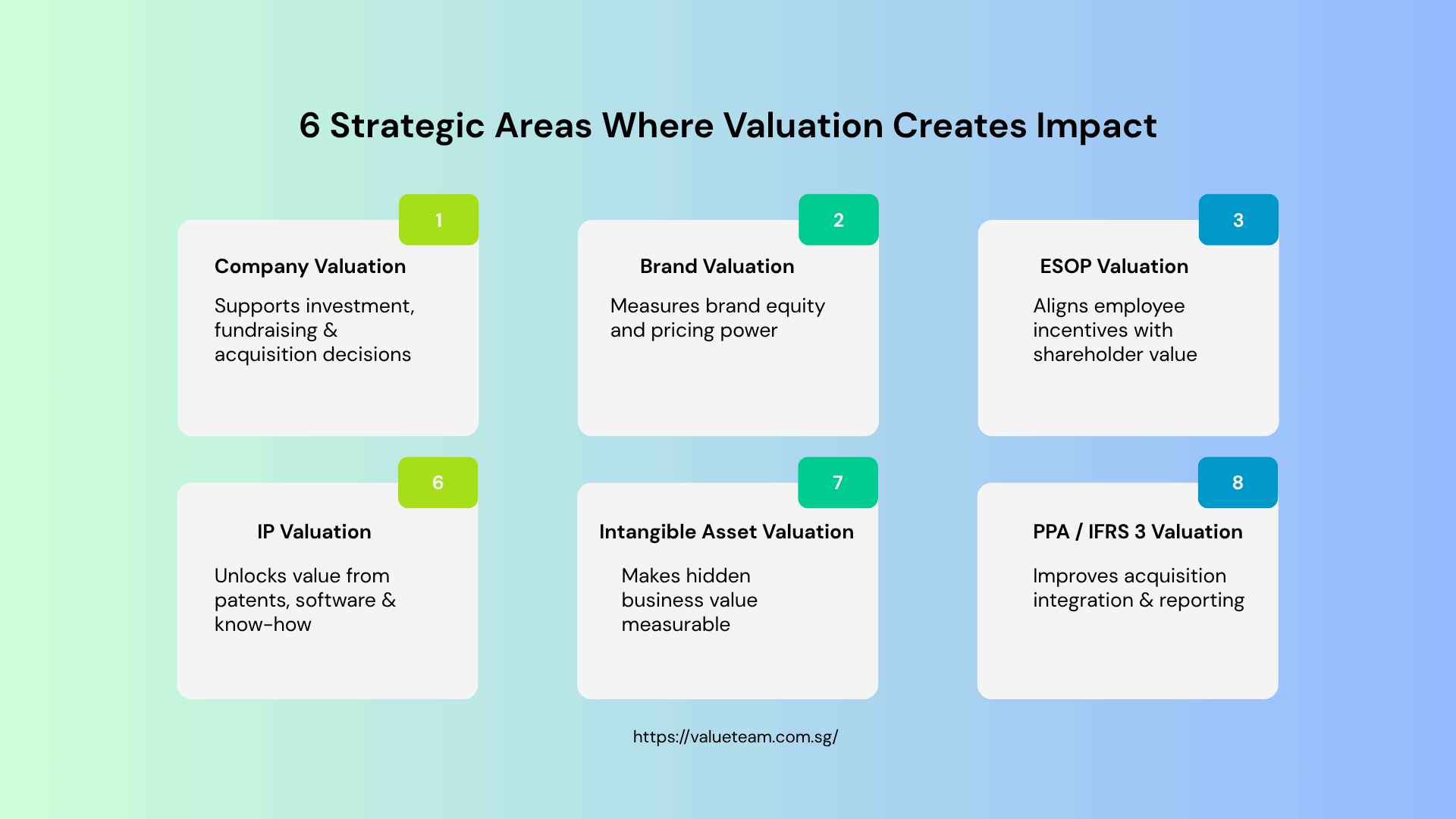
The relationship between valuation and strategy is through six practical domains, which are explored in the following sections. That’s why strategic business valuation is not an esoteric function of the finance department, but a function that needs to be at the core of a well-managed business in making decisions.
How Business Valuation Improves Strategic Decision-Making and Growth Planning
The most elementary of business strategic uses of valuation is also the one most often forgotten—the determination, on an ongoing basis, with reasonable precision, of the value of the business at a given time. While this may seem self-evident, it is not the case for most private companies that look to value when it comes time to sell: They estimate value loosely, based on a previous sale, a rough multiple of last year’s earnings, or what a peer sold for several years back. None of these can be a good indicator of the current fair market value, especially in fast-moving markets.
The fair market company valuation process looks at the business with the eyes of an informed, willing buyer at the time of an orderly transaction, taking into consideration market conditions, risk profile of the business, and the operations of similar companies. This is the same test used by corporate valuation professionals in undertaking formal financial reporting or on transactions, and the test that provides numbers that withstand external review.
For smaller and mid-sized businesses, SME valuation services based on this approach can have one special benefit: They can come to any important business discussion, whether it’s with a bank, an investor, another strategic partner, or a potential buyer, with a well-supported, independently developed view of value – instead of a number hastily cobbled together at the last minute. One of the most common and avoidable causes of value leakage in business transactions is the lack of information for a business owner who doesn’t have an up-to-date valuation and a counterparty that has done its own analysis.
In addition to transactions, it is important to have knowledge of the current value for capital allocation decisions. The value of the current business is the starting point for an analysis that is meaningful if management is considering investing in a new product line, acquiring a competitor, or returning the capital to the shareholders. Enterprise valuation services and corporate valuation solutions that create this baseline—and adjust it as conditions in the business evolve—provide leadership teams with a much more solid foundation for the conversation than intuition and past experience.
Valuation for Better Business Decisions: Why Brand Valuation Matters for Long-Term Business Value
There’s no strategic asset as much talked about as there is, as a measure as much analysed as the brand. Most management teams are aware that their brand is valuable, that it provides them with some pricing power, lowers customer acquisition cost, and contributes to being a barrier to competition. Fewer can measure that value with the acuity and accuracy of strategic decision-making. When your brand-related choices have a lot of capital at stake, it has real effects; this gap.
Brand valuation services are a formal process that converts the business value of a brand into a dollar and sense figure. The last one is the “relief from the royalty approach,” which values the brand based on the amount of royalties that the business would have to pay if it were to license the brand instead of owning it. It’s clear, based on observable information on the market and accepted by the auditors and regulators, that it’s as useful for strategic purposes as it is for the corporate brand valuation under IFRS.
The applications of the strategy are very broad. If a business is considering expanding its brand into a new category, it is important to understand its current brand equity value (or if there is any) as well as the possibility of the brand having the right associations to support its extension into the new category and the economic cost of the brand becoming overly associated with the extension, thereby lowering the premium it enjoys. If a business decides to enter into a licensing agreement, it must have a credible Trademark valuation service exercise to determine the arm’s length royalty rate to which the agreement would be based. Similarly, a business thinking about the disposal of a brand or sub-brand should have brand asset valuation that would account for the standalone value of the asset as well as any synergies or dis-synergies realised by a specific acquirer.
For groups that have several brands in multiple markets, strategic brand valuation offers the portfolio view that allows for making allocation decisions: investing in the brands with the greatest return on brand equity and not investing in the brands with decreasing value or where the market opportunity has dwindled. It is a domain of brand appraisal consultancy that is most commercially applicable – not only for measuring the current value of the brand, but also for elucidating the dynamics that will shape the future value of the brand.
It takes one step further with the reputation valuation dimension. For companies whose trust is a critical consideration for customers, whether in financial services, healthcare, or professional services, the commercial importance of their reputation may be the biggest component of an intangible asset portfolio. Value is a strategic as well as a monetary point of view, and the metrics that build or dismantle it are one of the key disciplines of a strategic business. Activity in this area—valuing marketing assets and performing consumer brand value analysis—provides a quantitative basis for informed brand investment decisions, instead of proxies like brand tracking scores and marketing spend.
Valuation for Better Business Decisions: Strategic ESOP Valuation for Employee Retention and Business Growth
Employee equity programmes are a tool in the strategic toolbox of a growing company. They put staff interests in line with long-term shareholder value, minimize cash compensation expenses during the growth phase, and demonstrate that they are committed to their employees, who have viable alternatives. However, they offer only those benefits when they are properly thought out, written, and understood by those to whom they are intended to give impetus.
The accounting dimension is an absolute. Under IFRS 2, the grant-date fair value of equity awards is recognized as a compensation expense over the vesting period, and valuation services for ESPOs are the way the fair value will be determined. The exercise is not as simple as it sounds: the valuation of employee stock options is far more complex because it needs to consider not only whether or not an option has an intrinsic value at grant date, but also the time value (or option value), which represents the chance of the value of the option rising above its intrinsic value before it expires. This is done by choosing the right pricing model and filling it with the correct pricing assumptions that are supported by market evidence, not arbitrary pricing assumptions that are easy to come up with.
A strategic aspect is also important. Through share option valuation analysis, managers can gain insight into the dilution economics of a proposed scheme, that is, the value of the options granted to the shareholders, the vesting conditions on the options, and the overall cost to the existing shareholders. The portfolio level employee equity valuation provides the board with a comprehensive view of the equity incentive programme, encompassing all outstanding awards (all tranches and classes) and their total cost, and whether it is delivering the commensurate value in terms of retaining talent, aligning performance, and cash compensation.
Valuation for startup ESOP is unique for startups and tech companies. Since there is no listed share price, the underlying equity value will need to be independently determined prior to performing any option pricing valuations. This gives rise to two valuation exercises in one business appraisal services process – an equity valuation exercise and an equity compensation valuation exercise – which must be coordinated carefully to make sure that the two outputs are consistent.
Well-structured ESOP advisory services combine the two elements: structuring the ESOP terms to meet the strategic goals, determining the accounting cost as accurately as possible, and ongoing support in the course of the evolution of the ESOP (modification events, new grants, equity structure changes of the company, etc.). Valuing the shares of employees as part of this broader advisory relationship is likely to yield better results – on the balance sheet, in terms of employee motivation, and in terms of the capital structure – than valuing shares in a point-in-time valuation exercise as a compliance measure.
How Intellectual Property Valuation Supports Competitive Advantage
In the case of technology companies, pharmaceutical companies, media companies, and many manufacturing companies, the assets that most of the balance sheet is blind to are the most strategic ones. Years of investment creating patents, software platforms, trade marks, copyright libraries, and proprietary know-how are recognised as an expense as incurred and are carried in the business at a minimal book value — yet are the main driver for a buyer to pay a significant premium to acquire a business.
Rigorous intellectual property valuation services and wider IP valuation services bring these assets out of the shadows by using accepted, auditor-approved valuation methodologies to value them. Where there is an active market for licensing, the relief-from-royalty approach is used, whereas multi-period excess earnings or replacement cost approaches are used where there is no market for licensing. The remaining legal life of the patent, and the scope of the claims and competitive landscape of the patented market must also be taken into account when valuing a patent — it’s as much about a commercial analysis as it is about the financial modelling.
The political ramifications are significant. A business with a map and the value of its IP armory will have the information to make decisions on licensing vs ownership, geographic registration strategy, and prioritisation of R&D investments. Valuation of software assets and technology assets is especially important when a business is considering monetizing a platform through licensing, selling a non-core technology asset, and/or utilizing IP as collateral in a financing deal. Digital IP valuation takes this a step further to include the value of data assets, algorithmic models, and the platform network effect, where existing valuation methods are now trying to catch up with the rate at which values are being created.
Innovation asset valuation and IP asset appraisal are the tools that establish the basis for arm’s-length pricing that meets accounting requirements and transfer pricing examination for businesses engaged in IP transactions with other companies within the enterprise or cross-border licensing agreements. Similarities between the assumptions made in copyright valuation and patent and trademark valuation arise in one context only, and these assumptions should be the same in the other context — a coordination challenge that is best met by integrating copyright and patent and trademark valuation processes instead of having disjointed and potentially conflicting processes.
Valuation for Better Business Decisions: The Importance of Intangible Asset Valuation in Modern Businesses
In most of today’s businesses, the difference between the book value and the market value is due mainly to the intangible assets of the company. Economic value represents a number of elements that are not adequately reflected in the standard accounting framework, but are well understood by customers and investors when assessing the value of an organisation’s price. Economic value comes in many guises, such as customer relationships, assembled workforce, proprietary processes, contractual rights, and the accumulated know-how of an organisation.
Formal intangible asset valuation is the process of converting the implicit value to an explicit, measurable value. Customer relationship valuation focuses on the economic value in the current customer base, and incorporates customer retention, revenue per customer, and the costs and benefits of acquiring the same customer relationships from scratch. Goodwill is one of the areas in financial reporting that is most subject to scrutiny, and both the allocation of goodwill in an acquisition and its testing for recoverability under IAS 36 are surrounded by such evidence.
Intangible asset appraisal is not only for compliance purposes, but also aids in various strategic decisions. A company looking at a divestment should not only know the book value of what it is selling, but also what value a potential buyer would be willing to pay for intangible assets to the company that can be considered as “fair value” and that is truly transferable and therefore truly valuable to that buyer – customer relationships, operational processes, proprietary data, brand associations, etc. The intangible contributions of each of the parties in a joint venture must be valued and agreed upon, and that’s where enterprise intangible valuation comes into play, which can be used by both parties and their advisers.
In recent years, the rise of intangible valuation services has seen the emergence of digital asset valuation as a unique field of practice, as data, algorithms, and platform assets become a crucial source of competitive advantage in the digital asset world. The assets are not always easily classified in an established accounting framework, but are growing in importance in determining enterprise value, and companies with the ability to show investors and acquirers the value of these assets have an edge over those that do not. In this new field, it is important to link analytical creativity with technical rigour, which is necessary for non-physical asset valuation and business intangible valuation, in addition to using methods that have been adapted from existing business valuation methods and adjusted for the digital characteristics of value creation.
Using Acquisition Valuation to Strengthen Post-Merger Strategy
How a company presents its acquisitions in its financial statements is not only a reporting requirement, it is a clear reflection of the company’s strategy and where it thinks the value that it purchased is going to be found. With IFRS 3, the purchase price of an acquisition must be allocated to the fair values of all identifiable assets and liabilities from the acquisition of the business, with the remaining value (after all allocation) being recognised as goodwill. It is a purchase price allocation valuation exercise that will have an impact on the balance sheet, income statement, and impairment testing framework for years following the transaction close.
The strategic dimension of this is generally overlooked. The firm that finalizes a complete acquisition accounting valuation will have gained a valuable insight into the company it has acquired: that is, where the value it has paid for the business lies and what assumptions need to be true for it to be maintained. If most of the value of the premium can be attributed to customer relationships with a five-year useful life, the business has set the bar high for retaining customers over five years. If it’s due to a technology platform, the business has agreed to maintain this technology’s competitiveness. Through the fundamental analytical approach to PPA, these commitments are clearly identified, not only for audit but with good intentions.
The IFRS 3 valuation framework calls for the recognition and measurement of all intangible assets that satisfy the separability and/or contractual-legal criteria. It translates to a systematic approach of discovering customer relationships, technology, trademarks, contractual rights, and workforce assets that are eligible to be recognised in the target business. When advisers get involved in the merger and acquisition process in advance of closing — which is ideal — they can provide the acquirer with an understanding of the potential accounting treatment for the acquired company as part of the broader transaction analysis, as opposed to as a shock 6 months later.
The allocation of the fair value of the assets by asset class also has implications for the post-acquisition integration strategy. As an example, knowing that a large part of the value is based on the acquired company’s customer relationship should guide the acquirer’s approach toward integrating the business in the first year, and the careful tracking of their customer retention when compared to the assumptions behind their goodwill allocation services and intangible asset recognition exercise.
Business combination valuation and post-acquisition valuation – when performed in a similar manner in terms of methodology, assumption setting, and documentation of the valuation – can serve as a basis for comparison and allow management and the board to determine the performance of different acquisitions against the value thesis agreed to and documented at the time of the transaction. Financial reporting valuation services that enhance this continuous process, instead of being a one-off requirement to comply with, add much greater value over the long-term to the business.
Building a Valuation-Driven Business Strategy for Sustainable Growth: Valuation for Better Business Decisions
Valuation is the thread that connects all six of the above domains – it’s a discipline, not a one-off project that can be completed in isolation; it keeps management on track with the economics of a business; it gives a business a common language to speak about strategy; and it brings the value a business creates closer to the value the business can realise.
This doesn’t mean these reports have to be commissioned regularly from outside. It involves making it a habit to be very disciplined in thinking about value creation, and to know what factors are behind the enterprise value multiple (the “EV”); to know what variables impact the EV, and to understand when to seek help from outside to perform an analysis that would not be feasible in-house. A valuation advisory firm is more than just a report-writing service; it’s a thinking partner that can make management think about their business in a different way.
Whether it’s company valuation, brand valuation, ESOP valuation, IP valuation, intangible asset valuation, or PPA valuation, ValueTeam’s valuation services are based on independent analysis, IFRS-compliant methodology, and underpinned by the business acumen that knows the most valuable valuation work is the one that leads to decision-making, rather than documentation.
Business valuation provides objective financial information that helps companies make informed decisions regarding investments, acquisitions, financing, and strategic planning.
Accurate valuation reduces uncertainty, improves financial planning, supports negotiations, and provides confidence for key business decisions.
Business owners, investors, lenders, auditors, accountants, consultants, and corporate executives all use valuation insights to support decision-making.
Businesses should consider obtaining a valuation before fundraising, mergers, acquisitions, restructuring, succession planning, or significant strategic changes.
Professional valuation delivers reliable and independent assessments that strengthen strategic planning, enhance stakeholder confidence, and support sustainable business growth.