
5 Key Factors That Affect Business Valuation
A Practical Guide for Business Owners, Founders, and Finance Professionals
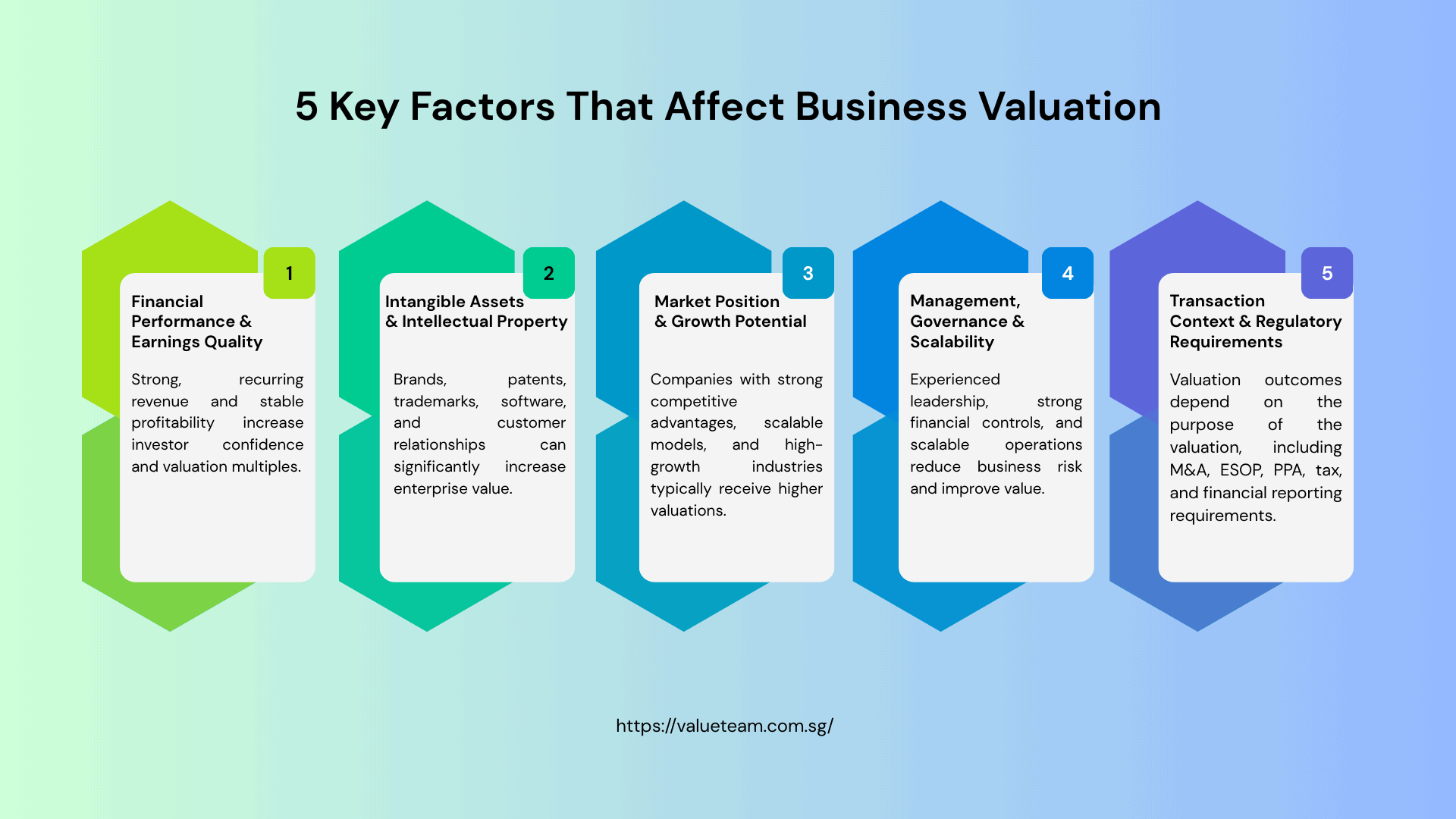
The key and often overlooked component of business financial planning for business owners is understanding what influences business valuation. These concepts of professional business valuation are relevant to all industries, in all sizes, when you consider business valuation for mergers and acquisitions, investment, succession, or simply to understand the value of what you’ve created.
This article discusses five key elements that will have a material impact on a company’s value. They all have direct consequences on the final figure in a company valuation report, but also on the perception about the health and future potential of the business by stakeholders, such as buyers, investors, regulators, and tax authorities. At ValueTeam, we offer company valuation services, brand valuation services, and a comprehensive range of financial valuation services in Singapore and throughout the region.
Factor 1: Financial Performance and Earnings Quality
The company’s financial performance is the most important of all factors in a business valuation. This is not just the revenue amount; it is also the quality of earnings that is important, if not more important.
What ‘Earnings Quality’ Really Means
Business valuation gurus pay particular attention to whether the profits are recurring and ongoing or whether they are based on one-off events, clever bookkeeping, or some fleeting market trick. A company that’s breaking out for good margins this year, as a result of a one-off government contract, is a vastly different proposition than a company that’s reporting steady margin performance over five consecutive years.
In most methods of corporate valuation, be they income-based, market-based, or asset-based, historical patterns of earnings are assumed to be a representative guide to future earnings. Usually, valuation professionals will normalise the earnings to exclude non-recurring items and report an adjusted EBITDA or EBIT that represents the underlying business reality.
It’s not just about the quantity; it’s also about the quality. Financials will be adjusted to reflect the actual earnings of the business during normal ongoing operations by business valuation experts.
This step is especially important when valuing an SME business. Numerous owner-managed operations have above-market owner salaries, above-market expenses charged to the company, and/or related-party transactions that skew the actual profitability figures. Professional business valuation experts will normalise these items to determine a fair market value of the business that is a true representation of what an arm’s length buyer would see.
Revenue Concentration and Customer Dependency
The issue of revenue diversification goes hand in hand with earnings quality. A business that makes 70% of its revenue from a single client is much more susceptible to risk than a business with revenue from 50 customers. The perception of this concentration risk is a direct consequence of one of the discount factors in the assessment of enterprise value: the greater the dependence of a business on any given source of income, the greater the risk perceived and the lower the calculated valuation multiple.
Financial valuation services buyers and investors will regularly simulate ‘what if’ scenarios with respect to customer attrition. The multiple used to the earnings of this business will reflect its lack of revenue-based diversification and stickiness if it has an insufficient base of revenue or it is not sticky.
Factor 2: Intangible Assets and Intellectual Property
Intangible assets are often a big part of a company’s value in the modern economy. It has been consistently found that intangibles — from patent and trademark rights, to customer relationships, proprietary software, and brand reputation — now contribute to a much larger portion of enterprise value than tangible assets, like machinery, inventory, or real estate.
The Scope of Intangible Asset Valuation
The valuation of intangible assets is a specialist area of expertise that demands financial skills and knowledge of the type of asset being valued. For instance, with regard to Goodwill valuation services, they focus on the amount of money that is paid by a buyer over the NAV of a business, which includes customer goodwill, supplier relationships, workforce competence, and market positioning. These are actual benefits that the acquirer is expected to gain and need to be measured with precision.
Likewise, intangible assets like patents, trademarks, and special processes need a specific valuation approach. In all three methods of business asset valuation – relief from royalty, income, and cost – business asset valuation services for intangibles must be based on defensible assumptions and backed up by market evidence.
Intangible business assets, such as goodwill, patents, brands, and customer lists, are frequently a company’s most valuable assets. However, many companies have them on their books at zero. The right approach to intangible asset valuation can uncover a lot of potential sales upside.
Intellectual Property as a Value Driver
For technology businesses, pharmaceutical firms, consumer brands, and any company based on proprietary rights, intellectual property valuation is of special interest. IP valuation services range from patent valuation service and technical process valuation to trademark valuation of brand identifiers to copyright valuation of creative and software assets.
Valuation of IP is not a philosophical debate. It can be directly used in licensing negotiations, litigation support, tax planning, transfer pricing, and corporate transactions. Investors are more and more asking for commercial IP valuation and technology IP valuation to help them understand the value drivers of a business, other than the income sheet.
The IP asset valuation is an integral component of the purchase price allocation valuation process for a business transaction, which we will be discussing in Factor 5.
Brand as an Intangible Asset
A brand may be the strongest intangible asset that a successful business can have. Brand valuation services offer a systematic approach for measuring the value a brand can add to a company’s performance, distinguishing the value from the name, identity, and reputation of a brand from the value from other drivers.
Brand equity valuation focuses on the facets of brand awareness, brand perceived quality, customer loyalty, and brand associations, and then turns these into a dollar value. For a company that will go into licensing or franchising, or where the brand name is the key reason why customers are buying into the business, corporate brand value is a real asset that can be found in the balance sheet.
In companies that have a solid customer-facing brand, strategic brand valuation can prove that the value of the business brand goes beyond its physical operations. The study shows that intangible brand assets, such as brand equity, goodwill, and reputation, are being examined more and more in M&A transactions and financial reporting environments.
Factor 3: Market Position, Growth Prospects, and Industry Context
No business operates independently. Its value lies in the market in which it trades, its relative competitiveness in that market, and the investment’s expected growth.
Industry Multiples and Comparable Transactions
The most popular method of corporate valuation is known as the market approach, and this involves comparing the subject company to other companies that are publicly traded, or comparing the subject company to private transactions that have occurred recently in the same industry. Industries have their own average multiples, which are determined by the growth rate of the industry, the level of capital funding, as well as the regulatory framework and predictability of earnings within the industry.
EV/Revenue multiples are higher for a high-growth software company, ranging from 8x to 15x, compared to a mature manufacturing business, which may trade at multiples of 4x to 6x of its EBITDA. These comparable transaction databases are used by business valuation experts to compare the subject business and to add or take off premiums or discounts for a specific business.
The industry context is not a background — but an integral part of the valuation process. A 30% growth company will command a very different multiple than a 5% growth company in an average 30% growth company sector.
Competitive Moat and Defensibility
Sophisticated acquirers and investors in professional business valuation exercises don’t just consider historical growth, but they are interested in whether that growth is defensible. Why can’t the competitor duplicate the business model? Are the customer relationships lasting or temporary? Is there a threat of the margins being squeezed by alternative products/commoditisation?
The answers to these questions have a direct impact on the risk premium used in the income-based approaches to enterprise value assessment, and hence on the result of the assessment itself. A business that can clearly show the competitive advantage it has is going to be more valuable than a business that has a competitive advantage that is dependent on the market or the relationship between the management and the business.
Growth Rate and Investable Future
The growth rate of the business is an important factor in making fair market evaluations of the business. Many income-based valuations are based on discounted cash flow models, which are very sensitive to growth rates and terminal value estimates. Assuming a 2% difference in the long-term GDP growth rate can result in a 20-30% difference in the indicated value.
The outcomes of professional business valuations will be more successful for business owners who can back their growth projections with hard data, e.g., signed contracts, discovered pipeline, market share data, and product roadmaps.
Factor 4: Management, Governance, and Operational Scalability
Buyers/investors purchase the future cash flow of a business, not only its past cash flow. The future cash flows of any business are provided by its people, its processes and its governance. That is why management quality and operational scalability are pivotal factors that should be at the core of any business valuation.
Key Person Dependency
Among the more common discount factors in SME business valuation is key person dependency, where the business’s performance is reliant on one or two people, usually the founder or one of the senior salespeople. The removal of one party would be significant to revenues or to operations, etc. – If that’s the case, a prudent purchaser will factor that risk into the offer.
This is minimised by business valuation professionals determining the quality of the management team, the documentation of processes and systems, and the extent to which the relationships with customers are formalised, not personal. Companies that have invested in developing their depth in building management and minimised key person risk will always deliver better assessment results for enterprise value.
Corporate Governance and Financial Controls
Company financial reporting, internal controls, and governance are directly related to valuation. A business with audited financials and a board or advisory committee that works is less risky to due diligence than a business with unaudited financials and ad hoc decision making.
Good governance is more than a compliance activity; it is true value creation. In a formal company valuation report process, companies that are able to show off clean and well-documented financials and strong internal controls tend to enjoy premium valuations.
Buyers typically make an adjustment for a ‘quality of earnings’ and a ‘management quality’ premium or discount when valuing businesses for mergers and acquisitions. The better and more business-like it looks, the business is being run, the lower the risk to the buyer, and the higher the multiple he is willing to apply.
Scalability and Systems
A business that can grow revenues without a proportional rise in costs is more valuable: a business with scalable systems, technology infrastructure and repeatable processes is more valuable than a business that requires linear investments in headcount and capital to grow its revenues. Financial valuation services analysis will look into the marginal cost of growth and the profitability of the business expansion.
This is an especially crucial factor for technology firms, franchise systems, and businesses with distinctive platforms. Premium valuation multiples are hard to argue against because of the operational leverage, or the ability to scale without proportional increases in costs.
Factor 5: Transaction Context — Purpose, Structure, and Regulatory Requirements
Last but not least is the reason behind the valuation and the transaction or regulatory context of the valuation (which is often overlooked).
Valuation for Mergers and Acquisitions
One of the most challenging financial valuation applications and perhaps the most critical is mergers and acquisitions valuations. Buyer and seller have competing interests in the results of a transaction. The buyer wants to pay as little as possible for the assets; the seller wants to get the maximum possible value for what he/she has created.
Here, it acts as a negotiation anchor and a governance document, the company valuation report is generated by independent advisors. The valuation can be relied on by boards of directors, audit committees and regulators as being satisfactory to them in satisfying their fiduciary responsibilities. In cases of M&A valuation, the business valuation professionals will need to employ the rigorously defensible methodologies and deliver results that could be challenged.
Purchase Price Allocation After Acquisition
After an acquisition has been made, the task of determining the purchase price allocation valuation starts. The two standards governing acquisition accounting valuation, IFRS 3 and ASC 805, both require that PPA valuation services be performed as part of the accounting for an acquisition.
For a post-acquisition valuation situation, all the consideration received for the acquired business is distributed to the identifiable assets and the liabilities acquired, which are to be valued at fair value. This means not just its physical property, but its intangible property as well, such as customer relationships, technology, trade names, non-compete agreements, and others that can be identified.
The allocation of purchase price is not an option, but a financial reporting requirement. PPA accounting services errors can have a significant impact on financial statements and may draw the attention of regulators.
What remains (not allocated to any specific assets or liabilities) is goodwill. The accounting for financial reporting valuations for PPA requires specialist expertise, as the assumptions for allocation of the fair value of assets to their respective classes are subject to audit review, and should be consistent with the market participants’ assumptions in the relevant accounting standard.
ESOP and Equity Compensation Valuation
Many companies, ranging from startups to well-known companies, are increasingly adopting equity as a recruitment and retention strategy. ESOP valuation services are needed to determine the fair market value of equity compensation in the form of shares or options issued to employees and to ensure the fair value of shares or options is valued in accordance with tax and accounting laws.
Standards like ASC 718 and IFRS 2 impose requirements for the valuation of employee stock options and share options that require estimating the fair value of options at the time of grant (the grant date) using recognised models for option valuation. A 409A-equivalent analysis, which is a valuation based on the fair market value of the startup for ESOP purposes on each relevant grant date, is often included in a start-up ESOP valuation.
Equity compensation valuation should account for the value of the equity, the terms and conditions of the options, and the implied volatility and time horizon of the option pricing valuation model for a company in different stages of growth. Additionally, the business and the class and terms of the equity being valued must include a discount for lack of marketability (DLOM), and control premiums.
Compliance valuation of the ESOP is not just a financial procedure; it has a tax and legal impact on the company and its employees. If not well documented and defensible, employee equity valuation can lead to taxing authorities’ troubles and lead to unforeseen liabilities for employees who exercise their options.
Conclusion: Getting Business Valuation Right
Business valuation isn’t a straightforward formula. It is a multi-dimensional evaluation that requires financial skills, industry experience, analysis, and knowledge of the situation in which the valuation will be applied. The five factors discussed in this article are interrelated in complex ways and a failure to accurately value one of the factors can lead to a significant misvaluation of the fair market business value of the enterprise.
From valuing a business for a transaction to a company valuation report for regulatory or tax requirements, to specialist services like brand valuation services, intellectual property valuation, or ESOP valuation services, ValueTeam possesses the expertise and methodological rigor necessary to meet the demands of the situation.
We have a team of business valuation experts that can serve clients in Singapore and across the region, whether they are SMEs needing SME business valuation, multinationals that need enterprise value for transactions with foreign offices, or private equity investors that need post-transaction financial reporting and accounting valuations for acquisitions.
Business valuation is influenced by financial performance, cash flow, market conditions, industry trends, growth potential, and operational risks.
Higher profitability generally indicates stronger financial performance and future earning potential, increasing the overall value of a business.
Economic conditions, competition, customer demand, and industry performance can significantly affect business value and investor expectations.
Yes. Experienced leadership, effective governance, and sound strategic planning contribute positively to long-term business value.
Understanding these factors helps business owners improve company performance and maximise business value over time.