
How To Determine the Value of a Company? Complete Guide
Understand How To Determine the Value of a Company?
Owning up to a company is one of the most useful skills in finance and is an important tool to know whether you’re getting ready to a sale, raising funding, resolving a shareholder disagreement, or just need to understand where your role fits into the company as it grows. It impacts almost every aspect of corporate life, from mergers and acquisitions to tax planning to compensation, etc., and many professionals only learn how it works in bits and pieces; in other words, what they learn is a partial understanding of the subject rather than the whole picture. It covers the fundamentals of the valuation approaches, the types of business valuation and their applicability to specific situations, the process of a professional company valuation service, why employee share valuation is worth considering, and some of the lessons that seasoned business valuation experts have learned through experience. When you’re done, you should not only have a set of formulas to memorize, but you should also have a working knowledge of how the value of a company is determined.
How To Determine the Value of a Company Using Core Valuation Approaches?
The three general methods of valuating a business are the asset approach, market approach, and income approach. The income approach takes into account the cash flow that a company is expected to generate in the future, usually through a discounted cash flow model that estimates the revenue, expense, and capital requirements for the company, and then discounts the resulting free cash flow to present value using a rate reflecting the risk of the business. The market approach, on the other hand, focuses on the outside, comparing the company to recently sold, comparable public companies to get valuation multiples like price to earnings or enterprise value to EBITDA that can be utilized for the company being valued. Both methods involve real judgment, far from data entry; not only can comparable companies make a difference in the value, but the discount rate chosen can also make a significant difference. It is often the case that the math is not the difficult part, but finding the value of the company is the difficult part, and many analysts new to this activity think that the math is. One of the best indicators that something is being rushed is when the discount rate, or growth assumption, is strikingly similar to the one that was used for the last, totally unrelated project that the analyst did.
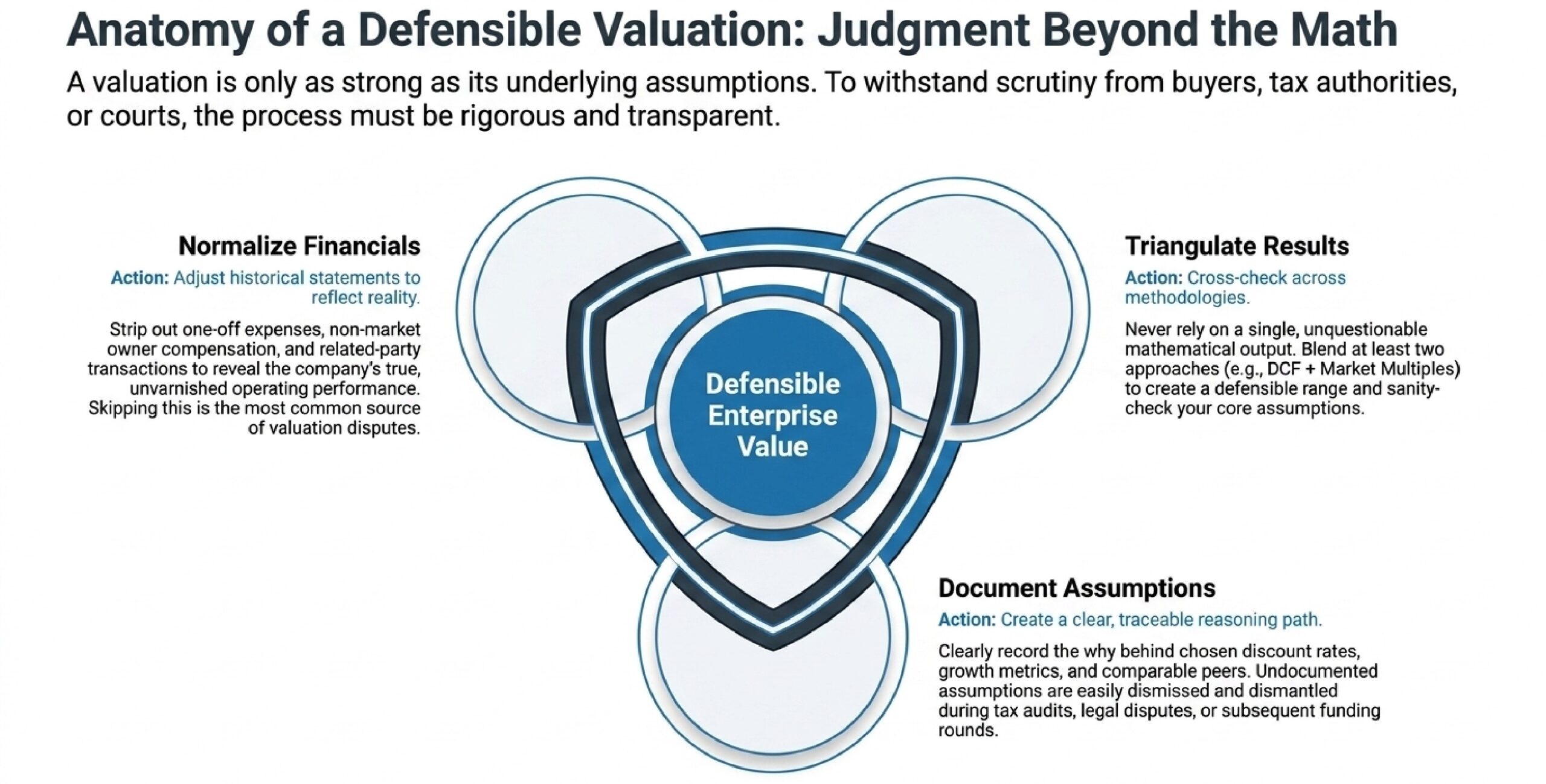
The third pillar is the asset approach, which takes into account a company’s assets valued at fair value less its liabilities, and for most operating companies is less relevant, but is key in the real estate holding companies and/or in cases of liquidation. In reality, most reputable valuations involve a multi-pronged approach – with the range of possible values used to sanity check assumptions – rather than relying on one approach’s output as though it were a precise, unquestionable answer. For a manufacturing firm that is being valued for its possible sale, say, a discounted cash flow model could be the main method used, and then compared with other similar transactions between companies in the same sector with comparable characteristics, providing a point of reference for both parties to defend during negotiations. This triangulation process is one of the most obvious signs of a solid valuation process, as a 100% reliance on one process makes the final result that much more vulnerable to any single erroneous assumption than a cross-checked or blended conclusion would be. When both parties have this in mind, they can converse more effectively, as their discussion becomes about which of a range of assumptions are defensible, rather than which number is correct.
Which Business Valuation Methods Fit Different Company Types?
The selection of a proper valuation technique is largely dependent on the type of business being valued, its stage of development, and the purpose of the valuation. Here are the five things that happen usually when they choose this. First, mature, cash generating businesses with a consistent operating history typically have a better fit with the discounted cash flow approach because its output is based on the earnings stream that has a consistency history. Second, in cases where the company isn’t established, or has a short financial history, they’ll be more inclined to use similar transaction multiples or the valuation of the latest funding round, because a cash flow projection based on virtually no operating history is far more of a guess than analysis. Thirdly, businesses with heavy assets like property holding companies or businesses that have a lot of equipment, generally rely on the asset method, especially when there is little operating cash flow as compared to the asset value. Fourth, professional services organisations, where value is more closely linked to people and client relationships, must be mindful of the risk of key people that may not be adequately addressed by a mechanical approach. Fifth, firms that have multiple separated operations may find that a sum of parts approach to business valuation is best, using a different valuation method for each operating segment before adding them all together. Business valuation experts who are used to dealing with numerous industries have a very good sense of where one of these five patterns is present in a company – usually at a very early stage, before even a model is constructed. There is a lot of value in this early pattern recognition and is a real ability that needs to be developed intentionally, to get a realistic feel for an engagement from the beginning, instead of finding halfway through that the wrong methodology was selected from the ground up.
One example is a regional healthcare services organization that had a long-standing established clinic-based organization and a newer rapidly expanding telehealth division that was still spending a lot on growth. If the same method of valuation had been applied to both segments, the results would have been skewed toward either a low valuation of the mature clinic business, or a high valuation of the still unprofitable telehealth business. Instead, the valuation team used a discounted cash flow model for the clinic network, which has a predictable number of patients and stable margins, and a market-based valuation approach based on recent funding rounds in the telehealth space for the newer division, and then blended the two to arrive at the appropriate blended enterprise value that better reflected the risk and growth of the business.
Table 1: Matching Business Valuation Methods to Company Type
| Company Type | Typical Method | Why It Fits |
|---|---|---|
| Mature, stable operating company | Discounted cash flow | Reliable earnings history supports projections |
| Early-stage or high-growth company | Market approach, comparable transactions | Limited operating history makes cash flow modeling speculative |
| Asset-heavy business | Asset approach | Value concentrated in owned assets, not operating cash flow |
| Professional services firm | Income approach with key-person adjustment | Value depends heavily on specific individuals and relationships |
| Multi-segment holding company | Sum-of-the-parts | Different segments warrant different methods and assumptions |
How Do Company Valuation Services Support How To Determine the Value of a Company?
There is a reason that professional company valuation services exist: If an accurate and defensible value can be determined, it takes special expertise, access to comparable transaction data and independence that an internal finance team, no matter how capable, can’t fully achieve. An independent valuation usually carries more weight than a self-prepared valuation because outsiders like investors, courts, or tax officials tend to trust their independent findings. When a business is considering a sale, a buyout of the shareholder, a tax filing or a legal dispute, the valuation from an independent party is likely to be more credible. Additionally, company valuation services offer a structured approach and documentation protocols that ensure the valuation is defensible in a dispute. In reality, this documentation discipline is incredibly significant because a valuation conclusion with no clearly defined and documented reasoning path is much more likely to be disregarded by an independent party (either counterparties or tax authorities) that would be a professionally-prepared document with a well-thought-out, explained justification for the valuation. Businesses that develop a relationship, as opposed to hiring a new valuation company for every assignment, also get to enjoy institutional knowledge of the business that helps the quality and efficiency of each of the future valuations.
It’s more likely to come out a smoother deal if you involve company valuation services earlier in the process, as opposed to when a dispute or transaction has already been set in motion. For a family business looking to acquire a minority stake in a company, for example, it was particularly advantageous to have an independent valuation firm consult them at the beginning of negotiations as opposed to when they had already gotten into an argument over the price of the acquisition. This example is just one of many that make it clear why it is so crucial to engage company valuation services proactively and not as a final resort when a disagreement has already become hard-fought conflict. The cost of hiring outside experts early in the process is relatively minor, and is often less expensive than the legal costs and damage to relationships that can occur during a lengthy valuation disagreement later.
Why Does Employee Share Valuation Matter When You Determine the Value of a Company?
Another particularly specific and widely used type of company valuation is employee share valuation, which is relevant to any type of company that issues stock options, restricted shares or any other form of equity compensation to its staff. Accurately valuing equity is important for a number of practical reasons: Tax authorities in many jurisdictions mandate that the value be defensible based on the date equity is issued rather than when the actual sale occurs; employees need to understand what their equity is truly worth; and the company needs the correct numbers for its own financial reporting and fundraising discussions. For example, a tech-startup that granted stock options to its early employees would require a strong, documented employee share valuation, in case there’s a significant change in company value before the options vest or are exercised, and they get in trouble with the taxman later on. It’s easy to forget that this figure will later be the subject of intense examination, especially when the company gets a later round with a significantly higher valuation than the previous one for options. Any major difference in valuation between an initial employee round and a subsequent round would be precisely the sort of difference most tax authorities and auditors would be looking for and would likely be the cause for a ton of questions.
The problem with valuing employee shares is that all private company shares, by definition, have no observable market price, meaning the valuation must be based on the same fundamental methods used for valuing whole companies, but then apply additional adjustments to reflect the special characteristics of the shares being valued—such as discounts for lack of marketability or certain rights or restrictions that afflict a particular share class. When a company delays the process of considering the valuation of its employee stock, and sees it as a routine once-annual formality versus real analysis, it can find itself in a position defending figures which it may not be able to justify during an audit or when the company goes for a new funding round. One of the things that many finance leaders have learnt is that a good employee share valuation that’s documented early saves a lot of time and money when it comes time to come up with a defense for a shoddy figure later. It is better to embed this valuation in the standard annual activities, instead of doing it as an action on demand for a particular grant, and to provide employees with a more regular and reliable understanding of the value of their equity compensation over time.
What Lessons From Business Valuation Experts Improve How To Determine the Value of a Company?
In many battles fought, a few lessons have been seen over and over again and can be considered as a truly valuable, practical tip from business valuation professionals. First and foremost, determine the purpose of the valuation before you choose a methodology because a valuation given for a tax filing, a sale negotiation or a shareholder dispute could require a different standard of value and degree of conservatism. Second, give the company’s financial statements a complete normalisation before using any valuation methodology, as one of the most frequent causes of contentious valuations is failing to do this. Third, clearly record all important assumptions, because if they are challenged months or years down the road, it will be hard to defend the valuation if it is not clearly documented. Fourth, verify results by comparing them with at least two approaches whenever possible; a single result without a second sanity check is much more subject to dispute than one result that is based on a number of independently reasoned approaches. Fifth, keep up with the pricing of similar companies and transactions—what was fair a year or two ago may change significantly over time as other factors in the economy and among investors move.
However, the most important takeaway is that there is no single formula to get right when valuing a company; there are a sequence of decisions to make, including choosing the right methods of business valuation, normalizing financial statements, picking comparable companies, and selecting discount rates, with each decision having an impact on the next. A business valuation expert with technical modeling expertise and true industry expertise will always yield more credible, defendable conclusions than a business valuation expert who sees valuation as a mechanical process. If you are looking to pursue a career in this area, the best way to make your judgment is to be exposed to a wide variety of company types and valuation applications, not specializing too much before you build a broad enough base. Getting mentorship from business valuation professionals who have worked on various engagements such as general tax valuations, as well as contentious shareholder disputes, is much more effective to quicken this learning curve.
Conclusion: Key Takeaways on How To Determine the Value of a Company
While Learning How To Determine the Value of a Company is not a matter of memorizing a single formula, it is a matter of developing the judgment to pick the right formula, correct the formula, and clearly communicate the resulting conclusion to people that may have financial or emotional interests that are very important to them. For those aiming to establish a career in this field, the next practical step is to become familiar with the process of normalizing a real or hypothetical company’s financial statements, compare the results of a discounted cash flow and a market-based valuation approach for the same company, and become comfortable with presenting valuation conclusions in plain English, not technical jargon. One of the quickest routes to real-life practice fluency in public company valuation is to watch the disclosure and reasoning in real company valuations, and watch the different ways company valuation services and business valuation experts organise their reports. With patience and diligence, the task of valuating a company can turn into a very rewarding, and not an intimidating, technical pursuit, not just for a narrow group of experts. Do it small, go through one company from start to finish, learn the process and then practice it a little bit each time you see another case.
A company's value can be determined using three main approaches: the income approach, market approach, and asset approach. The appropriate method depends on the company's financial performance, industry, growth stage, assets, and purpose of the valuation.
The three main company valuation methods are the income approach, market approach, and asset approach. The income approach commonly uses discounted cash flow, the market approach compares similar companies or transactions, and the asset approach considers the fair value of assets less liabilities.
There is no single valuation method that is best for every company. The appropriate approach depends on factors such as the company's size, industry, growth stage, financial history, asset base, and purpose of the valuation. Using more than one approach can help cross-check the result.
Professional company valuation provides an independent and documented assessment of business value. It can be useful for transactions, shareholder matters, fundraising, financial reporting, and other situations where a defensible valuation is required.
Employee share valuation applies company valuation principles to determine the value of shares issued through stock options, restricted shares, or other equity compensation arrangements. Private-company shares may require additional adjustments for factors such as marketability, share rights, and restrictions.