
How Much Is My Company Worth? A Practical Valuation Guide for Singapore Business Owners
How Much Is My Company Worth? A Practical Valuation Guide for Singapore Business Owners
Business owners in Singapore often find themselves asking themselves a question – how much is my business worth? You need to know the value of your business if you’re looking to exit, an investor, or just looking at your finances. Many owners wrongly believe that valuation is a process that only large companies use, but in essence, the principles it applies to are available to SMEs. This guide takes you through the process of valuing my company, the information you must collect, the most common methods of company valuation in Singapore, why similarly-sized companies can be valued so differently and when valuing my company is important. At the end, you will be equipped with a feasible strategy to tackle a business value calculation with assurance and without speculation.
What Information Do You Need to Estimate Company Value?
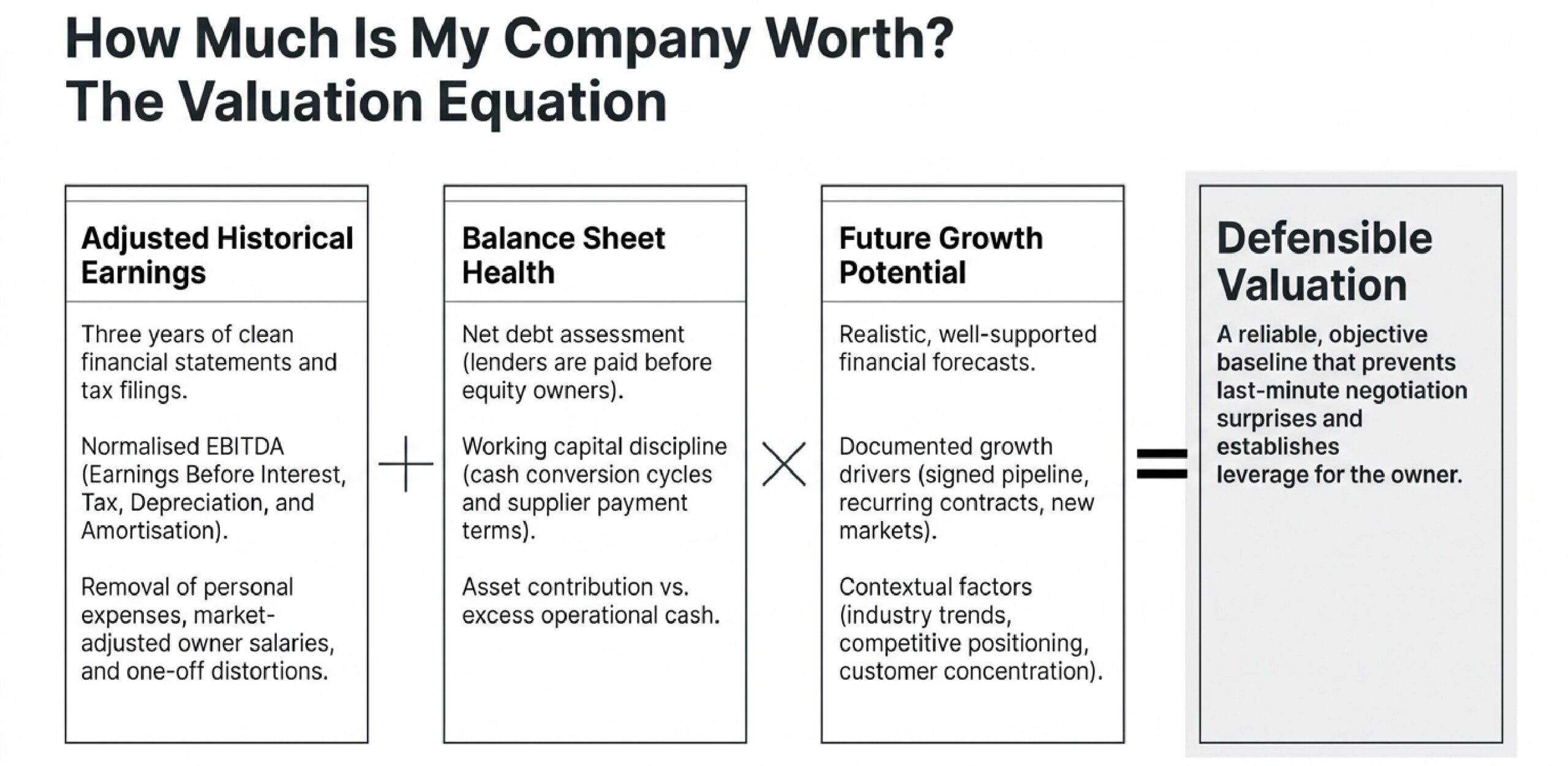
In order to determine how much is my company worth, you will need the correct, organised data. The value of a business is only as accurate as the numbers that are plugged into the machine, so the first step in determining how to value a business is to gather clean numbers. This usually includes financial statements, management accounts, tax returns, and any forecasts or budgets your company has created for at least three years. These documents should all be consistent with one another, and the absence or lack of consistency raises doubts on the eventual number that is reached by the buyer, the investor, or the valuer.
In addition to the numbers of course, you must have context; your industry, your competitive position, your customer concentration, and any legal or contractual obligations that may impact the future numbers. A business worth calculation is never only a recap of numbers from the past, it is an evaluation of the sustainability and transferability of numbers. Owners who are able to have this information ready and prepared instead of scrambling last minute when a buyer or investor requests it generally have the upper hand in negotiations and no “surprises” when it comes to the valuation. Having a simple company profile, summarising your history, who owns your company, who are your key employees and what IP you may have, can help with the assumptions made during the process later.
Revenue and Profit
Almost all valuation exercises begin with revenue and profit. Top-line revenue reflects the size of the business, whereas profit, more specifically, recurring normalised profit, reflects how well the business is doing in turning top-line revenue into value. Most approaches to determining the value of my company start with an adjusted earnings number, typically EBITDA (earnings before interest, tax, depreciation and amortisation), which removes financing and accounting choices unique to each company.
It’s worth pointing out that reported profit is not the profit as is. Owners sometimes pay themselves more or less than market rate, pay personal expenses from the company, or have one-off items that have an impact on a certain year. These shifts are normalised to get a clearer view of sustainable earnings, which is essentially what a buyer or investor pays for. This is an important step in the calculation of any credible business worth, and one of the initial steps an Accountant or Valuer will take before applying any multiple or discount rate to your figures.
Assets, Debt and Cash
A company’s balance sheet tells another story but it’s also a very important one. In asset intensive business lines like manufacturing or logistics, assets (property, equipment, inventory, intellectual property) add value. Debt, on the other hand, serves to decrease the worth that can be credited to shareholders, because creditors are paid off before owners in nearly every scenario. If you are looking at valuing your company from an equity point of view, rather than an enterprise point of view, understanding net debt is crucial.
Another aspect of cash and working capital is more important than owners realize. A business that has a strong earnings power but low cash conversion – slow paying customers, high inventory, cash flow constraints in the lean seasons – may be less worth than its earnings power indicates. A company with unused cash on its balance sheet, on the other hand, may have a higher value than it’s worth because the extra cash is a bonus to the operating value. Working capital discipline can make or break a valuation result almost as much as the profits line in SME’s that are faced with balancing the payment terms of their suppliers with credit terms for their customers.
Growth and Future Earnings
While valuation is very dependent on past data, it is fundamentally forward-looking. Two companies with the same history can be valued quite differently, one if it has a viable growth path, the other if it does not. That’s why it is important to consider pipeline, contracts, market trends and expansion plans, not only last year’s accounts to understand the value of a business.
Growth goals must be realistic and substantiated. Any estimates that are too high and unbacked by data are likely to be seriously discounted by anyone looking at your business, while cautious, well-informed estimates can help create more confidence and help justify a higher multiple of the value. New product introductions, new markets and repeat contracts make a difference to the final number and when you need it, it’s easy to document the number of pipelines or renewals that have been signed.
Which Valuation Method Should You Use?
Valuing my company isn’t a one-size-fits-all process since different methods work for different companies, industries and sizes. The three most popular methods in Singapore are market multiples, discounted cash flow (DCF), and asset-based valuation. They all have pros and cons and professional valuers tend to use two or more methods to determine a defensible valuation range rather than a single valuation figure.
The selection of the method will depend on the type of industry, growth stage, and the purpose of the valuation. A tech startup that has little to no property or equipment will get judged much differently than a manufacturing business with lots of machines and property. Even if it’s just at a basic level, knowing these techniques means you can be more productive with your accountant, your valuer or potential buyer during any business worth calculation and helps you not be caught by surprise at any point during negotiations by the unknown terminology.
Table 1: Valuation Method – How Much Is My Company Worth?
| Method | Best Suited For | Key Driver |
|---|---|---|
| Market Multiples | Established SMEs with comparable peers | Industry multiples on earnings or revenue |
| Discounted Cash Flow | Businesses with predictable future cash flows | Projected cash flows and discount rate |
| Asset-Based Valuation | Asset-heavy or distressed businesses | Net asset value on the balance sheet |
Market Multiples
The market multiples approach values your business by looking at other businesses that have recently been sold or are listed on the stock exchange. Multiple – typically based on earnings before interest, taxes, depreciation, and amortization (EBITDA), revenue, or net profit, is applied to your company’s own numbers to estimate value. Much like the actual trading method, this is a method that is popular because it is relatively quick and based on real market transactions, hence it is a practical approach to determine the worth of my organization without developing complicated financial models.
The biggest challenge is finding companies that are truly comparable, especially for niche or highly specialised SMEs in Singapore. The multiples are also very different depending on industry, size and growth profile, and therefore should not be used in isolation. The multiple is not an industry average, and two companies in the same industry may not have the same multiple applied to their earnings because a good adviser will take into account your company’s specific risk factors and growth trajectory.
Discounted Cash Flow
Discounted cash flow valuation: Values using projections of cash flows and discounts them back to the present at a rate that reflects risk. This approach is seen as more rigorous because it directly incorporates the time value of money and the risk profile of your business as opposed to what the market has valued other businesses.
If you have a business that has consistent and recurring income, like a subscription-based or a long-term contract, then DCF can be especially helpful. It is, however, highly sensitive to assumptions, however; the growth rate and discount rate need to be changed only slightly to result in a large change in output. For those business owners who are considering this approach to business valuation, it is also worth stress-testing scenarios to determine the value of the business at various levels of future growth, as a valuer/investor will almost always ask the question of what the business is worth if growth occurs at a lower level?
Asset-Based Valuation
The value of an asset is determined by its assets minus its liabilities, which is known as the net asset value. In the context of asset-intensive business, a holding company, or situations where the business is in the process of being wound up instead of sold as a going concern, this approach is most appropriate. It is frequently undervaluing businesses that have a high earnings power, but low physical assets, like service or technology companies.
Although it is somewhat limited, asset-based valuation does give a minimum value to a business, which is the most a business should be worth, if based solely on its balance sheet. Many valuers apply it as a sanity check in conjunction with other valuation approaches such as multiples or a DCF analysis, and to make sure that the business value calculation doesn’t work out lower than the value of the assets themselves. For owners who are considering offers, this is an effective cross-check that will show them if they are getting a fair value for the business as a going concern.
Why Two Companies With Similar Revenue Can Have Different Values
Owners often compare their business to a competitor that generates a similar amount of income and assume that the valuations will be similar. In practice, it is not like this at all and knowing why is key to understanding the worth of my company compared to other companies in my industry. When it comes to business, revenue is nearly an irrelevant measure – it’s neither a good indicator of profit nor risk nor the sustainability of that profit over time.
The actual differences are found below the line: the percentage of that revenue which translates into profit, the level of concentration of customers and the space available for business expansion. They influence the multiple or discount rate used for any serious business worth calculation, and is why two businesses of similar size can be sold at very different prices, sometimes two or more times the price for one company for another of similar size after adjusting for risk.
Profit Margins
This is because a company with a 20 per cent margin can generate more cash flow from its sales than a company with a 5% margin, and that is the key to the company’s value. When I’m trying to value my company against its peers, margins tell me whether I’m being efficient, have pricing leverage and am being cost disciplined.
Margins indicate resilience as well. Increased perceived risk because a business with thin margins can’t handle any increase in costs, wages or downturns in the economy. Higher-margin businesses, on the other hand, are likely to have higher multiples – in part because they can take a hit from the shock without it jeopardizing their profitability, and that makes them a safer purchase and investment than a lower-margin company, and a more comfortable answer to the question, “How much is my company worth compared to a lower-margin company?”
Customer and Market Risk
There are two companies with the same revenues, but different risk distributions. Business that has and depends on one or two big customers for most of their revenue is far more volatile than a business that has a diverse customer base, as losing a large customer could have a significant effect on business overnight.
The same applies to market risk. One business within a narrow niche is more susceptible to downfalls in that niche than one that serves several markets or industries. Customer concentration and market diversification are nearly always taken into account when assessing business value by professionals, with either a discount rate or multiple applied directly impacting the value. One of the more effective ways owners can enhance the valuation return over time is to diversify proactively, ahead of a sale or a fundraising process.
Growth Potential
The value of growth is often the biggest distinguishing factor between two companies of the same size. One business with potential to grow, whether by launching new products, expanding to new markets or new customer segments, is likely to be valued higher than another that is mature and not seeing growth, even if their revenue is the same.
That is the reason when you value your company is as important as the numbers themselves. If a business is valued during a peak period when it has proven ability to continue growing and increasing in value, it will be valued more than the same business valued at a time when there was no evidence of future growth or value. A favorable trading time is the key to making a positive difference.
When Should You Get a Professional Valuation?
While in most cases a complete formal valuation is not necessary, some times it is crucial to ensure that a proper and defensible valuation is obtained. Knowing how much to value your company can help you avoid situations where you may be taken aback during a negotiation, fundraising round, or conflict when you are not taken seriously because you provide an outdated or inflated valuation. An appointment with a professional valuation ensures objectivity and methodology which internal estimates lack.
The other aspect is the use of a professional valuer or corporate advisor, as the “right” method and assumptions will depend on context, as described above. The valuation used in an internal planning exercise may not withstand the demands of a bank, investor or court, so be prepared to do the same and be ready to spend time and money on the task as the value of the exercise demands.
Selling or Buying
When you are considering sell your business, or you have decided to buy a business, it is nearly impossible to negotiate without the help of a professional valuation. When sellers approach negotiating without a solid, independent number, they either inflate the price of their business or risk losing credibility (because they don’t have an independent, credible number to back their asking price). Buyers, on the other hand, must be confident that they are not paying more than they should, because of an inflated seller assumption.
A professional valuation also makes them a better negotiator, as it is based on recognised methodology and not emotional attachment to the business. This is usually the most clear and high-stakes case where the owner truly wants to know the value of his or her company because cash and contracts are at stake, and any mismatch of expectations and realities will typically reveal themselves in a hurry when the due diligence process starts.
Fundraising
Valuation is a direct link to how much of your company you are giving away when you seek investment funding like equity or Venture funding. Although investors will perform their own analysis, it is important to come to the table with a well-supported valuation that is based on a solid understanding of how to value a business.
In addition, valuations for funds tend to be based on a greater valuation of growth potential and market opportunity than on just historical earnings, especially for early stage or growth companies. The fact that this is so makes it all the more important to make sure that the growth story is well documented, because the investors are not investing in the business, they’re investing in where the business is going, not where it has been.
Shareholder Transactions
Valuations are also often needed for various internal shareholder issues: when a partner is selling out another, when implementing an employee share scheme, for an estate or succession plan or in a dispute between co-owners. These scenarios can be emotional as well as financial and value an independent and professionally prepared business that can help to ensure negotiations are kept fair and thoroughly based on facts.
In many such situations, there will be an agreement between shareholders or a company constitution that will prescribe how the valuation will be carried out, often with the involvement of an independent valuer to prevent conflict of interest. This is essential to safeguard financial results, but also to keep the relationships intact – and so on whatever amount of money is agreed it should be able to withstand the difficulties of the future as well as the present.
The value of a company depends on factors such as revenue, normalised profit, assets, debt, cash flow, growth potential and business risk. Common valuation approaches include market multiples, discounted cash flow and asset-based valuation.
Company value can be estimated using market multiples, discounted cash flow or asset-based valuation. The appropriate method depends on the company's industry, financial performance, growth prospects and valuation purpose.
A company valuation typically requires financial statements, management accounts, tax records, forecasts, revenue, profit, assets, debt, cash, customer information and details about future growth.
Companies with similar revenue can have different values because of differences in profit margins, customer concentration, market risk, cash flow, growth potential and future earnings.
A professional valuation can be useful when selling or buying a business, raising investment, transferring shares, resolving shareholder matters, planning succession or supporting other significant financial decisions.