
How Does IFRS 3 Affect M&A Transactions?
For the finance and accounting team, signing is just the beginning of a new segment of work. One of the first things a new analyst or incoming controller should know about IFRS 3 is that it influences the reporting of an acquisition for years after the ink has dried. One of the more influential of the technical standards a finance professional will face is IFRS 3 business combinations, which decides what constitutes an acquired asset, how to determine the amount of goodwill, and the impact of the transaction on reported earnings. Overall, this article covers the impact of IFRS 3 on deal structuring and diligence, what IFRS 3 purchase price allocation really means, the reality of purchase price allocation in a typical M&A transaction and the lessons learned by experienced practitioners about how to implement the IFRS 3 standard in real transactions.
How Does IFRS 3 Affect M&A Transactions Before a Deal Even Closes?
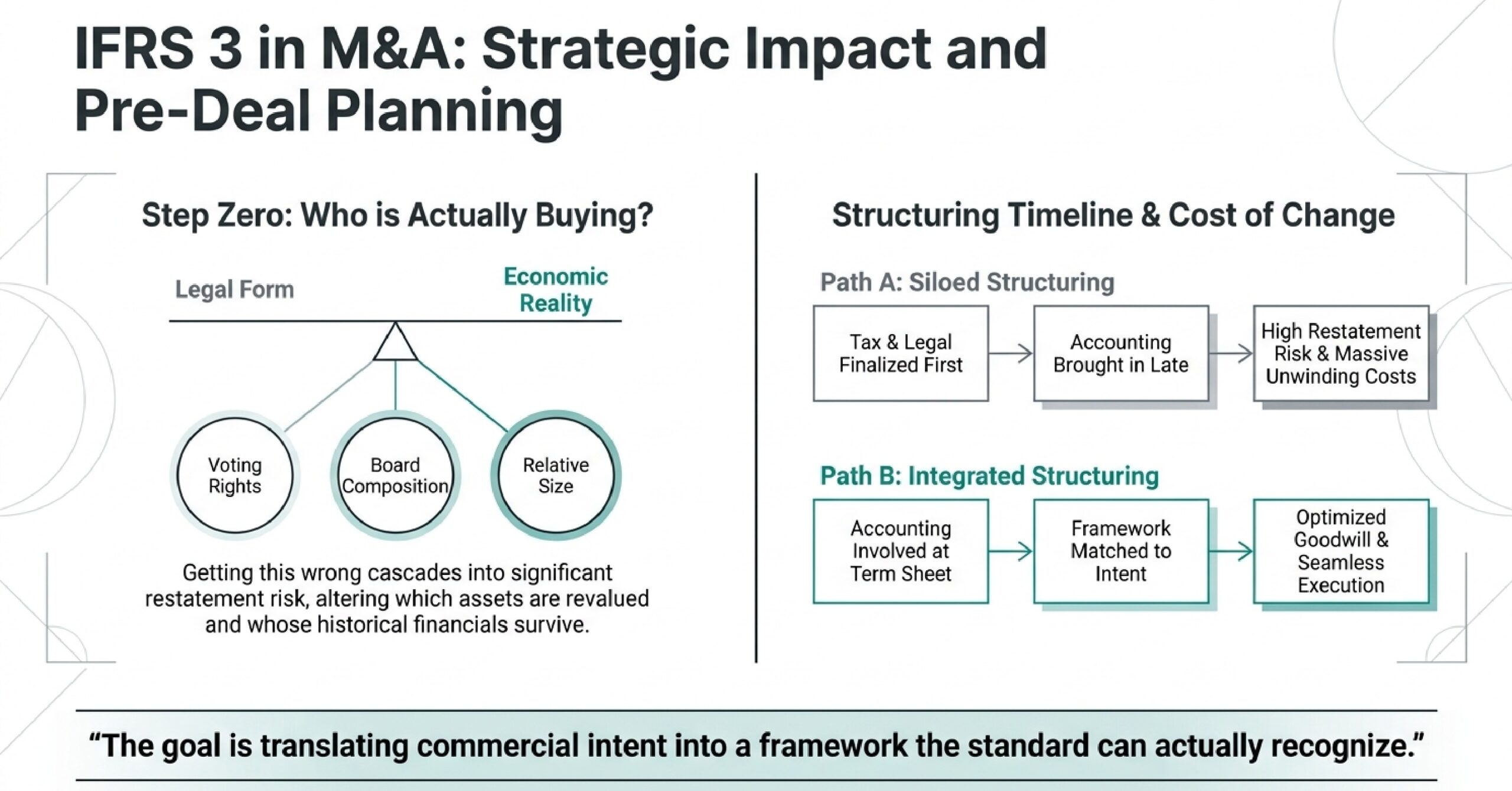
How Does IFRS 3 Affect M&A Transactions is already impacting the negotiating table at a time when, before closing, no transaction has actually taken place. The identification of the acquirer in a business combination as required by IFRS 3 can seem simple, but is actually complex in a merger of equals and/or in transactions involving complex share exchange structures where the accounting acquirer may be difficult to identify, depending on the voting rights, board composition and relative size of the parties. If the initial classification is incorrect, it can trigger major restatement risk later, as the accounting treatment that follows and which company’s assets are revalued and which company’s historical financials are continued depend on this initial classification. It is one of the more obvious examples of the depth into which How Does IFRS 3 Affect M&A Transactions delves into matters that at first sight appear only commercial or legal and not accounting related. These determinations are frequently described by deal lawyers who work closely with accounting advisors on these determinations as more of a process of translating commercial intent into a structure the standard will recognize, as opposed to a mechanical checklist exercise.
The structure of the deal is also affected by the way the deal will be interpreted in IFRS 3 at closing. An asset purchase as opposed to a share purchase and vice versa, for instance, can have very different accounting implications under IFRS 3 and in this respect tax advisors, lawyers and accountants are beginning to need to address deal structuring and financial reporting together from the outset rather than in isolation, sequentially. A cross-border technology acquisition is a good example of this: the deal team initially designed the transaction with tax efficiency in mind, only to find that it would result in a less favorable goodwill accounting treatment under IFRS 3 than an alternate treatment would have, and then have to renegotiate the deal to account for this late change – a negotiation that could not have been avoided by including earlier accounting input. Deal teams have become more sophisticated in bringing in their accounting advisors to the structuring process, not just at the point of signing the term sheet. The price of having an accounting advisor involved a few weeks sooner is nearly always negligible in comparison with the price of unwinding a framework once commercial terms have been agreed upon and shared with both parties.
What Are IFRS 3 Business Combinations and Why Do They Matter?
Technically, IFRS 3 business combinations are transactions in which an acquirer obtains control of one or more businesses and the business combinations are accounted for using the acquisition method, which requires the identification of the acquirer, the determination of the acquisition date, the recognition and measurement of identifiable assets acquired and liabilities assumed in the transaction and the recognition of goodwill and gain from a bargain purchase. In this context, one of the main judgments will be whether the entity being acquired (a business combination) is a collection of significant assets and activities that, coupled with inputs and substantive processes, enables economic benefits to be delivered by the acquirer other than those provided by an individual asset or asset group. A company may use the guidance of IFRS 3 business combinations to perform a screening test to determine whether the business combination is treated as an asset acquisition. This screening test would be useful but in borderline cases, it does require real professional judgment and that is why it is often useful to have experienced practitioners advice even when the company maintains an in-house accounting team that can perform the mechanics of the analysis themselves.
The distinction is important because IFRS 3 business combinations involve remeasurement of the acquired assets and liabilities to fair value and the recognition of goodwill, whereas a simple asset acquisition does not result in subsequent remeasurement to fair value of the acquired assets and liabilities, or the recognition of goodwill, so the same purchase price may generate vastly different financial statements results depending on the nature of the acquisition. Determining the transaction to be a business combination (as per IFRS 3) versus an asset acquisition (which will be easier to record) can materially affect the reported numbers, for example, if a real estate company acquires a portfolio of properties with an existing operating team and operating processes. Those who have an understanding of the distinction from the beginning of their analyst career have a greater chance of catching classification errors that more junior analysts who just want to be able to get the ‘model up and running’ may have missed. One of the easiest ways for a junior professional to gain a sense of comfort with this judgment call, not just a box-ticking exercise, is one of the best ways they can show a genuine sense of technical depth to a senior professional in their first few deals. It also makes the work more interesting, because every time you need to do it, you have to think of a different set of facts and maybe a different answer; it’s not a formula, it’s something new you have to think about each time.
Table 1: IFRS 3 Business Combinations vs Simple Asset Acquisitions
| Feature | Business Combination | Asset Acquisition |
|---|---|---|
| Accounting method | Acquisition method under IFRS 3 | Cost allocation based on relative fair values |
| Goodwill recognized | Yes, if consideration exceeds net assets | No, goodwill is not recognized |
| Fair value remeasurement | Required for identifiable assets and liabilities | Limited to allocation of purchase price |
| Transaction costs | Expensed as incurred | Often capitalized into asset cost |
| Deferred tax implications | Recognized on fair value adjustments | Generally more limited |
How Does IFRS 3 Purchase Price Allocation Actually Work?
Once the transaction is accounted for as a business combination, the focus of the accounting becomes the purchase price allocation process in IFRS 3, which involves the acquirer measuring the fair value of all acquired assets and assumed liabilities, and adjusting for the consideration transferred to arrive at goodwill. This is where a lot of the actual technical accounting work occurs in post-deal accounting, and it’s the process where a new analyst gets his first real-life experience in intangible asset valuations. Below are the key actions that most finance teams take in this process. The first step is to calculate the total consideration transferred, and this can include cash, equity issued, contingent consideration and the fair value of any pre-existing relationship settled as part of the transaction. Second, measure all acquired tangible assets, for example property, equipment and stocks, at their fair value at the date of acquisition. Third, recognize and assign separate values to intangible assets like customer relationships, trademarks, and technology, as these are often the biggest and most subjective part of the allocation. Fourth, determine the contingent liabilities of the target that were recorded on the target’s balance sheet that satisfy the recognition criteria of the standard and should be included on the acquirer’s balance sheet, even if the contingent liability was not recorded by the target in its balance sheet. Fifth, determine goodwill as the excess of the cost of a business acquired over the fair value of its net identifiable assets, or record a bargain purchase gain if the consideration received is less than the fair value of the net identifiable assets acquired. The process of going through these steps in sequence (as opposed to just working up to a goodwill figure and then working backward) can result in a much more defensible and internally consistent allocation.
A good case in point is a medium-sized industrial equipment company that bought a smaller company to grow its regional distribution channels. In the course of that transaction, the IFRS 3 purchase price allocation process resulted in a significant customer relationship as part of the long-term distribution agreements, a trademark linked to a well-known regional brand and a small goodwill amount for synergies the acquirer could expect from combined purchasing power and shared logistics. There was also a significant amount of time spent in finalizing the allocation, in part, because the target’s customer contracts had to be reviewed on a case-by-case basis to establish if there was a genuine contract in place, as opposed to an unwritten commitment, which would have a material impact on the allocation of value to the customer relationship intangible versus the allocation to goodwill. This is one of the least exciting aspects of an IFRS 3 purchase price allocation engagement, but often one of the most defensible and audit-ready recommendations is actually generated by this type of granular review. If teams try to move on to a more rapid and general estimate, they tend to end up going back and repeating the process when the auditor follows up with a question about the details of a headline figure.
What Challenges Arise With Purchase Price Allocation in M&A?
One of the most enduring issues around purchase price allocation in M&A has been the measurement period – which in IFRS 3 can be as long as 12 months after the acquisition date as new facts and circumstances on the acquisition date are discovered. While the flexibility is useful for complex transactions where information isn’t completely available upfront, it also adds pressure to finance teams to catch investors and auditors up on the final numbers in advance of the measurement period closing. One frequent difficulty is that during a deal negotiation, the management projections included in the deal price may be more optimistic than the detailed intangible asset valuation that occurs during the deal allocation process, making the negotiated price feel more like it is “too good to be true” compared to the recommendations of the accounting analysis. This space can be crossed effectively with the help of finance teams that make that communication transparent and early; and not at the last minute and quietly adjust assumptions, only to hope that no one catches the change in the allocation. Many controllers report that if you engage in the conversation ahead of time, before a board or investment committee receives the final figures, you can avoid having to deal with the technical accounting adjustment mistake which may be interpreted as an indicator that the transaction itself was a bad one.
The advantage of a strict purchase price allocation in an M&A transaction is a set of financial statements that is truly representative of the economics of the transaction, providing investors, lenders and management with a sense of where the purchase price truly went and what amortization and impairment risk is likely to look like in the future. The problem is the rigor requires time, a certain expertise in valuating assets, and close cooperation between the finance, tax and legal departments – elements not necessarily present in smaller transactions or when several acquisitions are being rolled up at once. One of the most valuable lessons many practitioners have learned is that involving valuation professionals early in the proceedings, not just afterwards, helps to minimize the risk of hurried or rushed, or poor valuation, resulting in allocation that will be subject to questions from auditors or regulators. A more effective process improvement that a finance function can make is to incorporate this earlier engagement in the standard deal playbook, instead of making it an optional additional step in the transaciton process.
What Lessons Explain How Does IFRS 3 Affect M&A Transactions in Practice?
In many completed transactions, the lessons from the process tend to be repeated so frequently they can be considered the real-life guidance to anyone considering How Does IFRS 3 Affect M&A Transactions. Early engagement with the accounting and valuation team in the deal structuring process is critical in that decisions taken for tax or legal reasons may have unforeseen accounting implications that are difficult to fix at the end of the day. Second, schedule the allocation of the purchase price as an integral component of the overall deal, not as a “post-signing” activity which can be completed in a single day. Third, note all important assumptions explicitly as the allocation is developed, as this information is crucial when the allocation needs to be adjusted during the measurement period or if it is challenged by an auditor or regulator in the future. Fourth, don’t overlook the fact that purchase price allocation in M&A is a process, not a one-time calculation that can be done at the beginning and then set aside for the other people. New things do come up during the measurement period on most non-trivial M&A transactions and it is an iterative process. Fifth, allow someone who did not make all of the assumptions to review the final allocation before it is accepted, because a reviewer who wasn’t involved in all of the assumptions in the middle of the process is more likely to see an inconsistency that the previous team has become so immersed in the numbers that it missed.
Perhaps the most important takeaway, however, is that IFRS 3 business combinations accounting is best performed as a true cross-functional effort, not the one-and-a-half man effort of a single overworked analyst running at the deadline. Whether it’s the legal team understanding how deal terms will impact consideration measurement, tax teams understanding how the allocation will impact deferred tax balances, or operational leaders understanding how the resulting amortization expense will impact reported earnings in the years after the deal, there are several teams involved who need to be informed. Those who would develop fluency in these interrelated fields, rather than just think of purchase price allocation as a technical accounting exercise, tend to be the professionals that their organizations come to for help when a complicated or unusual transaction arises. This general know-how, rather than any individual certification, is typically what set[s] apart an analyst who is drawn into any and all major transaction to one who only sees the deals that come his or her way. This fluency can be deliberately acquired rather than developed passively over 10 years of daily homework drills, and can be gained by a motivated junior professional in a few years.
Conclusion: Key Takeaways on How Does IFRS 3 Affect M&A Transactions
How Does IFRS 3 Affect M&A Transactions is very real and relevant to deal structuring, financial reporting, and years of postacquisition analysis – it’s not just a topic for the specialists. The next action step for professionals developing a career in accounting, valuation or corporate finance is to read a real IFRS 3 purchase price allocation disclosure from a public company filing, and follow along as the identified intangible assets are tracked down to the amortization expense that will be reported, and then practice explaining the goodwill figure in simple terms that a non-accountant could understand. Applying IFRS 3 business combinations rules to various deal structures, along with becoming accustomed to the judgment calls involved in purchase price allocation in M&A, will acquire more expertise necessary for a career in a shorter time than will studying the standard text alone. If viewed in this light, IFRS 3 is a useful tool to consider when trying to understand what a deal actually achieved – not a daunting compliance document that has to be completed just as fast. Read through the footnote that reports the purchase price of one of the recent, well-documented acquisitions you’ve been working on, and, as you read it out, explain aloud why each of the big numbers is where it is; this is more judgment than you will get anywhere else, like from any single course or certification.
IFRS 3 is the accounting standard for business combinations. It guides how an acquiring company recognises and measures acquired assets, liabilities, goodwill, and identifiable intangible assets in an M&A transaction.
IFRS 3 requires the purchase price to be allocated to identifiable assets and liabilities based on their acquisition-date fair values. Any remaining amount is generally recognised as goodwill.
Goodwill arises when the consideration transferred, plus other applicable amounts, exceeds the fair value of identifiable net assets acquired. It is subsequently subject to impairment testing rather than routine amortisation.
Valuation helps determine the fair value of acquired assets, liabilities, and intangible assets. Accurate valuation supports appropriate purchase price allocation and reliable financial reporting.
Depending on the transaction, identifiable intangible assets may include customer relationships, brands, patents, trademarks, technology, software, and contractual rights.