
How Can Business Valuation Reduce Financial Risks?
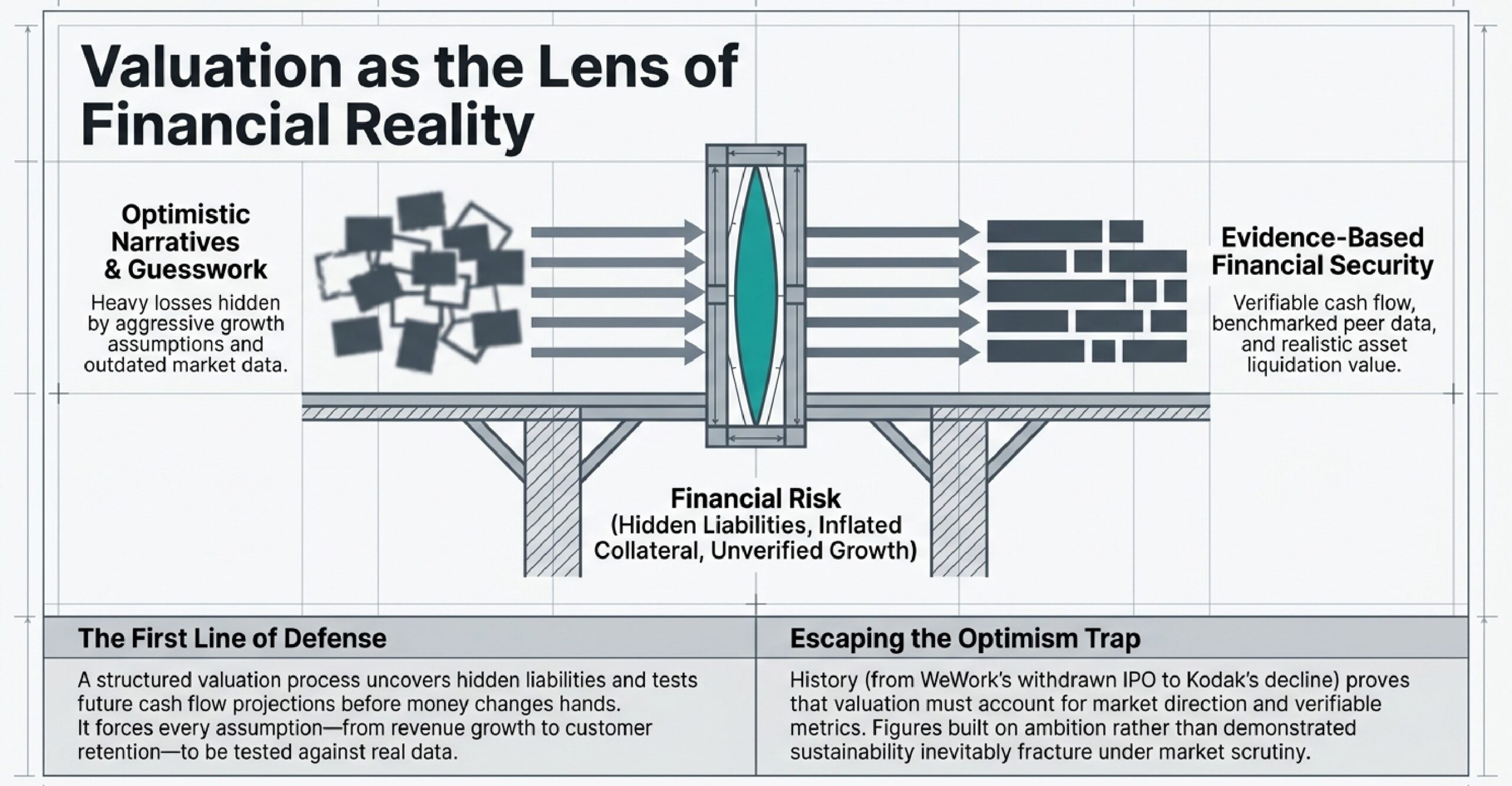
While all business decisions have financial implications, it becomes much easier to manage when the company knows the value. Business Valuation Mitigates Financial Risks: Provide owners, investors, and lenders with a clear, evidence-based picture of what an asset, division or entire company is truly worth, not a number derived from guesswork or out-of-date assumptions. The structured valuation procedure identifies the hidden liabilities, validates future cash flow forecasts, and compares performance with industry counterparts, making sure that financing, mergers, and/or expansion decisions are not based on optimism but on reality. Early and mid-career professionals are better able to grasp the link between valuation and the minimisation of financial risk, not only in the finance department, but also in the decision to hire, plan for insurance, and make everyday budgeting decisions. It details the process step-by-step, provides actual examples from familiar brands and explains risk management strategies that make this a real, continuous protection against financial losses. The emphasis is consistently practical – how Business Valuation Risk Management works in the real world, and how Accurate Business Valuation can be used by other professional advisors who aren’t yet senior specialists.
What Is Business Valuation and How Does It Support Business Valuation Risk Management?
The structured process of determining the economic value of a company, business unit or specific asset is known as Business Valuation.The incomee approach involves estimating future cash flows, discounting them to present value; the market approach requires comparison with similar businesses that have recently been sold or merged; the asset-based approach simply adds up the fair value of assets and subtracts the liabilities. Each approach is used for a different purpose in various industries, and based on the stage in the life of the company and the purpose of the valuation. For instance, a young technology company that has few assets, tangible or intangible, is typically valued according to projected cash flow, whereas a manufacturing plant is likely to be valued mostly on its tangible assets, equipment, and property. Good valuers seldom use one method alone, but combine two or three methods to cross-check the value and compare the results and figures obtained; otherwise, a single formula used without cross-checking will inevitably produce a skewed figure which clouds decision makers. Two of the most obvious ways to see how Business Valuation reduces financial risks in practice are this blended approach because a single calculation cannot be the ultimate judge of value. Combine,d this mix of methods, checks and professional judgment is the heart of Business Valuation Risk Management. It also provides an explanation as to why two analysts looking at the same company can come up with completely different numbers – it generally isn’t the math, but rather the assumptions. Closing the gap between the two is one of the first real-world lessons a junior analyst learns on the job.
The relationship between valuation and risk is evident as soon as a company must sell equity or seek a loan or raise capital. A loaner who takes a higher valuation as collateral will be at risk of losing his or her money if the borrower defaults and the property is sold off for less than the lender’s valuation. In a similar way, if the valuation of a target company is not verified or it is over-optimistic, there will be a risk that the buyer will have to wait many years for the money to be returned by the company’s earnings (this will also have a negative impact on the overall returns and the buyer may have to write down later), and as a result the buyer will lose money. Because this is one of the most obvious and clearly stated objectives of any corporate finance risk management strategy. This is why Accurate Business Valuation is not a formality, but rather a first step to ensure every assumption is tested with real data before business dollars are exchanged, allowing every assumption made in a deal — from revenue growth rates to customer retention — to be explored. One of the most useful habits for developing a foundation in Business Valuation Risk Management is for the junior analyst to learn to ask “what assumption is this number based on?” Most errors in valuations stem from a lack of questioning of the assumptions underlying the number. This habit over time becomes second nature, and it is one of the most obvious, transferable ways that cutting financial risk manifests itself in a day-to-day role in finance, not just on a large scale in the headlines.
How Does Accurate Business Valuation Reduce Financial Risk in Real Business Situations?
Through real-life examples, it is evident that an improper valuation or appraisal originating from hasty or incomplete assessments can have dire consequences. Early private estimates of WeWork’s value at its initial public offering in 2019 were around 47 billion US dollars, with the value being primarily built upon the company’s ambitious growth projections rather than actual, sustainable profit generation. With a closer look at the accounts, public market analysts and potential investors saw the recurring losses, aggressive lease agreements and governance issues ,and the estimated value plummeted by over 50% in weeks. The IPO was cancelled and the company entered into a major liquidity crisis, which in the end changed the company’s leadership, ownershi,p and long-term trajectory. It is a classic case of an episode where growth expectations were substituted with disciplined financial analysis and is one of the reasons why minimizing financial risk requires financial valuation based on actual cash flow and market comparisons instead of optimistic stories that are sold to investors. After-the-fact analysts noted that the warning sign risks were apparent even before the withdrawn IPO, “the kind of detail” that disciplined Business Valuation Risk Management is supposed to bring to the fore early in the game.
The lesson for smaller companies is just the same, but not as noticeable. Imagine a medium-sized manufacturing company that wants a loan from the bank, using its inventory and equipment as security. The bank could give out more credit than it can be repaid with the equipment if it has been overestimated in the company’s internal valuation, due to the lack of taking into account, among others, the depreciation, wear, and technological obsolescence of the equipment. A later, independent appraiser review may result in the borrower receiving a sudden deficiency, a forced sale of assets at a discount, or new loan terms with a lower interest rate, if the borrower does not have enough funds to cover the costs of the appraisal. Whether it’s a big headline grabber or a more discreet small business scenario, the financial risks can be reduced if the business valuation process is independent, methodical, and is continually updated as opposed to a one-off that is performed just before the transaction closes. Whether in either scenario, the key message remains the same: An Accurate Business Valuation is not just a number on a report but a working tool that should be reviewed whenever the underlying business or market conditions evolve.
What Are the Core Risk Management Strategies Built Around Business Valuation?
There are a handful of Risk Management Strategies that explicitly depend on valuation information to shield a company from monetary surprises, and most are sensible enough that any finance staff can employ. Finance teams, controllers, and outsiders use the five practices outlined below to ensure that the valuation remains in step with the real value of the business over the years, not just between large transactions. All of these steps are not particularly difficult to implement individually but when compounded, they form a reliable framework that can be utilized by a small finance team with a small-sized (in number) team:
- Periodic revaluation cycles – Revalue important assets and the business as a whole on a regular basis, e.g., annually or after significant events such as a new product offering or a downturn in the market, to ensure that figures do not move far out of line with market reality.
- Independent third party review – Have an external valuer review the internal valuations to ensure that no bias or calculation or assumption errors occur in valuing and consequently influencing financing or deal decisions.
- Scenario and sensitivity testing – These tests are used to show the impact of the valuation based on best, base and worst case scenarios regarding economic conditions, interest rate levels or customer demand.
- Documentation and audit trails – Maintain clear, organized records of methods, data sources and assumptions used, which aids Accurate Business Valuation during audits, disputes and due diligence.
- Integration with insurance and compliance planning – Match insurance coverage with regulatory reporting and compliance – ensure the right number of units are covered, insured and compliant with regulatory reporting requirements.
These five steps make up a viable, repeatable business valuation risk management framework which can be followed by any finance professional in any company no matter the size or the industry. None of them need to be a specialised tool or advanced modeling software — most can be incorporated into an existing quarterly or annual review calendar. The bigger point is that you’re not aiming to be perfect for one number, but consistent and transparent about that number being produced, challenged, and updated throughout the organization, so that minimizing financial risk is part of your day-to-day routine, not a response to a crisis that just happened. A junior professional with some knowledge of these five practices has a better understanding of Business Valuation Risk Management than many of their colleagues who are only exposed to Business Valuation once a year at a formal review.
What Benefits and Challenges Come With Business Valuation Risk Management?
Valuation’s value is more than just preventing bad things from happening. A business with a history of accurate business valuation usually secures better loan terms because the potential lenders believe that the information they receive about the business’s worth is accurate, and as such they make a lower risk premium. Investors also gravitate towards companies that can back their numbers with transparency and a clear, documented methodology, a practice that will cut down on due diligence time in funding rounds or in mergers and acquisitions, and can make a difference in negotiating leverage. Valuation reports are a real career benefit for juniors, as they demonstrate the ability to read the financial statements critically, and to ask relevant questions about their numbers, rather than taking them at face value. It’s a simple and practical example of the way business valuation reduces financial risks is helpful – long before a big transaction is ever in the cards. The table below outlines the contribution that various valuation methods can make to alleviate financial risk in a variety of typical situations that practitioners would face early in the course of their careers, whether in banking, corporate financ,e or in a more general accounting setting.
Table 1: Business Valuation Methods and Their Role in Reducing Financial Risk – How Can Business Valuation Reduce Financial Risks?
| Valuation Method | Best Used For | Risk Reduction Benefit |
|---|---|---|
| Income Approach (DCF) | Companies with predictable, recurring cash flow | Tests whether future earnings genuinely justify the current price |
| Market Approach | Businesses with comparable public or recently sold peers | Anchors value to real, observable transaction data |
| Asset-Based Approach | Asset-heavy, early-stage, or distressed businesses | Confirms realistic collateral and liquidation value |
But there are legitimate obstacles to this, and one would do well to have realistic expectations. It can be costly and time consuming to value, not least because external experts are often needed but also because of the need for detailed market research and the need to review financial records, which may not have been well kept and thus require a forensic examination. Another common problem is data quality: as long as the methodology is technically correct, but the data used is outdated (e.g. inventory data) or not properly attributed to specific business units or business lines (e.g., patents, brand value, etc.). There is also a human element to be directly named: an internal team might give themselves an inflated valuation, either because they want to deal with the preferred team or because they want to reach a funding target, or because the performance bonus is based on the value of the company, which is the reason why an independent evaluation is one of the most effective of the Risk Management Strategies available. It’s a great benefit for a company to know from the outset how long, how expensive, and how much internal resources it will require to value a company instead of it being a quick formality towards the end of a transaction. The professionals who know what to expect make more realistic project timelines and set clear expectations with stakeholders, and that’s just one way to lower financial risk before a single number is even finalized.
What Lessons Do Real Valuation Processes Teach About Reducing Financial Risk?
Eastman Kodak’s long, slow demise is a more extended study on the connection between valuation and risk. For years, the company’s financials focused on the importance of its film patents, brand recognitio,n and manufacturing ability, and consistently underestimated the rate at which digital photography would diminish the value of that fundamental business. When the leadership changed its own estimates of the film business’s dwindling size and the constantly evolving competition, it was too late – the competitors had already cornered the digital photography market – and the company went under in bankruptcy protection in 2012. The lesson for professionals is that the value of a company is not a fixed figure based on the company’s assets or on its history of performance only; it must also consider market direction, technological change, and competition that may not yet be evident in current statements. It is a forward-looking subject that’s able to cut down Financial Risk throughout the long-term and not just at the time of a deal being signed. Even if the numbers appear great in the past, a Business Valuation Risk Management approach that does not take into account the future trends of the industry will ultimately be incorrect. The bigger lesson is quite clear: the value of any Accurate Business Valuation will be much more than the value of one company; it will be the value of a value that, like other intangible assets, is constantly changing with the arrival of new customers, new technology, and new competition.
If you are still in the beginning stages of your career, the lesson to learn is that valuation literacy is not a specialty that investment bankers have alone, but a skill you can transfer to other jobs. Knowing how to read a discounted cash flow model, question the assumptions made in a market comparison, or identify an overstated value of an asset makes a person credible in financial, accounting, operations, and general management positions. A candidate who has clearly written out how they have applied Business Valuation Reduce Financial Risks in a previous project, such as a class assignment, a case competition, or a summer internshi,p is more likely to stand out in an interview, as they will exhibit analytical thinking and not theory. This skill can be developed over time, working through real financial statements and publicly available case studies such as those mentioned above, and may prove to be useful for helping financial professionals do their job and manage financial risk long before they reach a senior role or receive a formal valuation credential. As companies in all industries have become more and more focused on the candidates who go beyond giving numbers and are able to tell what those numbers mean to the business, strong Risk Management Strategies would be able to do that.
Table 2: Common Valuation Challenges and Risk Management Strategies to Address Them – How Can Business Valuation Reduce Financial Risks?
| Challenge | Recommended Strategy |
|---|---|
| Outdated financial data | Schedule regular revaluation cycles |
| Overly optimistic growth assumptions | Apply scenario and sensitivity testing |
| Internal bias toward favorable numbers | Bring in independent third-party reviewers |
| Inconsistent documentation | Maintain clear audit trails for every assumption |
| Ignoring technological or market disruption | Review valuation assumptions against industry trend data |
Conclusion : How Can Business Valuation Reduce Financial Risks?
Business valuation is not a one-off event that must be passed before a business goes under; it’s a continuous discipline that helps safeguard a company’s finances from year to year, at each life stage. Business professionals who grasp the implications of accurate business valuation for lending, merger and acquisition transactions, insurance coverage, and corporate strategy are more likely to identify potential dangers before they turn into a crisis. The next step for the reader, whether a student, job seek,er or working professional, is a simple one: get into the habit of regularly reviewing valuation assumptions, asking for independent support of any major assumptions, and writing down the rationale for each number so it can be subjected to outside scrutiny. These are the basic habits of good risk management strategies and they come at a much lower cost in the early stages than they do if they are prevented in later stages of life. These risk management strategies, when used regularly, make business valuation risk management a true competitive safety device, and another proof that Business Valuation reduces financial risks best when it’s not an event to be performed once before a business is sold.
Business valuation provides an objective estimate of a company's worth, helping business owners make informed decisions, identify financial weaknesses, and reduce the risk of overpaying, underpricing, or making poor investment decisions.
Business valuation supports financial planning by providing accurate business value for budgeting, forecasting, fundraising, succession planning, and long-term strategic decision-making.
A company should obtain a business valuation before mergers and acquisitions, fundraising, shareholder changes, financial reporting, succession planning, or whenever significant business changes occur.
Business valuation considers factors such as revenue, profitability, cash flow, assets, liabilities, industry conditions, market trends, competitive position, and future growth potential.
Business owners, investors, lenders, startups, SMEs, corporate executives, and shareholders all benefit from professional business valuation by gaining reliable insights that support better financial and strategic decisions.