
Why Do Failed PPA Valuations Trigger Audit Issues?
Understanding Why Failed PPA Valuations Trigger Audit Issues
Once a business has been acquired, the accounting that has to be done following the deal is as good as the analysis which led to it. These are one of the most frequent audit findings in today’s mergers and acquisitions accounting and are often revealed at the last minute when a company is trying to close the books for the year – when the books are least expected to be checked. Learning the reasons why this type of scrutiny is applicable to IFRS 3 purchase price allocation and where the PPA valuation audit risks tend to focus is a vital piece of knowledge for junior and mid-level accountants, valuers and audit support professionals. In this article, you will discover how these failures happen, how auditors detect them, and what practical steps can be implemented to create allocations that are likely to pass an audit.
What Is IFRS 3 Purchase Price Allocation and Why Does It Attract Audit Scrutiny?
Under IFRS 3 purchase price allocation, an acquirer is obligated to recognise or measure every identifiable asset acquired and liability assumed in a business combination at fair value and the resulting goodwill amount is recognised as a residual amount. Many of the assets being valued, such as customer relationships, technology, and brand intangibles, are seldom traded in an observable market and require estimation through forecasts, discount rates, or comparable transaction data, which requires a lot of professional judgment. Valuing a customer relationship or an internally developed algorithm is unlike valuing a piece of equipment that has a price from the used market or a simple depreciation schedule, because the value estimate must be built around future cash flows that were never previously thought to be subject to this degree of quantification. Since a significant amount of the work in this area is subject to judgment on the part of the auditor, it is often judged to be the highest risk area in the financial statements, and would always be included in a list of areas where the auditor’s professional scepticism needs to be raised when reviewing a company that had an acquisition during the reporting period. There’s one part of the financial statements that experienced audit teams tend to spend more time reviewing than it deserves, based on the size of the item on the balance sheet, and it’s this line—the one that requires most judgment.
This review is in place because the impact of a bad allocation reaches far beyond the year that the deal closed. The misclassifications during an IFRS 3 purchase price allocation have a long-lasting effect on amortisation schedules and impairment testing for years after, which can lead to an under- or overstatement of reported profits for years after the initial classification error is made, without being noticed by investors until an unrelated audit or regulatory review occurs, perhaps decades later, and uncovers the misclassification. Auditors also know that management can sometimes have incentives to reduce the identification of intangible assets and to increase goodwill, because goodwill isn’t amortised and thus has less direct impact on reported earnings—these are the kind of incentives that increased audit procedures are meant to detect. This is because, in this dynamic, the incentive to under-allocate to amortizable intangibles is not dependent on the perceived integrity or reputation of the specific company preparing the allocation, but rather on the structural incentive.
What Are the Most Common PPA Valuation Audit Risks?
PPA valuation audit risks are likely to focus on a limited number of issues across successive engagements. Unsupported or internally inconsistent assumptions are the most common concern, such as a discount rate that is in conflict with the company’s weighted average cost of capital (WACC), or a growth rate that is different from the rates utilised in other portions of the deal model that present to the board. Many of these inconsistencies are not due to intentional falsehoods, but simply arise because one part of a valuation team uses a different version of the model than the other, which can be easily avoided if there is greater coordination within the company. These numbers are checked by the auditors against other documents in the deal file, and when they don’t match, they ask more questions, which may lengthen the audit process if the valuation team is not adept at providing explanations. Another frequent risk is the useful life assumptions used for intangible assets, where common industry averages are used instead of being based on a company’s own operating experience, which can be a prudent shortcut under a deadline but seldom withstands close audit examination when challenged.
The PPA valuation audit risks most frequently are summarised in the table below with typical triggers and the type of audit finding it is expected to yield. It might be beneficial to revisit this pattern when creating your first allocation, because it gives you a clear idea of where auditors are going to be asking the most questions before you enter the review process. Many finance teams are now adopting this as an internal pre-audit checklist, going through each of these categories deliberately before it ever gets delivered to the external audit team, who will tend to find and solve issues at their own time and speed.
Table 1: Common Audit Risk Categories in PPA Valuations
| Risk Category | Common Trigger | Typical Audit Finding |
|---|---|---|
| Unsupported assumptions | Discount rates or growth rates without documented basis | Requires re-performance or restatement |
| Overstated intangibles | Optimistic forecasts not grounded in operations | Adjustment shifting value into goodwill |
| Inconsistent methodology | Mixing valuation approaches without reconciliation | Auditor requests independent re-valuation |
| Missed measurement period | Allocation finalised without updated information | Prior period adjustment or disclosure note |
As the table shows, the vast majority of audit findings are either due to missing documentation or documentation that is not well thought out, not necessarily to any fault on the part of the entity being audited. The difference is important for those who are interested in this profession because it means that most of these risks can be avoided by the use of a disciplined process and not necessarily by means of any unusual technical sophistication. A junior analyst who gets into the habit of asking for each number in the allocation: where does it come from and where is it truly from, will avoid most of the issues above without having to take years of specialised valuation training first.
What Are Five Key Steps to Prevent Failed PPA Valuations?
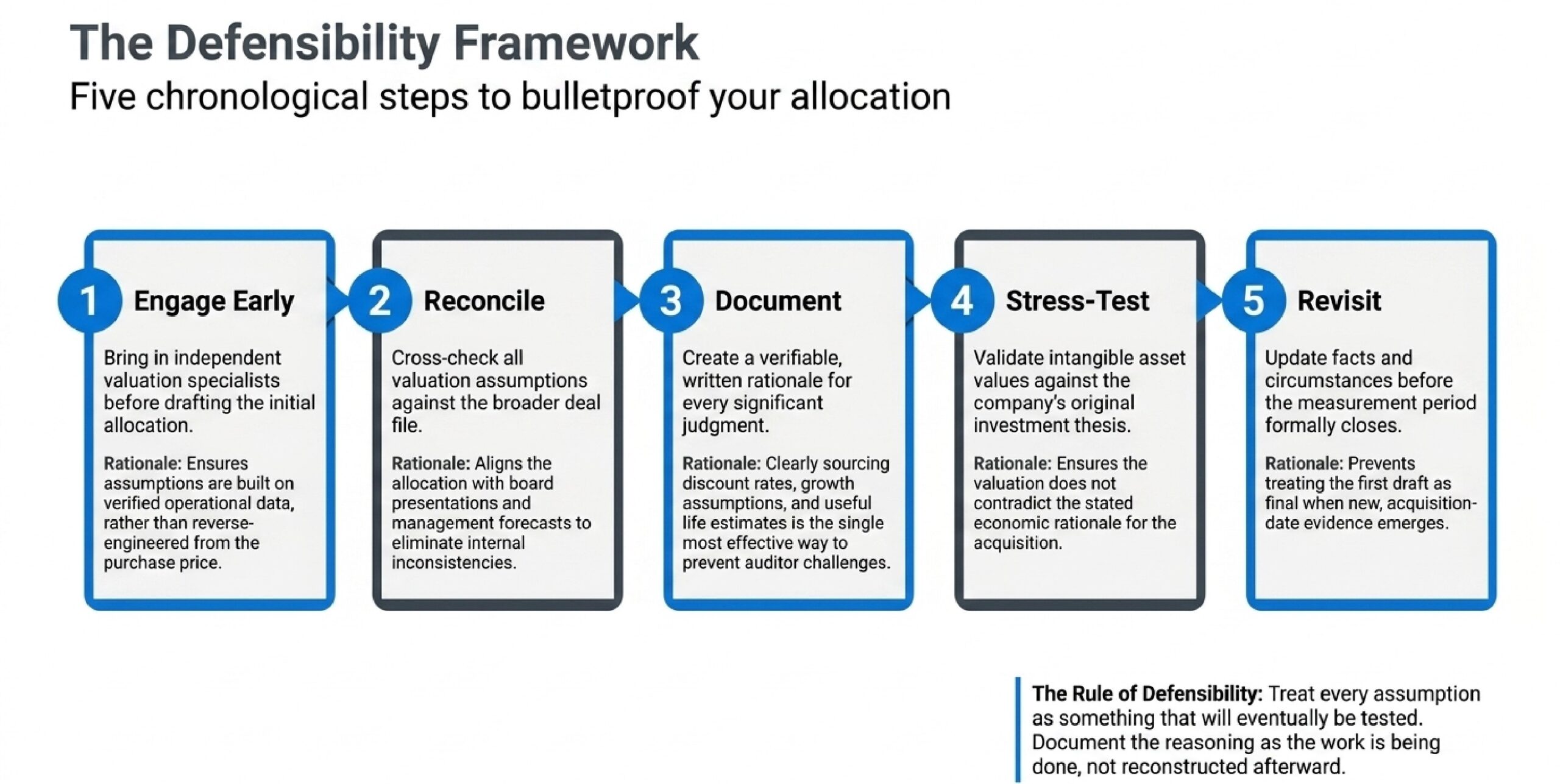
A structured process can be followed by the professionals preparing or reviewing a purchase price allocation in order to minimise the risk of a failed allocation of a purchase price being targeted in an audit. The following five steps are a typical process that an expert valuation and accounting team will follow to achieve complete defensibility and auditing preparedness of an allocation.
First, check each valuation assumption against the deal file as a whole, which means board presentations and management forecasts, as any differences in these documents are some of the quickest ways to raise auditor doubts. Second, record the basis for each major valuation decision, such as the basis for choosing a specific valuation model, the basis for any growth assumption or discount rate, as the basis for the assumption is often the only reason that an auditor accepts it without further inquiry. Third, do not involve independent valuation experts after the allocation is drafted, because the assumptions will be based on operational information rather than reverse engineered from the agreed purchase price. Fourth, test the values of intangible assets for the materiality of the transactions against the company’s own investment case for the deal, as a value that runs counter to the stated rationale for the deal is one of the most obvious areas in which an auditor will highlight differences, especially if the difference is related to the asset class the deal is rationalised around. Fifth, rework the allocation before the measurement period ends, including any information about facts and circumstances that existed at the acquisition date, not as a first cut but as an ongoing process. One of the most typical causes that rework becomes an issue when the allocation takes place is the failure to involve independent specialists, especially in the initial stages, as assumptions without direct access to operational data are far more likely to be challenged when the auditors start asking detailed and evidence-based questions. The ones that have been consistently applying all five steps together and not selecting the steps for use based on time constraints generally follow up with fewer follow-up requests through the audit review.
What Real-World Examples Show How Failed PPA Valuations Trigger Audit Issues?
Let’s say a medium-sized tech firm buys a smaller firm to be the source of its software development and engineering expertise, as is often the case in the software world where the acquiring firm’s true asset is not the physical facility but rather the engineering know-how and software that the target firm has developed over the years. In the first IFRS 3 purchase price allocation, the internal deal team concluded that the acquired technology was not easily identifiable from the overall business and therefore allocated a relatively small proportion of the purchase price to identifiable intangible assets, the majority of which was recorded as goodwill, which seemed sound for the time being because the technology was already tightly embedded in the acquiring company’s product suite. In the year-end audit, the external auditor questioned this treatment, stating that the software platform had a separate and identifiable revenue stream before the acquisition, which enabled a defensible valuation of the software platform as a standalone business. The company was forced to rework the allocation, which ultimately resulted in a significant allocation of value into an amortizable intangible asset, and in a delay of the company’s annual financial statements for several weeks. Later, the finance group admitted that it would have been better to have a valuation expert involved earlier in the process, and not predominantly based on its own opinion, to identify the same problem well before the audit.
The second example is a manufacturing company that acquired a valuable trademark as part of the operating businesses of the target. The trademark was originally assigned a short useful life, which was based on a standard used in that industry at the time, but not on the product’s real market life, as there was little time for a thorough review of customer data. The auditor raised a formal audit finding when it asked the valuation team for evidence to back the useful life assumption and was unable to get that documentation from the valuation team, leading to a camortisation schedule. In both instances, the root cause of the failed PPA Valuations was a series of smaller assumptions that were never documented, and which were only able to be reviewed by an auditor when they requested supporting evidence. In both cases, the technical judgment was not necessarily per se unreasonable; the problem in both was that there was no contemporaneous documentation of the linkage of that judgment to easily verifiable facts; a more disciplined process would have closed that gap well before the audit process was initiated.
What Are the Benefits and Challenges of Managing PPA Valuation Audit Risks?
By anticipating the risks that may emerge during a PPA valuation audit, companies and their financial statement preparers stand to benefit. A well-documented allocation can also help to shorten audit timelines, minimise the risk of a restatement at the end of the transaction, and help provide management with more confidence that the reported earnings are truly representative of the economics of the acquisition, thereby helping to improve their internal forecast and budgeting for years after the transaction. A clean audit record, which includes the absence of any large-scale acquisition accounting issues, also adds to a company’s credibility with investors and lenders, as they are more likely to pay attention to the fact that such a company is good in their financial management, especially if they have consistently made acquisitions. How the professionals do their work is one of the most trustworthy ways to establish a reputation, whether it involves transaction accounting or valuation advisory work: Audit partners and finance leaders know who they can count on to clean and defend under pressure to meet the deadline.
The problems, however, are genuine. Purchase price allocations are generally prepared under harsh post-closing timelines, and at the same time, the integration team is involved in an integration process that requires time for comprehensive diligence, which is necessary in order to build a defensible allocation. Comparable information can also be difficult to come by, especially for private companies and complex valuations, where the management’s representations are relied upon even more. In recent years, the documentation requirements have increased in importance and have become more rigorous, even for technically sound allocations, if the rationale is sparse or conflicts with other portions of the deal file. Differences in accounting principles and the availability of information in the market can introduce additional complications with cross-border acquisitions, as it can impact the certainty with which a valuation team can justify its results in multiple jurinew-to-the-fieldew to the field professionals, the takeaway is that documentation is as important as financial modelling, and even a very correct valuation may result in an audit finding if the reasoning behind it is not documented. This habit is beneficial in transaction accounting for the whole career, as reasoning should be documented as it is being carried out – which is much easier when it is done at the outset rather than added on to at a later stage.
Why Do Failed PPA Valuations Trigger Audit Issues? : Conclusion
Failing PPA Valuations lead to audit problems, as it reveals that there is a discrepancy between the claims contained in the allocation and the evidence and documentation that can be produced. The steps taken to reduce the risks for PPA valuation audits begin well before the audit begins, through rigorous data collection, assumptions that are cross-checked, and involving valuation professionals early in the process of the IFRS 3 purchase price allocation. As a professional who is establishing a career in accounting, valuation or audit support, the takeaway is straightforward: Assume that each assumption is going to be challenged at some point and document it, as the distinction between a smooth audit and a long one is often whether this discipline was used from the outset. As the deals keep trending from industry sector to industry sector, it is those who consistently allocate well-documented, defensible allocations that will be trusted with bigger and more complex deals as their careers go on. It’s the same field, whether you’re looking at a first assignment as a junior analyst or leading a valuation for a big acquisition years later — every assumption is subject to a check against the facts, the reasoning is documented as it happens, and each allocation is subject to careful and evidence-based scrutiny of one’s own.
Incorrect Purchase Price Allocation (PPA) valuations may result in inaccurate asset values, goodwill calculations, and financial statements, leading to audit concerns and compliance issues.
Common PPA mistakes include failing to identify all intangible assets, using unsupported valuation assumptions, applying incorrect discount rates, relying on unrealistic financial forecasts, and providing insufficient documentation. These issues can reduce the reliability of financial reporting.
Companies can minimize audit issues by engaging experienced valuation professionals, using recognized valuation methodologies, maintaining comprehensive documentation, and ensuring compliance with IFRS 3 and IFRS 13. Regular reviews of valuation assumptions also improve audit readiness.
An independent valuation provides an objective assessment of fair value, increases the credibility of financial statements, supports management's assumptions, and helps auditors verify compliance with accounting standards. This reduces the likelihood of audit disputes and material adjustments.
The primary standards governing Purchase Price Allocation are IFRS 3 Business Combinations and IFRS 13 Fair Value Measurement. IFRS 3 requires acquired assets and liabilities to be recognized at fair value, while IFRS 13 provides guidance on determining fair value. IAS 36 Impairment of Assets also applies to subsequent goodwill impairment testing.