
Startup Valuation in Malaysia: Methods & Financial Reporting Impact
A Practical Guide for Finance Professionals, Founders, and Investors
Introduction to Startup Valuation in Malaysia: Methods & Financial Reporting Impact
The startup ecosystem in Malaysia has developed significantly during the last ten years. Since the initial incarnation of government accelerators and grants via MDEC and Cradle Fund, the market has grown to be one that draws to it regional venture capital funds, corporate venture arms and more advanced angel investors. Pre-Series A, Series A, and growth financing rounds are becoming a constant occurrence in industries such as fintech and healthtech to agritech and logistics SaaS and have valuation transitions that represent both their current performance and their future potential. Along with this increase in activity, however, comes a range of financial and reporting issues that most founders and their finance teams are ill-equipped to negotiate, most prominently how to value an early-stage business in a way that is credible and defensible and investor ready.
The valuation of a startup is quite unlike that of a mature and cash-bearing business. Conventional approaches that are based on historical earnings, dividend yields or book value are less applicable when the target company could possess little revenue, no profit, and a business model that is yet to be proved. Rather, startup valuation relies on a combination of prospective approaches, market standards and qualitative judgement – all of which is exercised in a context that is more and more likely to be professionally recorded and be supported by independent documentation by investors, auditors, and regulators.
The article is targeted towards junior to mid level finance practitioners, founders seeking to plant funds and candidates seeking career in corporate finance, venture capital or financial reporting in Malaysia. It defines the major valuation techniques applied to early-stage firms, the steps of getting to a believable valuation, the financial reporting consequences of equity financing, and the real-world issues that are likely to occur. In developing a term sheet, financial statements or working to learn how investors think, the material below represents a grounded and practical point of departure.
The Reason Behind Startup Valuation and Why It Counts — Startup Valuation in Malaysia: Methods & Financial Reporting Impact
The process of valuing a startup is a highly informed estimation and not a calculation. The conventional instruments of corporate value such as discounted cash flow analysis based on a history of performance, the discounted earnings multiple based on years of reported EBITDA, or the net asset value based on the tangible balance sheet items are of little use where the company has been in operation of 2 years, annual recurring revenues of RM 800,000 and is forecasting 4x growth over the following 3 years. The future is much more than the past, and the future is uncertain in nature.
This uncertainty does not imply that there is arbitrary valuation. What it implies is that methodology to be used has to be chosen carefully and implemented in consideration of what is known, what benchmarkable, and what has to be assumed. Investors, be it an angel network or venture capital firm or corporate strategic investment and all manner of investors use some form of valuation structure in determining the amount of stake to undertake and at what price. The mechanics of that structure are critical to every founder going into a negotiating situation, and to any finance person giving advice.
The financial reporting perspective is also very high. The accounting implications of a transaction involving the raising of equity financing by a startup be it an issuance of ordinary shares, preference shares, convertible note, or a SAFE issue has long lasting accounting implications far beyond the cash collected. In case the financing round includes the issue of instruments with equity characteristics to employees, directors, or advisors, MFRS 2 (Share-based Payment) can be activated. When such round is of preference shares, which have liquidation preference, anti-dilution right, or conversion right, such instruments should be closely evaluated under MFRS 9 (Financial Instruments) to ascertain whether they are an equity or a financial liability. All these determinations are based on the valuation which should be done with the same rigour that would be required in any formal financial reporting setting.
Table 1: The Major Variations in the Startup and Mature Business Valuation — Startup Valuation in Malaysia: Methods & Financial Reporting Impact
| Dimension | Mature Business | Early-Stage Startup |
|---|---|---|
| Revenue history | Multiple years of audited financial data available | Limited or no revenue; projections are the primary basis |
| Primary valuation driver | Historical EBITDA, cash flow, net assets | Future growth potential, market size, team quality, traction |
| Preferred methods | DCF, EV/EBITDA multiples, dividend yield | Scorecard, Berkus, VC Method, revenue multiples (forward-looking) |
| Comparables availability | Abundant listed peer data for benchmarking | Limited; relies on private transaction data and international benchmarks |
| Uncertainty level | Moderate; bounded by operating history | High; outcomes range from total loss to exponential return |
| Financial reporting complexity | Standard P&L and balance sheet focus | MFRS 2, MFRS 9, convertible instrument classification, ESOP expense |
5 Valuation Techniques Used in Practice — Startup Valuation in Malaysia: Methods & Financial Reporting Impact
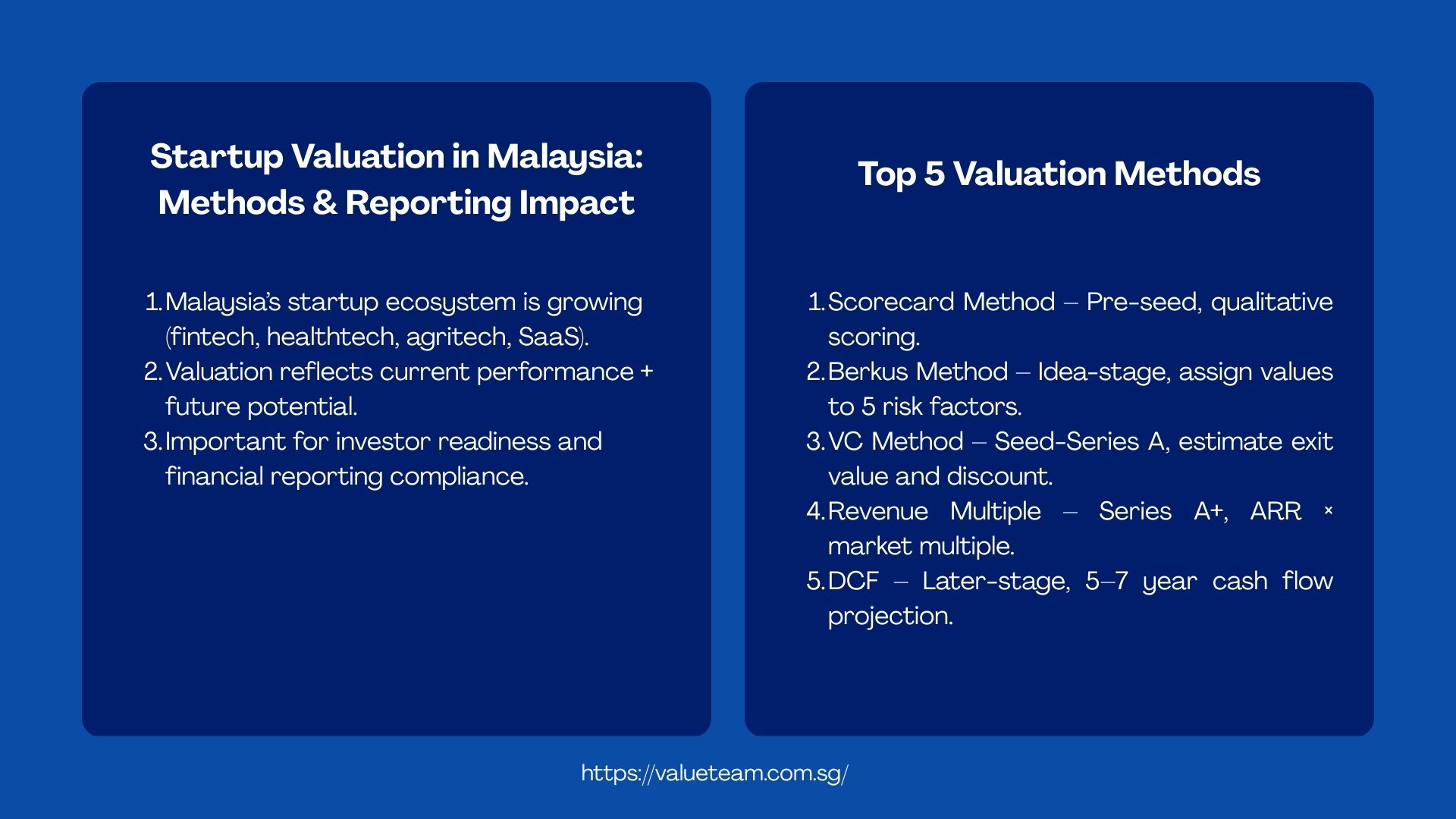
No one right way of valuing an early-stage startup. In practice, the most plausible valuations will rely on many approaches and triangulate a conclusion using the outputs of the approaches. The latter are the five most common in the Malaysian venture and angel investment environment, where each has its particular applications, advantages, and weaknesses.
Table 2: Comparison of 5 Major Methods of start up valuation at a glance — Startup Valuation in Malaysia: Methods & Financial Reporting Impact
| Method | Best For | Key Inputs | Typical Use Stage |
|---|---|---|---|
| Scorecard Method | Pre-revenue or very early revenue startups | Benchmarks from comparable funded startups; qualitative scoring of team, market, product, traction | Pre-seed to Seed |
| Berkus Method | Idea-stage companies with a working prototype | Up to RM 2.5M assigned to each of five risk factors (concept, prototype, team, strategic relationships, sales) | Pre-revenue |
| VC Method (Venture Capital Method) | Startups with a defined exit horizon | Terminal value at exit, expected return multiple, dilution through future rounds | Seed to Series A |
| Revenue Multiple Method | Startups with measurable ARR or GMV | Forward revenue projection multiplied by sector-appropriate multiple from comparable transactions | Series A and beyond |
| Discounted Cash Flow (DCF) | Later-stage startups with visible cash flow path | 5–7 year projection, terminal value, risk-adjusted discount rate (40–70% for early stage) | Series B and beyond |
Scorecard Method is mostly applied to pre-seed and seed-stage deals in Malaysia, where such limited financial data may exist to base the valuation. It operates by initially setting a median pre-money valuation of similar funded startups in the same sector and geography and then increasing or decreasing that base in response to how the subject startup performs on five to seven qualitative dimensions the quality of the management team, the size and availability of the market, the competitiveness of the product, any existing partnership, and any early commercial traction. The valuation that results is a calculated opinion and not an exact estimate, but it is much more justifiable than an untidy figure stated in a pitch deck.
Venture Capital Method has an alternative approach. Instead of beginning with the current, it begins with the conclusion: what value are we likely to get the company at the exit, normally in an IPO or trade sale in five to seven years? The terminal value is then discounted back to the present at the target return of the investor in the case of Malaysian VC funds, 10x to 30x discounting, the target is usually due to the high failure rate of the asset class. The resulting present value will be an estimate of the investor of the value of the company today which in turn will decide the pre-money valuation and the amount of equity stake to be provided.
The Revenue Multiple Method is more practical with an established and significant recurrent revenue base of the startup. An example of a fintech startup that could be worth 8x to 15x of annual recurring revenue, such as a startup with a growth rate of 50 and a gross margin of 30 (for example) and an optimistic market may be valued at 8x to 15x revenue, which a specialist can benchmark with recent similar deals in Southeast Asia. This method reflects the way investors tend to think in Series A and further on and ties the valuation to the commercial performance metrics that provide continuous investor confidence.
The Process of Valuation: A Step-by-Step Learning Process — Startup Valuation in Malaysia: Methods & Financial Reporting Impact
Whichever approach and/or a blend of techniques is employed, a credible startup valuation is reached in a similar way. To the finance professionals who are new to this field, it is as critical to understand how to go through the engagement to deliverable as it is to understand the technical techniques. The process shown in the four stages below is the typical kind of structure of a professional startup valuation engagement.
Figure 1: Four Stage Startup Valuation Process — Startup Valuation in Malaysia: Methods & Financial Reporting Impact
| 01
Understand the Business Review pitch deck, financials, cap table, term sheet, and market context |
02
Select Methods & Gather Data Choose appropriate valuation methods; source comparable transactions and benchmarks |
03
Build & Calibrate the Model Apply selected methods; stress test assumptions; triangulate outputs across approaches |
04
Deliver & Document Issue valuation report with assumptions, rationale, sensitivity analysis, and disclosures |
This is because phase one is the most crucial and least taken seriously. It is necessary that the valuation professional learns what the business actually does, how it makes money, what the competitive environment looks like, who the founding team is, and what the terms of the financing round entail before the numbers are modelled. A 2x liquidation preference anti-dilution preference preference share is an entirely different instrument to a regular share in the company, and the valuation of the company, and the particular instrument being issued, should reflect this difference. This is where the participation of an independent startup valuation consultant in Malaysia in financing the equity, as opposed to the self-estimated figure by one of the founders, contributes to actual value.
The second step is the proper choice of the methods and finding credible similar data. In the case of Malaysian startups, this may be difficult as there is a lack of publicly available information on the multiples and valuations of privately held transactions in the country. Valuation firms engage a professional valuation company, those rely on proprietary databases, regional reports on VC (as published by Gobi Partners, 500 Global, or Intres Capital), and cross-border transaction data in similar markets. The arbiter of the validity of the resulting valuation is the quality of the analogous set.
The third level is the technical work. Majority of the models are constructed, assumptions are recorded, and outputs are stress tested. In the case of the VC Method, e.g., the sensitivity of the present value to the hypothesized exit multiple and target return rate is noteworthy when the exit multiple changes by 5x to 8x revenue, the implied pre-money valuation may change by 30 per cent or more. It is the open presentation of these sensitivities, and not the grounding on purely the most favourable of scenarios, that distinguishes a professional valuation document and a promotional document.
The fourth phase is documentation and delivery where the financial reporting implications are covered. A valuation report prepared to raise funds should be designed in a manner that it endorses the disclosures under MFRS 9 and MFRS 2 where it is applicable. It should explicitly have the purpose, the date of valuation, the standard of value, the methods, the key assumptions and the conclusion of value. This report forms the audit supporting evidence on the way the equity instruments were recognised and measured during the financial statements.
Table 3: Startup Valuation (An example of a Malaysian Fintech SaaS Company, Series A) — Startup Valuation in Malaysia: Methods & Financial Reporting Impact
| Parameter | Detail | Notes |
|---|---|---|
| Company type | B2B Fintech SaaS platform (receivables financing) | Incorporated in Malaysia; 3 years old; 42 enterprise clients |
| Annual Recurring Revenue (ARR) | RM 4.2 million | Year-on-year growth of 85%; gross margin of 72% |
| Method 1: Revenue Multiple | RM 4.2M x 12x = RM 50.4M pre-money | 12x applied based on comparable SEA fintech transactions at similar growth profile |
| Method 2: VC Method | Exit value RM 180M in Year 5 (10x ARR) / 20x return = RM 9M PV; pre-money RM 45–55M after dilution adjustment | Assumes two future rounds with 25% dilution each; 20x target return for lead investor |
| Method 3: Scorecard | Baseline RM 40M (regional median for fintech seed–A); score adjustment +15% = RM 46M | Adjustments for above-average team (+10%), strong traction (+15%), moderate competition risk (-10%) |
| Triangulated Pre-Money Valuation | RM 47M – RM 52M | Mid-point of RM 49.5M used as basis for term sheet negotiation |
| Round size (Series A) | RM 12 million | 20% dilution at RM 49.5M pre-money; post-money RM 61.5M |
| Financial reporting implication | Preference shares — assessed under MFRS 9 for liability vs equity classification; MFRS 2 triggered for advisor warrants | Independent valuation required to support fair value measurement in financial statements |
Impact of Financial Reporting and Real-World Problems — Startup Valuation in Malaysia: Methods & Financial Reporting Impact
The accounting implications of a Malaysian startup raise are far-reaching when the firm completes a financing round because of additional transactions. The terms of the round, the type of instrument, the rights issued with it and any share-based awards that come with one, all present different financial reporting implication that should be treated with caution and, where material made through independent valuation.
The classification of preference shares is one of the most widespread complex areas. In most Malaysian Series A and growth-stage investments, investors are issued with preference shares that have liquidation preferences, participation privileges, anti-dilution, and mandatory redemption option. Under the MFRS 9, the difference between equity and financial liability of such instruments is based on whether the company has the right to avoid the delivery of cash or other financial asset to the holder or not. Preference shares that have a mandatory redemption or cumulative dividend that is not at a discretion, but is required by contract should be considered entirely or partially a financial liability, which in turn would influence the gearing ratio of the company, interest expense, and the reported equity. Here one can see a convergence on a fine and consequential basis between commercial deal terms and accounting standards and where an early counsel by a professional in the business of structured instruments on such matters is especially helpful.
The other issue that can often be met is that of the valuation of share-based payments under the MFRS 2. Options or warrants to founders, employees, advisors and strategic partners are common with Malaysian startups. All these grants involve a fair value measurement at the date of grant – which, in the case of an unlist company, should involve an official valuation exercise. Most startups completely ignore this requirement until it is brought up by their auditor, at which point the company must recalculate a valuation as at the original grant dates usually over a long period of several years. This backward undertaking is lengthy, expensive and unnecessary strain with the audit staff. The alternative solution is to seek up-to-date valuation of startups in each round of funding and make it the foundation of MFRS 2 compliance.
Take the case of a Malaysian agritech startup that has already raised a seed round and has a Series A eighteen months after. At seed stage, the founding team had given advisor warrants without having an independent valuation, basing on their own estimation of the value of the company. Upon their interaction with their auditors prior to the time of the close of the Series A, the auditors realised that the MFRS 2 charge of the advisor warrants had not been recognised and the grant-date valuation had not been documented. This forced the company to engage an external startup valuation consultant in Malaysia to do equity financing in order to reestablish the grant-date fair value which incurred an MFRS 2 cost that decreased equity and necessitated an adjustment in the previous period. The price in terms of time, professional fee, and investor relationship was a lot bigger than what an upfront valuation would have cost.
Table 4: Accounting Implications of typical Startup Financing Structures — Startup Valuation in Malaysia: Methods & Financial Reporting Impact
| Instrument | MFRS Applicable | Key Reporting Consideration | Valuation Required? |
|---|---|---|---|
| Ordinary shares (new issuance) | MFRS 132 / MFRS 9 | Generally classified as equity; proceed price recorded in share capital and share premium | Recommended for third-party rounds; required for RPT or ESOP pricing |
| Preference shares (with redemption/dividend rights) | MFRS 9 / MFRS 132 | May be classified as financial liability if mandatory redemption or non-discretionary dividends exist; affects gearing and P&L | Yes — to determine fair value at issuance and subsequent measurement |
| Convertible notes / SAFE | MFRS 9 | Split accounting may apply (liability + equity components); fair value of liability component at inception required | Yes — to determine fair value of embedded derivative and debt component |
| Employee share options (ESOP) | MFRS 2 | Grant date fair value expensed over vesting period; non-cash charge reduces reported profit | Yes — independent valuation of underlying shares and options required |
| Advisor / founder warrants | MFRS 2 | Fair value of services received measured at grant date; if equity-settled, recognised as expense and equity reserve | Yes — must be valued at grant date; retrospective valuation is costly |
In addition to the classification of instruments, the financial reporting effects of the valuation of a startup have a direct investment into communication with investors. The investor business valuation of early-stage startups in Malaysia is slowly taking up a more professional approach, not necessarily to reflect the due diligence process as such, but to ensure that advanced investors, especially institutional venture capital firms and family offices, will index the valuation assumptions made to them. A founder that can take a walk through a triangulated valuation of two or three approaches, describe the similar transaction set, and describe how sensitive that conclusion is to critical assumptions will have much more credibility in a room of seasoned investors than one that is launching a pitch deck with a number on it and no explanation of their methodology.
Table 5: Key Startup Valuation Issues and Practical Solutions —Startup Valuation in Malaysia: Methods & Financial Reporting Impact
| Challenge | Why It Arises | Recommended Approach |
|---|---|---|
| No revenue to anchor the valuation | Pre-revenue or very early traction stage | Use Scorecard or Berkus method; benchmark against comparable funded peers in the same sector |
| Lack of comparable transaction data in Malaysia | Private market; limited public disclosure of deal terms | Supplement with Southeast Asian and regional data from Crunchbase, Preqin, or VC fund reports |
| Instrument classification uncertainty (equity vs liability) | Complex preference share or convertible note terms | Engage finance professional with MFRS 9 experience before closing; review legal terms against accounting criteria |
| Undocumented MFRS 2 charge for ESOPs or warrants | Grant issued without prior valuation or accounting advice | Commission startup valuation services in Malaysia for fundraising at each grant date; maintain ESOP register |
| Investor and founder valuation misalignment | Founder anchors on aspirational valuation; investor applies market discipline | Use independent valuation to provide neutral, methodology-backed anchor for negotiation |
| Retrospective valuation requests from auditors | Valuation not obtained at the time of grant or issuance | Engage independent specialist to reconstruct; document all assumptions and align with auditor before finalising |
Conclusion : Startup Valuation in Malaysia: Methods & Financial Reporting Impact
The valuation of startups in Malaysia has long since surpassed the informal back-of-the-envelope practice of it used to be. With maturity of the ecosystem, the demands of investors, auditors and regulators have increased in tandem regarding the rigour and documentation of the valuations. To founders, this implies that the figure on a term sheet can no longer be anchored by a supportable methodology, which is based on market experience, which should be consistent with the resultant financial reporting requirements upon any equity transaction. It is somewhat similar to the situation with finance professionals, where proficiency in the startup valuation techniques is no longer a specialist skill, but rather a core of a career in corporate finance, venture capital advice, financial due diligence and accounting advice.
The techniques presented in this paper, including the Scorecard and Berkus strategies of working with pre-revenue firms to revenue multiples and the VC Method of more established startups are not mutually exclusive. These are the complementary lenses and when jointly applied and triangulated with an intelligent mind will yield a more believable and strong conclusion than what single one is capable of providing. Two or three converging methodologies supported by a well-calibrated valuation based on the real market data and documented by a professional report of a good quality is qualitatively different to one obtained by way of a single spreadsheet model; or an informal market comparison.
The practical lesson that can be learned by anyone trying to finance startups in Malaysia is as follows: valuation is a process that should be considered as strategic and continuous, and not a one-time transaction cost. Fundraise and venture capital Obtaining startup valuation services in Malaysia will provide you with an opportunity to exercise at every material round and consider it a chance to also disclose your MFRS 2 requirements, the classification of instruments and the documentation that your auditors will ultimately require. Contract with a separate startup valuation firm in Malaysia who has experience in both the financial modelling and financial reporting environment – since the same valuation that justifies your term sheet negotiation justifies your financial statements and your ESOP expense and your disclosure to investors. It is inefficient and dangerous to treat them as independent exercises. It is just good practice to treat them as a whole process.