
The Importance of Accurate Valuation for Investors, Auditors, and Business Owners
Understanding The Importance of Accurate Valuation for Investors, Auditors, and Business Owners
Business valuation is not always what it says it is: a number generated for reporting purposes, put away in a file, and not looked at again until it is needed. It gives no one a true sense, and it does not meet the requirements of any of the three audiences it is intended to serve.
Valuation, on the other hand, is a “living document” which represents the economic situation of a company. It represents the risks encumbered by the investor and the things he or she is paying for. It provides auditors with the necessary support to be confident in forming an opinion on the financial statements. And it provides businesses with the most accurate possible reflection of what they have accomplished over the years — not sentimentally, but in terms of ‘hard cash’ — in other words, the price that a willing buyer would pay for the business in an open market.
The desire to be accurate isn’t a school thing. If a valuation is not precise, for any reason, whether because it is less than accurate because of methodological limitations, because of a motivated assumption, or just because it isn’t particularly rigorous, then the impact is felt on all three audiences. Over or under pricing risk. Auditors give their views and opinions about financial statements that do not necessarily capture the economic reality. A business owner does things strategically based on a misleading perception of their business. When these costs are realised, they are typically not insignificant.
This article looks at the importance of accurate valuation and what it might be like in practice from the three angles outlined above, specific to the disciplines that most often come into play related to financial reporting, transactions and strategic decision-making.
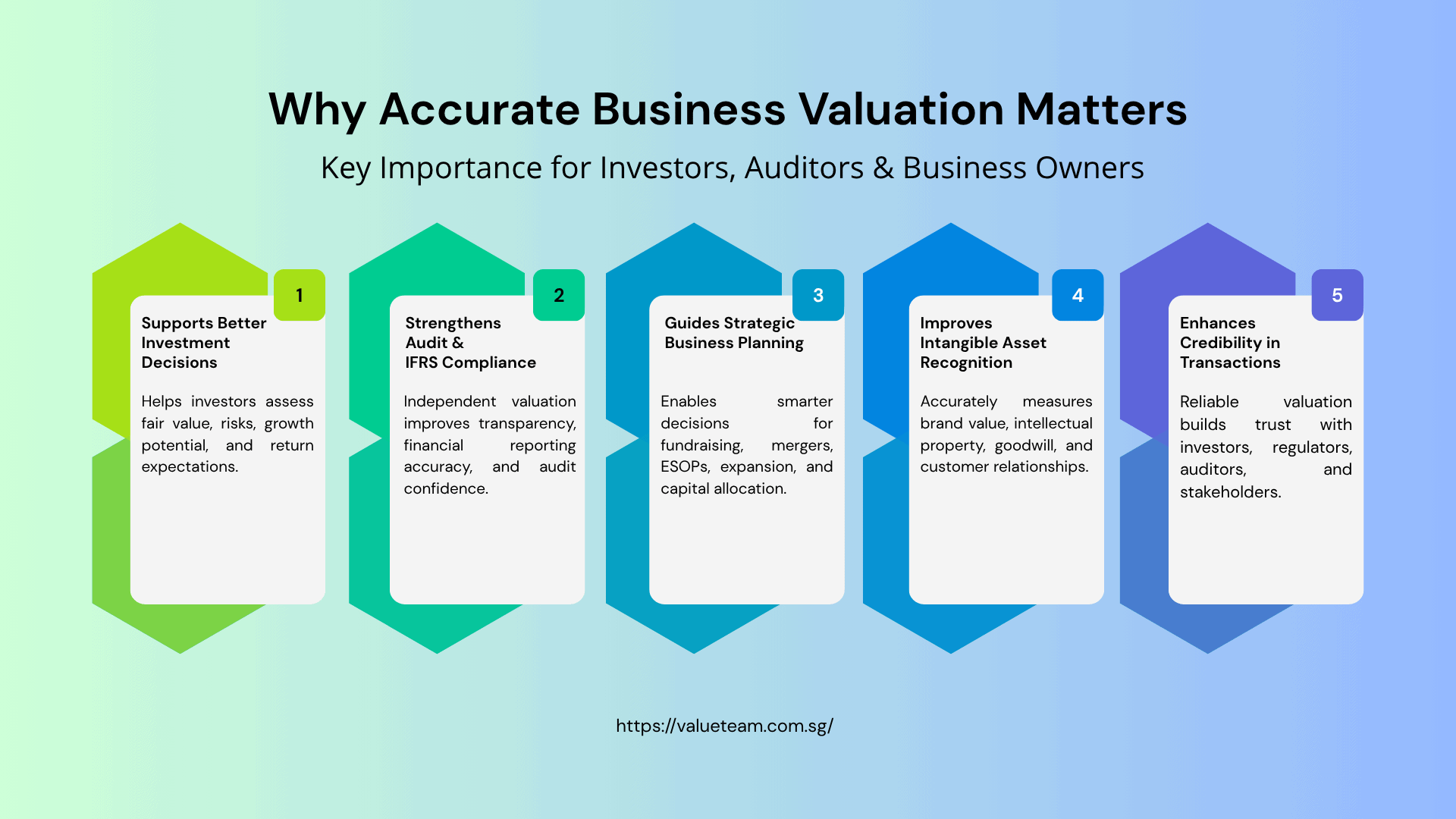
Why Accurate Business Valuation Matters for Investors and Financial Decision-Making
Investor’s relationship with valuation starts before investment of money is done and it goes on till the investment is made and kept. The simple question at the entry point is whether the price being offered is a fair reflection of the economic reality of the business and if the return profile is appropriate for the risk taken? The answer to that question is not easily answered, and is more than just a multiple of last year’s earnings.
Professional company valuation services for investment purposes consider the quality and sustainability of the earnings base, the composition and defensibility of the revenue stream, the depth of the intangible asset base, and the competitive dynamics that will give rise to the sustainable margins of the current business. An honest business valuation consultancy engagement will rationalize historical earnings, create a forward-looking model based upon market evidence, and compare and contrast with other transactions and listed peers — yielding a range of possible results, rather than a single point estimate, to reflect the real uncertainty of the process.
Additional considerations for private equity and institutional investors include the capital structure: how each class of securities will participate in an exit and how the equity investor can perform at various exit valuations. This is especially important in the case of the target having issued preference shares, convertible instruments or other securities whose payoff profile is non-linear. Financial modelling expertise and market knowledge are essential in this field, and are shared by the corporate valuation professionals who work in this area and can help an investment committee to derive analysis that it can trust.
The portfolio monitoring phase is where regular independent business valuation will give investors the evidence needed for fair value reporting to their own investors (limited partners), regulatory authorities and boards that need to review the value of the portfolio on a regular basis. Financial valuation consultancy to support this continuing activity should be consistent in approach over time, based on explicit assumptions, and should have an independent approach from the management — not merely be management’s preferred set of numbers.
The investor perspective also includes the particular aspects of financial reporting in accordance with IFRS. Valuation in a fair market business valuation of investment entities is required to meet the measurement objectives in IFRS 13 which states that the fair value must be based on the market participant’s assumptions and not on the assumptions of the business that is being valued. Valuation advisory services that grasp the investment logic, as well as the accounting framework, and can deliver work that meets both criteria are far more useful than services that deal with them separately.
The Role of Independent Business Valuation in Audit Compliance and IFRS Reporting
Auditors have a particular and challenging role with regard to valuation. They are not valuation professionals themselves, but must assess if the significant estimates in a set of financial statements are reasonable, meaning they must be able to understand, question and draw a conclusion on valuations that are often technically complex and judgement based. Their ability to carry out this responsibility is directly linked to the quality of the valuation work that they are handed to review.
Even a well done valuation by management is not evidentially as strong as if it had been prepared by an independent specialist. This is not a comment on the competency of finance teams; it’s a structural comment on independence. In a valuation, where the management has an interest in the outcome, the assumptions underlying the analysis will be motivated, as opposed to independent analysis. Implementing strategic company valuation work for audit should be done from day one to withstand this scrutiny: assumptions should be benchmarked to outside evidence, sensitivities should be identified and recorded, and results should be presented in a manner that will satisfy audit requirements.
Volatilities are concentrated in the same areas as are the disciplines of greatest auditor interest. For example, goodwill impairment testing solutions delivered as part of a business valuation must show that the recoverable amount of each cash generating unit has been calculated based on assumptions that are consistent with what a market participant would expect – not what a business is targeting. The level of evidence demanded is demanding: auditors are looking for external benchmarks, similar company analysis and sensitivity tables that check the conclusions for a variety of possible outcomes.
Purchase price allocation continues to be an audit focus. IFRS 3 valuation services should perform valuations to identify all intangible assets that are required to be recognised under the standard at acquisition date fair value, and should measure each of these intangible assets at acquisition date fair value and report the results in a format that facilitates the disclosures required by the standard in the financial statements. Physical difficulties are not the only issues: value being acquired in bundles that results in goodwill being recognised without thoroughly assessing whether identifiable intangibles should be recognised separately is one type of scenario that creates audit problems — not to mention possible restatements — that could have been avoided by better analysis up front.
The scope of the subject matter that needs specialist input has grown and today auditors are seeking financial reporting valuation reports that cover a number of asset classes, which are integrated in a coherent framework. A report that aggregates the fair value allocated to the three primary categories of acquired assets (customer relationships, technology, and brand) with consistent discount rates, market participant assumption, and documentation standards is not only more reliable, but more efficiently reviewed than a series of individual reports, each of which may look different.
The Role of Independent Business Valuation in Audit Compliance and IFRS Reporting
Accurate valuation is not only vital to meet a requirement but also to have a clear picture of the business that has been created by the business owner. It’s important at each of the major decision points — and these come a lot faster than most owners realize.
The first advantage is that it gives you leverage in the negotiating process. If a well-informed and independent valuation is provided to the owner, at the very beginning of any sale, fundraise or partnership negotiations, he or she is in a significantly stronger position than if he or she is going on his or her gut instinct or an internal estimate. The counterparty will have developed a view of value, a question being whether the owner’s view is as well supported. Business appraisal solutions that provide owners with a report that contains conclusions which are supported by a method and analysis provide the analytical power to engage on an equal footing, and also to discover where the counterparty’s assumptions are not in line with reality and where they are.
In addition to transactions, accurate valuation is also the basis for capital allocation. Whether the business owner should reinvest profits or buy a new business or return funds to shareholders hinges on a sound basis of value for the business as it is and on the basis for a specific investment. Strategic company valuation work at this level is not just a number, it is knowledge of the drivers to the extent that it is possible to model their likely effect with reasonable confidence if the company selects a strategic option.
One of the equity compensation aspects is especially significant to founders and start-up companies. IFRS 2 requires that the grant-date fair value of options and equity awards be recognised as a compensation expense, for which the ESOP valuation services are the way to determine the fair value. It’s important for the income statement, for investor communications and for the company/employee relationship that’s trying to be developed. The undervalued valuation of an employee stock option gives rise to an undervalued income statement while the overstated valuation unnecessarily dilutes reported earnings and could negatively impact the interpretation by potential investors of the employee stock option.
If a company has granted equity awards to a substantial number of its employees, management and the board can benefit from a single valuation of the equity awards on the entire company—including all outstanding tranches and classes at once—and have a complete overview of the cost of the equity compensation programme and its connection to the existing enterprise value. ESOP advisory services which incorporate this analysis with ESOP scheme design advice, modelling of vesting conditions, and continual valuation of the awards, can provide a much greater value-added service than a one-off stock option valuation prepared solely to meet an audit requirement.
It’s a unique set of challenges for startup founders. The accuracy of the share scheme accounting underlying Startup ESOP valuation will be dependent on the accuracy of the underlying business valuation on which it is based — that is, without the underlying business valuation which is the basis for the accounting, the accuracy of the option pricing valuation or equity compensation valuation will be in doubt. Careful coordination is required in these two exercises in order to have the same set of assumptions and the output would be expected to be helpful to the company’s auditor and future investors.
Why Brand Valuation and Intangible Asset Valuation Are Critical for Enterprise Value
The valuation inaccuracy is most likely to have the greatest impact when the assets being valued are not easily noticed on conventional financial statements. For most of the acquisitions in today’s modern business world, brand and customer relationships, intellectual property and assembled workforce are all sources of true economic value, not reflected at fair value on most balance sheets. Accurately measuring is very important.
The pressure is even higher for brand, as the asset is not only one of the biggest but also one of the hardest to objectively measure. Based on the relief-from-royalty approach, Brand Valuation Services offer the brand manager a clear, market-based means of measuring brand value that is both transparent and defensible using a methodology that can be questioned by auditors, called into question by counterparties and understood by management. Brand values based on proprietary measurement tools or management’s subjective claims on the value of their brands are less likely to withstand external examination and are costly to litigate in due diligence or at audit.
Each asset in the brand family also deserves special consideration. The services of trademark valuation are an economic assessment of trademark rights in a specific market, which is different from the evaluation of brand value and commercial relationships. For groups with several brands across jurisdictions, there is a need for coordination between the group entities in relation to the financial accounting and transfer pricing rules for the allocation of the corporate brand value, which necessitates consistent assumptions and a clear brand value allocation logic supported by individual asset valuation of brands.
Strategic brand valuation is more than just the financial reporting application, it provides management with an analytical foundation to assess the brand investment decisions like they do with capital expenditures or M&A. With a model that correlates brand investment, brand equity and enterprise value, built on evidence from similar businesses, a brand appraisal consultancy can help you change your brand management conversation from one that is about expense control to one about value creation. The quantitative basis of decisions on brand extension, licensing and positioning, which are traditionally based on gut feeling, is provided by marketing asset valuation and reputation value analysis work within this framework.
There is a new dimension to consider for businesses that interact directly with customers. Consumer brand value analysis quantifies the commercial premium that a brand enjoys in the end market, through the price premium, the conversion advantage and the loyalty premium which stems from consumer recognition and preference. As vital as it is to understand the evolution of this premium and the factors that influence it is to report the value of the premium on a balance sheet.
Brand isn’t the only intangible asset. Intangible asset valuation extends to the entire spectrum of non-physical assets which add to the enterprise value: Customer relationships, proprietary technologies, contractual rights, licences, and assembled workforce. There are different valuation methods, different relationships between the cash flows of the business, and different effects on the financial statements for each. For instance, in the multi-period excess earnings method, the economic value of the customer base is separated from the value of all other assets that support profitability, which is a very challenging task that requires sensitivity testing of the attributes that are used to value the assets associated with the customer base.
The traditional intangible valuation services frameworks are proving insufficient in the context of a growing number of businesses that have substantial digital assets or data assets. Many platform businesses, data-driven companies and algorithmic trading organizations need non-physical asset valuation models that have been modified from existing models but adjusted for the economics of the assets they are valuing, which are unique for each organization because of the nature of their assets—whether network effects, data scale or the performance of their algorithms. Business intangible valuation in these scenarios is a dynamic field and businesses with a more rigorous perspective on value, meaning those that don’t use conservative accounting to “deflate” the economic value of their assets, will be in a better position to accurately communicate their value to investors and acquirers.
Goodwill valuation and regular impairment testing under IAS 36 is a discipline that is a natural consequence of acquisition accounting for groups that have undergone acquisitions and does much to demonstrate the quality of the acquisition accounting. The financial statements are kept in touch with economic reality over time through enterprise intangible asset valuation at the cash-generating unit level, which is updated annually and compared to the carrying value of the goodwill and other intangibles. Its performance when done well will assure investors and auditors that the balance sheet is not impaired in value. If it’s not done well, the goodwill write-down that will usually follow is not a surprise to anyone who has been paying attention — at least to them, if not to the board.
The same principles are applied to the accounting of the post-acquisition asset, more generally. Post acquisition valuation services exercise includes the identification and measurement of contingent liabilities, deferred revenues and unfavourable contracts, which are related to the initial PPA valuation services exercise. Valuations of merger financial statements that are done with “real methodological care” and are updated “as may be appropriate in the measurement period” as new facts emerge, provide the three audiences mentioned at the outset of this article with more reliable, more defensible and more useful financial statements.
Best Practices for The Importance of Accurate Valuation
Valuation is a process approached in different ways by investors, auditors and business owners, with each having their own set of main concerns, and each having their own uses for the final product. But they are all subject to the same test: that the valuation should be based on demonstrable reality, must be based on sound assumptions that are defensible and that it must be arrived at by someone whose judgment is not clouded by involvement in the result.
That’s the standard, independent, rigorous and documented, that sets apart genuine work that is valuable, work that is present. Also, it’s the factor that can make or break a valuation, whether it’s in a boardroom of a company making a major decision based on the numbers in front of them, in an audit room, or in a negotiation.
All of the above, if performed to this standard, help to bring about financial statements and business decisions that are trusted by all three audiences.
Accurate business valuation provides a reliable estimate of a company's worth, helping business owners, investors, and stakeholders make informed financial, strategic, and investment decisions.
Businesses commonly require accurate valuations for mergers and acquisitions, fundraising, financial reporting, taxation, litigation, succession planning, and shareholder transactions.
Financial performance, market conditions, industry outlook, future cash flows, business risks, and appropriate valuation methodologies all contribute to a reliable valuation.
Business owners, investors, lenders, auditors, accountants, regulators, and financial advisors all benefit from dependable valuation reports.
Professional valuation provides objective and credible insights that reduce uncertainty, support negotiations, strengthen compliance, and improve strategic business planning.