
6 Financial Metrics That Influence Business Value
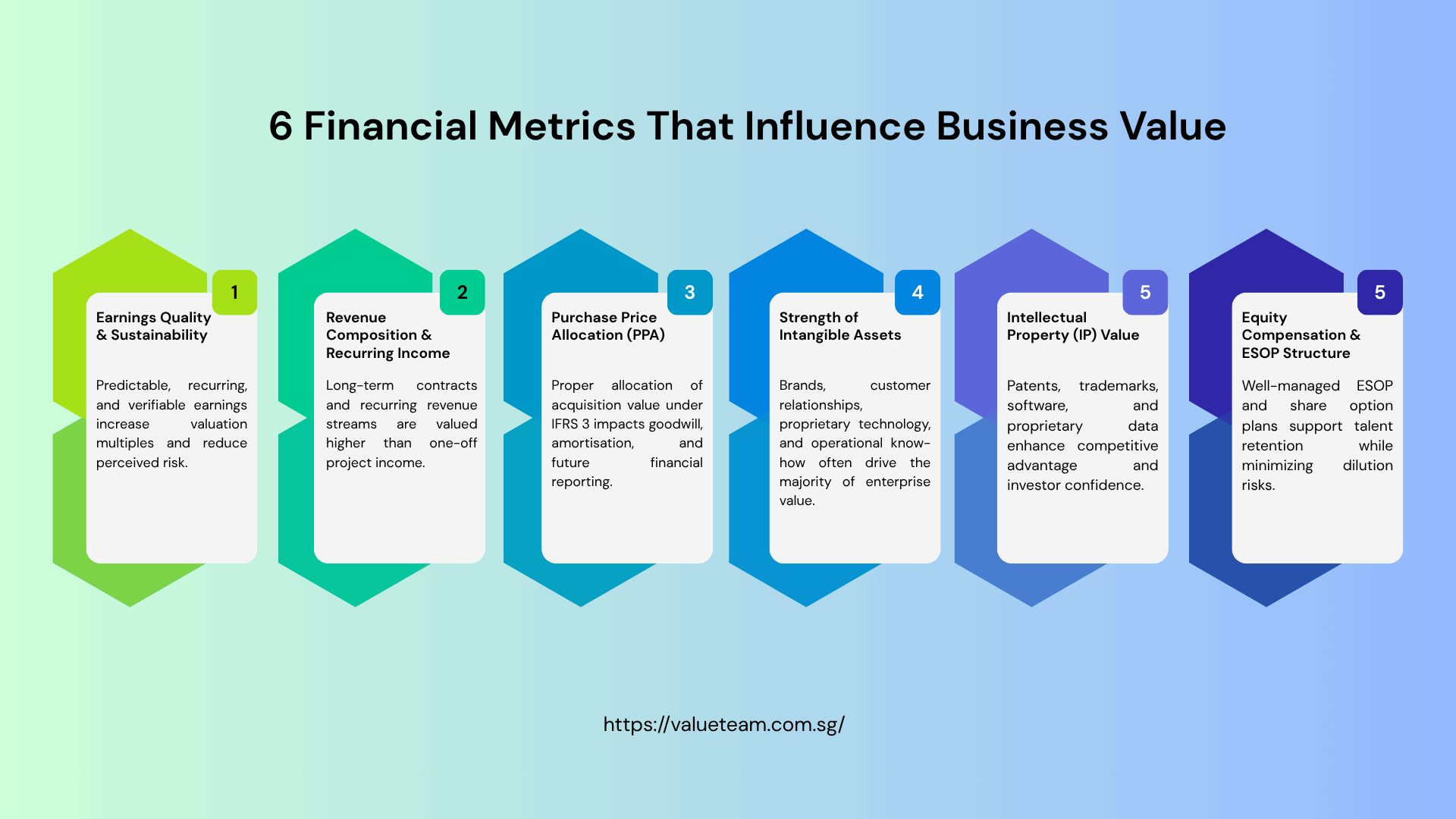
Introduction to 6 Financial Metrics That Influence Business Value
Business owners tend to be taken aback when they experience a formal company valuation services engagement for the first time, and are amazed at the importance assigned to issues that they never thought of as being pivotal to the value of their business. Certainly, revenue is significant. Although the dollar value of that revenue may be less significant, its quality (that is, its predictability, its concentration, its defensibility) may be more so. In the same way, for a sophisticated buyer, the only assets that are not recorded on the balance sheet may constitute most of the purchase price.
Any successful business valuation consultancy will start with analysing the key financial factors affecting the risk and return of a business. The numbers tell the story of the company’s ability to turn what it does into sustainable and defensible value, and the numbers are the ones that will be questioned — the most closely questioned — by acquirers, investors, and auditors when they make their own decisions.
These are some of the most commonly influential metrics in a variety of industries, ownership, and for every type of valuation, but not the only six. Each of these (and why, how, and what it means to those who value it along with it) gives any business owner a more solid and realistic understanding of the value of his or her business and why.
1. Earnings Quality and Sustainability
If there is one of the financial metrics that can affect business value, it’s likely the quality of earnings, which is often misunderstood. Ten million dollars in EBITDA isn’t necessarily more valuable than six million dollars in EBITDA. It’s not about how much you make, but rather if that money is sustainable, if that money reflects the actual performance of the business, and if that money is verifiable on its own.
Earning quality analysis covers a variety of factors: the percentage of revenue that is recurring versus one-off; how much is coming in from actual operational efficiency versus one-time cuts; how much of the revenue is coming in from a few big customers; and whether the earnings do not include non-cash items or whether one-time adjustments are used to boost the headline. Corporate valuation experts and enterprise valuation services practitioners will normalise profits before applying a multiple (removing the owner-related costs, non-recurring items, and accounting policies that diverge from the market average), to obtain a number that reflects the true run-rate performance of the business.
The bottom line for the business owner is that it is worthwhile to improve the quality of reported earnings prior to entering the valuation and/or transaction process in almost every case. It simplifies the job of the business appraisal services team to read the management accounts and accounting policies that are used, and have been used regularly and consistently, and to see that they are documented and don’t include any “normalisation adjustments” that would work against the seller’s interests, if imposed by a counterparty’s adviser.
The sustainability of earnings also directly impacts the discount rate that’s used in any income-based valuation. A company with more steady and predictable cash flow, with contractually fixed cash flow, will have a lower discount rate – and higher valuation multiple – than a company with more erratic or customer-driven cash flow. It is the connection between earnings quality and risk that lies at the core of the detailed questioning of the income statement by valuation advisory services professionals.
2. Revenue Composition and Recurring Income
The first, obvious number that comes to mind for a business owner is revenue, but composition is just as important and relevant when trying to value the business. It is well established that a business that has annual recurring revenue of five million dollars from long-term contracts is worth a lot more than a business with the same annual recurring revenue but from a set of one-off projects, though they have the same profits. The difference is in predictability, which brings down risk, which adds value.
This difference is especially important in independent business valuations, where the income approach will be the most important method of valuation. The discounted cash flow model is based on forecasted cash flows, and one can’t be as credible as the base of recurring cash flows upon which it is constructed. A company that has high levels of churn, a non-uniform customer base, or is highly reliant on a few customers will have higher risk adjustments and more of a variance in valuation.
Another factor that can impact the valuation of a private company versus a listed company is the composition of the revenue. For software companies, for instance, annual recurring revenue is often used as a basis for valuing the business and not EBITDA, in fact, because the consistency of subscription revenues means that they can better demonstrate the value of the business over time than a profit stream that is subject to investment timing. It’s important to consider the valuation logic of your particular industry and how your revenue structure relates to market averages before engaging in financial valuation services.
Revenue composition is a very good initial screening factor for investors and acquirers in businesses that are valuing the business for investors. Companies that have a larger percentage of recurring revenue, diversity, and contractual protection are more favoured, are valued with higher multiples, and progress through due diligence more swiftly. Fostering these attributes within the business during the process over time — not at the time of sale — is one of the best ways to maximise value.
3. The Value Allocated Across an Acquisition
Whether or not a company has been acquired or has been targeted for acquisition, how value is distributed among the acquired assets is a financial measure, and one with far-reaching implications. Under IFRS 3, the overall consideration exchanged is split between the fair values of all the identifiable assets and liabilities, and the remainder is recognised as goodwill. This exercise is called purchase price allocation and directly affects the financial statements for years to come.
An extensive purchase price allocation services engagement will identify all assets that qualify for separate recognition (including customer relationships, technology, trade marks, non-compete agreements, and favourable contracts) and will value them at the acquisition-date fair value. The other approach—namely the accounting approach of recognising undifferentiated value as goodwill in the balance sheet—is likely to be examined more closely as impairment testing cycles build up, and is not a true reflection of the economic substance of the deal.
The stakes are worthwhile. The charge for amortisation of post-acquisition goodwill is derived from the allocation of the difference between the amortisable intangible assets and the non-amortising goodwill and is a direct charge to reported earnings. It also lays the foundations for the future impairment tests, which are included in IAS 36. Valuation consultancy services should thus be considered as a part of the deal, rather than an afterthought, after audit pressure has been raised six months after the deal is closed.
All the assumptions made in the methodology must be in line with those a market participant would make under IFRS 13, and in line with the framework of services provided to measure fair value. This implies that growth rates, discount rates, royalty rates, customer attrition assumptions, and other inputs should be benchmarked against available information from the market and presented in a way that can be independently tested by the auditors. The IFRS 3 valuation services that rely on the management assumptions and do not have independent benchmarking do not stand up to audit scrutiny very well.
It is becoming more of a competitive edge for companies involved in a valuation process prior to a merger and acquisition closing. Acquirers who are able to model the post-acquisition intangible asset profile (and thus amortisation charge and future impairment risk) will be in a better position to accurately price their deals, and to avoid surprises during the first reporting period after the deal.
The post-acquisition valuation work is also applicable for regulatory submission, earn-out, and intercompany restructurings where value allocation between the entities has tax and accounting implications. In the context of financial reporting, valuation services must be aligned and synchronised among the accounting work stream, tax work stream, and legal work stream to ensure alignment of assumptions and defensibility of conclusions across all the relevant work streams. Some of the most challenging and expensive mistakes to correct are the intangible asset allocation mistakes made when acquiring the company, and so it’s much more efficient to have the PPA valuation experts involved early in the process.
4. The Depth and Quality of Intangible Assets
For most businesses today, whether they are technology-based, consumer brands, professional services, or knowledge-based, most of the value is in assets that are not on a traditional balance sheet. Proprietary technology, customer relationships, assembled workforce, brand identity, and operational know-how are developed over years, accounted for as they are used and carried on the balance sheet at near zero under standard accounting rules. But these are the things acquirers, investors, and lenders are mostly focusing on.
Formal intangible asset valuation services are actually available just for this reason — to provide a credible, and documented by a third party, representation of the economic worth of intangible assets which cannot be traditionally represented by accounting. The discipline leverages proven techniques, such as multi-period excess earnings for customer relationships, relief from royalty for brands and technology, and replacement cost for assembled workforces and proprietary data sets.
Buying into the intangible asset assessment knowledge base is no simple task for business owners, not just from a financial reporting standpoint. It serves as the basis for pricing in licensing negotiations, supports intercompany transactions of IP, offers a basis for insurance valuations, and bolsters the business case in any M&A transaction. A business with a valuation for its intangible business assets that shows how deep and of good quality these assets are is in a much stronger negotiating position than one that turns to its counterparty’s adviser for identification and quantification.
Here, the goodwill valuation services dimension comes in as well. Goodwill on an acquired company’s balance sheet is the amount paid above the fair value of the net identifiable assets (including intangibles). If strong intangible asset consultancy work is done at the point of acquisition, then the value that is captured in the goodwill can be allocated between the other intangible assets that have identifiable useful lives. This results in a more accurate representation of the acquired business, and a more predictable impairment testing process thereafter.
Digital asset valuation and intellectual asset valuation are emerging practice areas of digital asset valuation for businesses that have substantial digital assets or data assets. In the current environment, where proprietary datasets, algorithmic models, and network effects are creating value in ways not adequately captured by the traditional accounting rules, this is a significant challenge. The valuation of intangible assets in such contexts involves both technical knowledge of the way the assets work and financial modelling knowledge to turn this into a soundly based fair value. Valuation of the customer relationship: This is often the biggest single value in a digital business transaction, and it quantifies the economic value of a customer’s relationship that already exists.
5. Intellectual Property as a Value Driver
Intellectual property is closely related to the other intangible assets, but is defined as a specific type of intangible asset that is crucial to maintaining competitive advantage. Where a business makes money through patents, trade marks, proprietary software or exclusive licences, rather than relationships or its operational efficiency, its value is based on something more substantial than that.
The first step in any IP valuation services engagement is to conduct an audit of all IP assets – registered, non-registered (but in use), significant to revenue, and transferable and identifiable separately. A large number of businesses have not done this and, as a result, cannot explain the IP part of their business to the buyers, investors, or lenders.
In the case of technology businesses, technology asset valuation and technology valuation consultancy would include the algorithms, technical architecture, and data assets that form the basis of the product, as well as the proprietary software. The methodology chosen will depend on the presence of an active licensing market: If such a market exists, the standard approach will be to use relief-from-royalty; otherwise, a multi-period excess earnings or replacement cost approach may be more suitable. An additional step of analysis is required when valuing patents: the legal life, the scope of the claims, the freedom-to-operate situation, and the actual revenues protected by the patent.
Trade mark valuation is a measure or estimation of the economic protection that a registered trade mark affords and the income stream that a registered trade mark supports in particular jurisdictions, and is a part of the brand valuation process. In this analysis, the scope and strength of the trademark protection, its enforcement history, and the competitive environment will be considered by the trademark valuation experts involved in the analysis. Copyright valuation services are based on the same principles as in other areas of creative content, media libraries, and software code, in which the economic value is derived from the exclusive right to reproduce, distribute, or license the work.
Businesses with multiple IP portfolios can use intellectual capital valuation to gain an understanding of the contributions of various asset types to enterprise value, and individual IP asset valuation can offer the level of granularity necessary for financial reporting, IP licensing negotiations, and M&A positioning. Businesses that have to make complex decisions regarding the structure, protection, and monetisation of their intellectual property can best benefit from IP valuation consultancy work that combines both aspects — the portfolio aspect and the individual asset aspect. It’s so much more valuable to have an IP assessment that comes up with these insights than one that just assigns a number to an asset.
6. Equity Compensation Structure and Its Impact on Diluted Value
The forms of employee equity compensation are a financial measure, and for growth companies and businesses that have active equity incentive programmes, the structure of employee equity compensation is directly related to the cost of capital and the diluted value available to existing shareholders. While most business owners appreciate that the inclusion of options and restricted shares carries a dilution risk, fewer have a clear sense of the fair value of the options and restricted shares on their books or the impact of the options and restricted shares on the ownership structure at a variety of exit scenarios.
IFRS 2 requires the grant-date fair value of equity awards to be recognised as a compensation expense over the period of vesting. This means the ESOP valuation services exercise is not just a theoretical exercise, but it will be a line that auditors test, and investors will be looking closely at. The work of the employee share valuation and share option valuation services that are required to support this accounting should be based on assumptions that are supported by the market and be recorded in a way that can be demonstrated to the auditors.
The valuation of a Startup ESOP is a tricky process for early-stage and pre-IPO companies. It’s impossible, of course, to estimate the volatility of the business because there’s no list price history, so it must be estimated by a peer group of similar listed businesses. The choice of the peer group – and the time frame for measuring volatility – can make a substantive difference in the fair value conclusion and, consequently, the compensation expense recognised. Valuation of employees’ shares for these businesses must involve technical modelling skills as well as a sound knowledge of the business industry.
The value of shares received as part of the incentive scheme is not only of importance for accounting purposes; it also gives the economics of the incentive scheme itself. It is essential for the management to understand the current fair market value of the ESOP and how it compares to the strike prices of outstanding awards in order to gauge whether the ESOP is truly motivating to the employees or whether the options are so far “out of the money” that they are not likely to provide meaningful alignment. This requires equity valuation consultancy, which will draw on financial modelling and an understanding of the construction and administration of equity incentive schemes.
The overarching business value message is that equity compensation schemes managed and measured appropriately can be a positive force for enterprise value, as they can draw in and retain talent that generates value for the company that outweighs the dilution. However, this is only correct if the scheme has been well designed, the accounting has been clean, and the ESOP valuers who have assisted in the financial reporting have provided a service that is useful to management, the auditors, and investors. When the grant-date fair values are not supportable or a poorly documented scheme, it’s a due diligence issue at exactly the time the business can least afford it.
Conclusion: 6 Financial Metrics That Influence Business Value
These 6 are just some of the metrics discussed here, but not all of them. They are the areas where the discrepancy between the financial statements as the business owner sees them and as the buyer, investor, or auditor does not typically match.
There’s a bit of a money issue and a bit of a mindset. It involves a willingness to think as a stranger to the business would think, to consider what would be considered to be an abnormal assumption, what would be normalised numbers, and what assets would be studied independently from the rest of the business before a determination of value is made. Proactively, as opposed to reactively, these businesses regularly discover that the transaction/reporting process is smoother, quicker and more successful in achieving the desired result.
ValueTeam helps companies throughout Singapore and the region with the entire spectrum of disciplines that these metrics impact – company valuation services, purchase price allocation services, intangible asset valuation services, intellectual property valuation services, ESOP valuation services, and brand valuation services. Every engagement is tackled independently and rigorously, no matter the objective, whether it’s the completion of financial statements, a transaction, or a strategic review. A discussion with an independent adviser, of course, is an ideal place to begin the conversation for the business owner who wants to know the value of his or her enterprise and why.
Financial metrics help assess a company's financial health, profitability, efficiency, and future earning potential, supporting accurate business valuation.
Common metrics include revenue growth, EBITDA, net profit margin, cash flow, return on investment, and debt levels.
Strong and consistent cash flow demonstrates financial stability and supports higher business valuations by reducing investment risk.
Investors use financial metrics to assess business performance, compare investment opportunities, and estimate future returns.
Businesses can improve profitability, increase operational efficiency, strengthen cash flow management, and reduce unnecessary costs to enhance overall business value.