
Licensed IFRS PSAK Business Valuation Indonesia
The story is as follows: you have been hired to work on the finance team of an Indonesian firm that is about to issue its first international debt. The bank of the lead arranger which is based in Europe demands financial statements that are international financial reporting standards (IFRS). Your current accounts are prepared on PSAK. The CFO requests you to answer the following question: what must change, and how does it impact the value of our assets? In case you are not quite sure how to answer that question yet, you are not alone- and this article is written just at that very moment.
The connection between IFRS and PSAK in Indonesia is not straightforward similarity and even negative opposition. It is a well-regulated convergence: Indonesia has declared to adopt IFRS by its local standard-setter, Dewan Standar Akuntansi Keuangan (DSAK IAI) and most of the major standards of IFRS are now captured in the PSAK framework, with a one-two year lag in adoption. However, there have never been perfect convergences and the gaps, especially in the fair value measurement, impairment of assets, and business combination accounting, have a direct and significant impact on the way the businesses can be valued and the way in which the values are reported.
To the junior and mid-level finance professionals in Indonesia, IFRS valuation is becoming an absolute necessity. You may be working in audit, corporate finance, transaction advisory or financial planning but the skill to IFRS valuation standards for Indonesian companies and be able to articulate the variability to the stakeholders is such a skill that would distinguish strong applicants. And to the already-in-the-workforce, understanding when and how to seek the help of an IFRS valuation expert in Jakarta may be the difference between a clean audit and a qualified opinion.
This paper discusses the meaning of IFRS valuation in Indonesia, the five main areas where it has the most direct influence on financial reporting, real-life examples based on Indonesian practice, the pitfalls most likely to trouble practitioners, and what you can do to develop an authentic competence in this area.
Understanding the Licensed IFRS PSAK Business Valuation Indonesia
To learn about IFRS valuation in Indonesia, you have to learn about the local standards structure. Indonesia is not an adherent of IFRS. Rather, DSAK IAI examines every new or revised IFRS, translates it into Bahasa Indonesian and publishes a corresponding PSAK- occasionally with changed provisions to reflect local legal, regulatory, or market circumstances. The outcome is a framework that is considerably consistent with IFRS but not the same as it.
This difference is of critical importance in valuation. A foreign investor, international lender, or the cross-border acquirer will typically find that the financial statements that the foreign investor, international lender, or cross-border acquirer is looking at are comparable to those prepared under IFRS, however they need to be aware of the differences that are specific. On the other hand, when an Indonesian company organises the dual-currency reporting packages, aligns PSAK and IFRS or when a transaction between a company and parties that need full compliance with IFRS is to be made, the difference in valuation treatment may cause material adjustments.
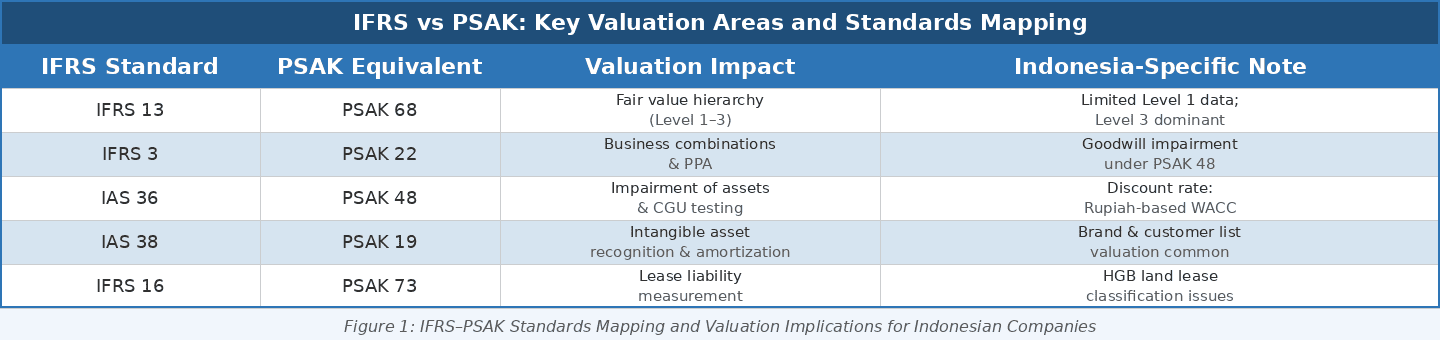
The most valuation-relevant IFRS standards and their counterparts in PSAK are better known by heart. The IFRS 13 (Fair Value Measurement) is incorporated in PSAK 68 where they provide the three-level hierarchy of fair value inputs. The IFRS 3 (Business Combinations) is related to the PSAK 22, which regulates the accounting of acquisitions and allocation of purchases prices. Goodwill and other impairments (IAS 36 (Impairment of Assets)) PSAK 48 is an impairment testing standard. The IAS 38 (Intangible Assets) is in line with PSAK 19, which deals with the recognition and amortization of intangibles. And IFRS 16 (Leases) is aligned with PSAK 73 that presented the concept of right-of-use asset recognition with direct valuation implications.
All these pairs possess nuances that bring to practice divergence of valuation. The next sections address the five areas in which those divergences are most relevant to the Indonesian companies.
Figure 1: Licensed IFRS PSAK Business Valuation Indonesia Mapping and Valuation Implications
Five Key Areas of Where IFRS Valuation Standards Shape Indonesian Financial Reporting
The convergence of the IFRS financial reporting and valuation in Indonesia are most evident in five areas. Both have practical implications that the finance professionals are left to come across on a regular basis in the support of audit, advice dealing and management reporting.
Fair Value Measurement of PSAK 68 / IFRS 13.
The Indonesian valuation that is based on IFRS is rested on fair value measurement. PSAK 68 is fair value that would be received to sell an asset or paid to transfer a liability in a well-organized transaction between market participants on the measure date. This concept of exit price is not complex, however, its implementation in Indonesia is highly judgmental.
The IFRS 13 fair value hierarchy has three levels of inputs. Level 1 prices are quoted on active markets, the most reliable, but not always available on the types of assets that the Indonesian companies own. Level 2 inputs are market data other than Level 1 prices observable (i.e. yield curves, credit spreads, etc.). Level 3 inputs are the ones that cannot be observed directly due to the assumptions that the entity makes regarding the expectations of the market participants and are the most frequently employed in the Indonesian practice of valuation.
Why is the Level 3 so hegemony in Indonesia? Due to the fact that the capital markets of the country though expanding are not at the stage of generating as much of the data on transactions as more developed markets would generate. Some of the assets that do not give prices include unlisted equity investments, investment property in secondary cities, specific manufacturing equipment in specializing products or any other intangible assets and there are no quoted prices or market transactions that are directly comparable. Valuers will have to construct their models, and report their assumptions in an exercise of rigour, and prove their results by whatever evidence is to be found in the market. This is both an analytical challenge and a disclosure challenge as PSAK 68 needs a significant amount of narrative and quantitative disclosure of Level 3 assumptions.
Purchase Price Allocation and Business Combinations Under PSAK 22/ IFRS 3.
According to the companion article about PPA valuation, the present PSAK 22 stipulates that all business combinations must be recorded with the use of the acquisition approach, i.e. all identifiable assets and liabilities must be recorded at fair value on the date of acquisition with any residual impairments being recognized as goodwill. This is IFRS 3 in the context of Indonesia.
The valuation issue presented in this case is how to recognize and measure the intangible assets that may never have been recognized on the balance sheet of the acquiree. A consumer brand of more than thirty years, a system of distributor relations established by an original entrepreneur, a home-cooked software system, none of these would normally be reflected in a pre-acquisition PSAK balance sheet. However, according to PSAK 22, in case they are separable or stem out of contractual or legal rights, they should be considered and valued at fair value. This is usually an eye opener to the Indonesian firms making their first big acquisition.
Impairment Testing Under PSAK 48/ IAS 36.
One of the most judgmental process of valuing in the IFRS financial reporting is impairment testing. The allocation of goodwill to cash-generating units (CGUs) and an impairment test should take place upon occurrence of indicators every year, as stipulated in PSAK 48. A CGU has a recoverable amount that is the greater amount of its fair value less expenditures to dispose of it and its value-in-use.
Value-in-use computation involves modeling of discounted cash flow at the CGU level with discount rates that consider the risks of the CGU. In Indonesia, it creates immediate problems: the cost of capital of a Rupiah-denominated cash flow of CGU cash flow needs to be an IDR-based cost of capital, but many Indonesian firms use USD-based WACC inputs as a starting point then tries to adjust to Rupiah. Carrying it out wrongly leads to systematic bias during impairment calculations. To construct a proper Indonesian WACC, one needs a Rupiah risk-free price (usually an Indonesian Government Bond yield), an equity risk premium that is set to the size and risk of the Indonesian market, and a size or company-specific risk premium where necessary.
Valuation of Intangible Assets Under PSAOB 19 / IAS 38.
The recognition, measurement and amortization of intangible assets are managed by PSAK 19. Although the standard has mostly been consistent with IAS 38, practice in Indonesia has certain considerations. Intangible value in assets that local accounting has never previously registered in the past-regional brand equity, distribution rights, franchise networks, and proprietary operational processes exist as common goods of the Indonesian companies.
In the first instance of the valuation of these assets (whether under an impairment review, the context of a PPA, or a statutory revaluation) the Indonesian valuers are required to take assumptions about useful lives, amortization profiles, and terminal values, which may not have any direct local data basis. The judgment involved is high and the result-amortization of charges in the income statement, possible risks of impairment in case the projections are not realized is high.
PSAK 73 / IFRS 16 Lease Accounting and Right-Of-Use Asset Measurement.
Indonesian listed companies became subject to PSAK 73 in 2020 which brought about a radical change in the accounting of leases. Formerly off-balance sheet operating leases were changed into right-of-use (ROU) assets and lease liabilities on the balance sheet. These ROU assets and liabilities must be measured by discounting the future lease payments at the incremental borrowing rate of the lessee, which in turn must be estimated where the implicit rate in the lease can not be easily determined.
In the case of Indonesian companies, PSAK 73 generated direct questions of evaluation. Incremental borrowing rate must represent the cost of borrowing in Rupiah in relation to the particular lessee, the particular date in which the lease is entered into, and a period that is equal to the leasing period. In companies that have several properties in a number of cities, this may imply dozens of various discount rates charged on the lease portfolio. Besides that, the distinctive land rights regime in Indonesia, in which land can be held either under HGB (right to build) or HGU (right to cultivate) with periodical tenures), poses challenges to classifying leases which is not such a concern in other jurisdictions and necessitates expert interpretation.
Table 1: Commonly Applied of Licensed IFRS PSAK Business Valuation Indonesia
| Valuation Context | Primary Method | Key IFRS/PSAK Standard | Common Indonesia Challenge |
| Investment Property Valuation | DCF / Direct Capitalisation | PSAK 13 / IAS 40 | Limited comparable yield data in Tier 2/3 cities |
| Goodwill Impairment (CGU) | Value-in-Use DCF | PSAK 48 / IAS 36 | Rupiah WACC construction; CGU definition |
| Listed Equity (Fair Value) | Market / Income hybrid | PSAK 68 / IFRS 13 | Thin trading volumes on IDX |
| Brand / Trademark | Relief-from-Royalty | PSAK 19 / IAS 38 | Royalty rate benchmarking; limited local data |
| Lease Liability (ROU) | Discounted Cash Flow | PSAK 73 / IFRS 16 | Incremental borrowing rate; land right tenure |
| Biological Assets (Plantations) | Fair Value less Costs | PSAK 69 / IAS 41 | Commodity price volatility; mature vs bearer |
Source: Compiled from common IFRS valuation practice observed in Indonesian financial reporting and transaction contexts (Licensed IFRS PSAK Business Valuation Indonesia)
Practice of Licensed IFRS PSAK Business Valuation Indonesia
The abstract forms come to life when you follow them on the basis of actual transactions and reporting exercise. The cases discussed below indicate trends that can be usually observed by those IFRS valuation professionals operating in Jakarta and the Indonesian archipelago.
Case One: Revaluation of Investment Property of a Listed Property Developer.
Its existing policy of PSAK 13 is to value its investment property portfolio at historical cost as it is carried by a mid-sized publicly listed property developer in Jakarta. At a time when the company decided to have a dual listing in the international exchange and hired international advisers, it was required to prepare the IFRS compliant reporting package. The IAS 40 compelled investors to note investment properties at fair value that resulted in a large-scale revaluation exercise of portfolio in Jakarta, Surabaya and Balikpapan.
A mix of the direct capitalisation and the discounted cash flow methods was employed by the valuation team where net initial yields were adjusted to observable transactions within the market in similar locations. In the case of the Jakarta Grade A commercial assets, Level 2 information was accessible based on observable commercial transactions related to leasing and arm-length sales that were made in the near past. In case of the mixed-use development in Balikpapan, the small market of comparables necessitated the Level 3 approach to which the yield assumptions are obtained via expert judgment, and they are adjusted to local market dynamics such as resource sector exposure.
Total fair value uplift was estimated at about IDR 2.3 trillion, which resulted in the revaluation of assets in the equity section and the creation of deferral of tax amounting to about IDR 575 billion. It took four months of fieldwork, coordination of the valuation team, the external auditors and the OJK-registered independent appraiser as well as large disclosure notes on Level3 assumptions.
The most important lesson: IFRS investment property revaluation is not that easy and involves marking assets to market. It involves a justifiable governance of all asset classes in all geographies, all-inclusive disclosure of all Level 3 assumptions and an apparent audit trail of market evidence to valuation finding.
Practitioner note:
In the case of Indonesian property portfolios where properties are located in Tier 2 and Tier 3 cities, there is no similar transaction data and, therefore, the valuers are almost automatically left in the Level 3 territory. Record your assumptions on yield and growth rates as far as you can support them by what you can observe in the market- place- auditors will investigation every contribution that people cannot prove on their own.
Case Two Goodwill Impairment Review of an Indonesian Conglomerate.
A conglomerate based in Indonesia had earlier taken over a local chain of retail outlets. The acquisition was acknowledged in PSAK 22, where IDR 890 billion of goodwill were identified and charged to one CGU that had the retail business. With the retail industry also experiencing headwinds due e-commerce disruption and changing consumer trends, the external auditors created an impairment review under PSAK 48.
To calculate the valuation, the valuation team was involved to develop a value-in-use calculation of the retail CGU. The exercise involved a five-year free cash flow forecast, which was prepared and approved by the management, the terminal value, and a Rupiah-denominated WACC. The WACC has been calculated by using an Indonesian Government Bond yield of 6.8 which is the risk free rate, a market risk premium of 7.2 on a blended Damodaran country risk premium method, a beta based on similar Indonesian and regional listed retailers and a size premium based on the mid-market nature of the business.
This gave a WACC of 13.4% – significantly greater than the WACC of 8.1% suggested by the treasury team of the group but in USD. This disparity, in itself, shifted the calculation of value-in-use out of the position of no impairment to a determination that IDR 240 billion of goodwill was impaired and had to be written down immediately. The case exemplified such an error, which is surprisingly frequent: the use of the USD cost of capital in the calculation of Rupiah cash flows and does not involve an inflation or inflation adjustment.
The lesson was obvious and persistent: when conducting impairment reviews in Indonesia, the currency denomination of the discount rate has to be equal to the currency denomination of the projected cash flows. It is not only a technical error to confuse the two, but can also give directionally wrong and materially misleading conclusions.
Case Three: Implementation of PSAK 73 to a Multi-Site F&B Chain.
In 2020, the Indonesian finance fraternity was yet to internalize the implications of PSAK 73 when it came into effect. A case in point was one of the most educative early cases where a mid-market food and beverage chain had more than 180 restaurant outlets totaling Java and Sumatra all operated under operating leases previously off-balance-sheet.
The implementation team was confronted with a direct challenge which is to compute the incremental borrowing rate of each lease. The lease dates of the outlets, the outlet space of the whole premium mall at Jakarta and the stand alone units in the provincial cities, the duration of the lease between two to ten years, required the team to have a system of rate allocation, instead of calculating the lease separately. They built a rate grid depending on both lease tenor and location tier, using what could be observed in the market between the rates at which the company was borrowing and additional market credit spread information on similar borrowers together with the treasury team of the company and external advice.
The ensuing identification of the right-of-use assets of IDR 1.1 trillion and a matching amount of lease liabilities made a big difference in the leverage ratios of the company- it brought in covenant headroom talks with the three lenders. Lease liabilities had a negative impact on net debt of the company that influenced debt-to-EBITDA ratios that are used in financial covenants. Implementing PSAK 73 projects require finance professionals to not only be aware of the accounting mechanics, but also the impacts on the financial KPIs, compliance with covenants and measurements of credit in the downstream that lenders and investors observe.
Challenges, Process, and Learnings of Licensed IFRS PSAK Business Valuation Indonesia
The theory of IFRS valuation standards for Indonesian companies is the point of departure. The practice of their application entails going through a particular range of challenges which are constantly faced by the experienced practitioners in Jakarta. This is a straight forward evaluation of the challenge.
The Data Scarcity Problem
The IFRS valuation models presuppose the presence of observable markets data. In Indonesia, such information is normally thin, late or completely unavailable on the asset classes under consideration. As it continues to expand, the Indonesia Stock exchange has had a small trading volume beyond the index constituents that are in the top quartile. The property market, which is not within the CBD of Jakarta, generates little publicly disclosed transaction prices. And the private firm M&A market, in which the majority of Indonesian deal action is provided, produces virtually no publicly available pricing data whatsoever.
The practical implication is that Indonesian valuers operate in the Level 3 space in which they build assumptions based on indirect evidence, expert judgment, and regional comparables. This per se is not very problematic, Level 3 valuations are allowed and are actively practised all over the world, but requires strict documentation, visibility of sensitivity analysis, and disclosure of the uncertainty of the estimation. Finance professionals that have acquired the Level 3 process, and can explain why certain assumptions are logical, are much more valuable than someone that understands the mechanics of the models.
Locating the Right IFRS Valuation Expert in Jakarta.
In cases where Indonesian companies need to obtain IFRS compliant valuations, be it audited financial statements, transaction advisory, regulatory reporting or dual reporting they are not insignificant. The IFRS valuation knowledge market in Jakarta is dominated by big four transaction advisory regulators, specialist boutique valuation regulators, and licensed public appraisers (KJPP) having been trained in international approach.
Not all appraisers and financial modelers are IFRS valuation experts. The main distinguishing factors to consider are: proven experience of the particular IFRS or PSAK standard to be applied in the engagement; and understanding of Indonesian specifics (land rights, OJK disclosure requirements, Rupiah WACC construction); and the capability of preparing valuation reports that are scrutinized successfully by Big Four auditors and, in any case, OJK audit. In the case of complicated or high-stakes engagements, the quality of the written valuation report including the narrative of its methodology, the disclosure of its assumptions, and sensitivity analysis is as significant as the numbers.
The Auditor, Valuer Relationship.
The military relation between the independent valuer and the external auditor is among such most consequential relations in any IFRS valuation engagement in the Indonesian practice. Auditors must also consider the reasonableness of such fair value estimates by the management, and in instances where the estimates are made by an external valuer, the auditors should evaluate the competence and independence of the valuer, as well as the sufficiency of their work.
The conflict between valuers and auditors (whether it be discount rates, similar selection, assumptions about useful life, or identification of intangible assets) is not unique and may slow down the issuance of the financial statements to a crawl. It is best to resolve this risk by engaging the auditor in the scoping processes earlier than the valuation commences, by releasing methodology outlines earlier than fieldwork is finalised and by agreeing on the points of principle earlier than they turn into disagreements.
The PSAK to IFRS Conversion Problem.
With more and more Indonesian firms beginning to interact with foreign capital markets, foreign capital providers, and cross border financiers, the need to report financial information in a manner that is compliant with the regulations of IFRS, and as opposed to or in addition to PSAK-based accounts is on the increase. This conversion exercise is technical in nature since the differences between PSAK and full IFRS may not be sweeping but may be material in certain areas.
The pattern of PSAK to-IFRS conversion in the Indonesian practice has involved the differences between investment property measurement policy, the treatment of biological assets under PSAK 69 and IAS 41, dissimilarity on timing of adoption of newer standards under IFRS and the lack of certain IFRS-mandated disclosures in PSAK presentations. Finance practitioners that are conversant with these conversion points; those that can prepare or review the reconciliation schedules that reflect them; are in high demand within the Indonesian companies that have international ambitions.
Final Reckoning: Construction of IFRS Valuation Competence in a Transitional Market (Licensed IFRS PSAK Business Valuation Indonesia)
The financial reporting environment in Indonesia is at the stage of a controlled and rapidly growing convergence on global standards. PSAK is already significantly aligned to IFRS and the way is obviously to more harmonization. Among those in the financial profession engaged in or entering this market, IFRS valuation is not a specialized area- it is a generalized area of competence which will be required in all of the transaction advisory, corporate finance, audit support and financial reporting parts of the financial professional.
Those who are able to perform three things at the same time, which are, to know the technical needs of the corresponding IFRS and PSAK standards, to apply best valuation methodology to those standards, and to be fully aware of the special market dynamics of Indonesia are those professionals who will obtain the best careers in Indonesian financial services. The third skill is usually not taken seriously. Technically sound IFRS valuation reports that are poorly communicated, or that do not reflect consideration of the questions that will arise in the minds of the auditors, are the source of friction that kills the value of analytical work that was behind the preparation of such reports.
The following are the most practical steps that the junior and the mid-level professionals should undertake to develop the real IFRS valuation skills within the Indonesian context:
- Review the IFRS 13 disclosure documents in the annual reports of Indonesian companies listed in the IDX, especially those with a large investment in property, biological assets, or goodwill. These revelations are a masterpiece of how Level 3 assumptions can be expounded and argued out in practice.
- Be able to construct a Rupiah-denominated WACC by hand. Know how to calculate the Damodaran country risk premium: how is a beta built on Indonesian and regional comparables; how does the adjustment of inflation differentials when calculating cross-country derivation discount rates?
- Research the transition disclosures of the PSAK 73 of Indonesian companies that used the standard in 20202021. That First Year Disclosures incremental borrowing rate methodologies and ROU asset reconciliations guide is a convenient guide to the way the standard was operationalized.
- Build an effective understanding of the Indonesian land rights (SHM, HGB, HPL) and their various legal characteristics and tenure profiles in influencing the asset valuation under IFRS. This is an eminently Indonesian skill that is not dealt with directly by international structures.
- Find activities or engagements that involve the use of external auditors in fair value issues. The skill to manage audit requests on valuation assumption, in a reasonably composed and clearly documented form, is a professional skill that can be learnt only through experience.
The M&A activity in Indonesia is increasing, the capital markets are becoming more entrenched, and the corporate sector is becoming more involved in international standards and international investors. There, IFRS expertise in valuation is not a mere academic degree but an experience-based distinguishing factor that opens channels to opportunity, makes decisions about financial matters more productive, and proffers an aura of professionalism that further careers. Begin erecting it, and erect it strictly.
Licensed IFRS PSAK Business Valuation applies recognised valuation methodologies to estimate business value while complying with IFRS and Indonesia's PSAK financial reporting standards.
Compliance ensures business valuations are prepared consistently, improving the accuracy, transparency, and credibility of financial statements and corporate transactions.
Professionals typically use the Income Approach, Market Approach, and Asset-Based Approach depending on the business, industry, and valuation purpose.
Licensed professionals provide independent, reliable valuations that support regulatory compliance, strategic planning, and well-informed financial decisions.