
10 Common Situations Where Companies Require Valuation Services
A Professional Guide for 2026 and Beyond
10 Common Situations Where Companies Require Valuation Services: The Landscape in 2026
In 2026, the business valuation services industry is poised for a dramatic change in its fundamental nature, revolutionizing the global market. The business valuation services industry is set to undergo a pivotal transformation in 2026, reshaping the global market’s landscape. The combination of tighter credit conditions and stringent regulations, cross-border M&A transactions, and changing IFRS and GAAP principles and guidelines, coupled with the increased availability of intangible-heavy business models, has placed valuation firmly on the agenda of the boards. During the last decade, the demand for professional company valuation firms has been increasing at a faster rate than ever before, due to a number of factors, including regulatory pressure and increased scrutiny of investors.
However, there are still many organisations that take a reactive approach to valuation, where an appraisal is required when a dispute brews, a deal breaks down, or a regulator calls. Reactive strategies are not working: they are trying to fit timelines and overcharging for services, and they are trying to make decisions on “old” numbers. The winning companies in today’s market are those that have proactive valuation practices throughout their strategic planning cycles: continuous annual company valuation services, stress testing assumptions before entering into transactions, and making annual independent valuations a continuous governance practice, not an event.
Detailing the expert solutions, approaches, and frameworks that set best practice apart from costly guesswork, the guide covers ten of the most common situations that necessitate a formal valuation engagement, ranging from M&A, shareholder disagreements, brand strategy, and regulatory compliance. From CFO to in-house counsel, private equity investor, or founder, these pages provide practical and informative information for each phase of the corporate life cycle.
Foundational Knowledge of 10 Common Situations Where Companies Require Valuation Services: Setting the Stage
Core Principles of Business Valuation
The essence of valuation is to estimate the economic value of an asset, business, or liability at a certain period of time. It is important to recognise that there are three broad methodological approaches that are evident in most of the assignments: the income approach (discounted cash flow and capitalised earnings), the market approach (comparable transactions and guideline public companies) and the asset approach (adjusted net assets). A good corporate valuation advisory engagement will build a solid conclusion of value by triangulating over at least two of those pillars.
Key Terminology Every Professional Should Know
The terms of fair market value, fair value (IFRS 13), investment value, and liquidation value are not synonymous, but are often confused during negotiations and in court proceedings. The issue of intangible asset valuation is complicated and complex for assets that are either separable or contractual, and assets that are inseparable from the enterprise. There is a need to allocate the purchase price in purchase price allocation services to acquired assets valued at acquisition-date fair value, which is regulated by IFRS 3 and ASC 805.
The High Cost of Ignoring These Common Scenarios
Boards that wait until the storm hits to deal with valuation face a compounding penalty, as they are liable to over-pay for acquisitions, face damaging litigation by shareholders, may see tax authorities adjust their views, and can fall short in the capital markets. For example, if the PPA valuation services is wrong and a mid-market acquisition, then years of restatement and regulatory enquiries can follow. The up-front expense of engaging a professional company valuation firm is not an “expense,” as it’s a good way to protect yourself from the much greater expense of being wrong.
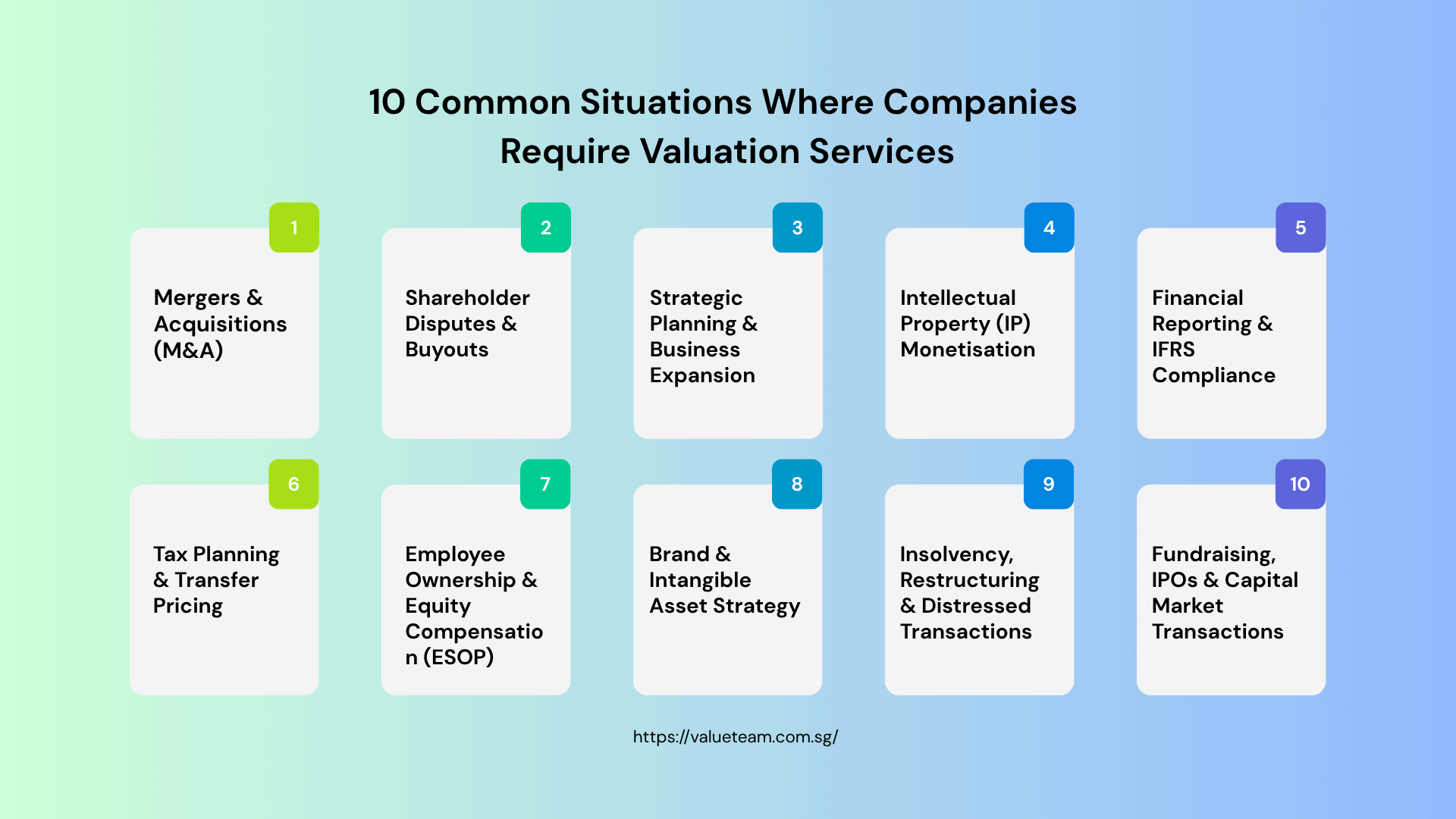
Deep Dive: 10 Common Situations Where Companies Require Valuation Services & Expert Resolutions
Situation 01: Mergers & Acquisitions — Knowing What You Are Really Buying
Business valuations are still dominated by M&A, as the largest source of valuations worldwide. When buying or selling, the consequences for the company are life-changing: they may induce a loss of value in a target by overpaying for it or inadequate compensation in a divestiture, leading to litigation.
The expert resolution process starts before the exchange of term sheets. A defensible anchor for negotiators is achieved by a credible independent business valuation of the target, including the tangible assets, working capital normalisation, and a sophisticated valuation of in-force contracts, technology and customer relationships (intangible assets). Post-signing, purchase price allocation (PPA) services help allocate the purchase price of the acquisitions to the identifiable assets and liabilities as per the IFRS 3 valuation services. It is more than an accounting convenience; the separation of goodwill from identifiable intangibles impacts the amortisation charges, tax deductions, and impairment risk in the future. Those companies that do not engage in this process or under-resource it often find that their projections for earnings turn out to be on shaky ground. The key to a value-creating deal and a costly lesson is when you hire an acquisition accounting valuation specialist at the beginning of due diligence, as opposed to post-closing.
Situation 02: Shareholder Disputes — Turning Conflict into Resolution
Unresolved shareholder disputes are one of the most detrimental issues to corporate value. The main issue in the conflict, regardless of whether it’s a minority buyout, a tie-in in the partnership, or allegations of oppression, is invariably the value of the business — and crucially, how.
A valuation is not only technically precise but also needs to be clearly independent for shareholder disputes, in order to be required by courts and arbitration panels. In a mid-market company, the choices of valuation basis (fair market value versus fair value, and whether to include minority or marketability discounts) can be significant and can make the difference in the outcome of tens of millions of dollars. The professional company valuation firm hired to value a company in a dispute needs to be able to withstand cross-examination, provide an evidentiary company valuation report, and be free from the advocacy pressures that plague partisan experts. Best practice is for parties to agree to a joint single expert report or for them to exchange expert reports within a framework timetable which will limit the scope of issues before the tribunal on areas of disagreement. The sooner a qualified corporate valuation advisory is hired, the higher the likelihood there will be a negotiated resolution of the case, which will spare the undue expense and risk of litigation.
Situation 03: Strategic Planning — Valuation as a Growth Compass
Businesses that use valuation as a strategic process, instead of an afterthought of the transaction, have one key advantage: They can make capital allocation decisions with greater clarity and insight based on the fact that the value they are creating and destroying is known throughout the portfolio.
The impact of each business unit, brand, and intangible asset is mapped to enterprise value, allowing leadership to prioritise investment in certain businesses, relationships are identified as being undermonetised, and legacy assets are identified for divestment. In particular, in a subscription or service business, the present value of future revenue from existing customers from the revenue recognition, which can vary markedly from book value, may be of great interest to the customer relationship valuation. The economic life of proprietary platforms and the cost vs build question when acquiring technology also comes to the fore in technology asset valuation. Businesses that engage in company valuation services based on strategy and not just compliance have better resource allocation, investor stories, and a more conservative strategy of organic growth versus M&A. Put simply, an effective independent business valuation does not take a snapshot of a company, it is a strategic tool.
Situation 04: Intellectual Property Monetisation — Unlocking Hidden Value
Many modern enterprises have intangible assets that don’t show up on their balance sheets, but can be quite valuable: proprietary algorithms, patents, trade secrets, software platforms, and brand equity. This is the field of study known as intellectual property valuation.
For organisations seeking IP monetisation measures, including IP licensing, IP securitisation, joint ventures, or outright sale, the demand for the appropriate methodologically and geographically sound IP valuation services is on the rise. There are three methods of relief from royalty: the multi-period excess earnings method and the with-and-without approach—all applicable to various types of assets and various types of transactions. Technological obsolescence curves are even more aggressive than accounting amortisation curves; they need to be considered in software and IP valuation. They are essential components of a company’s consideration in terms of trademark valuation services or brand equity valuation when it is in the process of sublicensing its brand to new geographies or new product categories – the transfer price should be sustainable not just commercially, but in terms of transfer pricing as well. Having brand valuation experts who have a cross functional background in both economics and IP law makes it possible to draw scientifically defensible and sound conclusions of value.
Situation 05: Financial Reporting — Compliance That Builds Credibility
Valuation of financial reporting has been one of the most technically challenging and common issues companies would seek specialist advice on when the convergence of IFRS and US GAAP came to the fore. IAS 36, services to allocate fair value, as required by IFRS 3 following a business combination, is a time when professional appraisal skills are required; likewise, the measurement of financial instruments at fair value as required by IFRS 9 and ASC 820 is a time when professional appraisal skills are required.
The post acquisition valuation is especially complicated as it is required to be done within the measurement period (usually the first year following the acquisition date) but the auditor expects it to be defensible at the balance sheet date. Mistakes in goodwill and asset allocation valuation not only raise the restatement risk; it also draws the regulators’ attention and reduces the investors’ trust in the quality of earnings. By having a PPA valuation services provider from the beginning of the transaction team, audit concerns can be avoided and close timelines can be shortened and a report created that will stand the test of audits. Likewise, the annual impairment review will call for business valuation services that are attuned to market conditions, new discount rates and new long-range plans – a transaction that is more of a relationship that will grow over the years than one that will just happen once.
Situation 06: Tax Planning & Transfer Pricing — Staying on the Right Side of Authorities
Transfer pricing audits have dramatically stepped up in sophistication for revenue authorities in all key tax jurisdictions and the valuation of intercompany transactions – especially of intangible assets and IP – is one of the most vulnerable areas of corporate tax compliance.
In a transfer pricing context, valuation of intangible assets should be based on the OECD’s DEMPE framework where the profit is assigned to the entity that does the development, enhancement, maintenance, protection, and exploitation functions. The valuation of intellectual property brands is used to set royalty rates for trademark licences, and technology asset valuation is used to determine the arm’s length consideration that is given to cross-border technology transfers. Family business estate and gift tax valuations and fair market value charitable contribution valuations are among the use cases that demand that you engage an independent business valuator — not an option. The effects of inadequate valuation support in tax controversy cases can be huge, not only because of the back taxes and penalties that can be imposed, but also because in very bad cases, it can lead to potential criminal referrals. The only safe thing to do is to use a corporate valuation advisory firm with documented and OECD-compliant methodologies.
Situation 07: Employee Ownership & Equity Compensation — Fairness You Can Defend
Equity based compensation has been growing in variety – from stock option plans listed on stock exchanges to phantom equity in private companies and employee ownership trusts – and the need to periodically, independently value the underlying equity shares has never been greater. IRC Section 409A has a requirement in the United States for the common stock to be valued independently at fair market value before options are granted. In the UK, Enterprise Management Incentive schemes will need to be valued by a party approved by HMRC.
In addition to meeting legal requirements, a company’s attitude to their equity as a tool for compensation will communicate a strong message to talent. An artificially high valuation will decrease the morale of these who have options, but over a conservative valuation will not bring in the quality of executive that equity is designed to attract. Company valuation services for equity compensation, therefore, have to be both defensible and realistic in light of the business’ stage and the discounts for control and marketability. Employee ownership transactions (or trust) are a growing succession strategy in the UK and are a transaction where the business valuation needs to be independent of the selling shareholders and the trustees, to ensure that the transaction price reflects fair market value and that HMRC would not take issue with the valuation.
Situation 08: Brand & Intangible Asset Strategy — Making the Invisible Visible
Brand valuation now plays a role in the boardroom as a strategic tool and is no longer a nice-to-have item for the marketing department. For consumer goods businesses, where brand equity can comprise up to 70% of enterprise value, it’s a governance imperative rather than a vanity exercise to know what value brand assets bring to the company’s balance sheet.
Brand asset valuation helps businesses to make informed decisions on brand architecture, such as extending the brand into new categories, removing a brand that is not performing well or investing in a repurposed brand. Valuation of trademarks and brands may also be necessary in the event of a holding company granting a licence to its operating subsidiaries, when a brand is transferred as part of a joint venture or in the event of a reputational event and the brand has to be assessed for impairment. The overall process ofvaluation of a brand for intellectual property is normally done by the relief from royalty approach, based on the valuation of other intellectual property licensing transactions, and modified to reflect the strength of the brand based on awareness, loyalty and pricing power. There is a constant struggle between finance and marketing teams and the ideas that come out of the quantitative vs the qualitative aspects of brand value. Leading brand valuation consultants combine financial modelling and consumer research to deliver results that appeal to both sides of the equation, overcoming the typical disconnect between the numbers and the business sense.
Situation 09: Insolvency & Restructuring — Clarity in the Most Difficult Moments
Valuation professionals are called upon to perform in a different manner in distressed situations. The range of value – going concern, orderly liquidation and forced sale – should be firmly established when a company enters administration, receivership or a formal restructuring process as the selection of value basis will have a significant impact on creditor recovery and feasibility of a restructuring plan.
Valuation of businesses in distress situations will need to be carried out within tight timeframes, with limited information, and with the rigour that is acceptable to challenge by creditors, courts and/or insolvency practitioners. In the following situations, valuation of intangible assets is often of paramount importance: In a distressed retailer’s brand, the unsecured creditors might well be able to sell the only intangible asset—its brand—at a high price. In a software business, the IP portfolio may be the most valuable asset for unsecured creditors. In a manufacturer, the customer contracts might be the largest unsecured asset. Likewise, it is crucial for valuation of intangible assets in a pre-pack administration to be arm’s length to ensure it is not open to challenge under the provisions of transaction-at-undervalue. A professional company valuation firm with restructuring experience is familiar with not only the technical requirements of the assignments, but also the procedural requirements, and can create defensible work product in the highly intense atmosphere of distressed situations.
Situation 10: Fundraising & Capital Markets — Credibility That Attracts Capital
The credibility of the valuation story provided by a company is directly related to the cost of capital to the company, whether in the case of a Series A round, or an IPO, or hybrid financing. Independent business valuation has been significantly improved by institutional investors, sovereign wealth funds, and private equity sponsors, each of which has raised the bar in terms of the level of independent business valuation that they will require prior to investing.
Pre-deal company valuation services can perform two functions: 1) they can give management an anchor to real market pricing for their expectations, and 2) they can set the groundwork for investor discussions, instead of merely aspiration. As a result, the value of brands such as technology and consumer brands has increasingly been included in investor materials because the traditional valuation metric that focuses on the assets of the company does not include the factors that drive long-run returns. The best practice for companies that are going public where exchanges mandate an independent fair value opinion (or require credit ratings for the fundraise that include intangible asset quality) is to engage a corporate valuation advisory firm months in advance of the fundraise, not days. Investors make their valuation assessment based on the value of the valuation work, which is considered a reflection of the financial thinking of management.
10 Common Situations Where Companies Require Valuation Services: Advanced Frameworks & Methodology
The Integrated Valuation Governance Framework
The most advanced companies have instituted an Integrated Valuation Governance (IVG) program that places valuation for strategic planning on the board agendas for annual meetings, links it to the M&A screening program, and incorporates it into the transfer pricing program documentation cycle. The IVG framework isn’t about individual valuations; it’s about intelligence and a system in which one valuation leads to another, which is validated by the next one.
At the heart of IVG is the creation of a valuation policy: a documented framework of valuation methodologies, policies, and procedures governing the discount rate and engagement procedures, which are approved by the audit committee. This policy resolves any “let’s use this methodology” issue, can minimise the risk of disagreement with the auditors and tax authorities, and can give consistency when applying the practice to purchase price allocation services, to impairment reviews, and to equity compensation valuations.
Integrating AI and Automation into Valuation Workflows
New machine learning tools are being used to speed up similar transaction search, automated financial normalisation adjustments, and stress test discount rate assumptions over thousands of scenarios in seconds. These features can significantly save time and costs of business valuation services and enhance the extent of sensitivity analysis that decision-makers can use. AI, however, is meant to complement, not supplant, the professional judgment of the analysts: the process of choosing the right comparables, evaluating risk in the individual company, and interpreting the resulting data within the commercial context are human functions that can’t be automated. The best professional company valuation companies are those that have seamlessly combined the efficiency of AI with human expertise.
How Professional Valuation Infrastructure Solves All 10 Situations
The ten situations have one thing in common: They all require a trusted, consistent and business-savvy valuation partner. A firm with a proven track record in intangible asset valuation, brand valuation services and PPA valuation services and corporate valuation advisory services, is the infrastructure that enables reactive, single-point engagements to become a proactive strategic asset. The higher the quality and efficiency of each assignment you perform under that advisor, the better the quality and efficiency of the next assignment; and the more weight every assignment you make carries with the auditors, the regulators, and the counterparties.
Comparative Analysis: Manual vs. Automated Solutions
For many mid-market businesses, the typical business valuation process (manual financial modeling, paper-based comparables and review cycles in sequence) is still the foundation of their approach. It delivers defensible results when in the hands of experts, but has substantial time and cost penalties: in the manual paradigm a fair value allocation services engagement typically takes 6-10 weeks from data room access to final report delivery.
This process can be made automated and with AI assistance, enabling the processing of similar tasks in a fraction of the time, two to four weeks, and also broadening the scope of the analysis. Previously, the Monte Carlo simulation took hours to run – now it takes a matter of minutes. Similar database of transactions has been previously filtered by hand and now is being algorithmically filtered and the relevant results ranked. An automated-first approach creates efficiency which directly translates to fewer compromises of analytical depth that must be made on reporting dates to meet audit deadlines and reduced audit fees for goodwill and asset allocation valuation and annual impairment reviews.
The 12 month cost benefit analysis is an eye-catching one. A company that is undertaking four separate valuation services engagements a year (impairment review, PPA valuation services exercise, brand valuation services update and equity compensation appraisal) can save 25-40% on fees without compromising the quality of audit and legal defensibility by utilizing a provider that has an integrated technology-based platform.
10 Common Situations Where Companies Require Valuation Services: Case Studies & Real-World Applications
Example A: A Mid-Market Technology Company Navigating Situations 2 & 5
This was a private, 180-person software firm at what was its fifth birthday. At the same time, the company had made another acquisition 12 months prior, and hadn’t yet worked out its acquisition accounting valuation. A major issue in the audit was the delayed IFRS 3 valuation services assignment and a growing dispute with shareholders which could escalate to a lawsuit.
To solve both the problems at once, the company selected a single professional company valuation firm, which allowed them to leverage the financial model developed for the post acquisition valuation for the shareholder dispute appraisal, resulting in a reduction of some 30% in the total fee spend. The valuation for shareholder disputes was done under a fair value basis with the proper lack of control discounts agreed to by both parties’ counsel, and the argument was resolved without litigation. No material changes were made to the methodology for the PPA valuation services report, which was delivered within the audit measurement period, and which the auditor accepted.
Example B: A Global Consumer Brand Managing Situation 3
A global consumer goods company with its business spread over 12 markets had to undergo a strategic review and determine if its range of regional sub-brands was generating or eroding value against a house-of-brands or a branded-house approach. The company ordered a brand valuation project including all fourteen brands in its portfolio, which included both relief-from-royalty brand valuations and brand equity brand valuations.
What was revealed from the valuation of trademarks and brands is that, after all, three regional brands, despite having a high level of awareness score, were not returning sufficient financial returns and would need an unreasonable investment in order to sustain their operation as a standalone brand. Two brands, on the other hand, had three times the book carrying value of their assets in latent brand asset valuation. By contrast, 2 brands had three times the book carrying value of their assets in latent brand asset valuation, signifying a high level of potential for underlicensing. The consultants in charge of the brand valuation strategy suggested an approach of brand consolidation, which relieved the marketing budget of the three poor performing brands and reallocated it to international licensing of the two most valuable brands. In just 18 months, it has signed contracts in three new markets and saw its portfolio-level brand contribution margin improve by 14 percent.
10 Common Situations Where Companies Require Valuation Services: Future-Proofing Strategy
Valuation is going to change quickly during the rest of the decade. As of late, the demand for corporate valuation advisory is changing in a few trends, which will further accelerate by 2030.
The growing number of digital and data assets, such as AI training datasets, algorithmic models, digital twins, and tokenised assets, will generate new intangible asset valuation categories that are not currently supported. The development of digital and data assets – including AI training datasets, algorithmic models, digital twins, and tokenised assets – will present new intangible asset valuation categories that current frameworks are incapable of tackling. However, standards setters are making headway in filling this void, and companies that invest in learning about how to value their technology assets today will be better prepared when the standards are fully defined.
Second, financing linked to ESG is generating demand for valuation for strategic planning that takes into account carbon liability, stranded asset risk, and social capital. Incorporating ESG into a business valuation service is no longer optional; it’s the new norm in the market.
Thirdly, cross-border M&A is coming out of its 2023-2024 trough, and the complexity of the multi-jurisdiction purchase price allocation services — where IFRS, US GAAP, and local GAAP standards differ on the rules for purchase price allocation — will become more prevalent, making globally competent acquisition accounting valuation services more valuable and scarce. Those organizations that have established long-term partnerships with professional company valuation firms will benefit from this cycle from a structural point of view.
10 Common Situations Where Companies Require Valuation Services: Frequently Asked Questions
What is the difference between business valuation services and corporate valuation advisory?
Business valuation services as a whole are the big category, which includes any type of formal valuation of a business. Corporate valuation advisory usually relates to a more strategic, continuous advisory arrangement where the advisor provides valuation reports and assists the management in understanding the meaning of the report and assimilation of the results in decision-making processes.
When is an independent business valuation legally required?
In many situations, an independent business valuation is required by law, including those where a company is changing hands under the relevant company law, including buyouts, related party transactions, compliance with IRC Section 409A requirements for equity grants, estate and gift tax valuations, IFRS 3 valuations for purchase price allocations after business combinations, and court-ordered valuations in divorce and partnership dissolution situations.
What does purchase price allocation involve?
Purchase price allocation services refer to the identification and measurement at fair value of all the assets acquired and liabilities assumed in a business combination in compliance with IFRS 3 valuation services/ASC 805. The tangible assets, financial instruments, contingent liabilities, and — most importantly for contemporary business — identified intangible assets like customer relationships, technology and trade names are all included. Goodwill is the difference between the value of the assets and liabilities recognised and the reported net assets of the acquired business.
How are trademarks and brands valued?
The method most commonly used for the valuation of trademarks and brands is the relief from royalty method, where the value of the trademark is calculated as the present value of the royalties that would be paid if it was not owned. This is compared to similar licensing deals, and risk is factored on a brand-by-brand basis. The income approach can also be adapted directly to brand valuation and the income premium of a brand over a unbranded or generic product can be isolated.
How long does an intangible asset valuation take?
Intangible asset valuation is subject to a timeline, which is dependent on the scope and data. The stand-alone assignment of the valuation of IP services for an individual patent portfolio can be done in two to three weeks. The time to complete a comprehensive valuation of intangible assets as part of a post-acquisition valuation – such as for customer relationships, technology and trade names across various entities – is usually 4 to 8 weeks, provided financial data and management are available in a timely fashion.
What qualifies as an intangible asset for valuation purposes?
IFRS and US GAAP require distinguishing between two criteria for recognition of an intangible asset: (i) separability and (ii) contractual-legal.IFRS and US GAAP require separating the intangible asset recognition criteria into two: (i) separability and (ii) contractual-legal. Valuation of intangible assets engagements are common in the valuation of customer relationships, order backlogs, non-compete agreements, technology and software platforms, and trade names. In service and subscription businesses, the most significant section of the customer valuation is typically the CRC (Customer Relationship Value).
Can brand valuation be used for transfer pricing?
Yes. In all cases where a holding company licenses its brand to operating subsidiaries, one of the key inputs of the transfer pricing documentation will be the valuation of the IP brand. The arm’s-length royalty rate should be defensible on the basis of a solid brand asset valuation based on analysis of brand strength and comparable uncontrolled transactions. Defensible brand valuation service documentation has become a first-line risk management tool for the revenue authorities of the OECD, the US, UK, and Australia in all their respective countries, who have all stepped up their scrutiny of arrangements in royalties.
10 Common Situations Where Companies Require Valuation Services: Moving from Theory to Action
The situations covered in this guide aren’t uncommon “edge cases”; they are common scenarios that arise in M&A, shareholder disputes, brand monetisation, financial reporting and more. They are the moments that define corporate life, and they happen more often with the growth of businesses, changes in markets, and adjustments to regulations. All of these scenarios have impacts due to the nature of the underlying valuation efforts. The quality of the underlying valuation efforts influences the outcomes in each of these situations: deal economics, litigation results, tax settlements, investor confidence, and strategic direction.
The organisations that manage these moments well regularly have a similar discipline; they use the services provided by company valuation firms as a strategic activity, rather than just a cost center. They keep a professional company valuation firm in their back pocket to come up with credible, consistent results when they’re pressed for time and have a deep understanding of their business model. They value brand because they do not need to value it; rather, they value it to gain valuable insights that simply can’t be generated by any other assignment. They value brand not because they are legally obligated to value brand, but because the wisdom these assignments provide is truly invaluable.
For many organisations, the first – and most crucial – step toward resolving any of the ten situations outlined here – whether now or in the next 12-24 months – is to start the conversation with a trusted professional now before additional pressure or a dispute makes it impossible to be strategic. Have an appraisal completed for strategic planning review, set your purchase price allocation services expectations, or order an independent business valuation to provide your board with a reasonable and up-to-date opinion of value.
The cost of getting valuation right is low. Getting it wrong — in any one of these 10 situations — does not cost as much as it does to get it right.
Companies require valuation services for financial reporting, mergers and acquisitions, fundraising, restructuring, taxation, litigation, and shareholder transactions.
Valuation helps buyers and sellers determine fair transaction prices while identifying risks and supporting informed negotiations.
Valuations ensure assets and liabilities are measured accurately, supporting compliance with accounting standards and improving financial statement reliability.
Business owners, investors, auditors, financial institutions, legal advisors, regulators, and corporate finance professionals frequently request valuation services.
Independent valuations improve transparency, strengthen stakeholder confidence, support regulatory compliance, and facilitate better business decisions.