
Professional Business Plan Writing
Introduction to Professional Business Plan Writing
The current competitive investment climate requires organizations to rely on good ideas only. The investors and lenders would require the structured plans, believable market research, and sound financial projections, before investing the capital. This is the reason why outsourcing a professional business plan writer had become a prudent decision among startups, SMEs and even long-established companies that are in need of expansion funds.
A developed business plan is not just a piece of paper but a mechanism of strategy that brings clarity, minimizes uncertainty and credibility among investors. Various founders have a good idea about their product and vision, but they cannot package this information in a format that investors can swiftly assess. Writing professional business plans is therefore necessary in this. An effective plan gives a clear picture of how the company is going to work, how it is going to grow and how it will be able to become profitable in the long run.
Above all, an investor-ready business plan will be geared towards the expectations of an investor. It has shown credibility, competitive advantage, scalability and financial discipline. This article describes the reasons why business plans are still necessary, why they are investor-ready, and what a significant boost is a professional planning in boosting funding ability.
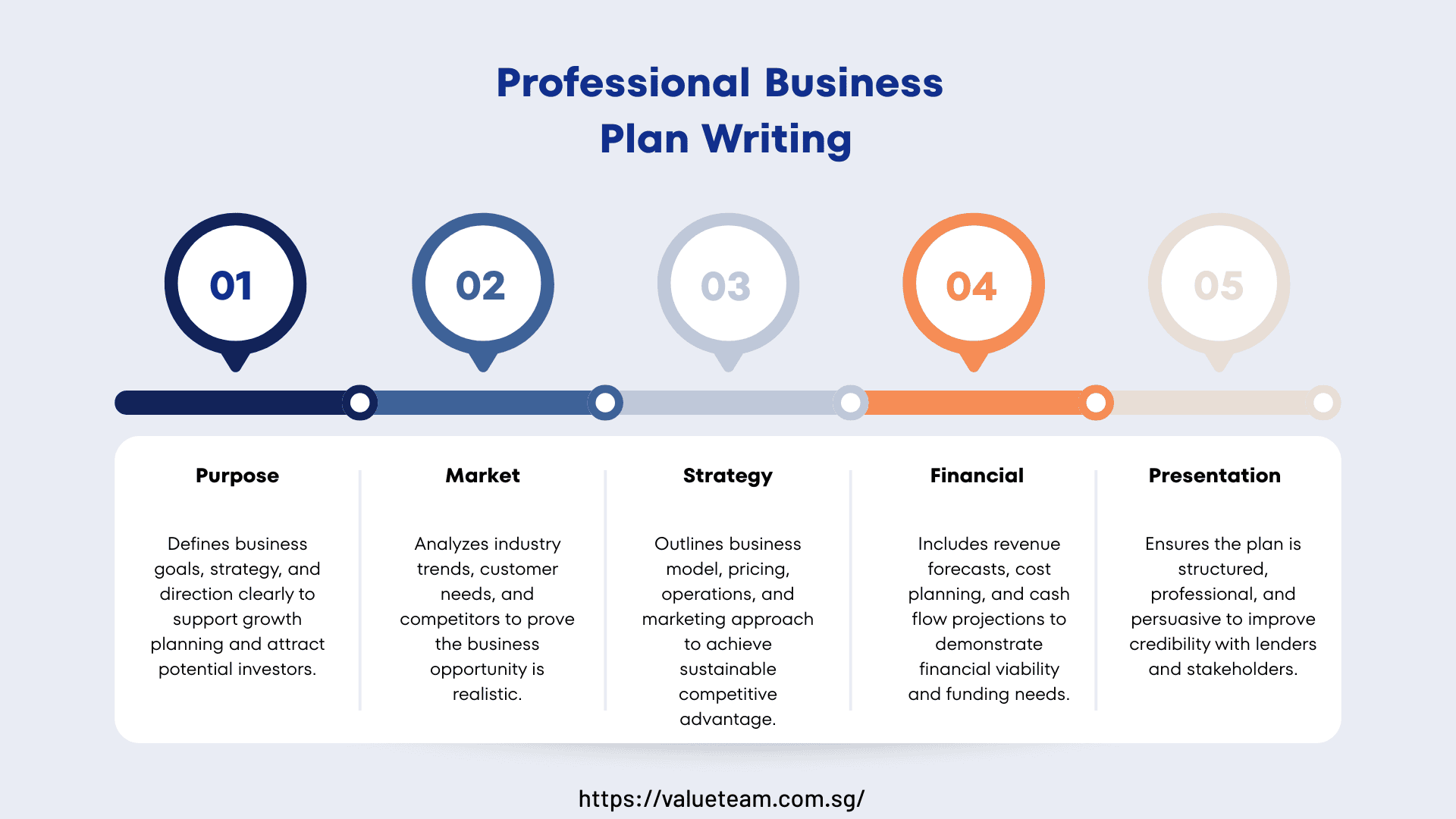
The relevance of Business Plans in the Contemporary Finance
There are entrepreneurs who believe that pitch decks have substituted business plans. Pitch decks are however mostly aimed at generating early interest. Serious investors would still want to be put down on paper to give them time to invest capital. A pitch deck is a summary of an opportunity, whereas a business plan will give a full strategic and financial explanation.
Plans are virtually always required by banks, government grant organizations as well as by private equity firms. Although growth is important to venture capital firms, they still consider the same basic principles, including market size, clarity of business model, positioning in the market, and financial sustainability. The founders do not seem to have a plan, and this aspect lowers the levels of trust.
This explains why those businesses that specialize in writing professional business plans
that are professional tend to be more favorable in creating investor confidence. The powerful plan also enhances the internal decision-making process by outlining performance objectives and priorities of implementation. A business plan ready to attract investors is in most instances, not only a fundraising requirement but a strategy document in the long term.
The Job of a Professional Business Plan Writer
Organizing the content is not all that a professional business plan writerdoes. Their main role is to transform business potential into an organized business investment document that is evident and convincing of value. This involves integrating market research, competitive analysis, strategic planning as well as financial modeling into a unified story.
Most of the founders have great ideas and they deliver weakly structured ideas or supported by assumptions. Shareholders are quick to identify unrealistic estimates, inconsistent strategies and lack of full risk planning. A professional writer foresees these issues and makes sure that the plan answers the questions of the investors before they are posed.
An experienced business plan writer is also an expert who realizes that various audiences in funding situations need varied strategies. Bank-written business plans are oriented towards stability and repayment potential whereas venture capital business plans are oriented towards scalability and high growth rate. This conformity will make the end product an investor-ready business plan, but not a generic business proposal.
The need to write professional business plans is an expertise that needs to be acquired
Business planning is something that is looked down upon. A great number of founders believe that they can formulate a plan in a short time, yet the planning at the professional level involves evidence, analytical thinking and strategic consistency. The business plan should be sound with coordination of operations, strategy, marketing, and financial forecasts in a rational organization.
Inconsistency is one of the major weaknesses in self written plans. As an example, an aggressive expansion by a founder can be proclaimed, whereas in financial plan, there is not enough marketing or staffing expenses. The other problem is the unrealistic market sizing unless there are good sources of data, which is a killer to investor confidence.
Professional approach makes the plan analytical rather than descriptive. It is because of this that professional business plans are hard to write unless one has great experience in finance and business strategy. An effective professional business plan writer makes sure that all the sections are relevant to the investment logic and this means a plausible and organized investor-ready business plan.
What Makes an Investor-Ready Business Plan
Optimism does not form the basis of an investor-ready business plan.It is anchored on factual basis, articulateness, and good implementation logic. Shareholders desire evidence that the company has knowledge on its market, customer demand, and its competition.
An effective plan consists of a clear business model, defined go to market strategy, realistic operations planning and plausible financial projections. Risk evaluation and risk mitigation is also part of it. Investors do not want to have a risk-free business, yet leadership maturity and readiness are expected.
A professional business plan writer makes sure that the plan is up to the expectations of the investors through formal, structured and measurable writing. This is what makes the business plan investor-ready and not an average business proposal.
Introduction: the First Funding filter
The executive summary is usually the most crucial in the whole plan. A great deal of investors form an opinion on whether to read more or not in the first few minutes. When the summary does not convey value the plan will commonly be rejected without any further analysis.
A well-developed executive summary should have a clear overview on what the business model is, what the market opportunity is, competitive advantage, and funding request. It must also draw the major traction points, anticipated financial performance, and the business growth map.
This section is of utmost priority to a professional business plan writer since it is an introduction as well as an investment pitch. The executive summary should be assured but not overreaching or based on guesses or imagination in an investor ready business plan.
Market Research and Industry Analysis
An analysis of the market is a test of credibility. Investors should be assured that the opportunity does exist and that the market is sufficiently large so that it can sustain growth over time. Here, the trend, customer requirements, market size and major growth drivers in the industry should be explained.
Good strategies have solid market segments and market share assumptions. Most of the poor plans overestimate the demand with unrealistic industry statistics. Professional writing of business plans on the other hand needs disciplined approaches to market sizing including TAM, SAM and SOM.
An expert business plan writer also makes sure that the market analysis underpins the positioning of the product of the company. This relation adds value to the investment case and enhances the authority of the investor-ready business plan.
Strategy, Competitive Analysis and Strategic Differentiation
A business plan should be able to show competition awareness. The statement of the absence of any rivalry is a significant red flag. Even innovative businesses have the competition of alternative solutions, existing products or even pattern of customer behavior.
A good competitive analysis determines the direct competitors, the indirect competitors and the alternatives solutions. It makes a comparison in terms of pricing, positioning, feature of the products and channels of distribution. Investors would wish to know the reason why the business stands a chance of winning and growing.
A professional business plan writer lays out this part in a manner that he or she presents competitive advantage with evidence. Some of the differentiation can be proprietary technology, good relationship with partners, brand strength, cost efficiency, and scalability. In a business plan to present to an investor, it is no longer differentiation that is claimed but rather justified by reasoning and evidence.
Business Model and Revenue Strategy
Business model describes how the company will make profit and gain profitability. Investors will demand transparency on how it intends to price, sources of revenue, customer acquisition, customer retention, and scalability in the long-run.
A powerful strategy will indicate the increment of revenue and how performance will be impacted on by major drivers. It needs to outline the channels of sales, conversion plan and customer lifetime value. This section is very critical as it is directly related to financial projections.
A professional business plan writer who will ensure that the business model is written in a professional way. In writing professional business plans, revenue strategy should be practical and in line with the reality in the market. An efficiently prepared model provides more investor confidence and enhances the investor-ready business model.
Operations Plan and Performance Ability
The idea is sometimes less important than its execution capability. Investors would like to know that the business will have ability to deliver products, manage business and grow efficiently. This part must consist of production planning, technology infrastructure, staffing requirements and operational milestones.
The plan must also indicate how the business will control quality, customer satisfaction and be operationally efficient as it expands. Shareholders consider the ability of the company to grow without a drop in performance.
An expert business plan consultant will make sure that operational planning enables growth forecasting. The road map of implementation should be feasible, quantifiable, and well-organized in an investor-ready business plan.
Sales Strategy and Marketing
An effective marketing strategy will be used to explain how the business will obtain customers and scale the demand. Investors do not tend to believe in the obscure marketing strategies that simply use a social media growth and do not have metrics.
The plan is to be specific on customer personas, acquisition strategy and sales-purchase pipeline framework and conversion plan. It must also describe what is anticipated in the marketing costs and customer acquisition assumptions.
That is why to write professional business plans it is necessary to align the marketing strategy and financial projections. An effective business plan author takes care of the fact that the projected revenue growth is backed by a realistic marketing investment. This congruence increases the effectiveness of the business plan that is investor-ready.
Financial Projections and Financing Needs
Investor decision-making is based on financial projections. A business plan has profit and loss projections, cash flow projections, balance sheet assumptions and break even analysis. Other important indicators that are anticipated by investors include gross margin, operating margin, and projected runway.
Financial assumptions realism is one of the leading investor issues. Unrealistic projections are usually refuted instantly. Good plans clarify how the growth rates, cost structures and revenue drivers will be achieved.
The projections made by a professional business plan writer are based on evidence and in line with the operational planning. An investor-ready business plan should give a clear statement of funding amount needed, how the funds will be used and the anticipated results. This openness enhances investor confidence and facilitates easy bargaining.
Risk Analysis and Risk Mitigation Strategy
In professional planning, risk analysis is a must. Investors know that all businesses are associated with uncertainty, but they need to see that they are ready. This part is to determine the market risks, competitive risks, operational risks, regulatory barriers and financial risks.
The manner in which risks are to be mitigated is also explained in a strong plan. The mitigation strategies can be diversification, staged growth, planning of legal compliance or contingency budget.
Another professional business plan writer will organize this part to show the maturity of leadership. Within an investor ready business plan, the management of risks is good to lessen the fears of the investors and enhance the general credibility.
Conclusion
A business plan is also one of the most useful resources to achieve funding success. The modern-day competitive investment market requires businesses to be articulate, evidence-based and professional in their strategy communication. That is why a good business plan writer proves to be a rather clever step by a founder and an executive willing to raise funds easily.
Developing an organized strategy, planning of the execution realistically, and forecasting the financial needs in a credible way are key benefits in the process of writing professional business plans that will prove to be of significant benefit when negotiating with investors. An effective plan enhances credibility, better decision making and likelihood of raising capital.
Finally, raising funds is not the only thing that can make an investor-ready business plan. It is a long-term growth strategy, positioning strategy, and a sustainable profitability strategy. Professional business planning is mandatory, not optional, to those businesses that are serious about scaling.