
Perform Fair Value Measurement PSAK 68 Indonesia
In Indonesian financial reporting, fair value measurement is touched by few obligations, asset classes and reporting decisions, compared to other reporting standards. Investment properties and financial instruments, business combinations and impairment testing all are determined, directly, by what an asset or liability is worth to a rational market participant, on a particular date, in an orderly transaction. Not only has fair value valuation Indonesia ceased to be a field of large dealings, but it is also regarded as a fundamental skill that any finance expert with PSAK compliance must possess and employ with certainty.
The fair-value measurement standard, PSAK 68 (Based on the International Fair Value Measurement) in Indonesia is the counterpart to IFRS 13 setting a universal, unified system of determining and reporting fair value in all standards of PSAK that require or allow it. It establishes the meaning of fair value, requires three-level hierarchy of inputs in the form of observability of market data and has disclosure requirements that aim to provide financial statement users with clear insight into the way fair values have been arrived at. To any company that has fair value amounts in its financial statements (which is the overwhelming majority of Indonesian listed companies) PSAOB 68 is a compulsory model that directly impacts on audit findings, OJK compliance, and the quality of published financial statements.
This guide is a practical step-by-step manual to meeting the PSAK 68 fair value measurement requirements in Indonesia, including the underlying principles of the standard, the most commonly used methods of company valuation in practice, practical examples in the major industries of Indonesia, best practice based on the experience of leading practitioners, and the most common pitfalls that can befall finance departments and their advisors to achieve consistently high standards of compliance.
Key Concepts: What Is Perform Fair Value Measurement PSAK 68 Indonesia?
PSAK 68 describes fair value as the amount one would get in order to sell an asset, or to pay in order to transfer a liability, in an orderly transaction between market participants at the measurement date. There are four aspects of this definition that have certain technical significance to the Indonesian practitioners.
Exit Price, Not Entry Price
Fair value is the exit price- what the market would pay a given asset today not what the object originally paid and would use to replace the asset. The conceptual shift that is needed in the case of Indonesian companies familiar with the use of historical cost accounting is intentional. The fair value of an office building in Jakarta is the amount that a market participant would spend on it in an arm-length sale currently- no matter how much he or she paid to purchase it or whether he or she intends to sell it in the future.
Participant View in the Market
The fair value is determined based on the view of a hypothetical and informed market participant who acts in his or her own economic interest. The measurement is not dependent on the personal intentions, restrictions of operations, or particular plans of the use of the entity. A business can decide to use thirty years of holding their land asset; a participant in the market can decide to hold them at a lesser period generating another fair value. PSAK 68 needs the market participant view and not the entity view.
The Principal Market
PSAK 68 stipulates that fair value be determined in the fair market of the asset i.e. the market that has the highest volume and activity. In the case of Indonesian assets, this is usually the IDX of the stock exchange, the OJK regulated secondary market of fixed income, or the Jakarta hire market of the commercial market of office property leasing. Where there is no major market one can identify then the best market is utilized.
The Three-Level input Hierarchy
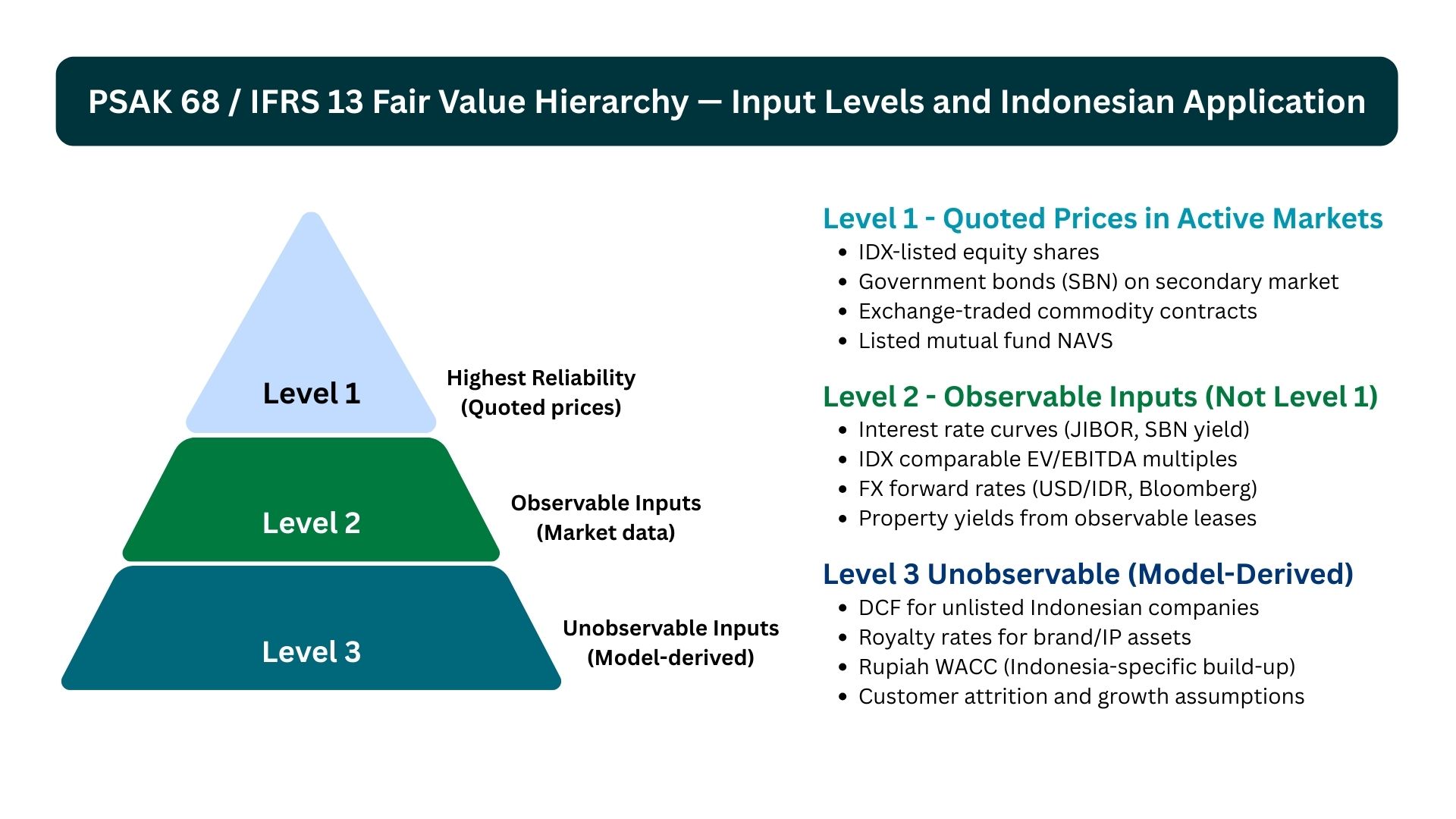
The three-level hierarchy of the inputs to fair value, in which the observability of the inputs is distinguished, is the most operationally significant characteristic of the Indonesian practitioner version of PSAK 68:
- Level 1: Active market quoted prices of the same assets or liabilities- the most dependable inputs which do not involve any adjustments. Level 1 is mostly used in Indonesia on shares that are listed on the IDX market, government securities (SBN) actively listed on the secondary markets, and the exchange-traded commodity contracts.
- Level 2: The same as Level 1, except that Level 2 quoted prices are observable (indirectly via observable market data) or directly observable (prices on similar assets). The examples used in Indonesia are the interest rate curves that were provided by JIBOR, the USD/IDR FX forward rates that are available through the Bloomberg, and the EV/EBITDA multiple that is provided by the IDX-traded similar firms.
- Level 3: Unobservable inputs due to the assumptions of the entity concerning what market participants would utilize- where there is no adequate observable inputs. The level 3 prevails in the Indonesian practice of fair value valuation since most of the non-listed assets do not have the observable transaction volumes to support Level 1 or Level 2 measurement in the Indonesian capital market.
The fact that Level 3 has been practically dominant in the Indonesian fair value valuation is that the majority of engagements are inherently rigorous judgment exercises, well-evidenced assumption-forming exercises, and transparent documentation exercises, and not merely the exercise of market prices. This fact forms the basis of all the directions that follow.
Figure 1: PSAK 68 / IFRS 13 fair value input hierarchy — levels and common Indonesian applications (Perform Fair Value Measurement PSAK 68 Indonesia)
Why Fair Value Valuation Matters across Indonesian Financial Reporting? (Perform Fair Value Measurement PSAK 68 Indonesia)
PSAK 68 itself is not a standalone standard, it is simply a measurement structure that is invoked by every other virtually all PSAK standard that deals with the measurement of an asset or a liability. It is critical to know where and to what extent it is appropriate, and to what can be the downstream effects of measurement errors, to resource and prioritise fair value compliance in the right way.
Purchase Price Allocation and Business Combinations
All business combination accounts less than PSAK 22 should be measured in fair value of all identifiable assets and liabilities as of the date of acquisitions. The balance sheet after an Indonesian M&A deal is constructed completely on the basis of PSAK 68 what the fair value is; in the case of tangible assets and financial instruments, in the intangibles and assumed liabilities. The quality of this measure defines the balance of goodwill, the amortisation profile of the identified intangibles, and the future years post-acquisition income statement. This is the most significant application of fair value valuation Indonesia in the expanding M&A market in Indonesia that cuts across digital platform, consumer goods, healthcare and natural resources.
Revaluation of Investment Property and Fixed Asset
In accordance with PSAK 13, parties can choose to report investment property at fair value and profit or loss changes will be realised. The entities are allowed to use the revaluation model in determining assets of property, plant, and equipment under PSAK 16 where the gains are recognised under other comprehensive income. The two elections are both PSAK 68 triggering. This presents a material recurrent fair value workload that plantation companies, property groups and infrastructure businesses with large heterogeneous portfolios are incurring that would necessitate strong internal capacity or periodic contact with licensed external appraisers (KJPP).
Financial Instruments under PSAK 71
PSAK 71 (equivalent to IFRS 9) mandates fair value measurement of equity investments of FVOCI or FVTPL, derivative instruments and some financial liabilities. In the case of Indonesian banks, insurance companies and corporate treasuries that have a complex holdings in financial instruments, the interplay between PSAK 71 classification ruling and PSAK 68 measurement ruling is a major source of financial reporting complexity. Credit valuation adjustment (CVA) requirement of PSAK 68, the counterparty credit risk in derivative fair values, is commonly ignored by the Indonesian finance teams and poses repeated audit questions.
Impairment Testing of PSAK 48
PSAK 48 refers to recoverable amount as the greatest between an asset value in use and fair value less disposal costs. The component of the fair value less costs of disposal is a PSAK 68 measurement that involves assumptions of the market participants, observable input maximisation, and sensitive disclosure of quantitative sensitivity. To the companies in Indonesia, which have goodwill due to acquisition or impairment signs, especially within the natural resources, retailing, and digital industries, this imposes an additional layer of measurement of fair values annually over the value-in-use DCF measurement that most teams are already undertaking.
OJK Market Disclosure Requirement of Listed Firms
OJK requires the Indonesian listed companies to report, on all classes of assets and liabilities, which are measured at fair value, the hierarchy level, the valuation techniques and inputs applied to the Level 2 and Level 3 measurements and for Level 3 alone, the reconciliation of the opening and closing balances, the description of the process, and a quantitative sensitivity analysis. Those companies that do not make sufficient disclosures regarding fair value are regular receivers of OJK enquiry letters, and any material omission can lead to the requirement of restatement. Strict PSAK 68 measurement thus is directly equal to sustainable OJK compliance investment.
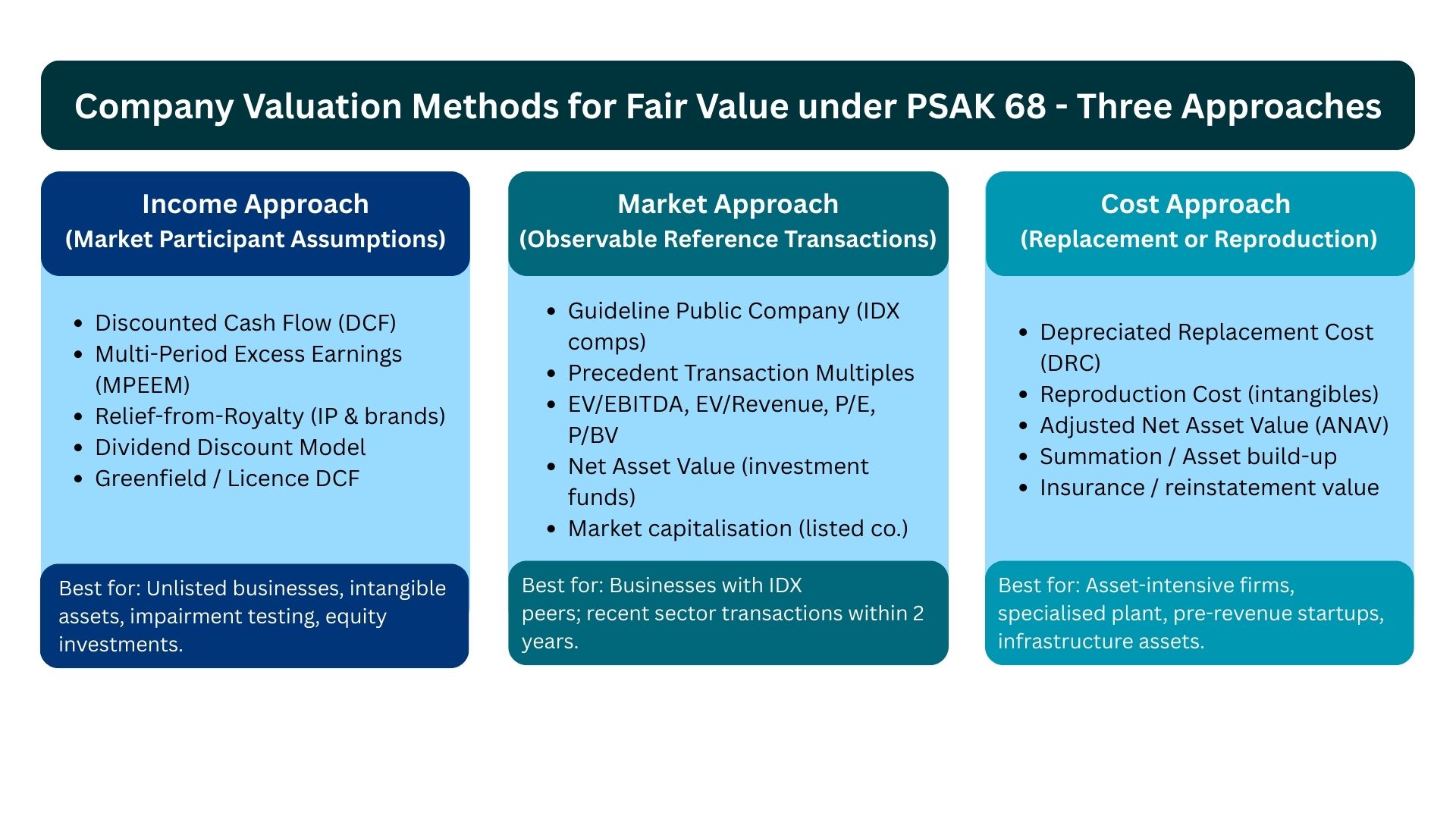
Figure 2: Three company valuation method approaches applied in PSAK 68 fair value measurement (Perform Fair Value Measurement PSAK 68 Indonesia)
Key Benefits of Rigorous Perform Fair Value Measurement PSAK 68 Indonesia
Debt Credibility in the Financial Statements
The calculation of fair value through the use of the right company valuation methods, observable contribution of the Indonesian market and clear documentation makes the financial statements to be relied upon by the investors, lenders and analysts. The credibility of fair value figures directly entered into the cost of equity and debt capital in the changing capital market in Indonesia where institutional investors are increasingly participating and the international governance standards are now table stakes to listed companies. Firms that have a history of high standards of fair value valuation Indonesia are considered to be less information-risk counterparties.
Less Audit Risk and Increment Closer
Measurements that satisfy the requirements of PSAK 68 using a methodology documentation, traceable inputs, and pre-built sensitivity analysis are easily reviewed by the auditors. Companies that consider fair value as a continuous process, such as having independent valuation commissioned on schedule, agreeing with auditors on fair value process methodology prior to fieldwork, and using an assumption register, invariably have a faster financial close and reduced audit costs compared to those that handle fair value obligations in a reactive manner. The discipline of the investment in process is dividend-yielding per reporting cycle.
Improved Capital Allocation Decision
Measurements of fair value that are based on the current market player assumptions provide the management with a more true image of the economic value of their assets portfolios. Valuations of investment property using observable evidence in the market is more useful in making disposal, development and refinancing decisions than the obsolete appraisals and the historical cost. Current DCF model or IDX-comparable multiples of equity investment fair values give a prompt warning of poor performance by a portfolio. The best practices in company valuation have always indicated that dependable fair value information is positive in enhancing internal investment decision-making just like it is beneficial when making external financial reporting.
Transfer Pricing and Regulatory Defensibility
A fair value measurement that is compliant with PSAK 68 offers a justifiable ground to intragroup transaction that is subject to review under the DJP transfer pricing. The transfer pricing position is far stronger in a case where, when transferring assets, licensing IP, and entering into intragroup financial transactions, the Indonesian firms do so at prices that are consistent with the independently determined fair values and record the consistency. This advantage is especially applicable to groups where there are intragroup transfers of property, where there is the IP licensing, or banking instruments or other arrangements between related parties.
Practical Applications of Perform Fair Value Measurement PSAK 68 Indonesia across Asset Classes
Fair value valuation Indonesia assumes different practical shapes, based on the specific asset category, availability of the observable market data and the particular PSAK standard that causes the measurement. Three examples are used to explain how PSAK 68 works and in within the major industries in Indonesia.
Investment Real Estate: Jakarta Office Portfolio
When a listed Indonesian property group selected the fair value model, as per PSAK 13, on its investment property portfolio, the fair value model, annual PSAK 68 measurements applied to 14 commercial assets in Jakarta, Surabaya and Medan with combined carrying value of IDR 7.8 trillion. The classification of assets was as Level 2 at which Jakarta CBD similar lease transactions and capitalisation yield data were evident and Level 3 where Medan assets had limited market evidence and management judgments had to be made.
In the case of the Level 2 Jakarta assets, it was direct capitalised- net passing income divided by the initial yields adjusted to visible similar transactions. Level 3 Medan assets were represented as DCF model constituted based on projections of management on the growth of the rental and terminal capitalisation rate based on Jakarta yield evidence with local market risk premium. Other fair value uplift totalled IDR 285 billion as shown in profit or loss.
Level 3 measurement needed a quantitative disclosure of sensitivity of the terminal capitalisation rate: an increase in the terminal capitalisation rate of 50-basis-points would cause Medan portfolio fair value to fall by IDR 112 billion. This sensitivity table was constructed during the initial modelling and not retrospectively, which allowed the clean audit clearance within two weeks of the start of the fieldwork. The point of the difference of timing was sufficient enough to warrant the training of integrated sensitivity.
Unlisted Equity Investment: Area Healthcare Chain
The measurement of FVOCI was needed under PSAK 71 by an Indonesian conglomerate which owned 38 per cent of a non-listed regional hospital group. The level of the investment was Level 3 as there was no evident transaction information regarding similar businesses of Indonesian hospitals. The methods of company valuation had been a primary DCF discounted at a Rupiah WACC of 14.4 percent, which was constructed out of the SBN five-year yield, the Indonesia equity risk premium, and the healthcare sector beta value, based on SBN-IDX listed hospital company data and an 20 percent illiquidity discount.
The two approaches generated IDR 1.82 to 1.96 trillion fair value, the fair value adopted of IDR 1.88 trillion recorded fair value with full Level 3 sensitivity: a 100-basis-point increase in WACC decreased fair value by IDR 167 billion; a 10 percent decrease in EBITDA decreased fair value by IDR 142 billion. Both the external auditors and the OJK reviewer accepted the measurement without any modification, directly due to the documentation of methodology prepared with the model rather than following it.
Financial Instrument: Interest Rate Swap
A listed Indonesian infrastructure company had an interest rate swap in which an exposure to floating JIBOR was swapped into a fixed rate at fair value as profit or loss under PSAK 71. The swap was categorized in Level 2 where JIBOR-SBN swap curve of Bloomberg was used as the main observable input. Fixed and floating leg presents values were discounted on prevailing market rates.
The finance department did not first take into consideration the credit valuation adjustment (CVA) which PSAK 68 mandates to record the counterparty credit risk. It was then decided to use an independent fair value valuation Indonesia specialist and a bilateral CVA based upon observable CDS spreads was computed which resulted in a total adjustment of IDR 8.2 billion. Although the CVA is not material to the balance sheet, compliance with the technical PSAK 68 required a disclosure in the financial statements, and the methodologically straight forward qualification of the audit against this technical disclosure was avoided.
Finance team process vision:
Construct the quantitative sensitivity analysis of all Level 3 fair value measurements of material under primary model- not as an exercise on its own when the auditor requests it. The sensitivity table that is created under audit pressure is highly likely to have errors and less deliberate input choice compared to the one created during the main modelling time. Do it once, and do it right and it meets both the PSAK 68 disclosure requirement as well as the auditor review in one step.
Table 1: PSAK 68 Fair Value Measurement — Asset Types, Hierarchy Levels, Methods, and Indonesia-Specific Notes (Perform Fair Value Measurement PSAK 68 Indonesia)
| Asset / Liability | Typical Level | Primary Method | Key Indonesia Input | OJK Disclosure Req. |
| IDX-listed equity | Level 1 | Quoted market price | Closing price of IDX at the date of measurement. | Level; source reference |
| Investment property (Jakarta CBD) | Level 2 | Direct capitalisation / DCF | Cap rates that are observable on similar leases. | Technique; inputs used |
| Investment property (Tier 2/3 city) | Level 3 | DCF; income approach | Local risk premium adj; management projections. | Complete L3 disclosure + sensitivity. |
| Unlisted equity investment | Level 3 | DCF + IDX comps (EV/EBITDA) | Rupiah WACC; IDX comps + illiquidity discount. | Reconciliation + sensitivity. |
| Brand / intangible asset (PPA) | Level 3 | Relief-from-Royalty or MPEEM | SEA/Indo royalty rate by licensing data. | Unobservable inputs; range |
| Interest rate swap | Level 2 | Discounted cash flow | JIBOR/SBN swap curve (Bloomberg); CVA adj. | Technique; discernible inputs. |
| Goodwill impairment (FVLCD) | Level 3 | Market comps or DCF | IDX peer multiples; Rupiah WACC | Considerable assumptions + sensitivity. |
Source: PSAK 68 / IFRS 13 requirements and Indonesian financial reporting practice.
Best Practices in Perform Fair Value Measurement PSAK 68 Indonesia
The best practices in company valuation for PSAK 68 compliance reflect the combined insight of Indonesian practitioners, Big Four audit teams, and OJK reviewers who have worked through fair value measurement across multiple sectors and asset classes. These principles are always used to make a distinction between high-quality and technically marginal outcomes.
- Maximise observable inputs at each stage – PSAK 68 dictates that one should use the maximum observable inputs possible. Prior to Level 3 assumption, clearly give a reason why Level 1 and Level 2 inputs are not available. Even the partial utilization of observable data, as in calibration of a terminal growth rate of the DCF to observable sector data, or in anchoring a WACC to IDX sector betas, shifts elements of the measurement to greater reliability and less complex disclosure.
- Use authentic market participant assumptions – the conceptual error most frequently made in the Indonesian fair value valuation is the replacement of entity specific projections with market participant projections without testing their differentiability. A business can forecast 18% of revenue increase; market players that set prices of similar businesses listed on the IDX may believe in 8%. The substantive requirement of PSAK 68 is the discipline of the market participant test and must be applied directly and not by implication.
- Build Level 3 sensitivity analysis in primary modelling – To each material Level 3 measurement, sensitivity at the three to five most influential, unobservable inputs can be run before the valuation is determined. This confirms the strength of the primary estimate, meets the PSAK 68 requirement of quantitative sensitivity disclosure and removes the most prevalent source of last-minute audit queries. Tables that have been generated under the pressure of auditing are not accurate or relevant compared to those developed together with the model.
- All inputs in Indonesian market, use the Rupiah-denominated yield of the SBN to build as a risk-free base, the Indonesia equity risk premium, and the sector-betas of the IDX-traded comparables. Using a global or USD-based WACC to apply to cash flows in Rupiah, without affirming the adjustment, makes a systematic understatement of the discount rate and a systematic overstatement of fair values a problem which is becoming more and more exposed to scrutiny by auditors and OJK reviewers.
- Schedule the fair value measurement calendar during the beginning of each financial year – determine all the material measurements necessary, establish commissioning dates and leave at least three to four weeks to allow auditor inspection before the reporting date in every valuation instruction. The most effective operation change in the context of the Indonesian finance team handling the PSAK 68 compliance on a large scale is proactive calendar management.
- Contract independent specialists in Level 3 material measurements – in the case of material investment properties, major equity investments, intangible assets in PPA situations and complex financial instruments, analytical rigour and professional credibility are offered by independent KJPP or specialist fair value advisers. best practices in company valuation always demonstrate that the fair value valuation of the company is conducted independently and fairly in Indonesia and results in clean audit report and higher levels of OJK quality disclosures as compared to estimates prepared internally of complex Level 3 company assets.
Common Challenges Perform Fair Value Measurement PSAK 68 Indonesia and How to Address Them
Also, the experiences of well-funded Indonesian finance departments in executing PSAK 68 measurements are consistent and share certain circumstances. By foreseeing these issues, and putting in place special guidelines to deal with them, organisations which take the initiative of being compliant anticipate the challenges and operate in a reactive mode with audit issues forcing them to deal with fair value obligations.
Level 3 Data Scarcity and Dominance
Most of the Indonesian fair value measurements are Level 3, due to the level of capital markets and private transaction databases in Indonesia failing to generate the data volume that are observable to measure most non-listed assets used in Level 1 or Level 2. It poses a structural problem: Level 3 demands the most disclosures, the most demanding documentation and the most scrutiny by auditors- and is based on the least verifiable inputs. Practical answer is to invest in proprietary market data: to have a database of IDXs trading multiples, to have property transaction data obtained through observable sources and to have evidence of comparable transactions involving particular sectors.
Those companies where there are real efforts to source observable inputs and record the reason why Level 3 assumptions were eventually made are audited materially less than those who fail to Level 3 without proving to have searched. The observable input search as is documented in the valuation file is a risk mitigation measure on its own.
Coherence Between Reporting Periods
PSAK 68 states that the method of valuation applied in the measurement of recurring measurements should be applied consistently each period. Alterations in technique or significant assumptions should be considered as alterations in accounting estimate and reported clearly and with quantitative value on the impact on reported values. Indonese practice To address a change in methodology of discount rate, composition of peer group, or assumptions of useful life, sometimes changes in accounting estimates are not formally recorded, although this creates a compliance gap that must be discovered in audit and thus necessitating retrospective analysis.
The remedy is to disclose the selected methodology of every fair value measurement category at the beginning of each reporting period, whether this is the same as it was in the preceding year and that it should be confirmed in writing by the audit team before it makes any proposed change. This protocol gets rid of the most prevalent source of failure in the fair value consistency in Indonesian financial reporting.
Rupiah WACC Errors and Currency Mismatches
In the case of fair value measurements in Rupiah, based on DCF models, the discount rate should be based on the current Indonesian market conditions which is constructed based on SBN yield, Indonesia equity risk premium, and industry sector betas, obtained as Indonesian data. Indonesian macro environment implies that the right WACC may vary significantly between one period and another. Finance departments which use a fixed discount rate over multiple years without adjusting to current SBN yields and equity risk premium dynamics generate fair values which deviate systematically with current market participant assumptions.
The way out is to incorporate the updating of WACC process into the yearly fair value measurement process, re-calculate the risk-free rate based on up-to-date SBN data and recalibrate the equity risk premium each time the valuation is measured. This is minor further analysis but is the one most vital technical field of keeping the market-participant consistency of Indonesian DCF-based fair value measurements.
The Introduction of Fair Value to Reporting Timelines
Fair value measurements should be established at the date of the balance sheet, and however, commissioning, executing, reviewing, and disclosing measurement is time-consuming. Indonese practice is characterized by valuations being commissioned too late into reporting dates, or delivered without time to be reviewed by auditors, or without the Level 3 sensitivity analysis that a PSAK 68 demands, and causes last-minute reconstruction, subject to further risk of error and delay in financial close.
The structural response is that fair value measurement should be a first-class work stream within the financial reporting calendar: positioning commissioning deadlines at least eight weeks in advance of the reporting date where there is a complex measurement, outlining interim review milestones, and engineering sensitivity analysis into the entire engagement scope letter at the very beginning. This field of logistics is equally significant as the competence of technical methodology in the provision of fair value results that are always consistent and compliant.
Conclusion: Incorporating Fair Value Valuation as Governance Discipline in Indonesia.
Fair value measurement done according to PSAK 68 in Indonesia is therefore as much compliance obligation as governance discipline and, to the extent that it is done rigorously by an organisation, a source of real financial reporting benefit compared to other less disciplined organisations. The requirements of the standard have a demand to analytical rigour, investment in Indonesian market data, and the consistency of the processes that make leading-practice organisations unique compared to the organisations that have to respond to the requirement cycle, cycle after cycle.
The main idea that can be derived after all the facets of this guide is that fair value valuation Indonesia is characterized by the quality of input materials, the rigour of the methodology, the transparency of documentation rather than the sophistication of the model. An Indonesian DCF model with proven inputs in the Indonesian market, constructed of an existing Rupiah WACC, and a pre-compiled sensitivity analysis will always pass an audit and OJK review more easily than an overly complicated model that has been constructed using unsubstantiated assumptions.
The company valuation methods that are involved in the measurement of PSAK 68, the income, market, and cost approaches, are established analytical tools which any competent practitioner may use. Their use in the Indonesian context is what is differentiated by the specific expertise which is needed: knowledge of IDX on the par with similar companies data, SBN yield curves, the dynamics of the Indonesian property market, and the changing disclosure expectations of the OJK. This experience should be actively developed, either by the company through the development of internal competencies or by the regular involvement of the qualified specialist of fair value valuation Indonesia.
The financial reporting environment in Indonesia will keep on changing to more towards the IFRS convergence, greater institutional investment, and stricter OJK regulation. The role of fair value measurement will continue to grow in stature, complexity, and significance in that direction. It is the organisations that make the investment today in creating PSAK 68 compliance in a methodological and calendar-based documentation-first discipline, as opposed to an annual scrumble, that will be in the best condition next decade to accommodate the reporting requirements, the transaction opportunity, and the governance expectations in which Indonesia will be a company in the next decade.