
IFRS Valuation Experts Malaysia for Reporting Compliance
Introduction to IFRS Valuation Experts Malaysia for Reporting Compliance
The financial reporting in Malaysia has been changing significantly in the last ten years. As the Malaysian Financial Reporting Standards (MFRS) framework is well-integrated to the International Financial Reporting Standards (IFRS), both the corporations listed publicly and the developing enterprises are expected to go to greater lengths to achieve more transparency and measurement accuracy. The core of this change is valuation: how a firm values its assets, liabilities, and financial instruments at a particular time, and whether these values can withstand regulatory scrutiny.
On the case of junior and mid-level finance professionals, the issue of valuation according to the IFRS is not merely a question of familiarity with technical regulations. It is all about understanding the importance of the numbers and how they influence the integrity of financial statements, and what specialists actually contribute to the right numbers. Even during audit, corporate finance, reporting or compliance, you will find that the knowledge of IFRS valuation professional in Malaysia on financial reporting compliance will not only be useful, but also necessary.
This paper takes a tour of the IFRS-related valuation work in Malaysia – what it entails, who does it, how the process generally runs, and what young professionals who are venturing into the space should be aware of.
The Significance of IFRS Valuation Experts Malaysia for Reporting Compliance
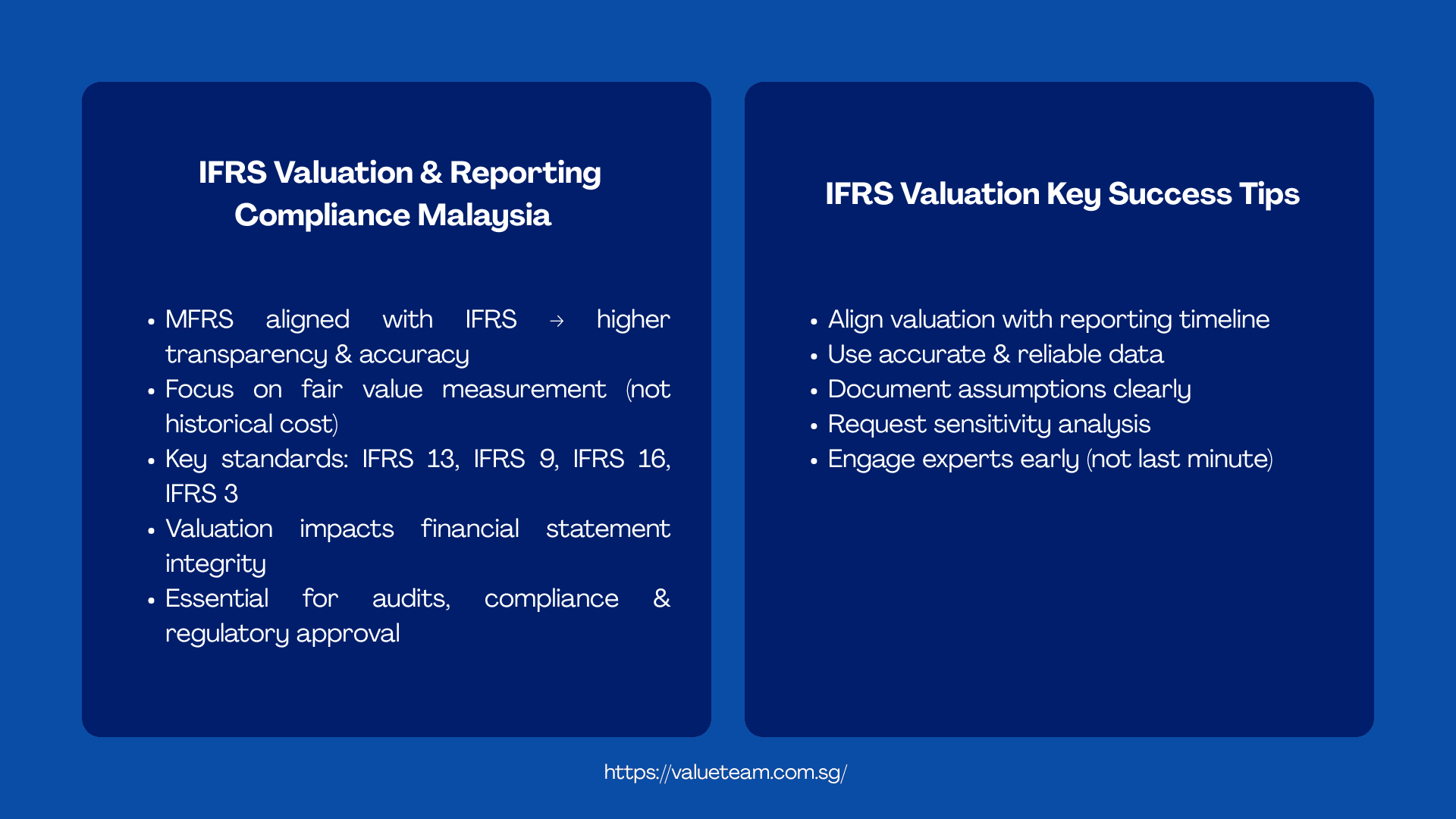
The concept of fair value gives birth to IFRS. Other standards like the IFRS 13 (Fair Value Measurement), IFRS 9 (Financial Instruments), IFRS 16 (Leases), and IFRS 3 (Business Combinations) all present the requirement that certain items be measured at their current economic value and not at their historical cost. This is a radical break with more traditional accounting models, and it poses a great demand of strong, justifiable valuation work.
Take into account the IFRS 3 that regulates the accounting of mergers and acquisitions by companies. In the case of an acquisition of a Malaysian company, the purchase price has to be assigned to all identifiable assets and liabilities at fair value Purchase Price Allocation (PPA). This is not a simple exercise. Intangible assets like customer relationships, brand names, technology platforms and non-compete agreements should be identified, considered individually and allocated useful lives to be amortised. A company runs the risk of misstating the balance sheet since it does not have a qualified valuer.
Instead, IFRS 9 puts the mandate on entities to measure financial instruments such as complex derivatives, convertible bonds, and equity-linked instruments at fair value; by profit or loss or other comprehensive income. The directly linked implications of the classification and measurement decisions made with this standard include the income statement. Audit qualifications, restatements, or regulatory findings could be caused by a miscalculation or wrong methodology. This is the reason why the services of professional IFRS valuation experts Malaysia in reporting compliance are gradually becoming no longer optional and rather a part of the financial reporting process.
Understanding The Reality of IFRS Valuation Experts Malaysia for Reporting Compliance
The work that is performed by valuation specialists within the IFRS context is wider than most individuals would think. It is far more than coming up with a figure. The goal of the valuation, the methodology to be used, the inputs to be collected and authenticated, stress-test assumptions and documenting will all be done by a qualified valuation professional to the satisfaction of external auditors, regulators like the Securities Commission Malaysia or Bursa Malaysia, and internal governance bodies.
As a matter of practice, financial reporting and compliance IFRS valuation specialists in Malaysia are often engaged in a variety of types of work. These involve impairment testing under the IAS 36 whereby companies should determine whether the carrying amount of their assets, especially the goodwill, is more than the recoverable amount. They also address the measurement of right-of-use assets and lease liabilities, fair value of investment properties and equity-settled share-based payments under IFRS 16, 40, and 2 respectively. All these areas possess their own requirements to methodology, their needs of data, and documentation.
A good valuation expert is not only a skilled professional but also an effective communicator with auditors and finance departments, a person who comprehends the big picture of the business and will defend his or her work when under scrutiny. The demand of such expertise has increased significantly in Malaysia where more companies are going regional and preparing to transact in the capital markets.
5 Steps in IFRS Valuation Experts Malaysia for Reporting Compliance
When it comes to the practical execution of a valuation engagement, more knowledge about the valuation engagement process would enable the finance professionals to work together with external experts more efficiently and schedule reporting in a more efficient way. The process is normally structured as shown below.
| Step | Activity | Key Output |
| 1. Scoping | Establish the topic of valuation, reporting standard and purpose. | Scope Agreement, engagement letter. |
| 2. Data Collection | Collect financial reports, agreements, market research, and forecasts of the management. | Data room, list of information requests. |
| 3. Analysis & Modelling | Use proper methodology of valuation (DCF, market approach, cost approach) | Written assumptions in the valuation model. |
| 4. Audit Support | Answer auditors, give sensitivity analysis and justification of methodology. | Responses to auditor working papers. |
| 5. Reporting | Present final valuation report and schedules. | Signed valuation report |
Step one – scoping is a step that is not taken seriously. A wrong scope can lead to the whole engagement having to be re-done. Indicatively, impairment testing using a brand name will have to be valued differently than one used in a licensing contract.
Step two – data collection is where the finance teams can play a role in value addition. The quality of management projections and contract data and the market comparables has direct influence on the reliability of the final number. Accuracy of data should be taken by the junior professionals in this stage as their main concern.
The third, fourth, and fifth steps – are the ones in which specialized technical knowledge is very important. It depends on the type of asset, available information, and the IFRS requirements to use an income approach (usually a discounted cash flow), a market approach (the use of similar companies or transactions), or a cost approach. The auditor support stage is a crucial element especially in Malaysia since the auditors are becoming more sophisticated in their examination of fair value estimates and a reported valuation report greatly lessens the aggravation in the audit procedure.
The Professional Pathway: 4 Key Development Stages | IFRS Valuation Experts Malaysia for Reporting Compliance
In the case of new entrants in the valuation or financial reporting profession, an obvious developmental curve exists. Grasping where you have been in this path enables you to know the loopholes and pursue the correct exposure.
| Stage | Focus Area | Skills Being Built |
| Foundation | Financial statements and accounting standards. | Reading MFRS/IFRS standards, interpretation of balance sheet items. |
| Technical | Modelling and valuation methodologies. | DCF construction, similar analysis, sensitivity analysis. |
| Applied | Operating on live activities. | Information gathering, contacting with clients, liaison with auditors. |
| Expert | Managing interactions and reports. | Judgement of methodology, knowledge of regulations, report writing. |
The majority of junior professionals come in at the bottom or lower technical level. The applied stage is usually introduced by exposure to actual transactions, whether in the course of an audit engagement in which fair value estimates are audited, or in a valuation team in support of a PPA or impairment exercise. Professional qualifications sought by those aspiring to become IFRS valuation specialists in Malaysia in the financial reporting and compliance fields are the Chartered Financial Analyst (CFA), Royal Institution of Chartered Surveyors (RICS) or more recently, the Chartered Business Valuator (CBV) designation.
Common Challenge in IFRS Valuation Experts Malaysia for Reporting Compliance
The best way of learning the complexity of IFRS valuation is to consider where things have gone astray- and what professionals have learnt.
Take the following example that is typical in the Malaysian property market: a developer whose portfolio of investment properties is measured under IAS 40 in fair value. The company used an external valuer on an annual basis, the valuation reports were based on market data which was 6 to 9 months old at the time, when the finalisation of the accounts was made. As the auditors had indicated this in an interim review, the company was forced to have new valuations performed on a short notice, which pushed the timeline of the audit by a few weeks. The lesson here is that valuation schedule must be factored into the financial reporting calendar at the onset, and not as an afterthought.
The other typical challenge occurs in case of acquisitions. A Malaysian conglomerate that is preparing its first acquisition of a local business can misjudge the level of complexity in the IFRS 3 compliance. The management may take the purchase price as the value of net assets without considering the fact that the intangible assets should be identified and valued separately. Once this is raised by the auditors, then the company should hire the valuation specialists retrospectively and in some cases they may have to restate the already issued accounts. Such a situation is not an isolated incidence as it ought to be, and it is indicative of the essence of involving IFRS professionals in Malaysia in financial reporting compliance at the transaction planning level and not after the closing.
The third area of difficulty is the goodwill impairment testing. IAS 36 stipulates that the companies should test goodwill yearly, or on a more regular basis in case of the existence of impairment indicators. Under increasing interest rate conditions, discount rates on impairment models will rise, the value of future cash flows will be lower and the current amount of headroom, the difference between recoverable amount and carrying amount will be brought painfully close to zero. Finance teams which have constructed their models on optimistic assumptions might end up in trying to talk to the auditors in hard terms. The moral of the story is that conservative well-supported assumptions are much more defensible than aggressive ones, even though the outcomes of the latter result in less favourable short-term outcomes.
How to Work Effectively with Valuation Expert |IFRS Valuation Experts Malaysia for Reporting Compliance
To junior to mid-level workers who work with or engage valuation experts, there are practical means through which they can make sure the engagement is running smoothly, and the results are useful and audit-ready.
| Do This | Why It Matters |
| Early projections of share management. | The inputs to valuation models are only as good as the inputs; there is no need to repeat something. |
| Be familiar with the standard of IFRS in use. | Being aware of the standard assists you in posing better questions and critical review of outputs. |
| Establish valuation schedules into reporting schedule. | Eschews last minute engagements at the cost of quality and cost. |
| Keep proper records of assumptions. | The question asked by auditors will be; a trail will save back and forth. |
| Deliverables Request sensitivity analysis. | Guides you to comprehend a variety of results and sets you up against questions of the auditor. |
An example of practical habits that should be cultivated at an early age is to read valuation reports critically instead of looking at numbers as they appear. Inquire about the methodology applied and the rationale of this approach, the major assumptions, and the consequences of the output, in case of an increase or decrease of the assumptions by 10 or 20 percent. Such analytical activity will turn you into a much better finance practitioner, with or without valuation specialisation in your portfolio.
The establishment of a relationship with professional IFRS valuation experts Malaysia in the reporting compliance service is also dividend yielding in the long run. Experts who can comprehend your business, industry and reporting environment will give more effective and better-tuned advice than those who are involved in an entirely transactional relationship. It is due to this reason that many of the bigger Malaysian corporates and listed companies have panel arrangements with valuation firms.
Conclusion: Implementations in the Practical of IFRS Valuation Experts Malaysia for Reporting Compliance
Technical rigour and business judgement have to be in concert in the field of IFRS valuation. The quality of work done on valuations of the reporting ecosystem in Malaysia, comprising of listed issuers, audit firms, regulators as well as the company themselves, directly impacts on the credibility of financial statements. The importance of the IFRS valuation specialists in Malaysia in the field of financial reporting and compliance will only increase as standards keep on changing and as the regulatory expectations increase.
The course of action is evident to those professionals in the junior to mid-level level. Begin by establishing a good grounding on the IFRS standards applicable to your sector the most – be it IFRS 3, IFRS 9, IFRS 13, and IAS 36. Get trained to read and question valuation reports as opposed to taking them as black boxes. Look to get involved in engagements in which fair value measurement is to be applied, even in an ancillary role. And invest in the growth of your profession by recognised qualifications which the market recognises.
It is organisations and professionals that make valuation compliance an authentic discipline, not a checkbox, that develops sustainable financial reporting credibility. That credibility is an asset that should be defended in a market as dynamic and growth oriented as Malaysia.