
IAS 36 Impairment Testing in Malaysia
Practical Valuation Approach for Finance Professionals
Introduction to IAS 36 Impairment Testing in Malaysia
The impairment testing takes a unique position in the financial reporting calendar. Contrary to most accounting exercises, which are subject to a predictable mechanical computation, impairment testing under the IAS 36, which is adopted in Malaysia by MFRS 136, entails a real forwards-looking assessment of whether the assets that a company shows on its balance sheet are in fact worth what it seems to be worth. Apparently a simple question, it entails predicting cash flows in the future, choosing discount rates, establishing the limits of cash-generating units and making long-term growth judgements, which will be subject to scrutiny by auditors, audit committees and in some jurisdictions regulators. This does not constitute an annual administrative formal to any listed company that has in its possession goodwill as a result of a past acquisition. It is among the most significant valuation activities done by the business.
The impairment testing is relevant in Malaysia due to the nature of the corporate environment. Bursa Malaysia has a huge conglomeration / diversified groups of companies who have within the last 20 years, acquired companies in various sectors and geographies. A large part of those acquisitions is being recorded on current balance sheets as goodwill, some of it is substantially explained by good underlying performance, some of it is above businesses that have since gotten worse than they used to be. Meanwhile regulatory environment has become increasingly challenging: the listing requirements of Bursa Malaysia and Securities Commission Malaysia increasingly focus on the quality of disclosures of impairments, and auditors are more and more pressurized to question the assumptions that are not supported by the available market data.
The guide is meant to be used by people in finance who are interested in knowing about impairment testing not only as a reporting requirement but also as an analytical science. It includes the regulatory framework, the practical process, application into practice in Malaysia, and the issues that arise repeatedly among practitioners. Regardless of whether you are about to embark on a financial reporting, audit, or independent valuation advisory position, the content here will provide you with a written and practical basis.
The Regulatory Framework: MFRS 136 and What It Really Demands | IAS 36 Impairment Testing in Malaysia
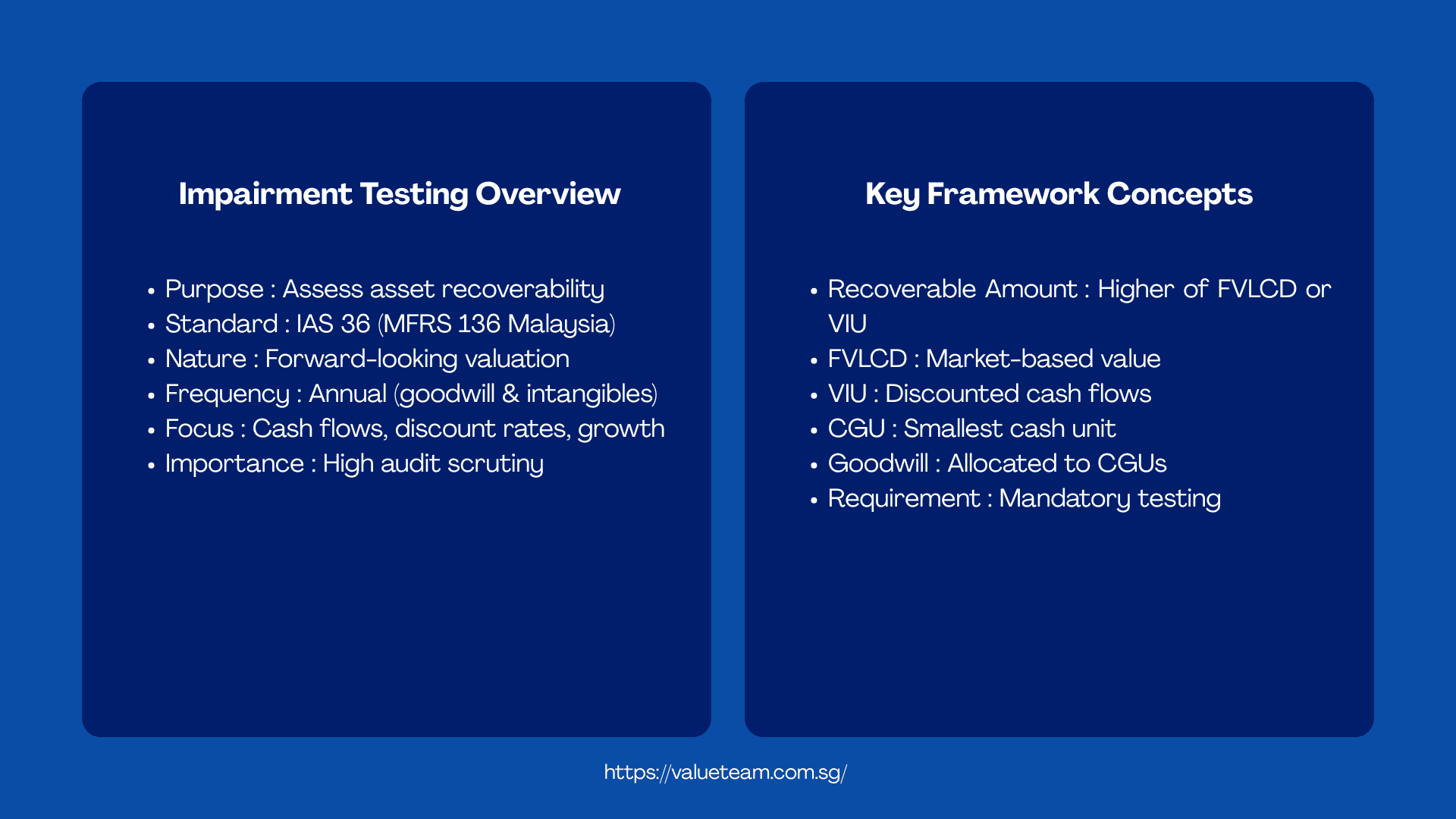
MFRS 136 is the adoption of the IAS 36 in Malaysia and it has the same substantive requirements. Its central requirement is simple to articulate; an entity has to evaluate at every reporting date whether there is any suggestion that an asset is liable, and in case the latter is at risk, approximate the recoverable worth of the asset. Goodwill obtained in a business combination and intangible assets with indefinite useful lives have an unconditional requirement; that they are tested every year whether there is any indication that they are impaired or not. This difference is of importance in practice. In good faith, it is not whether the circumstances have changed sufficiently to justify a test; rather the test is necessary and the standard of such test auditors will assess annually.
According to MFRS 136, recoverable amount is the best amount between the fair value of an asset less expenditure of disposing assets (FVLCD) and its worth in use (VIU). The two measures are conceptually different, and produce different calculations of meaning. Fair value less expenditures on disposal is a market-driven estimate – it inquires what the asset would fetch in an untroubled transaction in the market, less the incremental costs that can be specifically linked to the disposal. Value in use, in contrast, is an entity-specific measure – it incorporates the entity projections of future cash flows discounted at a pre-tax rate based on current market evaluation of time value of money plus asset specific risks. Value in use is rather more widely used in the case of going-concern businesses, as it enables the management to take into consideration the future prospects of the business instead of the valuer being compelled to model a hypothetical market transaction.
The application of MFRS 136 in practice is based on the concept of cash-generating unit or CGU. An asset whose cash flows are not independent of the other assets have to be tested as the smallest group of assets which jointly produce a significant amount of cash inflows, independent of other groups. The setting of limits on CGU is a judgemental task with important down-stream implications: a wide CGU boundary gives more assets access to recoverable amount, which can mask impairment within single component; a small boundary can give access to impairment which would not otherwise be visible were the assets to be determined in the same way as complementary activities. Listed companies in Malaysia under MFRS have to conduct annual impairment testing valuation which means that the boundaries of CGU have to be defined on a year to year basis unless the business operations are actually changing in terms of monitoring and controlling them internally.
The goodwill should be assigned to CGUs, or groupings of CGUs, which are likely to enjoy the goodwill synergies of the business combination which gave rise to the goodwill. This allocation should be done prior to the first annual impairment test after the acquisition and it is on this basis that all subsequent tests will be done until the time the associated business or segment is disposed of or re-organised. It is important to understand how goodwill is assigned and why such decisions on allocation were taken before trying to comprehend the impairment test results that occur afterwards.
The Five Step Impairment Testing Process | IAS 36 Impairment Testing in Malaysia
Testing of impairment under MFRS 136 is not a calculation but a process that has to be carried out in a systematic, well before the construction of any model is done and thereafter is followed up by disclosure, which has to meet the standard of the audit as well as the expectation of the users and auditors of the financial statements. The process is usually outlined in five steps as follows in a properly managed engagement.
Step 1 – Determine CGUs and verify Goodwill Allocation. Prior to any kind of modelling, the practitioner needs to verify that the CGU structure is a mirror of how the business is managed and monitored at the moment. In case any major organisational change has occurred since the last test (restructuring, a divestment or a reorganisation of the management) the CGU boundaries might have to be reviewed. Any goodwill that is on the balance sheet ought to be remapped to either CGU or group of CGU that goodwill has been allocated to. This mapping exercise itself, in complicated group arrangements, may be an important piece of work, especially when the acquisitions have been incorporated into the existing businesses and the original allocation records are incomplete or old.
Step 2 – Indicator Assessment. In the case of the assets other than goodwill and indefinite-lived intangibles, the initial formal step used in MFRS 136 presents an examination of the presence of indicators of impairment. There are external and internal sources of information to be taken into consideration. The following table lists the indicators of the most frequently occurring impairment indicators in the Malaysian corporate environment, according to type, and with comments on the impact of each one on the testing approach. Where the standard does not require a full test to be made, a well documented indicator test is sufficient to prove that the entity has taken the question seriously and not just state that no impairment exists.
Table 1 : Indicator Assessment in IAS 36 Impairment Testing in Malaysia
| Indicator Type | Examples in Malaysian Practice | Implication for Testing Approach |
|---|---|---|
| External — Market | Decline in Bursa sector index; rising OPR impacting WACC; commodity price drops affecting resource sector CGUs | Triggers mandatory between-period testing; discount rate must be refreshed |
| External — Economic | Weakening ringgit increasing cost of imported inputs; regional demand contraction; new regulatory restrictions | May require scenario modelling rather than single base-case projection |
| Internal — Performance | CGU revenue 15%+ below budget; EBITDA margin compression for two or more consecutive periods; anchor customer loss | Headroom from prior year may no longer be reliable; full re-run required |
| Internal — Strategic | Management changes growth strategy; restructuring or disposal of CGU assets; significant capex deferred | Cash flow projections must be rebuilt from revised business plan; prior model cannot be rolled forward |
| Internal — Carrying Value | Recent acquisition increasing carrying value of CGU; revaluation of assets increasing book value above recoverable amount | Goodwill allocation schedule should be reviewed; CGU boundaries may need reassessment |
Step 3 – Building the Cash Flow Projections. The assumptions that support a VIU calculation should be founded on realistic and reasonable assumptions that represent the best estimation by the management of the economic conditions that will prevail during the remaining useful life of the asset. According to MFRS 136, the maximum number of years over which detailed projections are to be made is five unless it can be demonstrated that a longer period of time is justified, and that after the detailed forecast, a steady-state growth rate must be used, which in most cases would be no higher than the long-term average growth rate of the markets, in which the CGU operates. Very practically, the single most critical subject in this step is the fact that the projections must be internally consistent and commercially based. Projections which indicate a quick restoration of historical margin levels after a bout of underperformance without express support of operations will attract challenge by the auditors and should attract challenge by the management itself. The impairment testing services in Malaysia that are prepared according to the IFRS requirements always indicate management optimism bias as a quality risk that is most rampant in the VIU modelling.
Step 4 – Decision on the Discount Rate. A VIU calculation should have a discount rate which is a pre-tax rate which indicates the current market evaluation of the time value of money and risks unique to the asset. Practically, the majority of practitioners take a post-tax weighted average cost of capital and gross it up to a pre-tax counterpart, which should be done carefully since it is not a mechanical relationship between pre-tax and post-tax rates but rather a product of the tax profile of the individual cash flows being discounted. The WACC, in turn, does require a number of inputs: the risk-free rate (usually determined based on the yields of the Malaysian Government Securities), the equity risk premium, a beta coefficient adjusted to the listed comparables, and the capital structure. In case CGU where a large part of the operations is outside Malaysia, an extra country risk premium can be charged. The most contentious assumption of impairment test is always the discount rate, and an independent impairment testing consultant in Malaysia of goodwill and intangible assets will normally record the derivation in great text to enable the audit review.
Step 5 – Determine Recoverable Amount, is Calculating Headroom, and Preparing Disclosures. After the computation of the VIU or FVLCD, this is displayed against the carrying amount of the CGU to ascertain the existence of an impairment loss. When recoverable amount is more than the carrying amount, the CGU has positive head room and impairment is not recognised. Where the recoverable amount is less than the carrying amount then an impairment loss should be recognised first against goodwill and then against other assets on a pro rata basis. The disclosures applying to CGUs with high goodwill or indefinite lived intangibles are extensive and should disclose the key assumptions, the basis on which values have been determined to such assumptions and a sensitivity analysis to give the degree to which a change in key assumptions would clear off the remaining headroom. These are revelations that are scrutinized closely by the high end investors and analysts, and their merit has a direct impact on the merit of the financial statements.
Case Studies: Practice of impairment | IAS 36 Impairment Testing in Malaysia
The principles of above become a lot clearer when they are considered through the prism of real-life examples. Two cases based on the Malaysian business context explain how impairment testing can be applied in various environments and what can be learnt by the practitioners in this case.
The former is regarding a telecommunications group based in Kuala Lumpur that has bought a regional mobile operator in 2019. The acquisition produced a high level of goodwill, which was assigned to a CGU of the acquired one, which included their Malaysian and regional operations. The CGU had been broadly performing in accordance with the acquisition business case in the first three years after the acquisition and the annual impairment tests had created comfortable headroom. This pushed the ARPU by the prepaid segment below material levels as of 2023, and subscriber growth reversed. The 2023 annual impairment test demanded a true review of the long-term revenue trend as opposed to the roll-forward of the previous year model. The updated forecasts, with a reduced rate of growth, an extended period in which the margin would recover, and a higher discount rate in which the benchmark rates have been adjusted to, delivered a recoverable amount that was RM 210 million less than the carrying value of the CGU. The ensuing impairment of goodwill was also the biggest single item within the 2023 income statement of the group and this needed to be communicated well to the investors. What practitioners need to learn is that impairment is not a technical failure – it is a commercial fact that, when it is accurately identified and reported, enhances not destroys trust in the quality of financial reporting.
The second case is that of a mid-sized manufacturing group listed on the ACE market of Bursa Malaysia that possesses a goodwill of the acquisition of a precision engineering subsidiary in 2017. Its subsidiary has still been doing well, yet the external auditor of the group, due to increasing interest rates and pressure on margins in the sector, has demanded a more stringent impairment test than in the past years that of an independent impairment testing consultant in Malaysia, instead of management alone. The engagement would start with the review of the CGU boundary wherein it is ensured that the precision engineering business produces cash flows that can be independently determined within the activities of the group as a whole. The VIU model is constructed around five years of projections that have been carefully prepared in partnership with the management and the growth rate is assumed to be 3.5 percent in the years after the forecast period. The WACC is calculated as 10.2 percent before tax. The resulting recoverable is greater than the carrying value by RM 28 million – small room by conventional measures. The sensitivity analysis indicates that an increase in the discount rate by 1 percentage point would decrease the headroom to RM 6 million and a decrease in the terminal growth rate by 0.5 percentage point would result in a marginal outcome. Such disclosures are fully disclosed in the notes to the financial statements giving the users a clear picture of the uncertainty in estimations used. Such stringent, self-administered test, and the transparent nature of its disclosure, is all the more likely to be presented to annual impairment testing valuation of listed companies in Malaysia under MFRS, especially in a context where auditors and regulators are examining the quality of impairment-related disclosures as never before.
Professional Learnings, Recurring Pitfalls, and Challenges | IAS 36 Impairment Testing in Malaysia
| Challenge Area | Description | Key Risk | Professional Focus / Solution |
| Cash Flow Optimism | Management often projects optimistic cash flows in VIU models due to natural incentives to show recovery and performance improvement. | Overstated recoverable amounts leading to unreliable impairment conclusions. | Apply constructive challenge: question assumptions, validate operational drivers, and benchmark against industry trends and peer expectations. |
| Terminal Growth Rate Selection | Choosing terminal growth rates (typically 2–4% in Malaysia) significantly impacts valuation, as terminal value often exceeds 60% of total recoverable amount. | Small changes in growth rate can materially distort headroom and valuation outcomes. | Justify growth rates using industry-specific data and transparently disclose sensitivity impacts. |
| Multi-Jurisdictional CGUs | CGUs with operations across countries (e.g., Vietnam, Indonesia, Middle East) involve foreign currencies and varying economic conditions. | Misaligned discount rates may fail to reflect actual risk profiles of different jurisdictions. | Adjust discount rates to reflect country-specific risks instead of relying solely on Malaysian WACC. |
| Documentation of Judgement | Many organisations lack proper documentation of assumptions and decisions made during impairment testing. | Weak audit trail leading to challenges during audit review and reduced credibility. | Maintain systematic documentation: CGU boundaries, assumptions, discount rates, and sensitivity analysis to ensure transparency and audit readiness. |
Conclusion: Construction of Impairment Testing Expertise with the Purpose| IAS 36 Impairment Testing in Malaysia
The IAS 36 impairment testing occupies the most challenging intellectually part of financial reporting. It involves having a technical understanding of the standard and financial modelling skills, commercial decision-making about the tested business, and the capacity to explain ambiguous and difficult conclusions in clear and honest terms. These are the skills that are acquired gradually by experience, and which can be enhanced in any meaningful way by practicing and learning about them.
| Key Focus Area | Description | Practical Importance |
| Mastery of MFRS 136 | Professionals should thoroughly read and understand MFRS 136, especially the distinction between Value in Use (VIU) and Fair Value Less Costs of Disposal (FVLCD), proper CGU identification, goodwill allocation, and disclosure requirements. | Direct familiarity with the standard reduces misconceptions and builds a strong technical foundation for impairment testing. |
| Proficiency in DCF Modelling | Beyond building models, practitioners must critically evaluate assumptions, identify key value drivers, create meaningful sensitivity analyses, and assess whether outputs are realistic in a business context. | Enables practitioners to identify risks and uncertainties effectively, adding more value than simply ensuring technical accuracy. |
| Active Engagement in Audit Process | Engaging with external auditors and understanding their questions, evidence expectations, and reasoning enhances professional judgment. | Real-world audit interactions accelerate learning and improve the quality of impairment assessments beyond classroom knowledge. |
| Growing Demand in Malaysia | Increasing interest rates, sector volatility, and stricter audit scrutiny are driving demand for high-quality, IFRS-compliant impairment testing. | Skilled practitioners with both technical expertise and practical experience will remain in strong demand across industries. |