
Goodwill Impairment Testing Guide Indonesia
The Goodwill Impairment Testing Guide Indonesia is among the most questioned parts of financial reporting of completed acquisitions. In a case where an Indonesian company acquires another business and remunerates a premium over and above the fair value of identifiable net assets, the surplus is captured as a goodwill, an intangible asset that, under PSAK 48 and global equivalent of IAS 36, must undergo an impairment test every year to-the-letter. The goodwill is not amortised like other non-current assets. Rather, its carrying value has to be checked on an annual basis against a calculated amount recoverable.
To CFOs, finance, auditors and M&A professionals with operations in Indonesia, goodwill impairment testing is a compulsory compliance exercise with direct impacts on the income statement. Malfunctioning tests welcome audit qualification; loss recognition that is delayed sends the investors the wrong signal. The guide presents an in-depth and practical tour of Goodwill Impairment Testing Guide Indonesia such as regulatory framework, step-by-step approach, examples of such practices in practice, common pitfalls, and the practical steps that truly distinguish between compliant reporting and truly excellent financial governance.
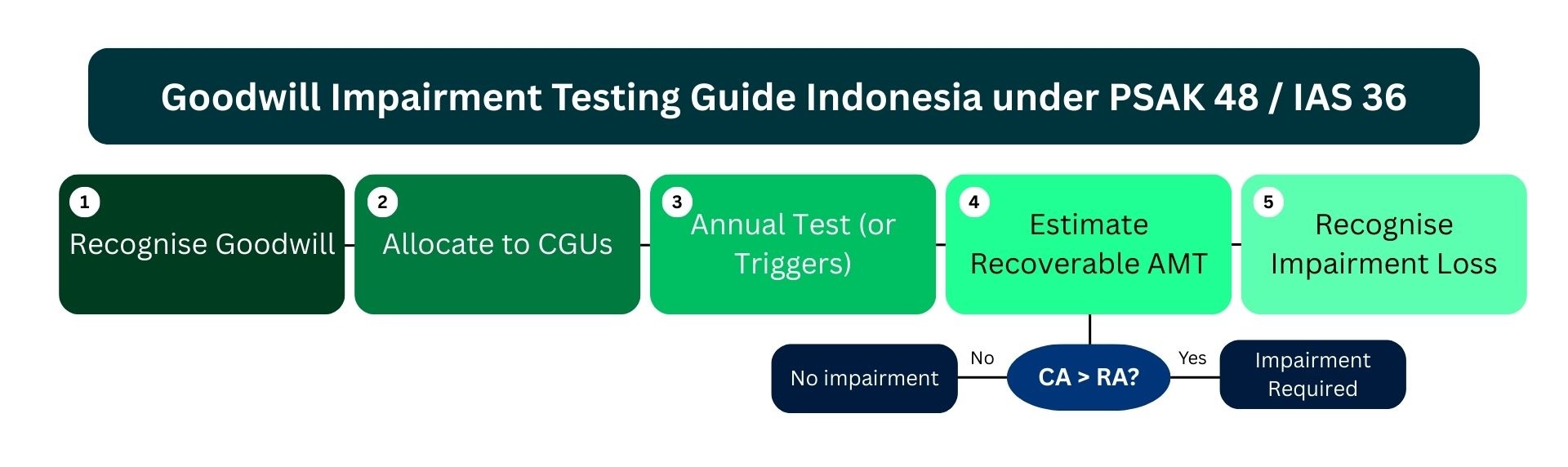
Figure 1: Five-stage Goodwill Impairment Testing Guide Indonesia under PSAK 48 / IAS 36
What Is Goodwill Impairment Testing Guide Indonesia and How Does It Arise in M&A Transactions?
Goodwill is the remaining value, which is included under the residual value of a business upon an acquirer paying more than the aggregate fair value of identifiable assets less liabilities of the business. According to PSAK 22, an Indonesian version of IFRS 3, all business combinations should be recorded with the help of the acquisition method, according to which the acquirer has to record all identifiable assets and liabilities at fair value on the date of acquisition. What is left after such an allocation is goodwill.
Goodwill in Indonesian M&A deals can be perceived in a convergence of the projected synergies, value of a purchased and trained workforce, the quality of management relationship with customers and regulators, the strategic premium which the buyer is ready to purchase to gain the power of the market position which it otherwise will struggle or take time to develop organically. These are true economic values but that are by their nature forward looking and incurable at the date of the sale and that is why PSAK 48 obligates them to be tested against reality annually.
Goodwill valuation for M&A is not an exercise that is done at the time of closing and forgotten. Since the time of its recognition on the balance sheet, goodwill bears a permanent, recurring liability: to show at each reporting period, that the amount at which the goodwill is carried still represents economic value it is likely that the business will generate. The impairment test is that demonstration.
Good will should be differentiated with other intangible assets which are recognized during a Purchase Price Allocation (PPA). Separable intangibles recognised and amortised by PSAK 19 include customer relations, brand name, technology and distribution networks. The same cannot be said about goodwill which cannot be sold independently, is not amortised, and is the value which cannot be included in the specific categories. This carrying significance has significant reporting implications: the reported intangibles carry less goodwill at the PPA level, and fewer impairment tests per year are required to determine annual impairment levels, and more of the post-acquisition earnings are predictable.
Figure 2: Goodwill accounting under IFRS — the M&A lifecycle from acquisition to ongoing impairment reporting (Goodwill Impairment Testing Guide Indonesia)

The Regulatory Framework: Goodwill Accounting under IFRS and PSAK (Goodwill Impairment Testing Guide Indonesia)
The framework of the Goodwill Impairment Testing Guide Indonesia is based on two pillars PSAK 22 (Business Combinations) which regulates how goodwill is generated and measured at the time of its emergence, and PSAK 48 (Impairment of Assets) which regulates how goodwill is actually tested and written down. The two standards have significant similarities with their equivalent IFRS standards- IFRS 3 and IAS 36 respectively with a few timing differences due to the lag in introduction of the standards in Indonesia.
Learning about goodwill accounting under IFRSis hence directly applicable to learning about PSAK. The fundamentals remain the same, goodwill is not amortised, goodwill must be tested for impairment at least once every year, impairment losses on goodwill may not be reversed once they are recognised, and goodwill should be allocated to cash-generating units (CGUs) at the time the acquisition is made, and not at the time an impairment test event causes the impairment loss to be recognised.
In the case of listed Indonesian companies, the regulatory layer over the PSAK is the OJK (Otoritas Jasa Keuangan). The loss of material impairment of assets should be reported in financial statements in an adequately transparent manner to allow the consumers to determine the major assumptions on which the estimate of recoverable amount is made. This implies that quantitative sensitivity disclosures are practically obligatory on any goodwill impairment determination with Level 3 valuation inputs, which in the Indonesian practice is nearly all.
- PSAK 22 / IFRS 3: Acquisition method, PPA, and initial goodwill recognition
- PSAK 48 / IAS 36 Annual impairment testing, CGU structure, VIU and FVLCD methodology.
- PSAK 68 / IFRS 13 level 3 and Level 1-3 disclosure of recoverable amount estimate.
- PSAK 19 / IAS 38: Intangible asset recognition and amortisation – controls what is not in the goodwill.
- OJK Circular Letters of Financial Statement Disclosure: Regulate the sufficiency and manner of disclosure of impairment of listed entities at the IDX.
The finance professionals dealing with Goodwill Impairment Testing Guide Indonesia should be at ease with all five of these standards at the same time. Practically, they are in constant interaction: the nature of the original PPA under PSAK 22 has to dictate goodwill and CGUs structure; the PSAK 48 test demands the use of fair value methodology that is continent on PSAK 68; and the disclosures should conform both to PSAK 48 and OJK.
The Five-Step Goodwill Impairment Testing Guide Indonesia under PSAK 48
Impairment testing on goodwill in Indonesia is done through a five steps process. Every step involves a particular analytical effort and has an output that it feeds the next stage with.
Step 1: Identify CGUs and Allocate Goodwill
The smallest identifiable grouping of assets that produces the cash inflows that are significantly independent of the other assets or groups is termed as a cash-generating unit. Goodwill would be assigned to CGUs at the date of acquisition- to the CGUs which were to enjoy the benefits of the synergies of the combination. This allocation is very important as it defines the unit of account in which impairment is measured. A CGU incorporating goodwill can never be restructured in the future to transfer non-performing goodwill into a larger, profitable division without a very narrow, written explanation.
CGUs are often characterized by Indonesian conglomerates and diverse groups of companies at the business unit or divisional level. The correct degree of granularity is that which represents cash inflows which are truly independent, not that which is intended to lump together profitable and poor-performing units to hide the impairment. The auditors and OJK are also very sensitive to periods of change in CGU definitions; any change should be reported and explained.
Step 2: Assess Indicators and Determine Whether Testing Is Required
In the case of non-goodwill assets, the indicators cause PSAK 48 impairment testing. As a show of goodwill, it has to be done annually irrespective of indicators. Nevertheless, the indicator assessment remains timely: when there are indicators in the middle of the year (a huge decline in commodity prices, an adverse event by the regulatory authority, a loss of a key customer), then then the test should be conducted earlier than the end of the year date.
The typical impairment indicators in the Indonesian industry are persistent Rupiah depreciation in import-intensive sector, tightening in regulation in fintech or healthcare industry, structural decay regarding physical foot-traffic in retail sector, over-supply in the hotel or residential property market, and decline in commodity prices of the mining and plantation businesses.
Step 3: Estimate the Recoverable Amount
The amount that can be recovered is the lesser of the fair value less disposal costs (FVLCD) and value-in-use (VIU). They both have to be taken into account but there is a probability that one will be overshadowed.
The value-in-use must have a pre-tax discounted cash flow model of management-approved projections, a maximum of five years explicit forecast period (unless justified by other factors), a terminal value which is based on a long-term stable growth rate and a pre-tax Rupiah-denominated discount rate based on the specific risk of the CGU. The most important input in any calculation of the Indonesian VIU is the discount rate, and the most frequent errors.
In cases where observable market data is available, fair value less costs of disposal is calculated. In the case of Indonesian businesses, FVLCD can be calculated using IDX market capitalisation data (where the listed CGU analogues are used), precedent M and A transaction multiples or a hypothetical sales price can be determined based on a market-participant DCF. In commodity markets, FVLCD based on similar dealings evidence can in fact surpass VIU sometimes specifically where the DCF is restricted by near-term earnings strain which a strategic purchaser would penetrate.
Step 4: Compare Recoverable Amount to Carrying Amount
The carrying amount of the CGU comprises of net book value of all the tangible and intangible assets assigned to it and the goodwill assigned to it. In case the recoverable amount is greater than carrying amount there is no impairment and analysis is recorded and reported. In case the carrying amount is greater than the recoverable amount, impairment should be recognised on the difference.
An error that is commonly caused by the carrying amount assembly is common. Corporated assets should be distributed uniformly as per the instructions of PSAK 48 on the corporate assets. The current audit cycle may tolerate a goodwill impairment conclusion which is caused by an incompletely assembled carrying amount, but in the future periods it will cause bigger problems as the difference is observed.
Step 5: Recognise, Allocate, and Disclose the Impairment Loss
On impairment discovery, the loss is initially identified as goodwill – written down to zero and no other asset in the CGU is subject to impairment loss. When goodwill has been used, any remaining impairment loss is charged pro rata on other assets in the CGU, subject to the floor, which no particular asset may be written below the maximum of its own FVLCD, VIU, or zero. Impairment in goodwill is never undone despite the fact that the situations that created the same improve later on.
The financial statements need to be taken in the notes showing the disclosures made by the goodwill impairment losses in accordance with the amount recognised, the CGU impaired, the determination of the recoverable amount basis, and the major assumptions and sensitivity analysis. In the case of entities regulated by OJK, such disclosures are examined as a part of the process of filing financial statements.
Key Benefits of Rigorous Goodwill Impairment Testing Guide Indonesia
The testing of impairment of goodwill is usually taken as a burden of compliance. In practice, the effective annual impairment test gives enormous returns that are not limited to the regulation requirements.
True Balance Sheet Representation
Goodwill not impaired where it ought to be indicates a fictitious asset such as one which inflates the balance sheet and gives a false impression regarding the net worth of the company. Recognition of impairment in a timely and accurate manner helps to present reported equity and total assets in true economic terms. This precision is a governance indicator that pays attention to sophisticated counterparties and that companies aiming to finance through debt or through equity investment would value.
Critical Strategic Decision-Making
In an annual impairment test, management is made to reexamine the original acquisition thesis the projections and assumptions that underlay the premium paid versus actual performance. Where there is a high level of headroom erosion as indicated by the test, it acts as a precursor that the business strategy beneath the business strategy itself is possibly a cause of the circumstances. This means that a rigorous impairment review is not only a reporting process but, a strategy review mechanism with quantifiable results.
Less Audit and Regulatory Risk
One of the most risky areas of financial statement audits around the world is the goodwill impairment and Indonesia is not an exception. Auditors subject the discount rates, cash flows assumptions and CGU definitions to great scrutiny. The degree of audit challenge, the number of questions and the speed of sign-off is materially less when the preparer undertakes the test in a rigorous well-documented methodology instead of a last-minute rush prior to the deadline to complete the audit.
Investor and Lender Confidence
Goodwill impairment testing should also be reported transparently and be well disclosed indicating credibility of management. Investors and lenders who are exposed to repeat, assumption-disclosed, sensitivity-analysed impairment disclosures across several reporting periods will develop the confidence that management is using reported assets prudently- not accumulating impairment losses that will be reported as a massive, one-period write-down when denial becomes unsustainable.
Real-World Applications: Goodwill Impairment Testing Guide Indonesia
Testing on the impairment of goodwill in various industries in Indonesia is done in various forms. The cases below show trends that are found in the Indonesian financial reporting practice.
Mining and Natural Resources: Impairment by Commodity
One of the Jakarta-traded mining companies has bought a nickel processing installation in Sulawesi, where IDR 780 billion of goodwill was recognised as representing a single CGU covering the processing plant and related mining rights. Because the prices of nickel in the world market dropped significantly below the values used in the initial acquisition model, the management had to perform an accelerated impairment test in accordance with PSAK 48 before the year-end.
The VIU was calculated using a consensus price deck of nickel, rather than the original, more optimistic assumptions of the management, discounted using a Indonesian risk free rate of 15.1% Rupiah WACC, a industry specific risk premium of mining cash flows and an asset specific premium of the single-asset concentration of the CGU. This VIU of IDR 510 billion, in relation to a carrying amount of IDR 1.02 trillion, generated an impairment loss of IDR 510 billion- whereby the goodwill has been written to zero and the remaining balance spread across the assets of the processing plant.
The major lesson: in commodity-intensive products, impairment triggers can become realised quite fast when the assumptions about prices constructed in the initial acquisition model do not match the market information. Half year indicator test needs to be part of annual testing calendar- especially of businesses whose prices have high exposure to commodity prices.
Digital and Technology: Growth Assumption Issue
It had purchased a mid-stage ride-hailing and logistics platform by a publicly listed Indonesian holding company, which identified IDR 1.4 trillion of goodwill distributed among a CGU that represented the operations of the platform in Java and Bali. Three years after the acquisition, the platform had increased its gross merchandise value significantly- however, EBITDA was heavily negative and the route to profitability had been postponed severally as opposed to the initial management strategy.
The impairment test involved five-year foreseeing projection in two circumstances, a management case, which shows the persistence of the growth trend, and a probability-weighted adverse case, which shows the probability of the unit economics failing to enhance as expected. The management case was questioned by the audit staff as not being supported by historical performance adequately, so an addition case of blended scenario was needed. The ultimate VIU which is a probability-weighted average of the three scenarios gave rise to the impairment loss of IDR 420 billion on goodwill.
The learning: to grow a high-growth, negative-EBITDA business, the VIU methodology should be clearly developed to deal with uncertainty on the road to profitability. It is more defensible as well as more intellectually honest than a single optimistic management case, and it is the direction that auditors will drive towards anyway.
Consumer Goods: Headroom Monitoring as an Early Indication System
The consumer goods group who owns a suite of regional food and beverage brands had purchased a snack manufacture 5 years prior with recognition of IDR 290 billion of goodwill. The CGU had also continued to pass its annual impairment test in the years after acquisition- but with decreasing margins. The finance department developed a headroom monitoring model to monitor the difference between recoverable amount and carrying amount versus a sensitivity overlay: what would the discount rate have to rise, or the projected decline in revenue, before impairment was incurred?
Upon realizing in the sensitivity analysis in year four that an increase in the WACC by 75 basis points would do away with all the headroom, the CFO had escalated the discovery to the audit committee- with a proposal of a strategic review. The positive side of the issue was the positive impact of the external auditors and the OJK on the proactive disclosure of the proximity of impairments prior to the actual recognition of the impairment is thus an example of transparent high quality financial reporting. It did not recognise any impairment that year, but the business plan had been updated and the headroom regained in other periods.
Best practice insight:
The goodwill headroom monitoring (monitoring the sensitivity of the impairment conclusion under the different ranges of the key assumptions) should be part of the standing management reporting, and not part of an annual exercise only to be prepared because of the audit. Firms with constant headroom checks are in a better position to appeal a corrective action prior to the eventual impairment.
Common Challenges in Goodwill Impairment Testing Guide Indonesia and How to Address Them
Although it is apparent that the regulatory transparency of PSAK 48 is great, the Indonesian goodwill impairment testing is performed regularly under the influence of a predictable complex of issues. The best mitigation is to understand them beforehand.
The Discount Rate Problem
A single technical error in Indonesian impairment testing is the application of USD-denominated cash flows without currency adjustment to the Rupiah cash flows. Since the interest rates of Rupiah are structurally higher than USD rates, which indicate the inflation differentials in Indonesia and the exchange rate risk associated with this currency, a USD WACC of 8-9 percent will usually report a lower value of the correct Rupiah WACC, by 300-600 basis points. This is a systematic overstatement of recoverable amounts and understatement or elimination of impairment that ought to be recognised.
This can be solved by methodological discipline: always compute the discount rate on the cash flows projected in the same currency. The WACC of the Indonesian CGUs that produce IDR cash flows should have the Indonesian Government Bond yield as the risk free base not the US Treasury or global yield. External advisers and finance teams who are unable to illustrate this derivation expressly must be compelled to construct their discount rate on first principles and no impairment conclusion should be embraced.
CGU Definition Manipulation
The most enduring problem in the Indonesian impairment practice is the definition of CGUs in such a way that they clusters profitable and a nonperforming units. When a poor performing acquisition is combined with a good performing domestic business within the same CGU, the good cash flows of the good performing business subsidise the impaired goodwill, and conceals a loss PSAK 48. It is the definitions of CGU that are causing escalation in questioning and criticizing by auditors, who have beckoned over the course of several years of poor performance in a single segment of the group.
The rule that must be adhered to is that CGUs are to mirror the real manner in which the management monitors and produces returns, but not how goodwill can best be conveniently buried. Good governance will involve independent examination of CGU definitions, by an external adviser or internal audit role, at least every two or three years.
Cash Flow Forecast Optimism in the Management
The viu calculations are not as valid as the projections which support them. The projection of the management in Indonesia entrepreneurial and family controlled corporate culture is more of aspiration, than a probability weighted expectation especially where the projections are also applied in internal incentives and target setting systems. The auditors will have to determine that management forecasts are reasonable, but the information asymmetry may limit this assessment.
Professionals in finance that help in the impairment reviews are expected to retain a comparative analysis between the management forecasts and the real facts in a period of at least two to three years. In cases where pattern of forecast overstatements is a consistent action, then this information must be disclosed to the audit team and be factored directly into the sensitivity analysis. The kind of forecast that must be attained at a considerably high level of performance than the one the business has never achieved cannot be achieved by just management belief.
Disclosure Arreftures and OJK Demystification
With respect to listed companies in Indonesia, the OJK has also become stricter on the disclosures of goodwill impairment. As often the focus of OJK inquiry letters, i.e. requests to submit additional information, without which, however, they may delay the approval of financial statements and cause reputational damage: financial statements that mention goodwill impairment testing but present no key assumptions, growth rates, discount rates and sensitivity analysis that should be performed as required by PSAK 48.
The answer to this is to make disclosure preparation as part of the impairment modelling rather than a drafting exercise written after the analysis has been done. Setting the PSAK 48 disclosure table, with all the necessary inputs, simultaneously, when the model is prepared, is made sure that the assumptions disclosed are completely compatible with the disclosed assumptions. This consistency check is a rudimentary quality control which is relatively rare among teams put into serious practice.
Table 1: Goodwill Impairment Testing Guide Indonesia — Key Standards, Requirements, and Practice Notes
| Standard | Key Requirement | Valuation Method | Indonesia-Specific Note |
| PSAK 22 / IFRS 3 | Acquisition method; first goodwill recognition. | Purchase Price Allocation | PPA should have to be completed in 12 months of acquisition date. |
| PSAK 48 / IAS 36 | Goodwill impairment test every year (no amortisation) | VIU (DCF) or FVLCD — higher of two | Rupiah cash flows (cash) WACC needed on IDR cash-flows; USD not acceptable without adjustment. |
| PSAK 68 / IFRS 13 | Level 3 fair value disclosure and inputs. | Level 1-3 hierarchy; Level 3 of DCF. | Level 3 prevailing; wide narrative + quantitative disclosures of sensitivity are needed. |
| PSAK 19 / IAS 38 | Other intangible assets are disaggregated of goodwill; amortised over useful life. | Income / market / cost approach | More intangible ID at PPA stage lessens the goodwill and eases testing of impairments. |
| OJK Regulations | Disclosure of the material impairment; the key assumption transparency. | Format of report on the basis of the OJK. | OJK enquiry letters are issued where disclosures are unsatisfactory; whereby listed companies are subject to added scrutiny. |
Source: PSAK/IFRS standards and Indonesian financial reporting practice observations. (Goodwill Impairment Testing Guide Indonesia)
Conclusion: Making Goodwill Impairment Testing a Governance Strength in Indonesia (Goodwill Impairment Testing Guide Indonesia)
Indonesia does not have a checkbox exercise in goodwill impairment testing. Properly conducted, i.e. with a properly prepared Rupiah WACC, a justifiable CGU structure, management forecasts calibrated against past performance, and disclosures that are fully compliant with PSAK 48 and OJK, is a control mechanism that ensures integrity of the balance sheet, informational usefulness to strategic decision-making and credibility with auditors, investors and regulators.
The main message of all of the cases and issues discussed in this crucial guide is the same: a goodwill impairment test can only be as good as its assumptions and the way it is documented rather than the complexity of the model. A complicated DCF constructed on management projections that cannot be verified and a non-disclosed USD discount will be put to audit test. A simple model with a strictly developed Rupiah WACC, an unrealistic growth rate and a fully disclosed sensitivity analysis will pass–and will credit the team which prepared it.
To practitioners in the process of becoming experts in this field, there are four tangible measures that will hasten competence. To begin with, learn how to construct an underlying Rupiah WACC, using the Indonesian Government Bond yield as the risk-free base, in the most basic technical way possible- this eliminates the most frequent technical breakdown in Indonesian goodwill impairment practice. Second, read study PSAK 48 CGU definition guidance and real-life examples of the IDX-listed company financial statements, where the structure of CGU and its modifications with time are reported and can be assessed critically. Third, practice in building sensitivity tables which look at the conclusion on the impairment under different ranges of discount rate, terminal growth rate and range of revenue assumptions- this develops the analytical fluency that OJK reviewers and auditors are looking at. Fourth, reveal goodwill disclosure impairment in Indonesian annual reports as it is at present, both as archetypes of what good is and as sample of what disclosure failures OJK enquiry letters are dispatched to solve.
The economy of Indonesia is still producing purchases, capital market and the goodwill that ensuing goodwill. Finance practitioners who are able to pass goodwill impairment testing in Indonesia with both technical and regulatory ease will have their feet on even firmer ground, in their advisory practice as well as in the corporate functions that will be left to deal with these requirements year after year.