
Fair Value Valuation Malaysia
A Practical Guide for Finance Professionals Navigating MFRS Fair Value Requirements
Introduction to Fair Value Valuation Malaysia
One of the most consequential ideas in the current financial reporting is fair value – and as far as the practitioners of the Malaysian financial reporting are concerned, mastering the principles of Malaysian Fair Valuation is beginning to be a prerequisite, not a skill set. In all industries and sizes of companies, including Bursa Malaysia-traded conglomerates and emerging mid-sized companies with their first audit approaching, the need to measure and report assets and liabilities at fair value is found in almost every part of the balance sheet.
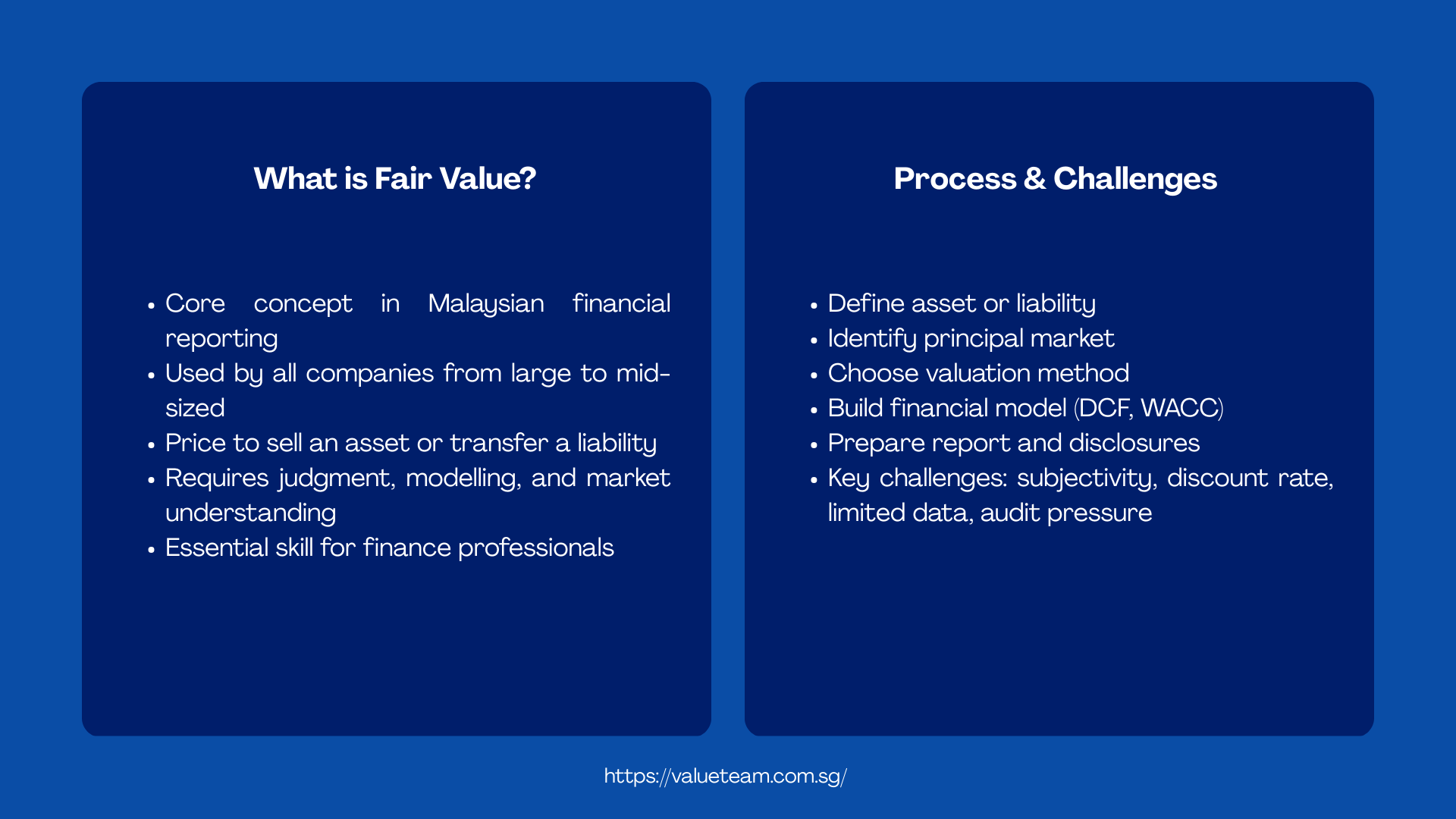
In the simplest form, fair value is the amount to be obtained by selling an asset or giving to the transfer of a liability in a transaction with an orderly transaction between the participants of a market at the date of measurement. The definition as provided by MFRS 13 (Fair Value Measurement) is very clear-cut, however its practical application involves a lot of judgment, technical modelling ability, and delicacy in the application of the markets behavior in the Malaysian setting. The sensitivity of the ringgit to international capital flows, the relative illiquidity of some domestic asset classes, and the concentration of Malaysian publicly listed comparables in a few industries all determine the determination of fair value in the area, relative to bigger or more developed markets.
The article is aimed at junior to middle-level financial practitioners – those who are either currently employed in a valuation advisory firm, a corporate treasury or accounting department, or those who are about to join jobs that might involve transaction advisory, audit or financial control. At the conclusion you are expected to understand what MFRS Fair Value is actually in real life professional practice, the general process of measurement between trigger and disclosure, the pitfalls that practitioners usually encounter and how you can position yourself to better handle such engagements in the future.
Fair Value Valuation Malaysia Framework of the MFRS
All Fair Value Services in Malaysia are based on MFRS 13 that was adopted as a result of convergence to the IFRS and that has been in force since January 2013 on annual reporting periods. The previous process of fair value guidance before MFRS 13 was fragmented — each standard had its set of measurement rules and disclosures to provide. This was brought together in one coherent framework under MFRS 13 and defines the definition, principles of measurement, and disclosure, which now govern fair value in all other MFRS standards.
The most important concept of MFRS 13 is the fair value hierarchy that categorizes the inputs relied on in valuation in three levels depending on their observability and reliability. This hierarchy is not just a technical one- it has practical consequences regarding the way in which valuations are done, checked and reported. The less the level, the more judgment is needed and it will be subject to more scrutiny by the valuation by the auditors, audit committees and regulators such as the Securities Commission Malaysia.
In addition to MFRS 13, fair value measurement in Malaysia is activated by a variety of other standards which is dependent on the type of asset or transaction. MFRS 3 (Business Combinations) entails fair-value measurement of all the identifiable assets and liabilities at the date of acquisition. The MFRS 136 applies testing of impairment based on recoverable amount that is frequently calculated on a value-in-use basis that aims quite close to the fair value methodology. MFRS 9 (Financial Instruments), MFRS 140 ( Investment Property), MFRS 141 (Agriculture) and MFRS 2 (Share-Based Payment) have their own requirements of fair value. All these should not be the focus of a single or two professionals, but a well-rounded professional in Malaysia Fair Valuation should be fluent in all of these.
Table 1: Fair Value Hierarchy Under MFRS 13 – Fair Value Valuation Malaysia
| Level | Input Type | Description | Example in Malaysian Practice |
| Level 1 | Quoted market prices | No adjustment in visible prices in the active market. | Bursa Malaysia equities (MGS), government securities. |
| Level 2 | Observable inputs (indirect) | Prices that are quoted based on observable market data. | Similar multiplications of transactions are interest rate swap curves. |
| Level 3 | Unobservable inputs | Under assumptions of own entity when market information is inadequate. | Unquoted company value, complicated intangible value, start-ups. |
5 Processes in the Fair Value Engagement – Fair Value Valuation Malaysia
As a valuation analyst aiding an outside engagement or as a finance executive with the process, you have to understand the overall end-to-end process of a MFRS Fair Value engagement is essential. It is not a linear process where every element is totally independent – however, considering it in phases is beneficial to prevent many of the traps such as the choice of inappropriate methodology at the initial stage or omission of important disclosure requirements at the final stage.
The initial one is the definition of what is measured. This is a truism and it is often brushed off. The unit of account, be it an individual machine, a portfolio of investment properties or a complete cash generating unit, has a significant impact on the valuation result. This should be accompanied by ensuring that you verify the date of measurement, standard, which should be applied, and the purpose of the valuation. A purchase price allocation prepared in accordance with MFRS 3 using different assumptions and disclosure narrative will not be the same as an impairment testing prepared under MFRS 136.
The second step is determining the primary or most beneficial market MFRS 13 obliges the valuers to look at the market where the asset or liability is likely to be sold. This is something that must be thought a lot in Malaysia. The main market in the case of the commercial property in Kuala Lumpur is evidently the domestic real estate market. However, when the stake is in a regional logistics business that operates in several ASEAN countries, the market can be regional or international, and it alters the group of comparable transactions as well as the risk premium. The third step, which is the choice of the valuation approach, comes easier after the market is established. Each of the income approach (which is usually a discounted cash flow), market approach (comparable companies or transactions), and cost approach, has its own application and many complex assets may also require a synthesis.
The fourth step will be construction and stress testing of the financial model, and it is where the actual analytical effort occurs. In the case of a DCF, it acts as the creation of strong cash flows projections, choosing a refreshing rate (usually a weighted average cost of capital or WACC) to utilize, using terminal value assumptions, and performing sensitivity tests to grasp the effect of the conclusion in various assumptions. The fifth step documentation and disclosure is the area that most junior professionals do not give their best at. Effective auditable working papers being able to trace all of their assumptions to a source and effective disclosure notes meeting the substantial requirements of MFRS 13 are what make the difference between an effective engagement and a merely satisfactory one.
Process Flow 1: Five-Step Fair Value Valuation Malaysia Measurement Process
| Step 1 | Step 2 | Step 3 | Step 4 | Step 5 |
| Define the Asset or Liability | Identify the Principal Market | Select the Valuation Approach | Apply Inputs & Build Model | Document & Disclose |
| Confirm the measured, its nature and the standard of MFRS. | Identify the most favorable market in which the transaction will take place on the measurement date. | Select between income, market or cost approach depending on the type of asset and data available. | Input Level 1/2/3 Prepare/test the financial model, sensitivity analysis. | Prepare valuation report, disclosures of notes and support audit review working papers. |
| Output: Scope memo/date of valuation approved. | Output: The rationale of market selection recorded. | Output: Methodology memo approved | Output: Table draft valuation of sensitivities. | Output Final report / audit support file. |
Fair Value Valuation Malaysia Across Key Industries
Fair Value Services is applied in practice significantly differently depending on industry and developing this industry-specific knowledge is one of the most useful things that a mid-level professional can accomplish. The property and REIT industry is one of the most conspicuous in terms of its presence in the field of Malaysia Fair Valuation activity, listed REITs must record their investment properties at fair value under MFRS 140, and any change to the value is to be recorded in profit or loss in every reporting period. An example of diversified REITs in the Klang Valley are retail malls, office towers and industrial holdings. Different types of property also require different approaches to valuation: the income capitalisation method is typical of stabilised income-generating property, but a discounted cash flow analysis is required in property under development, or with a lease expiring soon, to reflect the uncertainty in future flows of income.
MFRS 9 has largely extended the fair value measurement in the banking and financial services sector in Malaysia since its introduction. Banks are required to categorize their financial assets based on a business model test and cash flow features test where large sections of loan books and securities portfolios are currently valued based on fair value through profit or loss (FVTPL) or fair value through other comprehensive income (FVOCI). The pricing of derivative instruments, including interest rate swaps, cross-currency swaps and structured products, involves specialised modelling tools as well as having market yield curves. To the junior professionals in the banking-related professions, even a working knowledge of how these instruments could be fair-valued will open wide career opportunities.
The concept of fair value is getting more applicable in the technology and startup sector as a result of the increased employee stock option schemes (ESOPs) and warrant plans regulated by MFRS 2. An example would include a technology company that is about to list on the ACE Market and who would have to fair-value all of its prior-issued share options and restricted stock units and use option pricing models, like Black-Scholes or a Monte Carlo simulation, depending on the complexity of the vesting requirements. Plantation sector is a special challenge under MFRS 141 according to which, the biological assets such as oil palm trees, rubber trees or stocks in aquaculture have to be impaired to fair value less the cost of standing to sell, and consequently, fair value is normally determined with the help of the DCF methodologies as there is no active market to sell the biological assets.
Table 2: Sector-Specific Fair Value Considerations in Malaysia – Fair Value Valuation Malaysia
| Sector | Common Fair Value Trigger | Applicable MFRS | Key Valuation Challenge |
| Property & REITs | Annual revaluation of investment properties | MFRS 140 | Compression of rental yields; properties at the development stage. |
| Banking & Finance | Derivatives, structured products, loan portfolios. | MFRS 9, MFRS 13 | ECL modelling; basis risk of hedging instruments. |
| Manufacturing & Industrials | Re-valuation of the PPE; impairment test. | MFRS 116, MFRS 136 | No active resale market of specialised assets. |
| Technology & Startups | Share-based compensation; business combinations | MFRS 2, MFRS 3 | Great lack of certainty in revenue estimates; absence of comparables. |
| Plantation & Agriculture | Biological assets at fair value less costs to sell | MFRS 141 | Price volatility of commodities; estimation of yield. |
Fair Value Valuation Malaysia : Common Challenges and Key Learnings
The challenges, which professionals are always faced with, could not be discussed in the context of MFRS Fair Value practice. The most basic of them is the subjectivity of Level 3 valuations. It is where, in cases where market data cannot be observed or is inadequate, valuers have to make assumptions regarding discount rates, growth rates, terminal values, and risk adjustments. This is the rule in Malaysia, where much of the unlisted is in sectors with few direct comps, be it mid-sized manufacturing companies, Islamic fintechs or specialist health operators. It is not that the professionals make incorrect use of these assumptions that they are in danger, but rather that making materially different conclusions based on the underlying data is possible with different reasonable professionals, which poses a huge audit and regulatory risk.
Another related problem is discount rate calibration. Estimation of WACC on Malaysian entities is through sourcing equity risk premium information, estimating a beta of similar listed companies (usually of material size and liquidity dissimilarity to the subject entity), small firm premium, or company specific risk adjustment and the risk-free rate is usually benchmarked to Malaysian Government Securities (MGS). All these elements carry an element of judgment, and a combination of these little assumptions can make the estimates of WACC differ by 200 to 400 basis points among different practitioners of the same subject company. Developing a disciplined and well-documented method of WACC construction at an early stage of your career would be a dividend in the long run.
The relationship between the valuers and the auditors is one more aspect that the juniors in the profession tend to struggle with. In both the standards set by the Malaysian Institute of Accountants and International Standards on auditing (ISA 540) auditors are expected to exercise professional scepticism when examining significant accounting estimates by management, including fair values. This implies that the work of the valuer is not taken at face value; it will be questioned, and at times very fiercely. The audit teams can seek the alternative sensitivity scenarios, challenge the choice of comparables, or challenge the non-recurring items in the cash flow forecast. One of the most important practical skills within Fair Value Services is learning how to look forward to such challenges, and how to construct a valuation that is technically sound and well established in communicating the valuation.
Process Flow 2: The Feed of Fair Value into Financial Reporting – Fair Value Valuation Malaysia
| Trigger Event | Valuation Execution | Audit & Review | Financial Statement Impact |
| Acquisition, end close, the indication of impairment, new share scheme, or revaluation of assets. | Valuer uses methodology that is compliant with MFRS; prepares report that has full disclosure support. | Auditors examine material assumptions, Level 3 Level of test and question discount rate rationale. | Fair value recognised in balance sheet; gain/loss or OCI recognised with break down. |
| Who is involved: CFO, finance, External Valuer. | Involved parties: Financial modeller, Valuation specialist. | Who is involved: Technical accounting team, External auditor. | Participants: Finance people, Board Audit Committee. |
Building a Career in Fair Value Valuation Malaysia
The career opportunity is literally vast to those professionals interested in gaining meaningful knowledge in Malaysia Fair Valuation. Valuation advisory teams at the Big Four and at mid-tier accounting firms will position you at the most direct points of entry, where you will have a heavy exposure to various types of engagements – purchase price allocations and impairment testing, valuation of share-based payments and fair valuation of financial instruments. These jobs offer outstanding technical background as you will have witnessed numerous varied types of assets and industries within a short period, and may be subject to stringent reporting timelines that compels you to acquire not only analytical accuracy but also reality on the ground performance.
In addition to advisory, there is an increase in the need of in-house valuation talent at corporate level. Increasingly, large Malaysian public-listed firms especially in property, banking and conglomerates with active M&A programme are developing in-house competencies to measure and protect their own fair values measurements instead of depending solely on external advisors. These positions are best suited to the professionals who desire to gain high levels of sector familiarity, in addition to their technical expertise, and who have no problem interacting directly with external auditors, the audit committee, and the senior management. The skill of taking a complex fair value finding and explaining it to the non-specialist stakeholders in a narrative form, without the use of jargon, is a skill that is always undeveloped and always appreciated.
Qualification wise, CFA (Chartered Financial Analyst) and ACCA are generally accepted entry to MFRS Fair Value work in Malaysia. Individuals specifically looking at valuation positions ought to also consider the designation of Chartered Business Valuator (CBV) or American Society of Appraisers (ASA)-qualified. On a more pragmatic note, financial modelling, specifically, DCF construction, sensitivity analysis and the option pricing model, is the one technical skill that is the most crucial to acquire. Combine this with a sound reading of MFRS 13 and working knowledge on the standards that call on fair value requirements in various classes of assets, and you will be well-placed to bring immediate value to any team that is doing this work.
Conclusion: Advicing Your Expertise in Fair Value Valuation Malaysia
Fair value does not represent a peripheral technical matter – it is a fundamental block of the Malaysian financial statements reporting economic reality to investors, creditors, regulators and the general market. The need to conduct, defend and communicate Malaysia Fair Valuation work will continue to increase, as the MFRS standards become more complicated, and corporate transactions in Malaysia become increasingly more complicated. Being able to contend with this discipline at a younger stage in your career increases your advantage when compared to other professionals.
Today the best thing you can do is to read MFRS 13, not a summary of it but the standard itself. Specifically, the fair value hierarchy, the notion of the principal market, and the requirements of disclosure in paragraphs 91 to 99 should be put in focus. Then scan the financial statement notes of a Bursa-traded company in an area of interest to you – a REIT, a bank, a technology company – and trace all the locations of fair value disclosure. Attempt to identify the methodology applied, the point in the hierarchy the inputs fall into and the assumptions the company has revealed. The practice itself, once or twice only, will instruct you more of the working of MFRS Fair Value than you can learn by hours of reading in isolation.
In the case of the mid-career, the focus should be based on further specialisation. The professional identity of becoming truly competent in either one or both of the above areas, be it financial instruments under MFRS 9, intangible asset valuation under MFRS 3, or biological asset fair value under MFRS 141, opens the doors to greater value engagements and senior roles. Combine this depth with the communication skills to articulate your work, the professional discipline to will document your assumptions rigorously and the relationship skills to work openly with auditors and clients. It is that combination which makes up a most successful practitioner in Fair Value Services and it is accessible to any one who is ready to invest continuously in his trade.