
ESOP and Share-Based Payment Valuation Indonesia
Due to the rapidly increasing number of Indonesian firms, whether they are listed in the IDX, or pre-IPO, technology startups, employee share ownership plans (ESOPs) and share-based compensation have become a commonplace remedy to attracting, retaining, and motivating talent. However to most finance departments the accounting and valuation of these instruments is one of the most technically challenging parts of the financial reporting. ESOP and Share-Based Payment Valuation Indonesia is a field that also lies at the nexus of the option pricing theory, local accounting standards, tax regulation, and OJK compliance, and as such, is a field that requires not only specialized knowledge, but also requires a lot of documentation care.
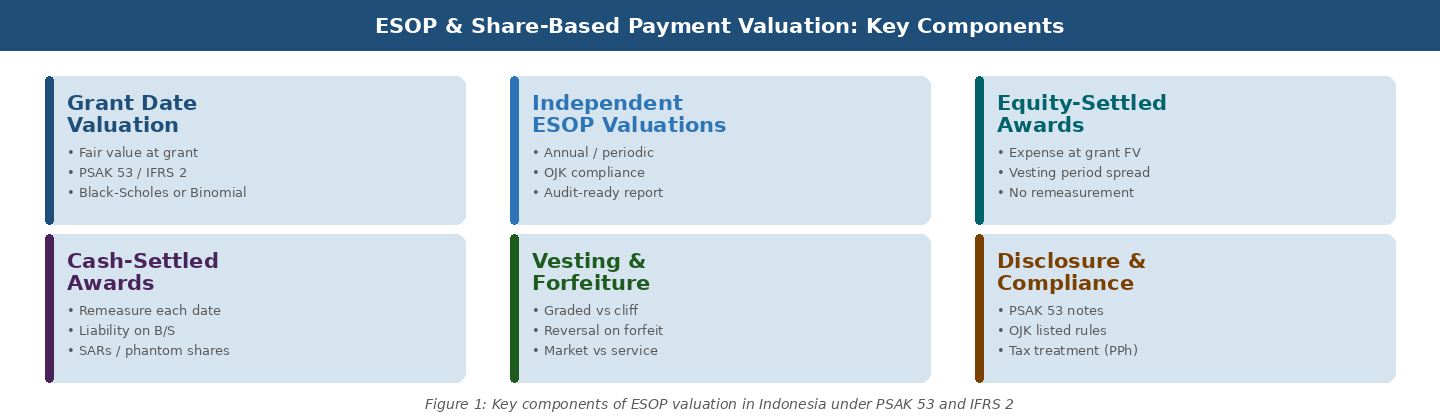
Under Indonesian Standards (PSAK53) Share-Based payment that is consistent with the IFRS 2, companies that grant equity-settled awards, i.e. options, restricted shares, performance shares, should recognise a compensation expense at the grant date but spread over the vesting period equal to the fair value of the such awards. In the case of cash-settled awards (including stock appreciation rights and phantom shares) the liability should be remeasured at fair value at each reporting date. These valuations are not nice to get right: they influence reported earnings, equity, and tax positions, and auditors, the OJK and tax authorities are keen to look over those items.
This journal article contains an exhaustive guide to ESOP and Share-Based Payment Valuation Indonesia, including the regulatory framework, methods of valuation in practice, practice in the field, good practice in governance and documentation, and the pitfalls that are likely to result even in the good intentions of a finance team in producing work that cannot pass an audit test.
Figure 1: Key components of ESOP and Share-Based Payment Valuation Indonesia under PSAK 53 and IFRS 2
Key Concepts: What Is ESOP and Share-Based Payment Valuation Indonesia?
ESOP and Share-Based Payment Valuation Indonesia is the process whereby the fair value of equity-based compensation agreements awarded to employees, which are mostly stock options, restricted stock units (RSUs), performance shares, and stock appreciation rights (SARS), are calculated to be used in the financial reporting process, tax filings, and regulatory disclosure.
ESOP and Share-Based Payment Valuation Indonesia is based on PSAK 53 as one of the local standards that can be compared to IFRS 2. PSAK 53 stipulates that all share-based payments that are transacted with employees or other parties should be recognised and measured at fair value. The standard has identified three categories of share-based payment:
- Equity-settled: the party completing the transaction does so by issuing its own equity (shares or share options). The fair value is calculated at the date of grant and expensed during the course of the vesting period. Remeasuring after grant is not done.
- Cash-settled: the entity uses cash to settle in accordance with the price/value of its equity instruments (e.g. SARS, phantom shares). They are recognised at fair value at the reporting date until the ultimate settlement, and any variation in fair value is recognised in the profit or loss account.
- Choice transactions: the entity or the counterparty has an option of settling in equity or cash. It is a matter of accounting treatment of whether the settlement option was in a party and the presence of the cash alternative generates the present obligation.
In the case of Indonesian companies, the most important valuation need is to identify the fair value of the award on the grant date, or in the case of cash-settled instruments, on every succeeding measurement date. It is at this point that an ESOP valuation services is required: fair value should be determined with the help of a suitable option pricing model, and filled with market-observable inputs as far as possible tuned to Indonesian market conditions.
The significant contributions to any ESOP valuation in Indonesia are:
- Share price: the market price of the underlying share at the grant date would be obtained with reference to a listed company through IDX data or calculated through an estimate of an independent enterprise valuation in the case of a private company.
- Exercise price: the price at which the owner can buy the shares and normally this is determined at or close to the prevailing price at the grant due date.
- Expected volatility: based on the historical volatility of the share price of the issuing company (or IDX listed similar companies), generally over a timeframe equivalent to the anticipated option term.
- Risk-free rate: yield of Indonesian Government Securities (Surat Berharga Negara / SBN) having the same maturity as the anticipated option term.
- Expected dividend yield: on the history of dividend paid in the past and prospective policy of the company.
- Expected option term Expected option term describes the duration between grant and expected exercise, including assumptions related to early exercise behaviour, post-vesting cancellations and employee turnover.
Why ESOP and Share-Based Payment Valuation Indonesia Matters for Companies and Finance Professionals
ESOP and Share-Based Payment Valuation Indonesia has much more than compliance. In the new corporate environment of Indonesia, the pressures of doing it right or wrong are high, on many levels, to listed companies, finance departments and advisers working in Indonesia.
Accuracy of Financial Statement
Share-based payment cost is an objective economic cost to the shareholders-the loss of equity interest. PSAK 53 will have this cost recorded in the income statement as opposed to off-balance-sheet. In the case of listed companies that report to the IDX, low disclosure of share-based payment expense gives a distorted view of profitability on which investors and analysts rely in making their decisions. The problem of overstatement, however, under-reports earnings.
The validity of ESOP valuation is what determines the validity of these figures that were reported. An error of 10 per cent in the estimated fair value of a large option grant would result in hundreds of millions of Rupiah of misreported compensation expense- a material amount in most of the Indonesian listed companies and will raise eyebrows of auditors.
OJK Compliance and Obligations of Listed Companies
The nature and amount of share-based payment arrangements of the Indonesian listed companies must be disclosed in the financial statements of the company, and such disclosures must include the number and the weighted average exercise prices of the option outstanding, the fair value of awards granted to the period and the inputs and assumptions of the valuation model. This is one of the disclosures that the OJK examines as it supervises the financial statements of listed companies. The lack of full or inconsistent ESOP disclosures (especially when the methodology used to make such valuation is described incompletely or inconsistently) creates OJK enquiry letters, which postpones the approval of the financial statements.
Auditors, audit committees, and remuneration committees of the listed companies are increasingly obliged by auditors, audit committees and remuneration committees to require independent ESOP valuations to discharge their governance duties. A board where one of the benefits that are being granted an extensive ESOP without an independent valuation conducted is putting itself at risk of shareholder attack- especially in the face of institutional investor expertise in the Indonesian equity market that still remains underdeveloped.
Tax Compliance in Indonesia Tax Law
The income tax Law (Undang-Undang Pajak Penghasilan) and related DGPT (Directorate General of Taxes) regulations control ESOP taxation in Indonesia. In the case of equity-settled awards, tax treatment largely parallels the accounting treatment, with the compensation expense deductible at the time of award exercise or award vesting- resulting in a timing mismatch between the accounting charge and the tax deduction which needs to be carefully managed in the tax provision. Independent ESOP valuations which are clearly documented and which have clear methodology and observable market inputs certify the evidentiary basis of the tax deduction and lessens the risk of DJP challenge of transfer pricing or arm-length.
Pre-IPO and Startup Context
The startup culture in Indonesia has generated a host of companies, which apply ESOPs heavily to reward their employees and other important executives as an alternative to cash. To such pre-IPO firms, most of which are still in the late-growth phase of their development, annual ESOP valuation in Indonesia is a governance requirement that will be checked by institutional shareholders and subsequent IPO underwriters during the due diligence. Firms with a steady and self-funded ESOP valuation experienced over a series of years indicate financial reporting maturity which enhances the due diligence process and contributes towards a higher IPO price.
Finance teams of startups note:
Annual independent ESOP valuations, regardless of the existence of a documented fair value history, are priceless in both Series B/C fundraising and pre-IPO preparation. It is a small fraction of the price of re-creating the record of valuation in a high-pressure environment during due diligence.
Key Benefits of Professional ESOP and Share-Based Payment Valuation Indonesia
Outsourcing professional ESOP valuation services provide real value in the areas of financial reporting, governance, taxation, and talent management.
Audit Preparedness and Low Friction
An ESOP valuation prepared by a reputable independent provider i.e. one prepared using stated methodology, observable market inputs in Indonesia, and with well defined assumptions is passed under audit scrutiny with little difficulty. In comparison, internally prepared valuations or those created without any Black-Scholes or lattice model recorded documentation frequently lead to audit queries of an auditor that add additional length to the annual audit process and excessively use the time of the finance department.
Professional ESOP valuation services providers are aware of what the Big Four auditors need in Indonesia: current SBN yield, as the risk-free rate, volatility based on the history of the IDX or peer comparables, and an obviously justified expected term. With this documentation produced only once, properly, it does away with the rework cycle.
Support of Governance and Remuneration Committee
In the case of listed companies and professionally managed private companies, the remuneration committee should have independent and credible data to grant ESOP grants. The committee can have a defensible, documented rationale behind the decisions it makes by having an ESOP valuation that is externally prepared and peer-benchmarked, i.e. demonstrate how the grant value compares to industry practice in Indonesia and the Southeast Asian market in general. This is very essential especially when high grants to top players or rather founders can be subject to shareholder examination.
Communication and Retention of Employees
One of the least recognized pros of high ESOP valuation in Indonesia is that it provides a method of communicating company employees in terms of the economic value of their share-based awards. A large portion of Indonesian employees, especially the mid-tier employees who are new to the equity compensation arena, lack the intuition about the value of their options or RSUs. The detailed explanation of the valuation with the independent supporting information would allow the employees to see the complete picture of the compensation package that the ESOP provides, enhancing the effect of retention and motivation that the system should have.
M&A and Secondary Transactions Support
In the case of acquisition, merger, or secondary sale of shares, ESOP awards that were outstanding should be valued and accelerated, converted, or cancelled, with the accounting to be varied according to the particular arrangement. An up-to-date and separately prepared ESOP valuation at the time of the deal can facilitate this process, and minimize the chances of arguments between the buyer and seller as to the fair value of unvested awards.
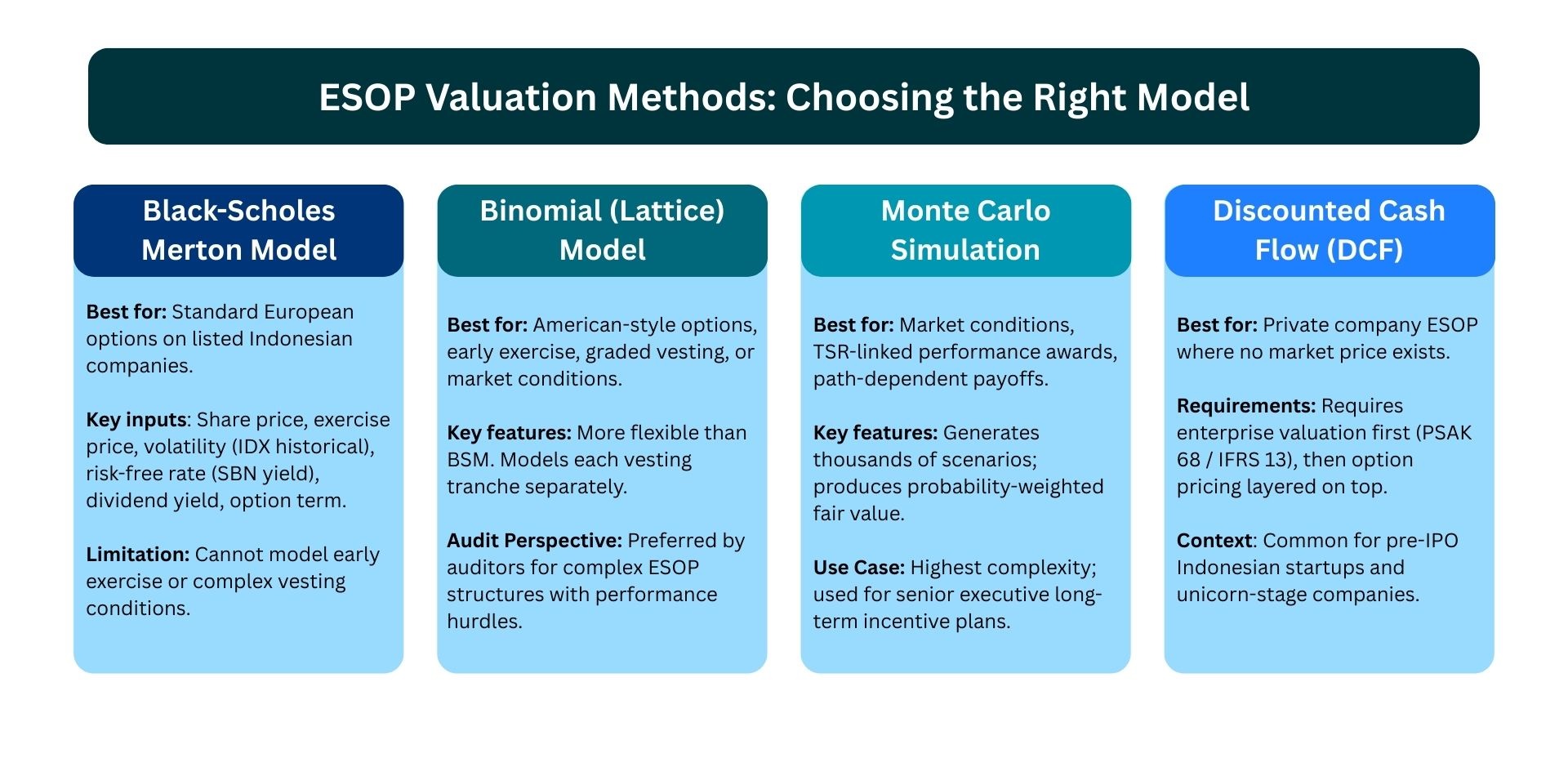
Figure 2: ESOP valuation methods — selection guide for Indonesian companies and ESOP valuation services providers
Practical Applications of ESOP and Share-Based Payment Valuation Indonesia Across Different Company Types
The nature of ESOP valuation requirements and methods vary significantly, based on whether the issuing company is publicly traded, privately owned, or is of pre-IPO status. The following cases present practice patterns that are seen among market players in Indonesia.
Case One: Annual Grant Valuation of Consumer Goods Company Listed
A consumer goods conglomerate with headquarters in Jakarta and a workforce of more than 15,000 was a rolling annual ESOP programme which gave options to about 200 senior-most managers of the company. The company had to calculate the fair value of every annual grant under PSAK 53 and record the expense, being the difference between the fair value of the grant on the grant date and the fair value of the grant in its yearly consolidated income statement, over the three years time span of the vesting.
The valuation team has used Black-Scholes Merton model, where the share price quoted on the IDX at the grant date was the valuation input, and the three-month mean quotation of the shares, annualised, was used as the historical volatility, the risk-free rate is the current SBN 3-year yield, and the estimated term of the option was 3.8 years on the basis of actual historical data of the company in previous grant cycles. The resulting option fair value was IDR 1,840- generating a aggregate grant-date charge of IDR 18.4 billion which was recognised over the three years of the vesting period.
The valuation was not subject to a material challenge by the external auditors since the methodology was clearly reported, the sources of inputs were all based on observable market data, and the assumption of the expected term was based on historical exercise data and not estimated based on general assumptions. The case shows the importance of having a uniform well-documented ESOP valuation methodology across multiple grants.
Case Two: Pre-IPO Technology Platform – Independent ESOP Valuations of Investor Reporting
One of the Jakarta-based fintech lending platforms that had Series C institutional investors had an ESOP pool of about 12% of the fully diluted share capital of the company. The company’s investors required annual independent ESOP valuations to support portfolio reporting, and the audit committee of the company (which was going to place the company on the IDX in a period of two to three years) needed that the entire valuation of the ESOPs should be done by an independent and qualified service provider.
Since the company was yet to be listed, there was no market price of the underlying shares. The ESOP valuation process thus involved 2 consecutive steps which include; firstly, independent enterprise valuation of the company in compliance with PSAK 68 which involves fair value of one share of a company; and secondly, application of an option pricing model, that is, a binomial lattice model, whose selection is due to its flexibility in modelling the company complex vesting conditions and performance hurdles required in the ESOP plan of the company.
The enterprise valuation reflected a mixed income and market method with a discount of lack of marketability (DLOM) to indicate the illiquidity of the pre-IPO shares. The most debated part of the valuation as it was examined by the investors consisted of the DLOM, which was 20 percent according to restricted share studies and put option models. The documentation of the derivation of DLOM needed to be transparent with reference to both the academic literature and what could be observed in the market through similar transactions of pre-IPO held in Indonesia to ensure that the investors could accept it.
Case Three: Regional Bank Valuation of Performance Share Unit
The performance share unit (PSU) plan provided to its executive directors by a regional Indonesian bank was built on the basis that the quantity of shares to be vested had to rely on the overall performance of the bank in comparison to a group of performance-measured regional banks in the Indonesian market, listed on the IDX. This kind of award based on market conditions cannot be valued in Black-Scholes; instead, it needs Monte Carlo simulation, where thousands of simulated TSR paths, including that of the issuing bank and individual peers, are modeled to determine the possibility of the probability-weighted number of shares to vest.
The valuation team constructed Monte Carlo model to calibrate on the correlation structure between the share price of the bank and the TSR peer group, and estimated the individual volatilities as well as the correlation between them using 60 months of IDX daily price data. The resulting grant-date fair value per PSU was the likelihood that the bank would outperform the median of the peer group- the threshold to full vesting- discounted by the likelihood of underperforming the threshold and not being in full or zero vesting.
Its intricacy of the PSU valuation and the obligation of the OJK to have complete disclosure of the Monte Carlo assumptions contained in the annual report of the bank rendered it impractical to the internal financial staff. Hiring an outside ESOP valuation services provider that has Monte Carlo modelling capability was a necessity to comply with and a governance best practice.
Table 1: ESOP and Share-Based Payment Valuation Indonesia — Award Types, Accounting Treatment, and Valuation Method
| Award Type | Settlement | PSAK 53 Treatment | Valuation Model | Remeasure? |
| Stock Options | Equity | Grant FV expense; over vesting. | Black-Scholes or Binomial | No (equity-settled) |
| Restricted Stock Units | Equity | Conditions expense at grant FV, (discount). | Share FV less dividend adj. | No |
| Performance Shares (TSR) | Equity | Condition of market; involve FV. | Monte Carlo Simulation | No |
| Stock Appreciation Rights | Cash | Liability; reimburse on a case by case basis on the reporting date. | Black-Scholes or Binomial | Yes (cash-settled) |
| Phantom Shares | Cash | Current share FV Liability per date. | Enterprise valuation + option. | Yes (cash-settled) |
| Employee Share Purchase | Equity | Cost of discounting aspect alone. | BSM for option element | No |
Source: PSAK 53 / IFRS 2 requirements and Indonesian ESOP valuation practice.
Best Practices for ESOP and Share-Based Payment Valuation Indonesia
The following practices are seasonally found by finance professionals, HR departments and boards that have designed or administered ESOP programmes in Indonesia to be critical to producing compliant, credible and commercially viable results.
- Commission independent ESOP PSAK 53: This is the annual valuation of equities settlement awards that should not be remeasured and PSAK 53 requires that awards should be settled at grant date. Nevertheless, independent ESOP appraisals of each new grant cycle, and of each tranche in a graded vesting plan, will assure that the fair worth of each grant is backed by up-to-date market information and independent validated practice. The standard itself requires independent valuations at each reporting date in case of cash-settled awards.
- Utilize observable inputs in the Indonesian market i.e. the riskless rate would be the SBN (Surat Berharga Negara) yield corresponding to the term of the option, not a USD Treasury rate. IDX historical data of listed companies should be used to derive volatility or a similar listed peer volatility data of private companies. The introduction of non-Indonesian inputs without express, written adjustment creates a systematic bias which will be questioned by the auditors.
- Select the valuation model to the award design – Black-Scholes should be used when the options to be awarded are simple European-style and do not have any non-market conditions. American-style options that are characterized by early exercise as well as the complicated vesting plans are best fitted by binomial models. TSR-based or any other market-condition awards require Monte Carlo. When an incorrect model is used, it is not only a measurement error but also a PSAK 53 failure to comply.
- Assumptions in documents must always be disclosed and stored clearly – the PSAK 53 disclosure requirements require the disclosure of the used inputs and assumptions. Creating an assumption register with respect to each grant cycle, documenting the source of every input, the foundation of judgment-based assumptions like expected term, and sensitivity of the fair value to variations in key inputs, gives both the audit trail required during this period and the benchmarking point of view in subsequent grants.
- Design ESOP to align PSAK 53 mechanics prior to granting grant – certain ESOP plan designs are subject to unwanted accounting consequences which would have been prevented had the valuation adviser been engaged earlier. The non-market vesting requirements (service days, revenue quotas) impact the quantity of awards which will finally be vested and demand a frequent re-evaluation of the expense accrual. One has to include the market conditions (TSR, share price hurdles) in the grant-date fair value, and may not adjust post-grant. Knowledge of such mechanics at the plan design stage, prior to grant issuance, is much less expensive than finding them out in the initial audit.
- Timing on seeking ESOP valuation services during the ESOP plan lifecycle- the best moment to seek an ESOP valuation services provider will be during the plan design stage and not at the initial query of audit. The application of PSAK 53 mechanics could also be used to design the terms of a plan in a manner that meets both the retention and motivation goals of the company with the least accounting complexity and the greatest degree of disclosure that enhances OJK disclosure.
Common Challenges in ESOP and Share-Based Payment Valuation Indonesia and How to Address Them
Even financially endowed finance units are still faced with persistent challenges in ESOP valuation. It helps to avoid compliance risk and cut work friction in audit by knowing in advance the most frequent challenges, and how to deal with them.
Estimation of Volatility of Privately Held Companies
In the case of unlisted Indonesian companies, most of the issuers of ESOPs in terms of volume, there is no directly observable history of share price to compute volatility. PSAK 53 allows the historical volatility of similar listed entities to be used in place of each other and this is a common practice in the Indonesian market. The problem is to find suitable comparables: the peers should belong to the same or the similar industry, be at the same or similar level of development, and listed on exchanges (IDX, SGX, or other markets of the region) where enough price history is available.
The remedy is to develop a documented system of peer selection – defining what screening criteria are applied to choose and disqualify certain comparables – and to estimate the volatility as an average of the peer groups as opposed to being a single comparable. This method is more justifiable compared to a single-peer estimate and offers a natural sense of sensitivity to disclose information.
Expected Term Estimation
The most judgment-sensitive contribution in a Black-Scholes ESOP valuation is the expected option term, which is the duration between grant and expected exercise. In the case of Indonesian companies where the grant history of an option has no history, this estimation should be based upon external reference: scholarly research examination, regulatory advice, or market practice information of similar Indonesian or regional firms. In the case of firms with established ESOP programmes, the actual historical data of exercise is the best basis, but might be small in amount when the programme is recent.
PSAK 53 allows plain-vanilla options to be presented using the simplified method, when only incomplete historical exercise data is available: the expected term should be the average of the contractual term and the vesting period. Although not as accurate as a behavioural model, this is a transparent approach, that is consistently used and easily acceptable to auditors as a reasonable estimate where more accurate data is not available.
Use of ESOP Valuation in the Case of a Privates and Pre-IPO Company
The Indonesian ESOP valuation of a private company must have another complexity: a further step of valuing the underlying shares with an enterprise valuation is needed to apply option pricing to the underlying shares. This makes a two-step procedure enterprise valuation and option pricing that necessitates that coordination be made between the enterprise valuation methodology (PSAK 68) and the ESOP pricing model (PSAK 53).
The interplay between the enterprise and ESOP valuation is of specific consequence to the lack of marketability discount (DLOM). DLOM on the per-share value decreases the option value at a non-linear rate, i.e. in-the-money and at-the-money options are not affected in the same way. One of the most technically delicate issues in pre-IPO ESOP valuation in Indonesia is the relevance of the DLOM in the calculation and the fact that its derivation should be clearly recorded.
Maintaining Plan Design Adoptions
Indonesian companies, especially high-growth technology firms, often vary in terms of the ESOP plan as the company transforms its compensation strategy. PSAK 53 modifications such as changes in the exercise prices, extension of the term of the options, alteration of the performance terms, and acceleration need recognition of incremental fair value as an incremental expense. Finance staff which fail to systematically record the change of the plan design run the risk of overlooking the situation where the changes are not recorded and when discovered during audit such changes must be corrected retrospectively and further disclosure undertaken.
The practical resolution is to have a change management procedure of the ESOP plan in place, that is, to have the finance team approve any given change proposal first before it can be passed by the remuneration committee, and that the PSAK 53 accounting impact should be a part of the approval documentation.
Conclusion: Building ESOP Valuation Capability as a Strategic Finance Competency
ESOP valuation in Indonesia is no longer a technical practice of the Big Four, or large companies. With the maturity of the Indonesian corporate sector, increasing numbers of companies using increasingly complex equity compensation programmes, increasing numbers of companies developing ESOP pools in anticipation of IPO, and increasing numbers of institutional investors insisting on a governance condition of having their ESOP valued every year using the PSAK 53 model, the call for qualified ESOP valuation work (competent, compliant with PSAK 53 model) is deafeningly increasing all around the market.
The essence of the werewithal that flows through all of ESOP valuation as required by the PSAK 53 is simple: the fair value of share-based awards are to be estimated with use of an appropriate model, which has to be filled with observable industry inputs of Indonesia market where so feasible and recorded with acceptable transparency to meet both the auditor review and OJK disclosure requirements. Any of these three conditions of wrong model, non- Indonesian inputs and poor documentation do lead to compliance failures that can be prevented using the right expertise and process.
The practical course in this field is obvious to finance workers who develop the ability to do it. Study PSAK 53 and IFRS 2 jointly- they cannot be substance different and of global IFRS 2 literature is significantly more developed. Master the mechanics of Black-Scholes: have a truly good command of all the inputs, be able to obtain each of them out of the Indonesian market data, and be aware of how the resulting output is sensitive to a change in any of the inputs. Consider the providers of ESOP valuation services that have managed to test themselves in Indonesian market conditions, not only in the technical deliverables they offer, but also in the professional development exposure they offer working with them.
The market expansion of equity compensation of Indonesia will keep on increasing with the increased involvement of the corporate sector in the country with the international capital market, international talent competition, international institutional governance standard. Those finance professionals who invest in expertise in ESOP valuation today (acquiring the technical expertise and the professional relationships that will allow them to perform independent ESOP valuation to the highest level of competence) will be better placed to bring substantial value in a market where such expertise is truly rare.