
Common Situations That Require Business Valuation
Introduction to Common Situations That Require Business Valuation
It’s not the exclusive preserve of the corporate giants or investment banks to understand the value of a business. From a startup founder setting up for a first round of funding to a CFO whose business is going through a complex merger, to a business owner deciding their exit strategy, professional business valuation services is a critical component in making informed and defensible financial decisions.
Business valuation is the valuation of the value of the company or business unit. It is based on financial analysis, market data, industry standards and internationally accepted methodologies, and provides an objective valuation of a business. However, valuations are not always performed when needed, as many organisations only request a valuation when in the middle of a transaction or a dispute — sometimes too late to reap the strategic benefit of a professional valuation.
This article describes the most frequent scenarios where companies need professional company valuation services, describes why it’s important in each scenario, and explains how it will work in your favor to work with a professional valuation consultancy in each situation.
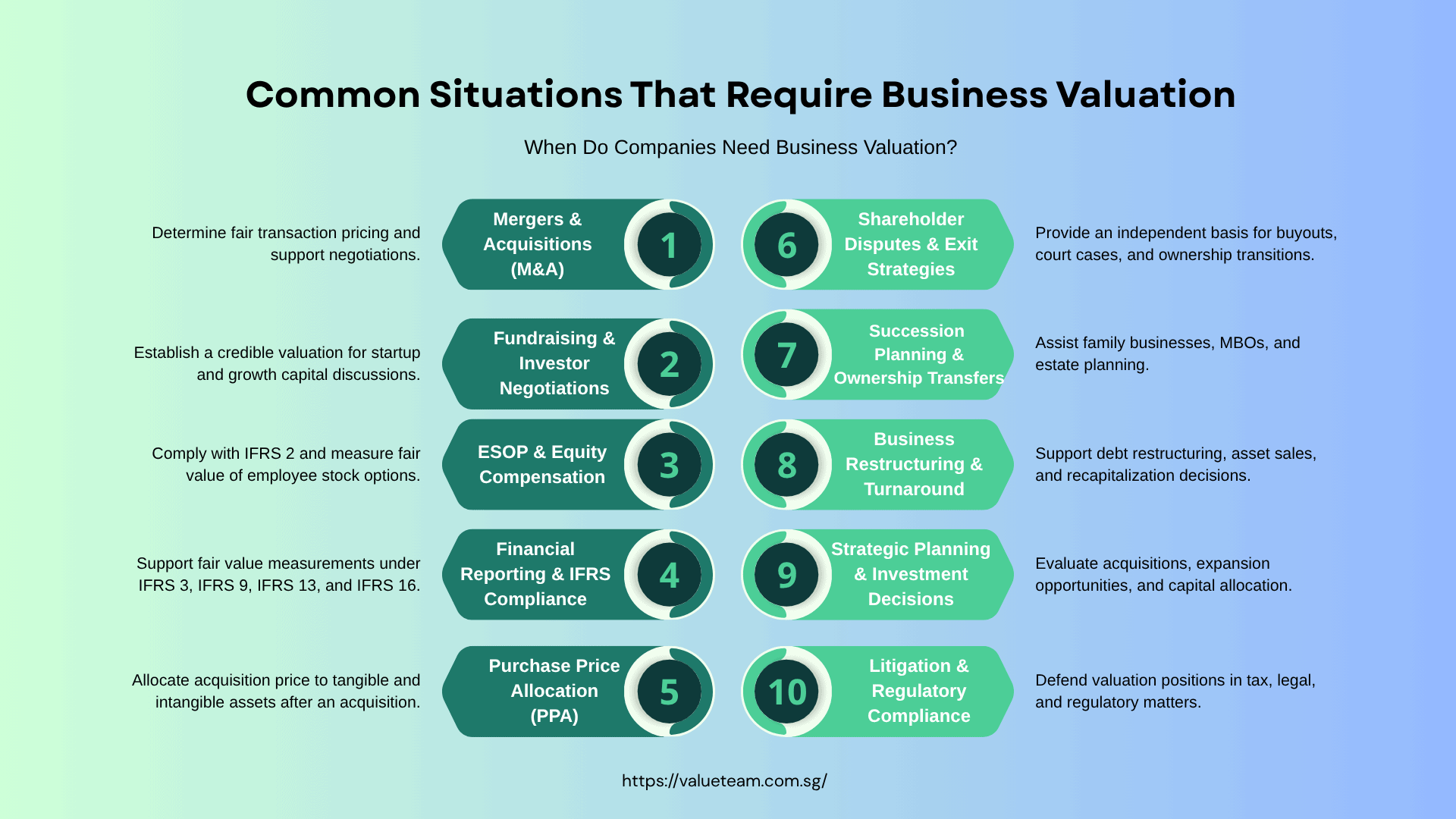
Mergers and Acquisitions Valuation in Corporate Deals
When a business merges or acquires another, it’s one of the biggest and most critical events in the business’s life. In any case of business acquisition, whether for a competitor, a strategic partner or a business unit divestment, precise M&A valuation services are crucial in structuring a deal that is fair.
Purchasing them, buyers should be aware that they are not paying too much. Sellers must make sure that they are not leaving money on the table. Both parties need an impartial, third-party review that is subject to audit, review and scrutiny by boards, auditors and regulators.
Professional M&A valuation services, provided by specialised experts like M&A valuation services, involve various valuation methods such as discounted cash flow (DCF) analysis, comparable company analysis, and precedent transaction analysis. These methods, if properly followed, can be used as a justifiable basis for negotiation and transaction pricing.
In addition to pricing, deal advisory valuations can assist with due diligence, aiding potential acquirers to understand the risks involved, confirm financial forecasts, and evaluate the acquisition strategy. A strong due diligence valuation expert minimises the risk of surprises after the acquisition and helps to inform decisions throughout the transaction.
Valuation in Fundraising and Investor Negotiations
Where early-stage startups and growth stage companies are looking for outside capital, valuation is the core of all funding discussions. As investors, whether they are angel investors or venture capitalists or private equity firms, they make their investment decisions based on the value they thing a company has. A founder that cannot back up their valuation with credible data will have a huge disadvantage.
Utilizing equity valuation services which are independent to the startup or fund conversation will give founders a defensible, data-driven position. It also provides a reassuring indication to prospective investors that the enterprise is professionally managed, and ready for institutional review.
For more advanced companies, enterprise valuation services are frequently needed by the institutional investors in their own internal reporting and portfolio valuation. In either case, a professional corporate valuation advisory firm is able to provide analytical rigor and market expertise to create a valid, well-supported valuation report.
Employee Share Option Plans & Equity Compensation
Importance of ESOP Valuation in Businesses
Employee Share Option Plans (ESOPs) and other types of employee equity incentives have become commonplace to recruit, retain and incentivize talent, especially within technology and startup companies. However, there are financial and regulatory downside risks in awarding share options without the proper valuation.
Companies are expected to record the fair value of share-based compensation at the grant date, and the fair value of share-based compensation must be disclosed, in accordance with the accounting standards IFRS 2 and FAS 123R. This will require employee stock option valuation specialist services that use option pricing models like the Black-Scholes model or the Binomial Lattice model to calculate the fair market value of the options being given.
Whether your programs are intended to boost employee engagement, foster loyalty or accomplish any other objective, a professional valuation of the ESOP can ensure that your equity compensation programmes are defensible, compliant and accurately reflected in your financial statements. It’s especially critical for companies that are nearing an IPO, are going through an audit or are planning a fundraising round in which investors will be looking closely at the cap table.
Key Factors in Equity Compensation Valuation
Share based compensation valuation should be based on the terms of the option plan which comprise of vesting schedules, exercise price and expiration dates.
- The inputs into option pricing valuation services include volatility, risk free rate, expected dividend yield and expected term.
- Startup equity valuation services must be able to deal with the particular problems within the context of early-stage, illiquid businesses, one of which is the use of the correct discount.
- The value of the shares for fair market value should be adjusted on a regular basis to changes in the company’s financial status and market conditions.
Valuation in Shareholder Disputes and Exit Strategies
Shareholder disagreements concerning the buy out price, how money is being allocated to the individual shareholders, or whether the length of the partnership is fair value are among the most delicate and controversial circumstances in which a business can find itself. In such cases an independent business appraisal services provider can be a neutral third party who will provide an honest and unbiased business appraisal that can be relied upon in negotiations or for presenting to a court or arbitration panel.
Shareholder agreements often contain provisions that necessitate an official private company valuation when a shareholder leaves, passes away or is in dispute. Not only can a pre-agreed valuation methodology save time, cost and aggravation in situations like these, but a trusted valuation consulting services firm can provide the parties with the information necessary to make the process smoother.
Having a professional shareholder valuation service allows both sides to have peace of mind that the valuation process is objective, well established and in accordance with market practice. This is particularly important in a family business or a closely-held business where emotions may get in the way of money matters.
Business Valuation for Financial Reporting and IFRS Compliance
A number of public-listed companies and many private companies are obligated to perform and disclose fair value measurements and disclosures of their assets and liabilities in compliance with IFRS Standards. The determination of the fair value of a financial instrument, whether it’s intangible assets, investment properties, or equity instruments, requires specialist expertise and independent judgment on its part under IFRS.
There are a number of standards in the IFRS that mandate that fair value should be used, such as IFRS 3 (Business Combinations), IFRS 9 (Financial Instruments), IFRS 13 (Fair Value Measurement), and IFRS 16 (Leases). Auditors could qualify the audit and regulators may be suspicious of restatement if companies do not apply these standards properly.
By using IFRS valuation services from a competent valuation advisory services provider, your financial statements will be prepared according to the IFRS and will be able to withhold the rigor of an external audit. It is a key service provided by any creditable company valuation consultancy.
Purchase Price Allocation (PPA) in Post-Acquisition Accounting
A company will have to allocate the purchase price of the acquired business among the identifiable assets and liabilities of the business after the acquisition is made, in accordance with IFRS 3. Purchase Price Allocation (PPA) is the process of allocating the acquisition fair value assessment for tangible and intangible assets, such as brand names, customer relationships, technology platforms and non-compete agreements.
PPA is a highly technical process which requires expertise in valuation and well knowledge of accounting standards. Misstatement of PPA may lead to misstatement of goodwill, the wrong amortisation schedule and/or a charge for impairment on the goodwill component that has an impact on reported earnings.
Purchase price allocation valuation services by a dedicated service provider like a specialist purchase price allocation valuation service can be a great help in completing this process in a proper manner and time. Your finance team and auditors will be closely involved with a qualified purchase price allocation consultancy to ensure the allocation is defensible, meets the acquisition accounting valuation services standards, and is properly documented.
In addition to initial PPA, companies must carry out periodic goodwill impairment valuation tests to assess the worth of their acquired goodwill, and if it doesn’t hold up, they have to revise the value down. This is an essential part of post acquisition valuations service and should be as seriously analysed as the original PPA exercise.
Valuation in Business Restructuring and Turnaround Scenarios
When a company is in financial trouble, going through an operational restructuring or is a company in the midst of strategic change, they often need an independent evaluation of their current and future value. This business worth evaluation helps in the choices with regards to restructuring debt, selling assets, separating business segments and recapitalisation.
In distress situations, there is an interest conflict among lenders, creditors and equity holders. An independent corporate valuation advisory report will offer an impartial basis for negotiation that can assist to develop a sensible restructuring plan. It also enables management teams to make the tough decisions with confidence, knowing that they have made decisions with a solid financial basis.
Companies undertaking the sale of a non-core business segment or divisional transfer through a spin off or a demerger can take advantage of sell side valuation consultancy services to provide the analytical support that will increase the value and ensure that the right buyers or investors are interested.
Business Valuation for Succession Planning and Ownership Transfers
There are distinct challenges to consider when planning for the next generation of a family business or business transfer in a family owned and operated business. The first step in developing any viable succession plan is to understand how much the business is worth today.
A professional business valuation services engagement offers business owners an objective and clear notion on the worth of their business. This information is critical for estate planning, tax structuring, co-owner buyouts and for the management and third-party sale of the business to be fair and transparent.
When businesses are considering management buy-outs (MBOs) and/or employee ownership transition, buy side valuation services can help the incoming ownership team determine if the transaction is done at fair value and if it is possible to finance the appropriate structure.
Valuation for Strategic Planning and Investment Decisions
Value is not just about reacting to change, it’s a valuable input for strategic planning. Regularly evaluating the value of their own businesses and the value of companies they are considering acquiring puts companies in a strong position to invest their capital wisely, detect undervalued assets, and time their decisions.
Whether a board or management team is considering a new market entry, a new product line, or an acquisition, investment valuation advisory services can help with the financial modelling and scenario analysis that allows for an informed decision.
Optimizing transaction valuation services additionally allows companies to plan for future liquidity occasions. A company with a good knowledge of its own worth – and with the documentation to back it up – is much more likely to be in a position to make a sale, an IPO or a strategic alliance at a proper time.
Valuation for Litigation Support and Regulatory Compliance
The valuation of a business is often needed in a legal dispute such as a breach of contract action, IP dispute, matrimonial action involving business assets or tax authority action. In such cases, a thorough valuation report by a trusted expert is necessary for a court or a regulatory body to consider.
The expert witness report, defending valuation positions in cross-examination and the level of analytical rigour required by the legal and regulatory process can be provided by a qualified valuation consultancy firm experienced in litigation. In such situations, there is a need for the credibility of the expert and also the strength of the methodology.
Where tax related issues arise such as transfer pricing, inheritance tax and employee share scheme valuations, consultation with a professional fair value measurement consultancy service ensures that there is a documented basis on which to support tax positions and prevent unwelcome tax disputes.
Importance of Professional Business Valuation Services
Then, there’s the question of why professional business valuation services are important.Last, but not least, there’s the question of why professional business valuation services matter.
The scenarios described in this article are a few of the most typical scenarios where a professional business valuation is necessary. Whether in the context of mergers and acquisitions or compliance with ESOP, financial reporting or succession planning, companies need advice from a credible, independent and technically sound source that will support them in every step of the company’s lifecycle.
They all have one thing in common: they all involve objective, defensible and expert-based business value analysis. The value of the advice you receive from the valuation firm will have a direct impact on the success of your transaction, compliance with regulations, dispute resolution or business planning.
Working with a trusted valuation advisory services provider with a broad and extensive background in enterprise valuation services, equity valuation services and acquisition valuation consultancy is more than just a compliance task. It’s an investment in the integrity of your financial decision making.
ValueTeam offers a wide range of company valuation, ESOP valuation and purchase price allocation valuation services for companies throughout Singapore and the region. Our staff have a wealth of technical knowledge and experience in solving business problems for our clients. We hope you will reach out to our valuation experts to explore ways to help you with your next strategic, financial or transactional decision.
Business valuations are commonly required for mergers, acquisitions, fundraising, shareholder disputes, succession planning, financial reporting, and strategic planning.
Regular valuations help businesses understand their current market value, monitor performance, and make informed financial and operational decisions.
Yes. Lenders and investors often require independent valuations to assess business value before approving loans or investment opportunities.
Business owners, investors, shareholders, financial institutions, accountants, and management teams all benefit from reliable valuation reports.
Independent valuation provides objective analysis that supports fair negotiations, informed decisions, and stronger financial planning.