
Understanding Different Types of Valuation Services
A Professional Reference for Business Owners, CFOs, Investors, and Corporate Finance Professionals
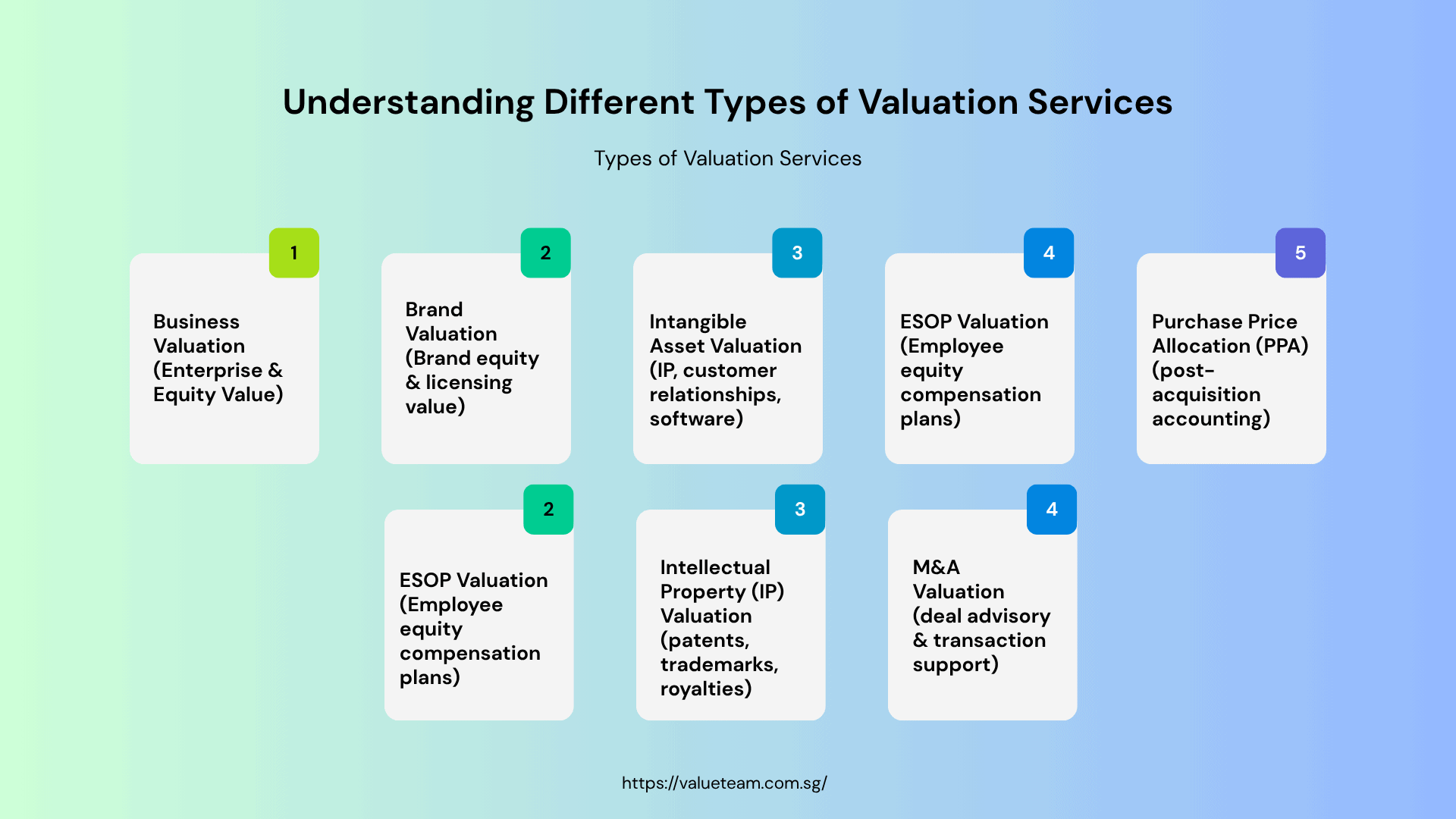
Introduction to the Different Types of Valuation Services
With the complexities and greater level of regulation in the business world in today’s day and age, it is not something that a company can afford to ignore and understand the various types of valuation services that are available to them. A business can need a reliable, logically sound, and independent valuation at any point in its life, whether it’s for an acquisition, equity compensation of its employees, licensing its IP, or submitting financial statements to an auditor.
The basic definition of valuation is the economic value of an asset, business or financial instrument. However, it’s not just one discipline. The field is broad and includes many specialisations, with different frameworks, methods and reporting requirements. Business valuation services are carried out for various reasons, ranging from a business transaction to the very specific services needed under International Financial Reporting Standards, each of which requires a particular skill set and application.
This article provides an authoritative and structured introduction to the main types of professional valuation advisory, the context in which they are needed and the key methods that each type is underpinned by. It is designed to be a useful reference guide for business owners, CFOs, accountants, auditors and corporate finance professionals in Singapore and throughout the region.
Why Professional Valuation Advisory Services Matter for Modern Businesses
An incorrect valuation or lack of a valuation can have major and long-term repercussions. Overvaluing the target can result in value destruction to the shareholders of the target in a corporate transaction. It can be very costly for the seller of the business to undervalue a business. A poor supporting fair value estimate in a financial reporting context may raise eyebrows with the auditor and regulators, cause financial statements to be delayed or cause restatements.
Professional valuation consultancy will give the analyst the necessary rigour, independence and documentation to produce a valuation which is prepared to meet the challenges of his/her counterparts, auditors, regulators and courts. A trusted valuation advisory firm will have access to experienced valuers, methodologies, and market-based inputs to generate a defensible and transparent valuation report.
Valuation advisory is not just about risk mitigation; it’s also about improved strategic decision-making. An accurate economic valuation of a brand, patent portfolio, customer base or business entity provides leadership teams with the information they need to make effective use of capital, to consider effectively in negotiations, and to plan for future growth. Valuation isn’t just a compliance measure; it’s a strategic tool.
Business Valuation Services: Understanding Enterprise Value and Equity Value
The most familiar type of valuation advisory is the valuation of the overall economic worth of the business entity. Business valuation services are utilised in a wide range of business situations such as shareholder disputes, equity financing, business sales, management buyouts, initial public offerings, succession planning and more.
A company valuation consultancy will usually use one or more of the three universally used methods. It is most often used in the form of an income approach, usually a Discounted Cash Flow (DCF) analysis, which assumes that the future free cash flows of the business will be determined and discounted back to present value using the risk-adjusted cost of capital. The market approach is based on transaction multiples of other public companies or private company transactions. The asset-based approach is applied in the case of a holding company or an asset-intensive business, and assets and liabilities are valued at their net fair value.
Enterprise valuation services take into account the value of the enterprise (debt), while equity valuation services are based on the value of equity as the result of deducting all financial obligations from the enterprise. Equity valuation can be of critical importance in minority shareholder buyout transactions, preference share issuances and employee equity structuring. In both instances, the proper approach needs to be carefully picked based on the nature of the company, its valuation objective and the audience that will depend on the valuation report.
- Examples of common situations that involve business valuation include:
- Shareholder conflicts, minority interest buyouts
- Equity Funding Rounds and Due Diligence with Venture Capital
- Pre-transaction structuring, mergers and acquisitions for business
The laws of the land will not be set aside for any reason. No reason will be given for rejection of the laws of the land, such as estate planning, succession transactions, and family business reorganisations.
To be listed on the Singapore Exchange (SGX) (or other regulated capital markets).
Brand Valuation Services: Measuring and Enhancing Brand Equity Value
Brand assets are some of the most valuable but also undervalued assets of a company. Brand valuation services are offered to businesses to give them a thorough and business-savvy valuation of the economic contribution of a brand to the overall Enterprise Value. This is applicable in the case of brand licensing deals, acquisitions, financial reporting and strategic portfolio management.
The most common approach to trademark valuation in trademark valuation services is the relief from royalties approach that calculates the hypothetical royalty that a business would pay to license its own trademark from a third party, if it didn’t own the trademark outright. The market value of the brand asset is derived from the resulting royalty stream, with the value being capitalised. Another method frequently used in brand equity valuation services, the excess earnings method, measures the amount of a company’s overall earnings that exceed the fair earnings that can be generated from all other factors that contribute to the company’s earnings.
Marketing intangible valuation is a larger field that includes the valuation of the brand as well as other marketing intangibles like customer relationships established via brand actions, trade dress, and domain names. Businesses engaged in cross-border royalty agreements, brand licensing and franchise activity can benefit from brand asset valuation services as the analytical basis for defensible pricing and structuring arrangements based on the arm’s length principle.
Brand valuation consultancy is also needed for IFRS 3 (Business Combinations) where a business is acquired with a strong consumer brand or proprietary trade name. If so, the acquired brand needs to be identified separately, and a fair value needs to be established for it to be part of the purchase price allocation exercise, as we discuss in more detail below.
Intangible Asset Valuation Services: Valuing Knowledge, Relationships, and Intellectual Capital
Most of the corporate value in the era of the knowledge economy today is in intangibles. Intangible asset valuation services are those services that involve the professional valuation of assets that do not have a tangible form but are still capable of providing measurable economic value. These consist of customer relationships, proprietary technology, software platforms, trade names, non-compete agreements, favourable leasehold interests and order backlogs.
The three most common circumstances where intangible asset valuation consultancy is required are after a business acquisition (purchase price allocation), for annual valuation under IAS 36 and in litigation or dispute resolution. Customer relationship valuation services involve estimating the worth of a company’s current customer base by valuing the future revenue it can yield based on the existing customer base and applying a discount at a risk-adjusted rate of return, taking into account an appropriate customer attrition rate.
Valuation of proprietary software, algorithms, manufacturing processes, trade secrets and technical know-how is all covered in a technology valuation consultancy. For technology and life sciences transactions, these assets often create the bulk of the value of the transactions, and it is important to accurately value these assets to perform a compliant and credible purchase price allocation exercise.
Goodwill valuation services are for the residual value that is left over after all the identifiable tangible and intangible assets have been given their fair value. Goodwill is the value of the reputational, synergistic and strategic advantages that are represented in an acquisition price which cannot be traced back to a specific identifiable asset. All these valuations of individual assets fit within a consistent framework, the fair value measurement services of IFRS 13, to ensure consistency, transparency and compliance with regulatory requirements across the reporting entity.
ESOP Valuation Services: A Guide to Equity Compensation and Employee Ownership Planning
Talent acquisition and retention, and equity compensation are increasingly common practices among companies to recruit and retain top-tier talent, as competition grows in the labour market for key positions in a variety of industries. ESOP valuation services offer the technical support that is required to design, value and report employee stock option plans and other equity-based compensation plans in a way that is commercially viable and in accordance with accounting standards.
IFRS 2 (Share-based Payment) stipulates that the fair value of equity-settled instruments must be measured at the grant date and a charge must be recognised in the income statement over the relevant period during the vesting period. Valuation of employees’ stock options has to be done in accordance with the accepted valuation models. The Black-Scholes-Merton formula is generally utilised for common vanilla options, and the Binomial lattice model is utilised for more complicated options that have performance conditions, market-based vesting criteria or early exercise options.
Employee disputes, regulatory inquiries and shareholder communications are other scenarios in which share option valuation services can apply. In startup companies and venture-backed businesses, startup equity valuations are an effective starting point for determining the exercise price of options at the time of grant; for managing dilution across funding rounds; and to ensure equity is fairly and equitably allocated to both the company and its employees.
For a business that intends to exit the company via trade sale or IPO, a set of defensively completed equity compensation valuations is an important element of vendor due diligence and exit readiness, and serves as a valuable asset for ESOP valuation consultancy. Equity compensation valuation reports should be prepared periodically and be updated whenever there are material changes in the financial conditions, capital structure and/or market environment of the company.
Purchase Price Allocation (PPA) Valuation Services for Accurate Acquisition Accounting
In an acquisition, the total consideration paid for the acquisition must be allocated to the identifiable assets acquired, and the liabilities assumed, with the amount of the residual goodwill. Purchase price allocation valuation services are available to perform this acquisition accounting exercise in a manner that is compliant, defensible and audit-ready, using the specialised technical analysis required.
In acquisition accounting, an in-depth list of all the assets and liabilities that stem from the business combination is needed. This includes property, plant and equipment and all intangible assets as described in the previous section. The fair value of each individually identifiable asset shall be established at the date of acquisition on the basis of methods that are applicable to the nature of the asset and market evidence available.
Purchase price allocation consultancy should be in line with IFRS 3 (Business Combinations) and IFRS 13 (Fair Value Measurement). The preparation of a detailed valuation report documenting the methodology used, key assumptions made and the fair value of each asset class is necessary for IFRS valuation services of this type. This report is the main audit support document and is scrutinised by external auditors in the annual financial statement sign-off cycle.
According to IFRS 3, the valuation of business combinations must be done during the measurement period, which is not longer than twelve months from the date of acquisition. Post-acquisition valuation services may also be needed to reestimate provisional fair values for additional information received during the measurement period. Having an experienced acquisition accounting expert on board at the beginning of a transaction helps to minimise the chances of measurement error, audit adjustments and restatements.
Intellectual Property Valuation Services (IPVS): Unlocking the Value of Innovation
Intellectual property rights are one of the most critical and lucrative types of assets for technology, pharmaceutical, consumer goods and media companies. IP valuation services offer a methodical analysis of how to value patents, trade secrets, copyrights, trademarks and licensing arrangements in transaction, reporting and litigation cases.
IP consultancy services are invaluable in a variety of business and legal circumstances. The patent valuation services are carried out for the purpose of IP transactions, patent licence negotiations, quantification of damages in case of infringement, and strategic IP portfolio management. The relief-from-royalty approach is used by royalty valuation services to estimate the implied value of the ownership of an IP asset, based on comparable rates of royalty that are found in the industry’s databases and in publicly available licensing transactions.
In the context of businesses with a revenue model based on licences or IP commercialisation via third parties, licensing valuation consultancy is especially relevant. The expert in intellectual asset valuation services will conduct a technical IP scope and enforceability analysis, market comparables and income-based modelling to provide a commercially viable and defensible valuation estimate.
IP valuation also has an important value for transfer pricing of multinational groups. If IP assets are transferred between related parties in different jurisdictions, they should be transferred at an arm’s length price in line with OECD Transfer Pricing Guidelines and the Singapore Transfer Pricing Guidelines issued by the Inland Revenue Authority of Singapore (IRAS). A credible IP valuation helps support the documentation necessary to support intercompany royalty transactions when the transactions are subject to regulatory review.
M&A Valuation Services: Supporting Transactions from Deal Origination to Closing
An M&A transaction is one of the most intricate, high-dollar, and timely corporate finance deals possible. M&A valuation services can be used at all phases of the transaction process, ranging from initial screening of the targets through to indicative bidding, to structuring the final deal, and to post-transaction financial reporting for both buyers and sellers, and for boards of directors and their advisors.
Acquisition valuation consultancy can assist a buyer in determining whether the acquisition price paid for a target is commercially rational and what the fundamental value of the business is. Transaction valuation services help the seller in setting up a defensible and credible asking price, negotiate a sale with an informed buyer and minimise the risk of undervaluing assets in competitive sale processes. In the case of listed companies, the valuation services provided for a deal advisory are usually needed to comply with fiduciary duties as well as the requirement for independent financial advice under the Singapore Code on Takeovers and Mergers.
The concept of due diligence valuation consultancy includes an independent critical review of assumptions that underpin the financial projections of the target, stress testing a number of value drivers and a review of the reasonability of the proposed price of the deal compared to comparable deals in the market. This form of analysis can be especially beneficial for private equity investors or strategic acquirers trying to manage downside risks in competitive auctions where managements’ projections may be overly optimistic and limited access to due diligence adds to the uncertainty.
In a cross-border transaction, M&A valuation advisory needs to also deal with regulatory considerations of the transaction across various jurisdictions, including Singapore’s Code on Takeovers and Mergers administered by the Monetary Authority of Singapore (MAS), which mandates independent financial advice in specific types of transactions. In the cross-border M&A environment, it is crucial to work with a valuation advisory firm that comprehends the technical and regulatory aspects of such transactions to ensure a seamless and well-managed M&A process.
How to Choose the Right Valuation Consultancy for Your Company
There are a multitude of specialised services in the valuation profession, and it’s important to select the appropriate advice provider. The best firm will possess extensive technical knowledge in the valuation method being used and be knowledgeable about the commercial, regulatory and industry environment of the valuation assignment.
When choosing a professional valuation consultancy to hire, consider the following qualities:
- Experienced and qualified valuers with appropriate and recognised training and qualifications from sources like the Royal Institution of Chartered Surveyors (RICS), CFA Institute, or American Society of Appraisers (ASA)
- A history of successfully reporting valuations in transactions, reporting and dispute situations accepted by auditors, regulators and courts.
- Documentation of methodology that is transparent and an explanation of the assumptions, judgments, and market evidence used
- Independence and objectivity, especially in cases where the valuation will be used in a way that third parties will count on it.
- Experience in dealing with the Singapore-specific regulatory requirements, such as IFRS as adopted by the Singapore Accounting Standards Council (ASC) and IRAS transfer pricing guidelines
It is also crucial to appreciate that the complexity, risk and regulatory sensitivity of various valuation engagements can vary significantly. The engagement process can be streamlined for a standard business valuation of a small private company, or most technically capable and experienced experts may be necessary for a complex business valuation, such as a purchase price allocation for a large company acquisition, or an IP valuation in commercial litigation.
Understanding the Strategic Importance of Different Valuation Services
The first step towards informed and confident business decisions is to understand the various types of valuation services. The quality and credibility of the valuation for any of these activities has an impact on the results of the activity, whether your organisation is acquiring a business, implementing an employee equity plan, negotiating an intellectual property licence, preparing for a corporate listing or completing the annual financial statements.
Whether you need a business valuation service, brand valuation services, intangible asset valuation, ESOP valuation, purchase price allocation, or intellectual property valuation, there is no other way to do it. By selecting the right valuation advisory firm, you can rest assured that the valuations you rely on are technically sound, commercially defensible and withstand scrutiny by auditors, counterparties and regulators.
Valuation is not a financial compliance activity. It is a key element of strategic thinking, governance, risk management and value creation. Organisations that hire good valuation consulting services will stand a better chance of dealing with confidence, reporting with integrity, and expanding with clarity.
If your business needs professional valuation advisory services, we recommend that you consult with a seasoned valuation consultancy firm with expertise in the corporate landscape and familiar with the relevant international standards, who can provide reliable, informative and audit-proof valuations that are relevant to your business needs.
Valuation services determine the fair value of businesses, assets, liabilities, financial instruments, or intangible assets for financial, legal, and strategic purposes.
Common services include business valuation, intangible asset valuation, PPA valuation, goodwill impairment testing, fair value measurement, and financial instrument valuation.
Different situations, such as acquisitions, financial reporting, litigation, taxation, and fundraising, require specialised valuation approaches and expertise.
Business owners, investors, auditors, accountants, financial institutions, legal professionals, and corporate executives regularly rely on valuation services.
Professional valuations improve decision-making, support regulatory compliance, and provide reliable financial information for stakeholders.