
Pre-IPO Valuation Strategies in SE Asia
A Practical Reference for Finance, Investment, and Corporate Strategy Professionals
Introduction to Pre-IPO Valuation Strategies in SE Asia
A major consequence of capital markets activities in the world in the last decade has been southeast Asia. A digitally native population, consisting of young people, more than 680 million people, rapidly growing middle classes in Indonesia, Vietnam, the Philippines, Thailand, and Malaysia, and a technology ecosystem which has attracted tens of billions of dollars of venture capital have all collectively produced a pipeline of companies, ranging between fintech platforms and e-commerce marketplaces to digital health businesses, which are approaching the public markets at scale. In practical terms, Southeast Asia has become one of the most practically valuable and commercially relevant skills in the industry for finance professionals in the field and in or around this region.
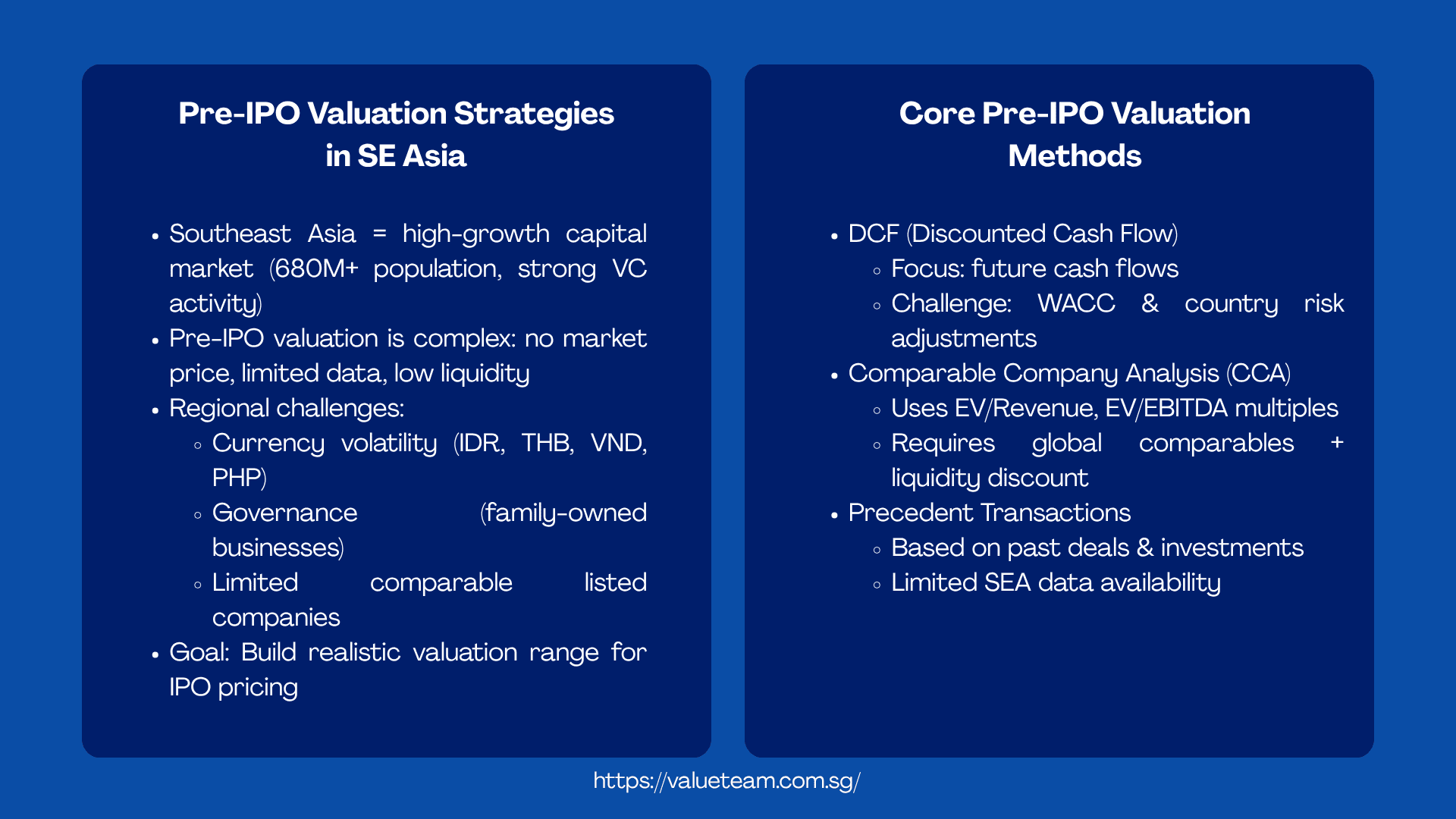
There is a fundamentally different exercise in valuing a company prior to the initial public offering of the company. Daily market price to anchor to, disclosure of information is normally limited, liquidity is non-existent, and the range of methodologies that various market participants employ, such as venture capital investors with rule-of-thumb revenue multiples, to investment banks that run full-blown discounted cash flow models, can come up with dramatically different figures on the same business. In Southeast Asia, such universal complexities are compounded by factors specific to the region: currency volatility across the Indonesian rupiah, Thai baht, Vietnamese dong, and Philippine peso; regulatory environments which vary significantly between markets; corporate governance structures which are often dominated by founding families/state entities; and a relatively thin landscape of publicly listed similar companies in key sectors.
The article is addressed to junior to mid-level professionals in investment banking, corporate finance, and/or the pre-IPO valuation in the Southeast Asian context. It includes the methodology landscape, market specific dynamics, the five step process that experienced practitioners go through and the lessons that can be learnt in real life situations by taking companies to the public markets in this region. It is aimed to develop not only technical knowledge, but practical judgment as well-the two attributes which make analysts who truly add value in this area.
Why Pre-IPO Valuation in Southeast Asia Requires a Regional Market Approach
What Southeast Asia is realising is that the models that were created in the United States and the European markets cannot be directly applied to this region without any substantial changes to it. This is not just an issue about new market risk premiums, but more about the fundamental way that businesses are structured, how new markets price growth rather than profitability and what institutional investors actually seek when they evaluate IPO candidates in the region.
The most widespread structural difference is perhaps the corporate governance. An important percentage of high-value businesses in Southeast Asia is owned and managed by founding families and still has majority stakes through sophisticated holding structures that are sometimes spread across a number of different jurisdictions. This results in the exact opposite of a controller premium: minority shareholders in a family-controlled IPO might price in a governance discount, as they have little ability to affect business decisions even after they have listed. In the Philippines, especially, the so-called conglomerate discount, i.e., a haircut on businesses that are under the control of diversified family groups, is a well-documented phenomenon that has a direct impact on the price of IPOs as well as on the size of the pre-IPO valuation adjustment.
The valuation results are also determined by liquidity and market depth in ways that are of huge importance to the pre-IPO practitioners. Indonesian Stock Exchange (IDX) and Thailand Stock Exchange (SET) are fairly liquid by local standards, but the Philippines Stock Exchange (PSEi) and the Vietnam HoSE are characterised by the thin trading volumes and highly concentrated domestic investor base. When a company price its IPO in a less liquid market, it must use a larger illiquidity discount on its own valuation when setting its own IPO price range because the public market in which it is floating is in itself less liquid than are the reference markets out of which it derives its own comparable multiples. It is these structural subtleties that distinguish a generic exercise of valuation as opposed to one that is based on the reality on the ground.
Pre-IPO Valuation Methods in Southeast Asia: DCF, Comparables, and Transaction Analysis
The variety of pre IPO company valuation techniques practiced in Southeast Asia are based on the same core set of tools that are deployed worldwide, but none of the techniques requires global calibration. There is no one method that suffices all on its own; the most plausible pre-IPO valuation exercises represents a triangulation across at least two or three methods, using the spread to define a range of defensible estimates as opposed to a single-point estimate.
In a typical corporate finance setting, the Discounted Cash Flow (DCF) methodology is the hypothetical basis of valuation in most corporate finance scenarios, and frequently is necessary in IPO prospectus documents submitted to regulators such as the Securities Commission Malaysia, Thailand SEC or Indonesia OJK. Its power is that it causes a stiff discussion on the future cash flows and the capital requirements as well as the economics of the business model. Its weakness in the SEA context is the discount rate: calculating an appropriate Weighted Average Cost of Capital (WACC) on a company operating across multiple currencies and regulatory jurisdictions in the SEA context involves a significant amount of discretion on the part of the decision maker with regards to country risk premiums, currency risk adjustments, and the appropriate equilibrium equity risk premium to apply- all of which can significantly vary the output.
Similar Company Analysis (CCA) compares the business of the pre-IPO to publicly-traded peers using multiples of EV/Revenue, EV/EBITDA, and Price/Earnings. The difficulty in Southeast Asia is that the level of detail of the local listed universe is limited. A Vietnamese logistics firm or a Thai fintech on the verge of an IPO will usually find that its most analogous comparables are listed in the United States, Hong Kong, or India as opposed to their home market, requiring adjustment in response to differences in market maturity, liquidity, and investor base composition. This is a fundamental aspect of any sound valuation method prior to IPO Southeast Asia: the similar set should be chosen with an intellectual rigour rather than just convenience and any discounts to be applied to less favourable listing venue characteristics should be applied in a transparent manner.
Precedent Transaction Analysis is based on multiples paid in similar private placements, pre-IPO investments or acquisitions of the same sector. The approach can be especially informative in areas where M&A activity has been active, such as the fintech of Indonesian descent or the real estate of Vietnam, but where the information is often incomplete, the deal terms are often not fully disclosed and the time elapsed between the transactions and the current exercise in valuation may render comparisons unreliable. Nevertheless, these limitations notwithstanding, the precedent transactions tie the expectations of the rational participants of the market, in the way that the DCF projections cannot, simply because they reflect what the rational market participants actually paid in order to acquire similar assets.
| Method | How It Works | Best Applied To | SEA-Specific Consideration |
|---|---|---|---|
| Discounted Cash Flow (DCF) | Future free cash flows and discounts of the projects are converted to the present value with the use of WACC. | Companies that are profitable or almost profitable with observable revenue trend. | The rates of discounts tend to be raised when additional premiums on the market risks appear. |
| Comparable Company Analysis (CCA) | Benchmark the valuation multiples of listed companies in the same industry. | Companies that have publicly traded identifiable comparables. | Limited local listed comps; global peers used with liquidity discount applied |
| Precedent Transaction Analysis | Values company as a multiples of such deals where the acquirer or pre-IPO investor has been willing to pay a higher price than other comparable deals. | Companies that expect to acquire a company or to undergo a dual-track process. | SEA deal databases are skinny; cross-regional information with modifications. |
| Revenue / GMV Multiple | Multiplies sector-specific revenue or GMV multiple, on current or estimated figures. | Digital, e-commerce, and fintech businesses which are pre-profitable. | Multiples squeezed after the 2022 cycle of rate; investors took a closer look at the road to profit. |
| Last Round Valuation + Adjustment | A point of reference for the latest round of private funding and adjustments to the market movement. | Ventures in the late stage of development, which are to be taken to IPO within 12-24 months. | Down-round risk occurs in the real world where market comps of the publics have been re-rated downwards. |
Table 1: Comparison of Pre-IPO Valuation Methods in Southeast Asia (DCF, CCA, Transactions)
5-Step Pre-IPO Valuation Process in Southeast Asia for Accurate IPO Pricing
Regularly delivering plausible, justifiable pre IPO valuation plans Southeast Asia go through a well organized process that takes one through the understanding of business and all the way to a range that does not come under the scrutiny of the investor. The five steps that follow, represent the essence of that process.
Step 1: Carry out an in-depth Business and Market Analysis.
Prior to opening a single spreadsheet model, veteran practitioners take a considerable amount of time to learn about the business qualitatively. What is competitive moat? The market position is how defensible it is against well-capitalised regional or global entrants? How good is the management team, and how have they been able to manoeuvre through the previous cycles? In Southeast Asia, such an assessment should also be concerned with market-specific risk: the regulatory risk in the highly regulated banking sector in Vietnam, e.g. is a fundamentally different risk profile as compared to the regulatory risk facing a Malaysian palm oil producer. The business and market analysis influences all the future modelling decisions, including the assumptions of the growth of revenues used in the DCF, as well as the discount applied to the similar set.
Step 2: normalise the Financial Statements.
Southeast Asian pre-IPO companies often show financial statements which need to be highly normalised before they can be used to support a credible valuation. Related-party transactions—as is typical with family-controlled businesses—can have inflated or deflated revenue or cost lines. The non-recurring items like the government grants during the pandemic, the revaluation gains and the restructuring costs that were made once must be stripped out to get to a clean underlying base of earnings. A particular attention is required in relation to the translation adjustments made on the basis of the translation of the company which is earning its income in several Southeast Asian currencies (e.g. rupiah, dong, or peso) where the weakness of the currency in relation to the dollar can distort the reported EBITDA in such a manner that the year-on-year comparisons will be misleading. The requirement of at least three years of audited, IFRS-compliant accounts typically required by investment banks preparing IPO prospectus financial analysis, is often a trap to many family-owned businesses as they usually prepare accounts in local GAAP without the rigour required of publicly-traded securities disclosure.
Step 3: Choose Methods and create Multi-Scenario Models.
Now that the normalised financial base has been established, it is now time to select the best valuation methods to these scenarios, making sure to model the scenario plans of both valuation methods. A properly developed valuation approach prior to the IPO Southeast Asia will generally consist of a base, bull and bear case of all approaches with well defined assumptions that drive the differences. The bull case in the case of a pre-profit digital marketplace, could be an accelerating-than-anticipated monetisation and market share consolidation; the bear case could be a continued competitive pressure and a slow path to EBITDA positivity. The expanded scenario is as significant as the central estimate–it puts the risk-reward being bid to IPO investors in perspective in a manner that the central estimate cannot.
Action 4: Construct the Comparable Set with Regional Discipline.
One of the most highly judgmental tasks in the pre-IPO process is the choice of the appropriate comparable companies. The temptation to make the most flattering comparables, those with the highest multiples must be resisted in favour of those with the most truly similar business models, growth profiles and market positions. In the case of Southeast Asian business this can often be a combination of a small number of regionally listed counterparts with a larger group of global comparables and the application of a discount matrix that takes into account the differences in market liquidity, regulatory environment, quality of corporate governance, and the level of sophistication of investor bases. A listing on a thin Southeast Asian exchange may incur a discount on its global comparables which may be between 10-30 per cent depending on the particular market- a judgement that will have to be documented and defended by market evidence.
Step 5: Discount Factor / Stress-Test the Range.
The last step is to combine the methodological outputs in a recognizable range of valuation, which applies the remaining discount factors that are specific to the pre-IPO context, such as an illiquidity discount reflecting the lack of daily pricing in the market, minority interest discount in case the IPO involves a partial float only, and a control premium or discount in the case that the governance structure of the post-IPO entity is under control. The stacking of these kinds of discount factors in Southeast Asian listings tend to produce an IPO price range significantly lower than the private market value determined in the latest funding round. It is not optional that the range be exercised against adverse conditions, in other words, a range that will perform in a volatile bookbuilding environment is one that is stress-tested against such adverse conditions.
Pre-IPO Valuation Process: Step-by-Step Flow
| Business & Market Assessment
Industry, unit economics, moat |
▶ | Financial Normalisation
Adjust EBITDA, one-offs, FX |
▶ | Method Selection & Modelling
DCF, CCA, precedents |
▶ | Comparable Benchmarking
Listed peers, deal multiples |
▶ | Range & Discount Factors
Illiquidity, control, market risk |
Process Flow 1: Step-by-Step Pre-IPO Valuation Process for Accurate IPO Pricing in Southeast Asia
From Pre-IPO Valuation to Successful Listing
| Pre-IPO Valuation Anchored
Internal & adviser alignment |
▶ | Governance & Audit Clean-up
IFRS restatement, board reform |
▶ | Roadshow & Price Discovery
Investor meetings, bookbuilding |
▶ | Offer Price Set
Final valuation with discount |
▶ | Listing & Post-IPO Monitoring
Lock-up, analyst coverage |
Process Flow 2: IPO Preparation Process and Pre-IPO Valuation Strategy Across Each Stage
| Market | Primary Exchange | Valuation Environment | Key Sector Focus |
|---|---|---|---|
| Indonesia | IDX (Jakarta) | Dominating investor base is domestic; GMV and user growth is giving more weight towards tech. | Online business, financial technology, customer. |
| Thailand | SET / mai | Multiples that are based on earnings are desired; the participation rate of retail investors is high. | Healthcare, property, industrials |
| Vietnam | HoSE / HNX | The limitations that are applied by the regulatory authorities on foreign ownership influence similar set and prices. | Housing, banking, industry. |
| Malaysia | Bursa Malaysia | Mixed; multiple listings of tech are increasing on ACE Market with multiples favoring growth. | Technology, palm oil, Islamic finance. |
| Philippines | PSEi | Discounting conglomerate is common; family-based structure impacts on minority pricing. | BPO, real estate, retail. |
Table 2: Southeast Asia IPO Markets Comparison and Their Impact on Pre-IPO Valuation
Pre-IPO Valuation Case Studies in Southeast Asia and Key Lessons Learned
The most didactic way of thinking about pre IPO company valuation methods Southeast Asia in practice is to think about how actually listed companies have managed to negotiate the difference between pre-IPO expectations of the company and the post-IPO reality.
The lessons of valuation of the most significant players in the digital economy in the region that the experience of the digital economy companies of Indonesia in the early 2020s can teach us in many. In April 2022, GoTo Group, a ride-hailing and payments platform formed as a result of the merger between ride-hailing and payments platform Gojek and e-commerce marketplace Tokopedia, was listed on the Indonesia Stock Exchange. The pre-IPO valuation of the company had been pegged with a set of late-stage private funding round valuations that anchored the value of the combined entity at around US28 billion. The IPO itself was at the lower range of initial estimates–a natural consequence of the world-wide technology sell-off caused by the US Federal Reserve interest rate increasing cycle which squeezed revenue multiples of pre-profit technology businesses around the world. In a few months of its listing, the market capitalisation of GoTo had decreased to a small fraction of the value that it had achieved in a private placement. The practitioner lesson is structural: the multi-compression of pre-IPO valuation based largely on revenue multiples based on zero-rate-era comparables is acutely vulnerable to multi-compression in case of global risk conditions shift. An effective pre-IPO valuation process Southeast Asia should emphasize the stress-testing of a similar multiple, which is set against a series of macro conditions, not just the current environmental conditions under which the modelling is carried out.
An opposite example, which demonstrates the successful valuation management, is the case of the healthcare sector in Vietnam. In the late 2010s, several mid-sized privately-owned hospital groups approached the Vietnamese public markets, building out network capacity, with a backing of private equity investment. Their pre-IPO valuations were built on EV/EBITDA multiples based on similar hospital groups in India, Thailand and Malaysia-markets which had longer histories of listed healthcare-than the Vietnam market. Through a modest comparable set, stress-testing in scenarios of a variety of healthcare reimbursement, and pricing IPO price ranges at small discounts compared to regional peers, these businesses priced efficiently, generating strong post-listing price performance and creating a favourable track record of follow-on capital raise. The moral is that regionally regionally disciplined valuation conservatism performs better than aggressive pricing that is based on flattering comparables, at least in markets where post-listing liquidity is minimal and the memory of institutional investors is long.
The third lesson is based on the experience of the Malaysian technology sector with the ACE Market – growth-company board of Bursa Malaysia – where between 2018 and 2023, a number of technology-enabled services businesses listed. Some of the first movers which valued themselves at high multiples of earnings, justified by the high rates of recent revenue increases, found that public market investors imposed much more rigid scrutiny to the quality of recurring revenues, customer concentration and competitive differentiation than that which their pre-IPO advisors had been expecting. The businesses experienced a high customer concentration; where one or two clients controlled an excessive portion of revenue, as the IPO valuation of these businesses were sharply marked down in the bookbuilding process. The moral of the story is that pre-IPO valuation in Southeast Asia should not be based in headline financials, but to model customer-level revenue quality, churn dynamics, and sustainability of reported growth rates. The investors in the public markets of the region are increasingly becoming sophisticated, and the difference that exists between the good headline figures and quality of the business is being scrutinised more than ever it was a decade ago.
Common Pre-IPO Valuation Challenges in Southeast Asia and Solutions
In addition to the methodological factors there is a set of practical and structural issues to Southeast Asia that contribute to its results in a manner that cannot be fully predicted using pure technical analysis.
The best challenge that seems to be endless is information asymmetry. Southeast Asian pre-IPO companies do not have the same culture of financial transparency as listed corporations, and many of them – especially family owned and controlled businesses – lack the same culture of financial transparency as do listed corporations. Incomplete management accounts, undocumented related-party arrangements, financial records maintained to minimise tax payable to tax authorities instead of presenting the financial status of the company to investors are common occurrences in the due diligence of advisers conducting pre-IPO due diligence. It takes extensive experience and judgement over the adjustments that need to be made and when to advise that the business is not ready to go to the public markets when it finds itself on its current disclosure path.
The second structural issue is currency risk that has a direct impact on the pre-IPO valuation mechanics. When a company earns the majority of its revenue in Indonesian rupiah but its valuation is based on comparables of the US dollar, the company has a translation exposure, which investors will price in-sometimes aggressively. In both 2018 and 2022, two years where a large proportion of Indonesian companies are pre-IPO, the rupiah has depreciated significantly against the dollar. Those practitioners who had not put in their valuation models the explicit currency sensitivity it needed to have found their ranges rendered incorrect by FX movements even before the books were even opened. A common component to the standard practice of rigorous pre-IPO valuation practice in the region is to build currency scenario analysis into the model and transparently communicate the same to the management and co-advisers.
Lastly, the difference between expectation gaps between founder valuation anchors and the reality in the public market is a challenge that needs a lot of advisory skill to go through. It is not uncommon to find founders in Southeast Asia having their business valued at rising round prices by optimistic venture capital investors, creating a point of anchor in valuing the business by the end of the round, which may be significantly above the eventual valuation of the business by the time it reaches IPO. It takes analytical rigour as well as inter-personal credibility to deliver a credible, data-driven range of valuation that is materially below a reference price of a founder. The most successful pre-IPO advisers in the market develop a market evidence base in a conservative range early in the engagement before the founder expectations hardened around a specific number, and frame the discussion around what pricing will result in a successful after market and not what their founder would like to see in terms of valuation.
Key Takeaways for Pre-IPO Valuation Success in Southeast Asia
The public markets in Southeast Asia are maturing at a high rate, and the quality of the pre IPO valuation strategy is on a high level in Southeast Asia. The individuals who will be of the most value in this space over the next decade are those who combine technical fluency with regard to valuation methodology with the real-world knowledge, that is, the knowledge, not just how to run a DCF model but how to tune it to the particular governance, currency, liquidity, and regulatory realities of each Southeast Asian market.
As an actionable starting point, the creation of a working knowledge of both the toolkit of methodological tools and the market-specific context table is the most actionable starting point of professionals earlier in their careers. Understand the most plausible techniques to use with which types of businesses, know the main exchanges and their characteristics of investor base in each of the major SEA markets, and take time to read prospectus of recent regional IPOs-they are publicly available and contain the valuation rationale, similar sets, and the discount discussion that is impossible to replicate in textbooks. To gain practical competence in pre IPO company valuation techniques Southeast Asia through studying actual transactions is the quickest path to practical competence.
In the case of older practitioners and advisers, the moral of the cases and challenges discussed throughout this article is the same: conservatism, regional calibration and scenario discipline always perform well compared to aggressive pricing being based on peak-cycle comparables. Almost invariably the valuation technique before IPO Southeast Asia that has been stressed-tested most rigorously, communicated most transparently, and anchored most honestly to the actual market conditions that the investors would face at the time of pricing is virtually always the one which has been most rigorously stress-tested, most transparently communicated, and most honestly anchored to the actual market conditions that the investors would actually face at the time of pricing. The latter is the essential principle of an effective pre-IPO valuation practice in one of the most dynamic and complex regions of the capital market in the world.
A pre-IPO valuation estimates a company's value before it becomes publicly listed, helping businesses prepare for fundraising and public market entry.
It supports pricing decisions, attracts investors, strengthens fundraising efforts, and helps management understand the company's market value before listing.
Revenue growth, profitability, market potential, competitive position, financial performance, industry outlook, and corporate governance all affect valuation.
Growing businesses, startup founders, private companies, investors, and financial advisors preparing for an initial public offering benefit from pre-IPO valuations.
Professional valuation provides an objective assessment of business value, supporting investor confidence and improving strategic planning before a public listing.