
Certified PPA Valuation Training Indonesia
Suppose this, your firm has just engaged in a big acquisition – a good consumer goods company in East Java which you acquire at IDR 500 billion. The contract is closed, the handshaking is completed, and everybody is in ecstasy. Then your financial group says to you “how do we record this on the books?” A jubilant event is instantly a complicated technical affair. In this regard comes Purchase Price Allocation or PPA valuation.
PPA valuation in Indonesia refers to the procedure of allocating the aggregate amount paid during a business combination to the fair values of the acquired assets, liabilities, and identifiable intangible assets- any amount of the balance is considered to be goodwill. It is not optional. Under the PSAK 22 (Business Combinations) which harmonises the accounting standards in Indonesia with the IFRS 3, any business that acquires, which is a controlling interest in the other business, should conduct a PPA exercise on the date of such acquisition.
To junior and mid-level finance professionals, the concept of PPA is becoming more and more critical, not merely due to compliance reasons but because it serves as the junction of accounting, valuation and strategic finance. It is a good understanding of PPA valuation methodology of Indonesian firms, regardless of whether you are working in a transaction advisory team, a business finance function, or you are preparing to work in M&A, that will be of a significant benefit.
This paper defines PPA valuation, how it functions under PSAK, what the process would appear like in reality and what pitfalls you are likely to face whenever undertaking real transactions in Indonesia.
What Is Certified PPA Valuation Training Indonesia and Why Does It Matter?
PPA valuation in its simplest form will provide the answer to a single question: where did the money go? When a business spends IDR 500 billion to acquire a business, this money does not actually appear on the balance sheet as one line. It should rather be closely cut and apportioned based on the economic reality of what was bought.
In accordance with PSAK 22, the acquirer should identify and recognize all of the identifiable assets acquired, all liabilities assumed, and any non-controlling interest in the acquiree at fair value on the acquisition date. The difference between the consideration transferred and the net fair value of those identified assets and liabilities is a goodwill, in some rare instances when the net assets are larger than the consideration paid, a bargain purchase gain.
Why does this have any practical significance? The allocation has direct impacts on post acquisition financial statements. Some intangible assets found in a PPA, including customer relationships, trademarks, or technology, are usually amortized over their useful lives, which has the effect of decreasing reported earnings. Goodwill, in its turn, is not charged on PSAK 22, but must undergo impairment tests on an annual basis under PSAK 48. These decisions have trickle-down effects on EBITDA, net income, tax strategy, and shareholder opinion.
The stakes are very high to the Indonesian companies. With the increase in the level of domestic M&A, across industries, including digital platforms and health care systems, plantation holdings and high-street chains, regulators, auditors, and shareholders are placing an increasing amount of attention on the quality of the PPA disclosure. Even a poorly made PPA is more than an accounting inconvenience; it may result in audit qualification, OJK inquiries in listed entities, and restatements that bring about lack of credibility.
Figure 1: The five-step of Certified PPA Valuation Training Indonesia Uder PSAK 22
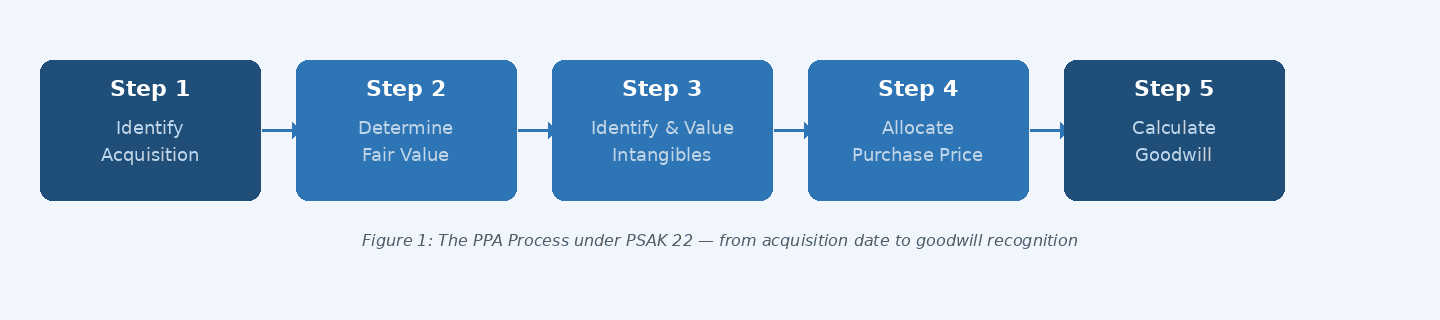
Five Major Steps of Certified PPA Valuation Training Indonesia
PPA is not a one calculation process but a process that is organized and may take four to twelve weeks depending on the complexity of the purchased business. In the following way it takes place in practice.
Step 1 – Check the Date and the Form of Acquisition.
All items in a PPA are determined by the date of acquisition the date of receiving control by the acquirer. This may be easy to say, but in Indonesia, the effective date may at times vary with the signing date especially where a regulatory approval (OJK, KPPU or BKPM) is needed. This error in acquiring date will replicate itself in all the other calculations. The team should also verify that the transaction is organized as a share acquisition or an asset acquisition as the accounting treatment is quite different.
Step 2 – Ascertain the Value of Consideration Transferred.
Purchase price does not necessarily involve a cash transaction. Consideration may take the form of cash, equity instruments, contingent consideration (earn-outs), deferred payment and fair value of any equity interest that has been held in the past under PSAK 22. Every part should be ascertained at fair value during the date of acquisition. The earn-out plans, typical of the Indonesian deals with performance-based payments to the founders, should be given special attention, since they present a certain uncertainty of being estimated, and it should be explicitly recorded and revealed.
Step 3 – Recognition and Appraisal of Tangible Assets and Liabilities.
The acquirer has to re-price all pronounced assets and liabilities to a fair amount, irrespective of their book prices in the pre-acquisition books of the acquiree. Independent appraisal is often necessary on property, plant and equipment, especially land and buildings, of which Indonesian land rights (HGU, HGB or SHM) have materially different values based upon their legal status and the duration of their tenure. The fair value adjustments required on inventories, receivables, and financial liabilities can be well removed as compared to historical cost.
Step 4 – Identify and Value Intangible Assets.
This is the most analytically intensive and the step that the most value is either discovered or overlooked. PSAK 22 perceives the need to identify the intangible assets that are separable or that occur due to a contractual or legal right, yet the acquiree never did recognize them. Indonesian transactions have brand names and trademarks, customer relationships, distribution or dealer networks, technology and software, franchise or licensing agreements, and non-compete covenants as the most common types of intangible. Both of them need a particular valuation approach: relief-from-royalty with brands, multi-period excess earnings with the customer relationship, and cost of income or approaches with technology assets.
Step 5 – Determine Goodwill and Draw-Up the Opening Balance Sheet.
After the fair value of all assets and liabilities is determined, the goodwill is determined as the consideration that exceeds the net fair value of the identified assets and liabilities. This value that usually shocks acquirers when it is either bigger or smaller than anticipated then gets transferred to the combined balance sheet. With PSAK 48, goodwill is to be charged to cash-generating units (CGUs) and is to be impaired on an annual basis- a measure which imposes continuing reporting liabilities far in excess of the original PPA exercise.
What the Standards Require for Certified PPA Valuation Training Indonesia
The PPA methodology of valuation of Indonesian companies is pegged on three interlocked standards, which include PSAK 22 (Business Combinations), PSAK 48 (Impairment of Assets) and PSAK 19 (Intangible Assets). Individually, these standards develop a complex guide to the accounting and subsequent monitoring of acquisitions.
Regarding valuation methods, the practice in Indonesia is more or less in line with the following three methodologies:
- Income Approach The Income Approach approaches assets in terms of the amount of future economic benefits that the asset aims to provide. This is the most widely applied method of non-physical assets like customer relations and technological platforms. The most important of these are revenue forecasts, attrition rates, royalty rates and discount rates which are tuned to asset-specific risk.
- The Market Approach that values by reference to observable transactions of related assets. In the Indonesia case, this usually entails finding royalty rates of similar licensing practices, but customized to reflect the local competitive environment of the Indonesian market.
- The Cost Approach, which determines the cost of recreation or replacement of the asset. This method can be most relevant with more of specialized assets with less market data available like proprietary software created internally or specialized manufacturing processes.
One of the major conditions of the PSAK 22 is that the PPA should be finalized during the measurement period; this period should not take more than twelve months after the date of acquisition. New information can be obtained during this window, whereby provisional values can be revised retrospectively. Once the measurement period has expired, corrections of errors only should be taken, any other adjustments should be recorded via the income statement.
In the case of listed companies, OJK regulations present an addition of disclosure on the PSAK requirements. The financial statements should include material business combinations in a sufficient level of details to ensure that the nature and financial impact of the acquisition is assessed by the users, including a disaggregation of the fair values of each major class of asset and liability, the value and reason why a goodwill is recognized.
Table 1: Common Intangible Assets Identified in Certified PPA Valuation Training Indonesia
| Intangible Asset | Typical Sector | Valuation Method | Useful Life |
| Brand / Trademark | FMCG, Retail, F&B | Relief-from-Royalty | 10–20 years |
| Customer Relationships | Financial Services, Healthcare | Multi-Period Excess Earnings | 5–12 years |
| Dealer / Distributor Network | Automotive, Consumer Goods | With-and-Without Method | 5–10 years |
| Technology / Software | Digital, Fintech, Manufacturing | Cost or Income Approach | 3–7 years |
| Franchise / License Rights | F&B Chains, Retail | Income Approach | Remaining term |
| Non-Compete Agreements | All sectors (founder-led deals) | With-and-Without Method | Contract term |
Source: Compiled from common PPA practice in Indonesian M&A transactions.
Real Cases Learning about Certified PPA Valuation Training Indonesia
To the naked eye, abstract concepts are significantly easier to visualize in real transactions. The examples below are based on the deal patterns that are common in the Indonesian market.
Healthcare Network Acquisition.
In 2022, a group of specialized clinics in the region was purchased by a large Indonesian hospital group. The price at which the transactions were made was a great premium on the net book value of the clinics which led to the auditors requesting an extensive PPA. The valuation team determined that the valuation of the three most important intangibles in the history of the acquiree was a regional brand with high patient loyalty, an assembled workforce of medical specialists (classified as an assembled workforce intangible) and patient records reflecting an established customer relationship.
This brand was estimated to have a value of about IDR 28 billion by the relief-from-royalty approach, which compared the rates of royalty that could be observed in licensing agreements of healthcare services. The multi-period excess earnings model was used to value customer relationship with the supposed patient attrition rate of 18 percent per year basing on management data. The workforce assembled had a replacement cost value attached to it. The identified total intangibles IDR 67 billion were subtracted from the original balance sheet as goodwill—the reduction of which, in its turn, had significant consequences on the impairment testing in the future.
The most valuable lesson: not to presume that a company that does not possess substantial physical resources has no intangible value. With service based businesses, such as, clinics, education providers and professional services firms, the intangibles are frequently the entire thesis of value of the acquisition.
Consumer Goods Brand Acquisition
A publicly traded multinational conglomerate in the FMCG business bought a locally owned snack food brand that had good distribution coverage in Sumatra and Kalimantan. The amount paid was IDR 1.2 trillion. The brand name trademark, a network of distributors and an extensive network of modern trade relations, and certain recipes, which are trade secrets, were identified by the PPA. The fair value of the brand alone was calculated at IDR 320 billion (more than 26 percent of the entire consideration) at a royalty rate of 4.5 percent based on the projected future revenues of the business over a useful life of 15 years, with a discount factor of the market position and sector risk of the brand.
The distributor network, worth IDR 180 billion based on a with-and-without analysis, demanded that the team model the incremental revenue that the acquirer would lose over that period of time that it would take to reestablish those relations on its own. This came with a lot of judgment of distributor exclusivity deals, switching, and regional competitive issues.
One of the most crucial issues was OJK review: the regulator asked to provide further support to the royalty rate assumption. The team had the task of giving a comprehensive comparables analysis based on the available trademark licensing agreements in the Indonesian and regional FMCG market. This created three additional weeks to the completion deadline- a lesson that the quality of documentation is not inferior to the analysis itself.
Lesson from practice:
As with the calculation itself in OJK-controlled transactions, where your documentation of assumptions is important. Questions that regulators and auditors will investigate include the selection of the royalty rates, derivation of discount rates, and assumptions on the loss of customers. You have to create your support file as you proceed, not after you have finished your analysis..
Digital Platform Acquisition
A large Indonesian conglomerate has purchased a mid-stage lending platform that was based on fintech. The deal depicted the specific complication of PPA valuation of digital companies. It owned very little in the way of tangible assets and its proprietary credit-scoring technology, its signed-up user base, and its fintech lending license issued by the OJK all represented a lot of value tied up.
Income approach was the technology, which was estimated at IDR 95 billion in terms of the avoided development cost of re-creating the scoring model, with an adjustment of the likelihood of a from-scratch re-build of the recreating scoring model having a similar performance. The number of users was considered an intangible customer relationship to be valued with the excess earnings model and cohort attrition was modeled based on historical data of loan renewals. Since the OJK license was legally transferable, in the prevailing regulatory context where new licenses were being offered, the nominal value was attributed to the license and a replacement cost approach was more suitable than an income approach.
The total identifiable intangibles of IDR 270 billion were out of total consideration of IDR 410 billion, with goodwill of IDR 140 billion still remaining, which is the strategic premium and expected synergies. This goodwill allocation was then allocated to one CGU to test on the impairment per year.
Problems and Lessons of Certified PPA Valuation Training Indonesia
PPA valuation in Indonesia is not only a technical process, but a compliance and reporting issue that involves close coordination by the finance teams, the independent valuers, external auditors and in the case of listed companies, the OJK. These are the most prevalent issues faced by practitioners, as well as field lessons.
Timeline Pressure
A maximum of twelve months is allowed by PSAK 22 to complete the PPA, in practice, however, auditors tend to press to have this completed much earlier so that the end year financial statements will show a completed rather than provisional allocation. The deals that are closed during the second half of the financial year pose specific pressure. Perhaps the best action that a finance team can undertake to deal with timeline risk is to engage an independent valuation firm as soon as the signing date has been signed as opposed to engaging it after the close.
Data Quality and Management Predictions.
The PPA valuations are strongly dependent on the financial projections prepared by the management, data on customers and operational metrics. In Indonesia the mid-market where most of the acquired businesses are currently changing their family-run operations to professional ones, there is no always reliable historical data. Revenue information can be recorded unevenly, related party activities can be used to inflate reported earnings and unformalized business practices can be used to mask the actual economic foundation. Valuation professionals who have been doing the job long enough will spend considerable time comprehending management information and normalizing it and then develop valuation models over it.
Auditor Alignment
Under the Indonesian practice, the independent valuer (who may be a licensed KJPP or Big Four advisory team) and the acquirer audit team have to agree on material methodology, material assumptions, and identification of assets. Valuer-auditor disputes are not rare, especially on whether intangible assets should be used in the productive life, the discount rates, and royalty rates to use, and could significantly postpone completion. The risk of finding out that methodology disagreements have arisen late in the process can be greatly mitigated by getting the audit team involved in scoping discussions, preferably before fieldwork has been done.
Deferral of Fair Value Adjustment Tax.
The impact of the deferred tax of fair value adjustments is one of the most common aspects of PPA that junior professionals do not pay enough attention to. In the case where an asset is written at fair value in the PPA, a deferral tax liability (DTL) should be recorded in the temporary difference between the new carrying value and tax base. This DTL decreases the net fair value of the identified assets and equalizes the goodwill, respectively. These DTL entries in transactions in Indonesia involving large property or brand revaluations can change the ultimate goodwill amount by a material amount – and their failure to be properly recognized can be a frequent cause of restatement risk.
Impairment of goodwill: The Tail of PPA.
The goodwill produced by PPA has got a long accounting life yet PPA is usually treated as a one-time exercise. According to PSAK 48, goodwill is to be tested to determine whether impaired annually, or more often where there are indicators of impairment. The unit of account in future testing of impairment is directly determined by the CGU allocation that was done during the PPA. A poorly designed CGU assignment – an assignment that attempts to consolidate in a single CGU businesses that are not related with an attempt to hide poor performance – brings about audit and regulatory risk, which continues to exist years later than the initial deal. It is not only good accounting practice to build a defensible CGU structure at the time of the PPA, though it is risk management.
Discussion: Developing Certified PPA Valuation Training Indonesia as a Professional Value.
PPA valuation in Indonesia is a field that lies between technical accounting, financial modelling and compliance with regulations. It is also among the most obvious deliverables of any M&A transaction- one that is audited, reviewed by regulators, and in some cases by shareholders. Getting it right matters.
In the case of junior and mid-level professionals in the field of finance, PPA competence is becoming a differentiator. The need to employ professionals who are not only familiar with the accounting framework but also with the valuation methodology underlying every line of the opening balance sheet is increasing at a very high rate as Indonesian firms consider increasing their acquisition of companies beyond their borders as well as domestically. The practitioners who will emerge most rapidly in the transaction advisory, corporate finance, or FP&A position are the ones who are able to fill the divide between the narrative of the deal team and the technical needs of the auditor.
The following are the steps that can be taken to achieve that competence:
- Geography Study PSAK 22, PSAK 48, PSAK 19 together- the most important is the understanding of how they relate with each other rather than individual memorization of any of the standards.
- Get familiar with the three fundamental valuation methods (income, market and cost) and apply them to certain asset classes. Begin with the most commonly employed brand valuation method the relief-from-royalty method–it is accessible conceptually and the most frequently used.
- Find exposure to actual PPA workbooks, even as an auditor or junior auditor. The design of a PPA model that is well structured, with well-established connections between management assumptions and the products of valuation and the balance sheet itself is a skill that is worth mastering.
- Be sensitive to disclosures. Indonesian listed companies which have had business combinations to complete are obligated to report the details of PPA in their financial statements. The most effective method of achieving such practical judgment that is underestimated and underused is by reading through such disclosures in real annual reports.
- Learn the aspect of deferred tax. Perhaps the most significant technical knowledge of competent PPA practitioners that makes the difference between them and excellent ones is a thorough knowledge of the interaction of temporary differences, deferred tax liabilities, and gross-up adjustments in the PPA model.
The M&A market of Indonesia is maturing. There is a rising regulatory inspection, auditors are more burdensome and acquirers are also more sophisticated than it was a decade ago. In that setting, PPA reporting valuation and compliance in Indonesia cease being a technical side note, it is a strategic competency. To those in the finance industry who invest in developing it at an early age in their career, the earnings will grow with time.
Certified PPA Valuation Training teaches participants how to perform Purchase Price Allocation in accordance with IFRS 3 and applicable accounting standards.
The programme is suitable for accountants, auditors, finance professionals, valuation specialists, consultants, and corporate finance teams involved in business acquisitions.
Participants learn fair value measurement, asset identification, goodwill calculation, valuation methodologies, financial reporting, and practical acquisition case studies.
The training develops practical skills for handling business combinations, improves technical knowledge, and strengthens compliance with IFRS and PSAK requirements.
Certification enhances professional credibility, strengthens valuation expertise, and equips participants with practical knowledge for conducting Purchase Price Allocation engagements.