
Goodwill Valuation Impairment Testing in Malaysia
A Practical Guide for Finance Professionals under MFRS 136 & MFRS 3
Introduction to Goodwill Valuation Impairment Testing in Malaysia
Among the most notable and the most controversial items on a corporate balance sheet are goodwill. In Malaysia, and most jurisdictions which are adherents to International Financial Reporting Standards, the generation of goodwill occurs when one company obtains another at a price, which is higher than the fair value of the net identifiable assets obtained. The value paid is a reflectance of anticipations toward brand strength, customer relations, synergies, workforce competency, and forthcoming earnings capacity which are immaterial and real in economic terms however hard to measure with exactness.
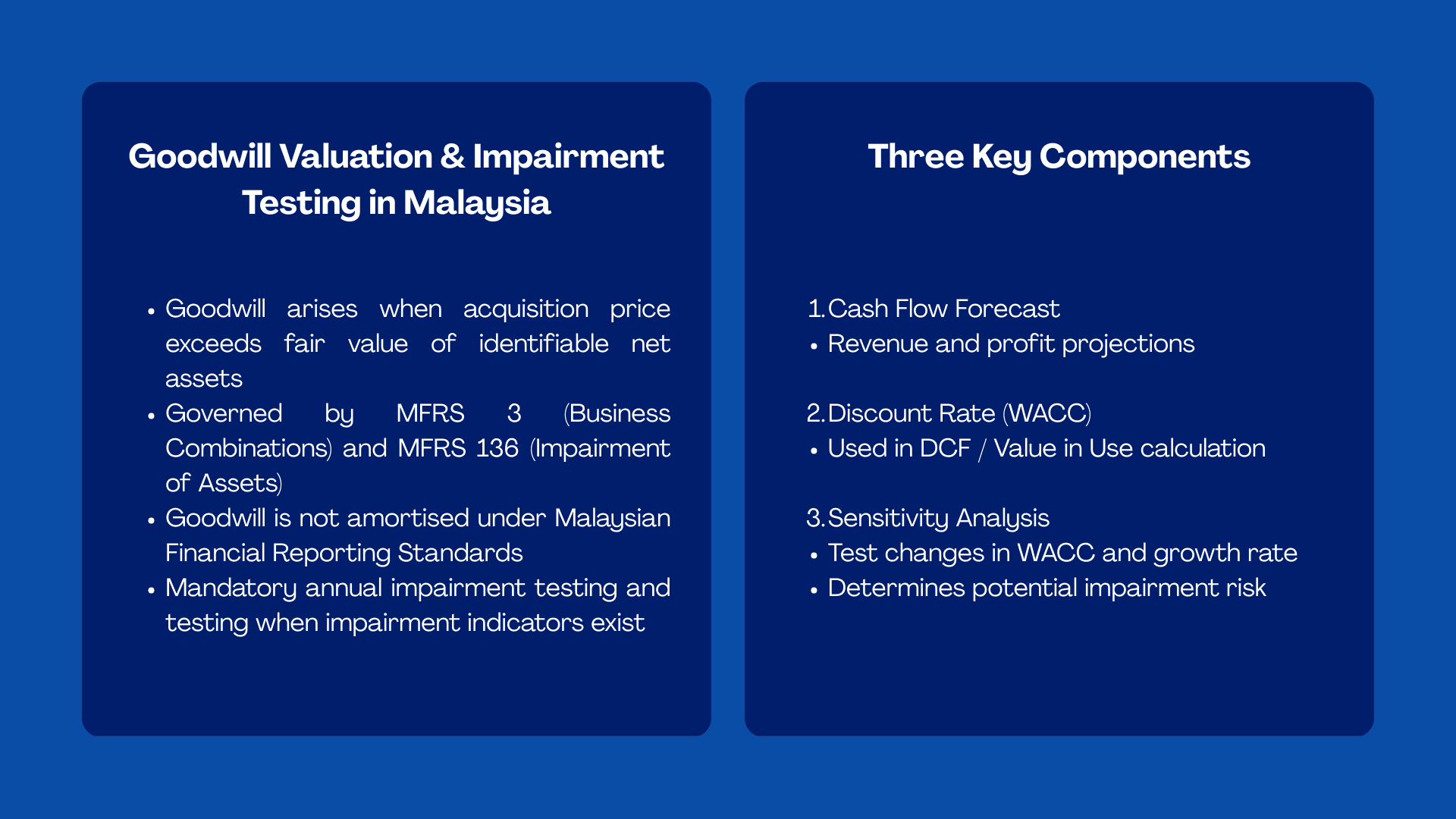
According to the Malaysian Financial Reporting Standards system, namely, the MFRS 3: Business Combinations and the MFRS 136: Impairment of Assets, goodwill is not amortised. Rather, it should be impaired at least once in a year and more often whenever there is an evidence that it has diminished in value. It is not a checkbox test as this annual impairment test. It entails a substantive reporting requirement which requires serious analysis, assumptions that can be supported and systematic documentation. It is also one of the hardest areas of financial reporting to perform well especially with many companies.
The article is intended to be read by junior and middle-level finance professionals, or those who are interested in creating a career in financial reporting, corporate finance, or valuation advice in Malaysia. It defines goodwill impairment testing, the process, and the common pitfalls that companies make as well as what the process looks like in reality. Be it in preparing financial statements, managing an audit, giving advice to a client, the insights into the mechanics and judgment call in goodwill valuation is becoming more and more critical.
What is Goodwill And How to Calculate it in Goodwill Valuation Impairment Testing in Malaysia
Goodwill is only realized due to combinations between businesses. Most of the time a Malaysian firm buys another company, be it a privately owned business, a listed subsidiary or a cross-border target the purchase price is never equivalent to the book value of the net assets of the target. The acquirer is indeed paying to the future economic returns, which the target is likely to produce on top of its balance sheet. The method of acquisition is used under MFRS 3 identifiable assets and liabilities of the acquired entity should be measured at fair value on the acquisition date, and any difference between the total consideration paid and fair value of identifiable net assets should be recognised as goodwill.
To provide an example to this: suppose a Malaysian consumer goods firm buys a regional food and beverage brand at RM 120 million. The net identifiable assets of the target, i.e. factories, inventories, receivables, trademarks, customer lists, etc. are evaluated at RM 85 million. The resultant goodwill of RM 35 million is placed on the consolidated balance sheet of the acquirer and it reflects what the acquirer paid over and above the quantifiable assets. It captures the market reputation of the target, distribution network, and synergies which are likely to be realized through the combination.
Goodwill once realised, is not lost unless it is written down by means of impairment charge. That is the essence of the annual testing requirement: businesses have to keep re-examining whether the premium that they have paid previously is still justified by the performance of the business that has been acquired. When the business performs poorly either because of a competition, an economic headwind, the loss of a key customer or a strategic misstep, the carrying value of the goodwill might surpass the value that can be recovered and therefore, impairment loss is incurred.
Table 1: How Goodwill Arises — A Simple Illustration
| Component | Amount (RM million) | Notes |
|---|---|---|
| Total Consideration Paid | 120.0 | Cash paid plus contingent consideration at fair value |
| Fair Value of Net Identifiable Assets | (85.0) | Tangible assets, intangibles, liabilities — all at acquisition-date fair value |
| Goodwill Recognised (MFRS 3) | 35.0 | Carried on consolidated balance sheet; not amortised; tested annually for impairment |
| Identifiable Intangibles within Net Assets | 22.0 | Includes trademarks (RM 12M), customer relationships (RM 7M), technology (RM 3M) |
| Residual Goodwill after Intangible Allocation | 35.0 | Reflects synergies, assembled workforce, and unidentifiable intangibles |
Impairment Testing Process Five important steps
The MFRS 136 process of impairment testing has a systematic procedure. Although there are many stages in which we can make judgment under the standard, the general methodology is properly defined. The following five steps indicate the way in which the process is traditionally implemented in practice in the Malaysian companies, starting with the initial allocation and ending with disclosure.
Table 2: The Five-Step Goodwill Impairment Testing Process (Goodwill Valuation Impairment Testing in Malaysia) in MFRS 136.
| Step | Action Required | Key Considerations |
|---|---|---|
| 1 | Allocate Goodwill to Cash-Generating Units (CGUs) | Goodwill must be allocated to CGUs or groups of CGUs that benefit from the business combination. The allocation must reflect the lowest level at which goodwill is monitored for internal management purposes. |
| 2 | Identify Impairment Indicators (or Confirm Annual Test) | Assess whether any indicators of impairment exist at interim reporting dates. Regardless of indicators, an annual test is mandatory. Indicators include revenue decline, margin compression, loss of key contracts, and macro deterioration. |
| 3 | Determine the Recoverable Amount | Calculate the higher of (a) Fair Value Less Costs of Disposal (FVLCD) and (b) Value in Use (VIU). In most Malaysian impairment exercises, VIU using a DCF model is the primary approach. |
| 4 | Compare Carrying Amount to Recoverable Amount | If the CGU’s carrying amount (including allocated goodwill) exceeds its recoverable amount, an impairment loss is recognised. The loss is allocated first to goodwill, then to other assets pro-rata. |
| 5 | Prepare Disclosures | Disclose CGU descriptions, carrying amounts of goodwill, key assumptions (growth rates, discount rates), sensitivity analysis, and the basis for determining recoverable amounts in the notes to the financial statements. |
The initial move involves giving goodwill to CGUs, which is not as easy to do as it seems. The smallest group of assets which yield cash inflows which do not depend on other assets to a large extent is referred to as a cash-generating unit. In a conglomerate with a diversification strategy, say a Malaysian plantation conglomerate, it may divide goodwill between its upstream upstream milling business unit and its downstream refining business unit as these have independent sources of revenue. The allocation decision forms the whole further analysis and is thoroughly checked by auditors during Goodwill Valuation Impairment Testing in Malaysia
Most of the technical complexity is in the third step, that is, determining the recoverable amount. In the Value in Use method, a projection of future cash flows of the CGU is made over a specific forecasting period which is normally five years after which a terminal value is added to reflect the going-concern value after the forecast horizon. These cash flows are then discounted at a rate which indicates the riskiness in this case of the CGU. It is a proactive exercise and largely relies on the assumptions of the management about the growth of the revenue, the operating margins, the capital expenditure as well as the long term growth rates.
The discount rate that is employed in the VIU calculation is usually a Weighted Average Cost of Capital (WACC) based on publicly available market information adjusted to the risk profile of the CGU. In the case of Malaysian operations, this ranges between 8 to 14 per cent, depending on the industry, leverage and country risk premium. Even a single percentage point difference of the discount rate can significantly affect the recoverable amount and, therefore, this input is the one that is under the most intense audit challenge.
The major Assumptions, Valuation Techniques, and an Exercise in Goodwill Valuation Impairment Testing in Malaysia
The mechanics of the Value in Use calculation are vital to any finance professional involved with or around the calculation of goodwill impairment. The model consists of two major components, which are the explicit forecast period and terminal value. They should utilize them in producing a recoverable amount that can be compared credibly to the carrying value of the CGU.
Table 3: VIU vs FVLCD – Selecting the most appropriate Recoverable Amount Approach in Goodwill Valuation Impairment Testing in Malaysia
| Dimension | Value in Use (VIU) | Fair Value Less Costs of Disposal (FVLCD) |
|---|---|---|
| Definition | Present value of estimated future cash flows from the CGU in its current condition | Price from an arm’s-length sale of the CGU, net of disposal costs |
| Primary Method | Discounted Cash Flow (DCF) using entity-specific assumptions | Market approach (multiples), DCF using market-participant assumptions, or recent transaction evidence |
| Common Use in Malaysia | Most commonly used; preferred when there is no observable market for the CGU | Used when a recent comparable transaction or listed peer multiple is available |
| Key Inputs | Forecast cash flows, terminal growth rate, WACC | EBITDA multiples, transaction comparables, broker valuations |
| Auditor Scrutiny Level | High — assumptions are entity-specific and not externally observable | Moderate to High — depends on quality of market comparables available |
In the majority of Malaysian impairment exercises, Value in Use is used due to the fact that the market in which the CGU under test can be seen is not readily visible. The analyst constructs a five year cash flow forecast using the latest board approved budget and strategic plan and uses a terminal growth rate, usually 1% to 3% in the case of Malaysian operations, to indicate long run sustainable growth after the explicit forecast period. The terminal value is determined by the Gordon Growth Model and usually represents 60 to 75 percent of the total recoverable value so the importance of the long-term value rate is high.
The discount rate is based on the WACC, which is computed using the Capital Asset Pricing Model (CAPM) of the cost of equity, which is mixed with an after-tax cost of debt at the target of the CGU capital structure. In cases where companies conduct operations in different jurisdictions, there is addition of a country risk premium that indicates the increment in risk in the operation of a developing market. In Malaysia, the risk-free rate is pegged on the yield of the 10 years Malaysian Government Securities, which is adjusted periodically according to the prevailing market conditions.
Table 4: Goodwill Impairment Test in case of illustration -Malaysian manufacturing CGU (Goodwill Valuation Impairment Testing in Malaysia)
| Input / Output | Value | Basis and Commentary |
|---|---|---|
| Goodwill Allocated to CGU | RM 48.0 million | Arose from acquisition of a domestic industrial parts manufacturer in 2021 |
| Total Carrying Amount of CGU (incl. goodwill) | RM 135.0 million | Net assets at reporting date including allocated goodwill |
| Forecast Period | 5 years (FY2025–FY2029) | Based on board-approved business plan; revenue CAGR of 6.5% |
| EBITDA Margin Assumption | 18.5% (Year 1) → 21.0% (Year 5) | Reflects cost optimisation and operating leverage over the forecast period |
| Terminal Growth Rate | 2.5% | Consistent with Malaysia long-run nominal GDP growth; benchmarked to industry |
| Discount Rate (WACC) | 10.8% | Derived from CAPM; peer group beta; Malaysian risk-free rate of 4.0% |
| Recoverable Amount (VIU) | RM 158.0 million | Present value of forecast cash flows plus terminal value |
| Headroom (Recoverable Amount minus Carrying Amount) | RM 23.0 million | Positive headroom — no impairment recognised at current date |
| Sensitivity: WACC +1% | RM 141.5 million | Headroom narrows to RM 6.5M — remains above carrying amount |
| Sensitivity: Terminal Growth -0.5% | RM 149.0 million | Headroom of RM 14.0M — impairment still not triggered |
The case in Table 4 represents a typical situation within the Malaysian firms that have been acquisitive over the last few years: a manufacturing CGU, with the goodwill material, the forecast moderately optimistic and the headroom real but not exceptional. It is important in this case to conduct the sensitivity analysis, which merely demonstrates that the recoverable amount was higher than the carrying value in the base case assumptions. MFRS 136 explicitly stipulates that the amount through which the assumption would have to change to result in the carrying amount matching the recoverable amount be disclosed. The WACC in this instance would have to increase by a margin of about 1.6 percentage points before impairment will be registered and the management and auditor would evaluate it against the probability of such an increase.
Difficulties in Impairment Testing Practice: Areas where Companies Gear up in Goodwill Valuation Impairment Testing in Malaysia
The impairment testing of goodwill is a more technical area of financial reporting and the difficulties in practice are well documented. Knowledge of these pitfalls is of use either when making the analysis as a finance professional, or when interviewing or advisory-seeking as a candidate and showing the depth of your knowledge.
Management biasness of the cash flow forecast is the most perennial problem. This is due to the level of tension that exists in the fact that VIU is dependent on entity-specific projections and as such, the natural inclination by the management is to be optimistic about their business and the constraints presented by MFRS 136 that the projections have to be reasonable and supportable. This tension is felt acutely by the auditors. They will make comparisons of the projected growth rates with the past performance, industry standards, and with macroeconomic data. Any prediction that continually predicts the rate of growth of revenues to be in double digit is going to be met with a great deal of criticism in a low-growth industry.
The second difficulty is associated with defining and stability of CGU. The boundaries of CGU are periodically redefined by companies either on a year to year basis; as a result of actual restructuring or, in other instances, to prevent a precipitating impairment. This is sensitive to auditors and regulators. In their guidance, both the Securities Commission Malaysia and Bursa Malaysia have stressed that the CGU definitions are needed to be based on how the management actually manages the business and any alterations in CGU composition must be fully disclosed and explained.
And take the example of a Malaysian conglomerate that had realised a lot of goodwill after acquiring a hospitality chain. When the business started registering losses after a spell of growth, management first contended that it would look good within the forecast period and it kept headroom within the VIU computation by assuming that the business would get back to the pre-downturn margins in less than three years. The auditors needed to reassess the previous two years of poor performance against the forecast but with more conservative assumptions, an amount in the goodwill write down was RM 60 million. Ultimately, the impairment charge was reported, but the incident showed how the failure to recognize impairment (although in good faith) sooner than possible can undermine the credibility of creditors and investors.
The third aspect of trouble is the calculation of discount rate. A common practice by many companies (especially those that lack the availability of specific treasury or valuation teams) is to estimate one group-wide WACC across all CGU impairment tests, irrespective of the varying risk characteristics of individual business units. This would not be right in MFRS 136. Different risk should be represented by a financial services business and a logistics business operating in the same group. The use of goodwill valuation services in Malaysia to test the impairment tests using the IFRS is a proper way to ensure that the WACC used on each CGU is prepared, benchmarked, and justified.
Table 5: Practice Challenges and Recommended Solution to Common Goodwill Impairment in Malaysia
| Challenge | Why It Occurs | Recommended Solution |
|---|---|---|
| Overly optimistic cash flow forecasts | Management bias; pressure to avoid impairment recognition | Benchmark projections against historical performance and industry data; stress test all key assumptions |
| Inconsistent CGU definition year-on-year | Restructuring or deliberate avoidance of impairment trigger | Document CGU rationale clearly; disclose any changes with explanation in the notes |
| Single WACC applied across all CGUs | Lack of dedicated valuation expertise internally | Engage independent goodwill valuation consultant in Malaysia for each CGU’s discount rate |
| Insufficient sensitivity analysis | Finance team unaware of MFRS 136 disclosure requirements | Prepare and disclose sensitivities for WACC and terminal growth rate as a minimum |
| Retrospective impairment recognition | Delayed acknowledgment of business underperformance | Reassess assumptions at each interim date when impairment indicators are present |
| Poor documentation of key judgements | No audit trail for assumptions used | Maintain a valuation model with clearly labelled assumptions, sources, and approval sign-offs |
The Answering the Question of Independent Valuation Professionals and Disclosure in Goodwill Valuation Impairment Testing in Malaysia
To a large number of Malaysian firms, especially those with material goodwill balances which occurred in recent acquisitions, the issue of whether impairment testing should be done in-house or outsourced to an independent specialist is not only a quality issue, but also a credibility issue. Although large companies that have well-endowed finance departments might be in a position to administer the VIU model directly, the analysis still needs to pass through a rigorous audit inspection and it can be much easier done with the help of an outsourced support.
A financial reporting independent goodwill valuation consultant in Malaysia has a number of benefits associated with it. To begin with, they can access current market information to build the WACC such as the current risk-free rate, the estimate of equity risk premiums, the beta based on the peer groups of the business and country risk adjustments. Second, they are trained in the manner in which auditors test assumptions and are able to anticipate the probable questions in the report. Third, their autonomy with the management shields the analysis against the disparagement of bias, which is of concern to the auditors as well as to investors looking at the financial statements.
It is also true that the goodwill impairment assessment and valuation under MFRS in Malaysia is also associated with a big load of disclosure obligations that are often underestimated. MFRS 136 also expects companies to disclose, per CGU or group of CGUs where there is significant goodwill, the carrying amount of the goodwill, the basis of estimating the recoverable amount, the assumptions used that are key in estimating the recovery, the period over which the management has estimated the cash flow as well as the growth rate used and the discount rate. The standard also makes disclosures on the sensitivity of the conclusion to the reasonably possible changes in the key assumptions where the difference between the recoverable amount and the carrying amount is not significant.
The purpose of such disclosures is very significant: this way, investors, analysts, and creditors can determine whether the goodwill mentioned on the balance sheet is indeed justified by the performance of the business acquired. With acquisition activity still alive and a goodwill balance also on the increase, especially in markets like technology, healthcare, financial services and consumer, the standard of impairment testing and disclosure has been a useful indicator of management credibility and financial reporting rigour.
Table 6: MFRS 136 Disclosure Checklist in Goodwill Valuation Impairment Testing in Malaysia- what should be included in the Notes
| Disclosure Requirement | Detail Required | Common Gap |
|---|---|---|
| CGU description | Identify each CGU or group of CGUs to which goodwill has been allocated | Vague descriptions that do not align with internal reporting segments |
| Goodwill carrying amount | Amount allocated to each CGU at the reporting date | Aggregation of dissimilar CGUs without justification |
| Recoverable amount basis | State whether VIU or FVLCD was used, and why | Failing to explain the choice of method |
| Forecast cash flow period | State the number of years covered by management projections | Using periods beyond 5 years without detailed justification |
| Terminal growth rate | Disclose the rate and whether it exceeds long-run GDP growth | Omitting the rate or using a rate inconsistent with macro benchmarks |
| Discount rate (WACC) | Pre-tax or post-tax rate used; basis for derivation | Using a group-wide rate without CGU-specific adjustment |
| Sensitivity analysis | Show impact on recoverable amount of reasonable changes in key assumptions | Omitting sensitivity or showing only favourable scenarios |
| Impairment loss (if any) | Amount, CGU affected, and line item in income statement | Insufficient explanation of the triggers and management response |
Conclusion: Making Goodwill Valuation Impairment Testing in Malaysia Compliance an Insight
One of the most challenging and judgmental areas of financial reporting in Malaysia in relation to MFRS 3 and MFRS 136 is goodwill valuation and impairment testing. It is located at the intersection of accounting standards, financial modelling, business strategy and market intelligence. When well done, it gives a clear and plausible evaluation on whether past acquisitions made still make sense based on business performance. When it is wrongly done, or kept light, it places the company at risk of audit, regulatory inspection as well as a tarnished reputation in case an impairment charge that ought to have been recognised previously comes out.
Increasingly, the ability to establish a true competency in goodwill impairment testing is becoming useful to finance professionals at all levels. Malaysian market is aggressive, goodwill balances of many consolidated balance sheets are high and the expectation by the auditors, regulators and investors of the quality of impairment analysis is on the increase. An individual that possesses not only the ability to operate a DCF model but to build defendable assumptions, locate CGU limits properly, stress test results and write full disclosures, is an exceptionally rare and coveted asset on any financial staff.
The practical message of any organisation with goodwill in its balance sheet is as follows: impairment testing should be viewed as a dynamic and active process at any rate than an annual compliance support. Keep track of performance of acquired businesses during the year. Rebuild assumptions when they are manifested through impairment signs, but not at the end of the year. Deem goodwill valuation services in Malaysia to conduct IFRS impairment testing on material balance of goodwill, complex structure of CGU or due to the auditor having indicated concerns over prior-year assumptions. And also ensure that all the major assumptions in the VIU model have to be substantiated with documented evidence, reviewed by a third party and properly communicated in the notes to the financial statements. It is that kind of discipline, used on a regular basis, that will cause organisations that have been proactive in managing the impairment of goodwill to be ahead of those which are caught off guard by the situation.
Goodwill represents the excess purchase price paid over the fair value of identifiable net assets acquired during a business acquisition.
Annual impairment testing ensures goodwill is not carried above its recoverable amount, supporting accurate financial reporting under IAS 36.
Declining profitability, market downturns, increased competition, operational challenges, and adverse economic conditions may indicate impairment.
Companies involved in acquisitions, auditors, accountants, finance professionals, and valuation specialists commonly require goodwill assessments.
Professional assessments provide objective valuations, improve financial reporting accuracy, and ensure compliance with applicable accounting standards.