
IFRS 13 Fair Value Measurement Explained for Indonesian Companies (2026 Guide)
IFRS 13 Fair Value Indonesia
Fair value measurement is now regarded as possibly one of the most difficult and heavily examined parts of financial reporting in Indonesia, particularly using IFRS 13 Indonesia (PSAK 68). The standard has greatly transformed the measurement of assets and liabilities, making it more difficult to measure the assets and liabilities using sound valuation techniques, market data, supporting assumptions and disclosures. The trend of valuation in the key business centers like Jakarta has been shifting with the increasing sophistication of the business environment of Indonesia and cross-border transactions.
Understanding how IFRS 13 operates in practice is therefore essential for finance directors, chief financial officers, accountants, audit committee members, risk managers, and corporate decision-makers who bear responsibility for ensuring that fair value measurements are technically robust, properly documented, internally consistent, and defensible during external audit reviews and potential regulatory examinations. This 2026 guide provides a comprehensive and in-depth explanation of fair value measurement principles, valuation techniques commonly applied in Indonesia, practical illustrations of implementation, and a discussion of the most frequent challenges encountered by companies navigating the local market landscape.
What is IFRS 13?
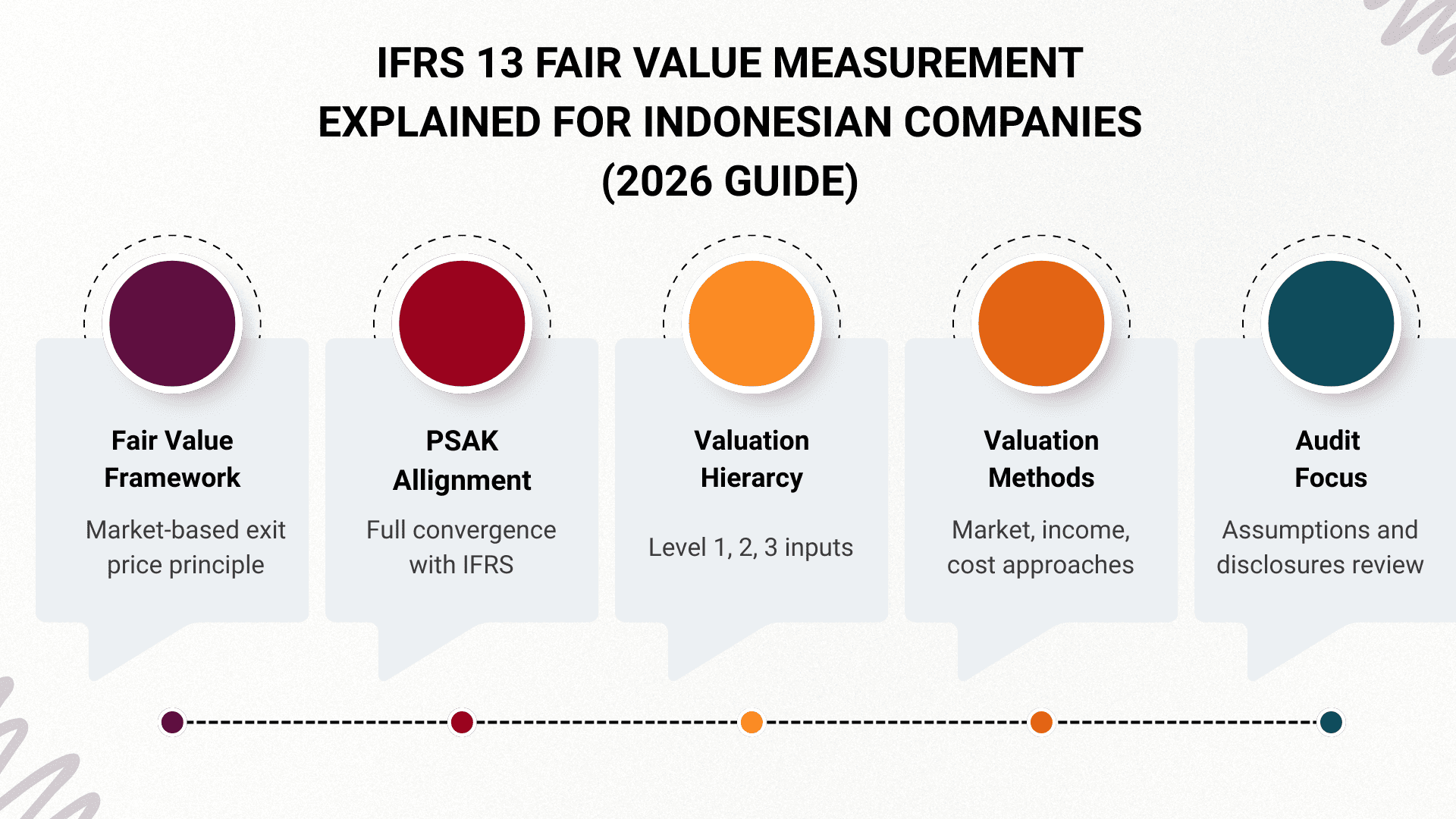
IFRS 13 establishes a single, comprehensive, and principle-based framework for measuring fair value whenever another IFRS standard requires or permits such measurement, thereby eliminating inconsistencies that previously existed across various accounting standards that used differing definitions and approaches to fair value. Rather than prescribing when fair value must be used, IFRS 13 focuses exclusively on how fair value should be determined, defining it as the price that would be received to sell an asset or paid to transfer a liability in an orderly transaction between knowledgeable and willing market participants at the measurement date under current market conditions.
Under IFRS 13 Indonesia, the fair value concept is explicitly market-based rather than entity-specific, which means that management must adopt assumptions that independent, rational, and economically motivated market participants would use when pricing the asset or liability, rather than relying solely on internal expectations, historical transaction values, or strategic intentions unique to the reporting entity. This market participant perspective has far-reaching implications, particularly within Indonesia’s developing and sometimes less liquid markets where observable data may not always be readily available, thereby necessitating enhanced professional judgment, advanced valuation modelling techniques, and careful benchmarking against available market evidence.
In practical terms, IFRS 13 applies to a broad spectrum of assets and liabilities, including but not limited to investment properties, financial instruments measured at fair value through profit or loss, biological assets, assets and liabilities acquired in business combinations, share-based payment arrangements, and certain classes of property, plant, and equipment under revaluation models. As a result, it has become one of the most frequently referenced and operationally significant standards in Indonesian financial reporting.
How PSAK 68 Aligns with IFRS 13
PSAK 68 is the Indonesian Financial Accounting Standard that fully converges with IFRS 13, thereby ensuring that fair value measurement principles applied by Indonesian companies remain substantially aligned with international practices adopted in major global capital markets. The issuance and implementation of PSAK 68 represented a significant milestone in Indonesia’s broader accounting convergence journey, as it formalised the transition toward a consistent and unified fair value framework applicable across industries, asset classes, and reporting scenarios.
The close alignment between IFRS 13 Indonesia and PSAK 68 ensures that financial statements prepared under Indonesian standards maintain comparability with those prepared under IFRS in other jurisdictions, which in turn enhances investor confidence, facilitates cross-border investment flows, and supports multinational group reporting requirements. However, despite the near-identical wording of PSAK 68 and IFRS 13, practical application in Indonesia may involve additional considerations relating to local market liquidity constraints, regulatory oversight dynamics, valuation professional standards, and the availability—or lack—of reliable market-based inputs.
In commercial hubs such as Fair Value Jakarta, where commercial property markets, financial institutions, infrastructure projects, and corporate headquarters are heavily concentrated, the implementation of PSAK 68 has encouraged closer collaboration between corporate finance teams, independent valuers, property consultants, and audit firms to ensure that fair value measurements reflect realistic market participant assumptions grounded in credible and supportable evidence.
The Fair Value Hierarchy (Level 1, 2, 3)
One of the most critical components of IFRS 13 Indonesia is the fair value hierarchy, which categorises valuation inputs into three levels based on their degree of observability, reliability, and objectivity, thereby guiding entities in selecting appropriate data sources and determining the extent of required disclosures. The hierarchy promotes transparency by requiring companies to prioritise observable inputs over unobservable ones whenever feasible.
Level 1 inputs represent quoted prices in active markets for identical assets or liabilities that the entity can access at the measurement date, such as publicly traded equity securities listed on recognised stock exchanges. Because these inputs are directly observable and require minimal adjustment, they provide the most reliable and objective evidence of fair value and typically involve limited judgment.
Level 2 inputs consist of observable inputs other than quoted prices for identical items, including quoted prices for similar assets, interest rate yield curves, credit spreads, forward exchange rates, and other market-corroborated data. In Indonesia, Level 2 inputs are frequently applied when valuing bonds, structured financial instruments, and certain derivatives where active markets exist but identical quoted prices are not directly available.
Level 3 inputs involve unobservable inputs that reflect management’s own assumptions about the assumptions market participants would use when pricing the asset or liability. In practice, many complex valuations within Fair Value Jakarta, particularly for investment properties, private equity investments, infrastructure concessions, and specialised industrial assets, fall within Level 3 due to limited transaction transparency or infrequent comparable sales. Level 3 valuations require extensive qualitative and quantitative disclosures, reconciliation of opening and closing balances, sensitivity analyses, and strong documentation to withstand audit scrutiny under PSAK 68.
Valuation Techniques Used in Indonesia
IFRS 13 permits three primary valuation approaches—the market approach, the income approach, and the cost approach and Indonesian companies typically select the most appropriate technique based on the nature of the asset or liability, the availability of observable market data, and the specific measurement objective required by the applicable accounting standard.
Market Approach
The market approach relies on prices and other relevant information generated by market transactions involving identical or comparable assets or liabilities, thereby reflecting actual market behaviour and prevailing pricing dynamics. In Fair Value Jakarta, this approach is commonly applied when valuing residential apartments, office buildings, retail spaces, and land parcels by referencing comparable sales transactions and adjusting for differences in location, size, physical condition, lease structure, and prevailing economic circumstances.
Under IFRS 13 Indonesia, adjustments made to comparable data must be carefully justified, consistently applied, and supported by objective evidence to ensure compliance with PSAK 68 disclosure requirements and to maintain credibility during audit review.
Income Approach
The income approach converts future expected economic benefits, such as projected cash flows or earnings streams, into a single present value amount using discount rates that reflect current market participant expectations regarding risk and time value of money. This approach is widely applied in Indonesia for valuing investment properties, intangible assets, financial instruments, and cash-generating units in impairment testing scenarios.
Discounted cash flow (DCF) analysis remains the most prevalent income-based method, requiring detailed estimation of projected revenues, operating margins, capital expenditure plans, working capital requirements, terminal growth assumptions, and risk-adjusted discount rates. Under IFRS 13 Indonesia, discount rates must reflect the asset’s specific risk profile and prevailing market conditions rather than entity-specific financing arrangements.
Cost Approach
The cost approach reflects the amount that would currently be required to replace the service capacity of an asset, often described as current replacement cost. This method is particularly relevant for specialised manufacturing equipment, infrastructure assets, and customised facilities where active secondary markets may be limited or non-existent.
In Indonesia, application of the cost approach often requires adjustments for physical deterioration, functional obsolescence due to technological changes, and economic obsolescence arising from regulatory developments or market shifts, all of which must be carefully documented and disclosed in accordance with PSAK 68.
Practical Example – Fair Value of Investment Property in Jakarta
Consider an Indonesian company that owns a premium-grade commercial office building located within Jakarta’s central business district and elects to measure the property at fair value under the investment property model permitted by applicable standards. Under PSAK 68 and IFRS 13 Indonesia, the company must determine the price that would be received to sell the property in an orderly transaction between market participants at the measurement date, assuming exposure to the market under normal selling conditions.
In Fair Value Jakarta, valuation professionals would typically apply the income approach by projecting rental income based on existing lease contracts, prevailing market rental rates, expected lease renewals, vacancy levels, and anticipated rental growth trends. These projections would be cross-checked using comparable transaction data under the market approach to validate key assumptions. The projected net operating income would then be capitalised using a market-derived capitalisation rate reflecting location quality, tenant creditworthiness, lease tenure stability, macroeconomic conditions, and broader capital market expectations.
Comprehensive disclosures would be required, including classification within the fair value hierarchy, detailed description of valuation techniques applied, quantitative disclosure of significant unobservable inputs, and sensitivity analysis demonstrating how changes in capitalisation rates or rental growth assumptions would affect the reported fair value.
Common Audit Issues in Indonesia
Auditors in Indonesia frequently focus on the reasonableness, internal consistency, and external supportability of assumptions used in Level 3 valuations, particularly when management forecasts appear overly optimistic or inconsistent with historical operating performance. Under IFRS 13 Indonesia, discrepancies between approved business plans, impairment testing models, and fair value calculations often result in expanded audit procedures and requests for additional supporting evidence.
Other recurring audit issues include insufficient explanation of valuation methodologies, inadequate reconciliation of Level 3 movements between reporting periods, unsupported derivation of discount rates or capitalisation rates, and incomplete sensitivity analyses. In heavily scrutinised markets such as Fair Value Jakarta, auditors increasingly expect independent valuation reports for material balances to enhance objectivity, reduce bias risk, and strengthen overall financial statement reliability.
Frequently Asked Questions
Is fair value always required under IFRS?
No, IFRS 13 does not mandate when fair value must be applied; rather, it explains how to measure fair value when another standard requires or permits it.
What happens if there is no active market in Indonesia?
Companies may rely on Level 2 or Level 3 inputs, applying valuation techniques that maximise observable data while clearly disclosing unobservable assumptions under PSAK 68.
Does fair value mean forced sale value?
No, fair value assumes an orderly transaction between market participants, not a distressed or forced liquidation scenario.
Are independent valuers mandatory?
Not always, but they are strongly recommended for complex or material valuations to ensure credibility and audit defensibility.
When Do You Need an Independent Valuer in Indonesia?
An independent valuer becomes particularly important when assets are categorised within Level 3 of the fair value hierarchy, when valuation adjustments significantly affect reported profit or equity, when regulatory authorities or auditors request third-party evidence, or when management lacks specialised in-house valuation expertise. In complex commercial environments such as Fair Value Jakarta, independent specialists provide technical rigour, market benchmarking insight, comprehensive documentation, and defensible analytical frameworks aligned with IFRS 13 Indonesia and PSAK 68 requirements.
By engaging experienced valuation professionals, Indonesian companies not only enhance the reliability and credibility of their financial statements but also strengthen corporate governance structures, improve audit efficiency, and ensure full compliance with evolving accounting standards in 2026 and beyond, thereby reinforcing investor confidence in an increasingly sophisticated and competitive market landscape.
IFRS 13 provides a consistent framework for measuring fair value and establishing disclosure requirements for assets and liabilities.
The standard improves comparability, transparency, and consistency by defining how fair value should be measured across different transactions.
IFRS 13 recognises the Market Approach, Income Approach, and Cost Approach depending on the nature of the asset or liability.
Accountants, auditors, finance professionals, valuation specialists, and businesses preparing IFRS or PSAK financial statements should understand IFRS 13.
It establishes consistent valuation principles and disclosure requirements that enhance the reliability and usefulness of financial statements.