
IAS 36 Goodwill impairment testing Indonesia –
2026 Update
Summary of the IAS 36 Impairment Testing Indonesia
Impairment testing of goodwill (annually) is also among the most subjective and regulator-conscious spheres of financial reporting under IAS 36. IAS 36 has been significantly converged into PSAK 48 in Indonesia, and entities that prepare financial statements in line with the IFRS are required to conduct systematic and documented impairment tests. With business combinations expected to continue to grow in manufacturing, infrastructure, technology, mining, healthcare, and financial services segments, the significance of the Goodwill impairment Indonesia procedures has become even greater going into 2026.
Goodwill – This is based on acquisitions that are recorded under IFRS 3 and is amount of future economic benefits that are based on assets that are not recorded and recognised separately. Goodwill is not amortised as is the case with identifiable intangible assets. Rather, it should undergo impairment testing at least once a year and on any occurrence of any sign of impairing the asset. This is also required irrespective of whether there are any visible external indicators of decline since all reporting entities with goodwill should do formal testing.
In 2026, regulators in Indonesia, especially ones that are publicly-traded and regulated by the Financial Services Authority (OJK), have heightened operational audit risk, especially concerning the assumptions associated with discount rates, cash flows, end-of-period growth rates, the absence of alignment between impairment models and published strategic forecasts. Subsequently, to perform a defensible IAS 36 Jakarta engagement is more than ever, a greater amount of documentation and benchmarking of markets and technical soundness is needed.
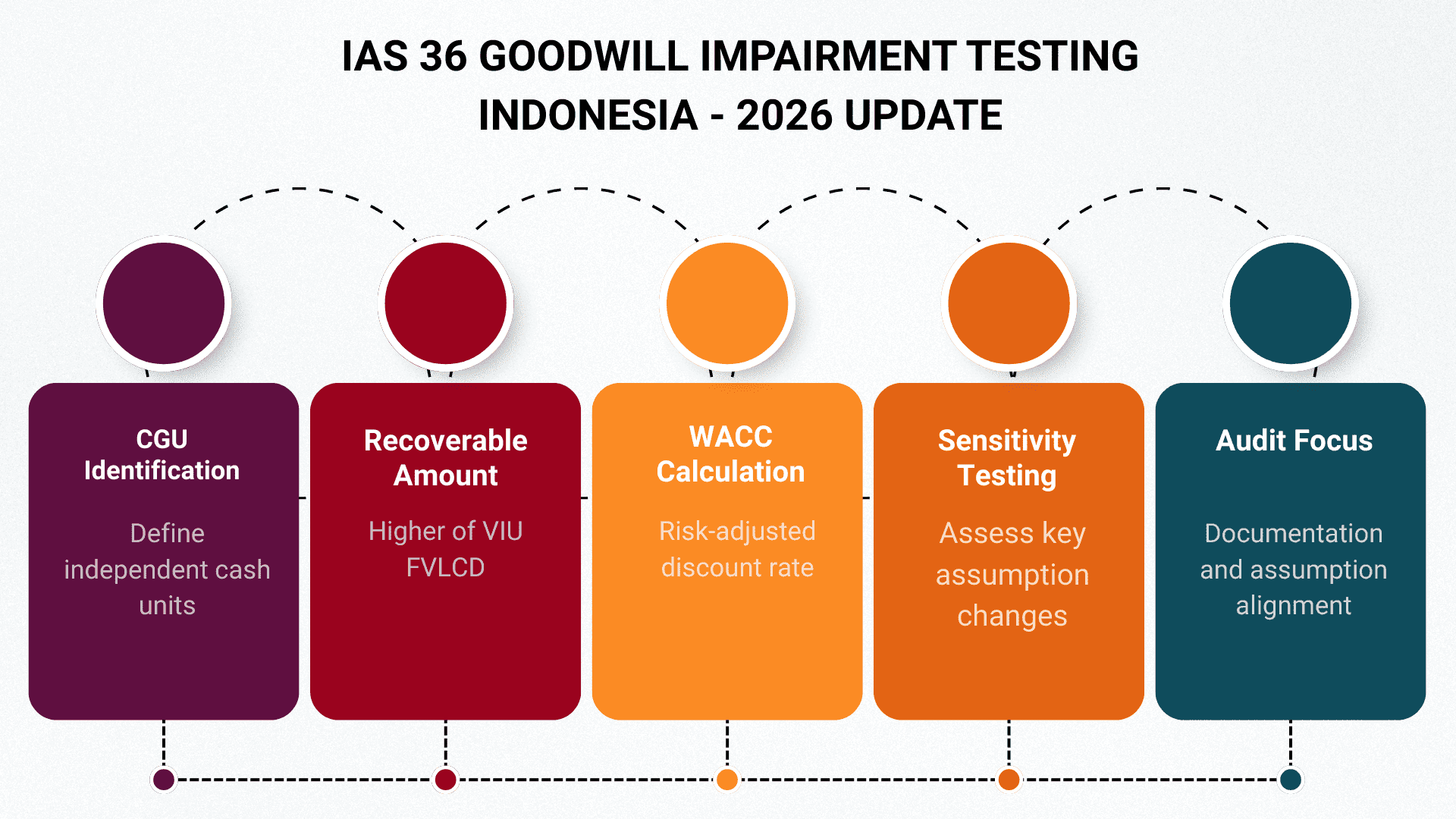
Determining Cash-Generating Unit (CGU)
One of the initial procedures of testing Goodwill impairment Indonesia is to determine the relevant Cash-Generating Unit (CGUs). Under the IAS 36, goodwill should be recognized in the CGU or group of CGU that is likely to enjoy the synergies of the business combination. A CGU is what is commonly referred to as the smallest identifiable group of assets that produces cash inflows that are rather independent of other assets or groups of assets.
In Indonesia, calculation of CGUs may be complicated by diversification of conglomerate structure, vertically integrated manufacturing process, or holding-company structure. A case in point is an Indonesian consumer goods group which is listed and has a single legal structure, but has a number of brands which are managed as distinct reporting units. In this situation, the management should carefully evaluate whether each brand is a distinct CGU or there are synergies that warrant combining the two into one.
CGU reporting should be aligned with internal management and operating segments reporting under the IFRS 8. Auditors often analyze whether the CGU level is consistent with the way the management tracks the performance and resources distribution. The incorrect identification of CGUs may either cover the impairment losses or initiate the write-downs too soon and hence this step is important in any IAS 36 Jakarta analysis.
Identification of Recoverable Amount
After proper identification of cash-generating units (CGUs) and goodwill is allocated, the second important step in the impairment testing process is to establish the amount that can be recovered in each of the CGUs. According to the IAS 36, the recoverable amount is the greater of Value in Use (VIU) and Fair Value Less Costs of Disposal (FVLCD). The amount of goodwill assigned to the CGU is contrasted directly with the recoverable amount. In case carrying amount is more than recoverable amount, then there should be impairment loss recognized. Notably, any impairment loss will first be used to reduce the goodwill to zero and thereafter it will be allocated proportionately to the other assets in the CGU.
One of the most widely used methods in the Indonesian impairment engagements is Value in Use. It is the sum of money that is presently valued by future cash flows in the form of cash that will be derived by utilizing the CGU and its disposal. To calculate VIU, the management will have to prepare comprehensive and substantiating cash flow projections. These projections are usually over a specific forecast period of five years in line with approved corporate budgets and strategy plans, and then a terminal value calculation of all the cash flows after the forecast period.
Making sound financial forecasts is not an easy task in Indonesia. Macroeconomic instability, currency changes, commodity price elasticity, political factors, as well as changes in regulations can have a great influence on business prospects. In turn, management assumptions need to be well formulated in order to capture reasonable and supportable expectations. The basis of forecasts should be the historical performance trends, budgets approved by the board, arrangements on the basis of contracts and reliable market information. Auditors and regulators are increasingly questioning projections that are too optimistic and lack any external support.
There are some important inputs that move a VIU calculation. The growth rates in revenues should be in line with realistic expectations regarding the performance of the industry and market share assumptions. EBITDA margins must take into account cost systems, productive use of funds, price force and inflationary pressures. The requirements of capital expenditure should include maintenance and expansion investment to maintain cash flow forecasts. The terminal growth rate, which is used to compute the terminal value, should be not higher than long-term industry or economic growth expectations.
Appropriate discount rate has to be determined carefully. This is done in Indonesia through the use of country risk premiums, risk factors unique to industries, assumption of capital structure, and current interest rate conditions. Considering the economic environment in the year 2026, auditors who will be assessing goodwill impairment models in Indonesia are all looking to compare the discount rates and growth assumptions with the research done by analysts, industry forecast report and macroeconomic forecasts given by institutions like bank Indonesia. This increased standard is an indication of regulatory demands of defensible and well documented valuation models.
In general, recoverable amount is not a purely mechanical process but a judgmental process that entails utilizing of sound financial modeling, good economics and extensive documentation. The proper and clear estimation of recoverable amounts are crucial in compliance of IAS 36 and investor confidence in financial reporting.
Calculation of WACC in Indonesia
One of the most examined aspects of the IAS 36 Jakarta impairment testing is determining an acceptable Weighted Average Cost of Capital (WACC). The WACC is the minimum rate of return that the equity providers and debt providers will demand considering the risks unique to the CGU.
The calculation of WACC is usually done in Indonesia and it includes:
- Risk-free rate (in most cases it is founded on Indonesian government bond yields)
- Equity risk premium
- Beta coefficient (leveraged and unleveraged)
- Country risk premium
- Cost of debt
- Target capital structure
The yield of long-term government bonds, which are in Indonesian Rupiah, is normally used to determine the risk-free rate. Usually foreign currency considerations can also apply to those companies that have revenues that are in USD form. Equity risk premium can be re-priced to capture emerging market risk, whereas beta is commonly compared to similar listed companies in Indonesia or the ASEAN region.
The country risk premium is especially a sensitive assumption of the Goodwill impairment Indonesia exercises where country risk premium takes into account the macroeconomic, political and regulatory risks. Auditors often demand external data, valuation databases and third party benchmarking to provide such inputs.
Several figures of WACC can artificially lower recoverable amount and can bring about impairment which is not necessary and that which is overstated may postpone recognition of actual economic downturns. As such, calibration and paperwork are required.
Case Study- Impairment Testing of an Listed Indonesian Company
As an example of how impairment testing is used in practice, an Indonesian listed manufacturing company that has acquired a domestic rival in 2022 is considered hypothetically. Under the business combination accounting at the acquisition time, the company recorded a goodwill of IDR 150 billion representing the anticipated synergies, increased market share, increase in production capacity and anticipated operation efficiencies.
However, the dynamics in the manufacturing industry is now much more difficult by 2026. Both regional and imported products have also increased competition, and pressures on the global supply chain and fluctuations on the global currency have also increased the cost of raw materials which has resulted in a tightening of the profit margins. The developments have encouraged the management to undertake its mandatory annual Goodwill impairment Indonesia test in line with IAS 36 and also evaluate the existence of indications of impairment due to the adverse market conditions.
The goodwill balance of IDR 150 billion has been assigned to the cash-generating unit (CGU) of which the total carrying amount is IDR 600 billion. As part of preparing the impairment assessment, the management prepares elaborate five-year cash flow forecasts and is prepared using formally approved internal budgets and strategic plans reviewed by the board of directors. These forecasts have low yet consistent revenue growth of about 4 per cent per annum which is a low optimism in both gradual market recovery and operational adjustments. It is expected that the EBITDA margins will stabilise at 18 through consideration of cost-control initiatives, renewed supplier contracts and expected productivity gains.
To calculate terminal value after the explicit forecast period, the management uses terminal growth rate of 3%. This rate is regarded as reasonable and in line with the long-term growth projection of the Indonesian GDP, that terminal growth-related assumptions must not be more than long-term economic growth patterns in the market concerned.
In order to discount the estimated cash flows in future to the present value, the management calculates the weighted average cost of capital (WACC) to be 11.5%. This discount rate takes into consideration; existing Indonesian government bond yields, a suitable equity risk premium, a firm-specific beta, which is used to reflect industry volatility and a country risk premium which is in line with market standards. The Value in Use (VIU) will be IDR 580 billion upon calculation of the discounted cash flows projected and the terminal value.
Sensitivity Analysis and Disclosure
The sensitivity analysis has become a vital issue in IAS 36 testing impairment engagements in Jakarta, especially in light of the economic volatility and capital market uncertainty that was experienced in 2026. In the IAS 36 Impairment of Assets, the entities must not only evaluate their impairments of goodwill or other assets, but also reveal the main assumptions used to derive the amounts that are recoverable. This is necessary to be transparent and to enable the investors to know how sensitive reported asset values are to fluctuations in the economy.
However, as a matter of practice, sensitivity analysis usually dwells upon the variables that are most significant in the models of the discounted cash flow. Another typical situation is that a weighted average cost of capital (WACC) may be adjusted by a fixed amount, usually 0.5 percent to 1 percent so as to incorporate any changes in interest rates, market risk premiums, or country risk perceptions.Terminal growth rate is another common variable that is tested. A 0.5% change in the assumptions of terminal growth may lead to a significant difference in the valuation. Firms can also simulate operational pressure due to increased cost, price limits, or rivalry by modelling declines in estimates of the EBITDA margins.
Among the Indonesian listed companies, the expectations of disclosure are especially strict. Financial statements should also be clear on the relevant CGU, the nature of its operations and the manner in which it will derive independent cash inflows. Moreover, firms must provide the main assumptions on which they are based, including the growth rate of revenue, the expectation of their margin, discount rates, and assumptions of the long-term growth. The approach that will be employed to establish recoverable amount, either the value in use or the fair value less costs of disposal should also be clearly indicated.
Frauds that Auditors have spotted
The auditors that examine Goodwill impairment Indonesia engagements often find out that they always consider the same issues, especially with first-time or internally prepared models.
Inevitability mismatch between impairment forecasts and budgets approved by the boards or those published publicly. Should presentations of investor show aggressiveness in expansion and the impairment models envision stasis, the auditors will question assumptions.
The other common problem is the incorrect use of pre-tax discount rates or the inability to reconcile post-tax cash flows with post-tax discount rates. IAS 36 mandates consistency on the basis of the cash flows, and the discount rate used.
Misidentification of CGU is also a recurring issue particularly where companies merge various under performing units so as to avoid impairment.
Also, ineffective recording of elements of WACC, unsupported country risk premiums and unrealistic terminal growth rates tend to cause the audit adjustments.
Lastly, there are companies who do not conduct interim impairment testing in case of obvious triggering events, e.g. high regulatory changes, the loss of major customers, or a significant drop in market capitalisation.
Conclusion
With the ongoing change of the corporate environment in Indonesia, in 2026, stringent and properly written Goodwill impairment Indonesia testing has become a mandatory regulation of financial statements and regulatory compliance. The entities under the framework of IAS 36 should identify CGUs with great caution, recoverable amounts should be derived using defensible valuation-based methodologies, and WACC assumptions should be applied with properly calibrated values and transparent disclosures made.
An audit and regulatory sound IAS 36 Jakarta impairment analysis has a significant benefit of satisfying audit and regulatory requirements and informing the management on important insights into the performance of operations, efficiency of capital allocation, and sustainability of the long-term strategies. Responsible corporate governance in Indonesia continues to be a strong part of the impairment testing in the increasingly suspicious financial reporting environment.
IAS 36 impairment testing determines whether the carrying value of an asset exceeds its recoverable amount and whether an impairment loss should be recognised.
It prevents assets from being overstated in financial statements and ensures financial reports reflect current economic value.
Goodwill, intangible assets, property, equipment, and cash-generating units may require impairment assessments under IAS 36.
Companies, accountants, auditors, finance professionals, and valuation specialists responsible for IFRS or PSAK reporting should perform impairment testing.
IAS 36 enhances transparency by ensuring asset values are reviewed regularly and reported at their recoverable amounts.