
Case Study: ESOP Valuation Supporting Governance, Compliance, and Talent Retention
Background on ESOP Valuation Case Study
An example of a fast-growing private company that uses Employee Share Option Plan (ESOP) services as a long-term talent retention and incentive strategy was being implemented. The ESOP was also aimed at promoting shareholder value creation and employee interests in enhancement of the growth and succession goals of the business. As the company expanded its business and enlarged its management team, the board realized the need to make sure that the ESOP was designed, appreciated, and managed in a clear and justifiable way.
In order to facilitate the issue of share options and to continue with the ESOP administration, the company used our ESOP Valuation Services in order to have an independent valuation of the underlying equity and share options of the employees. The valuation was needed to meet the financial reporting, governance as well as stakeholder communication.
Issues and Challenges
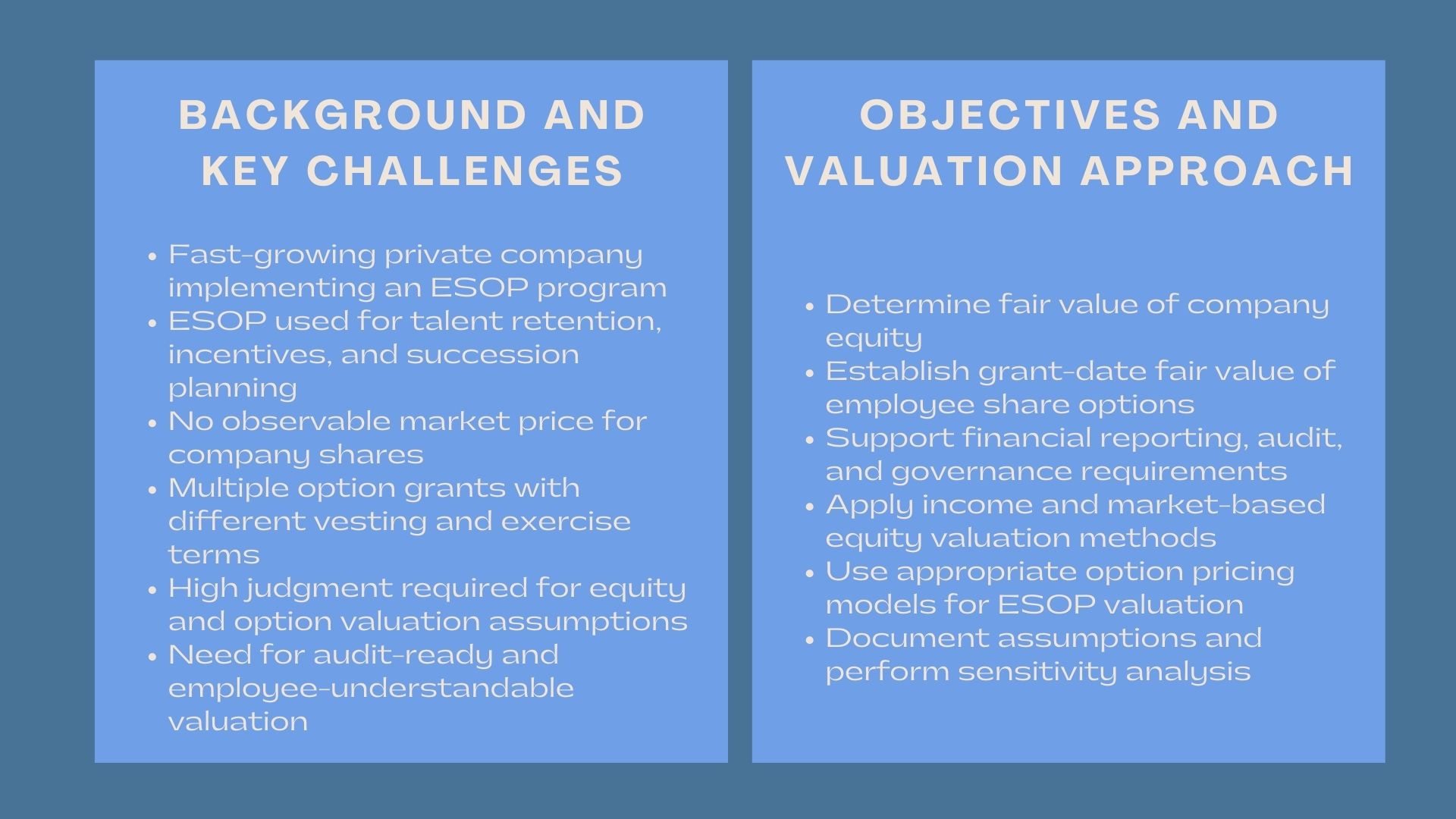
There were some technical and practical challenges in the ESOP valuation engagement. The company was privately owned and thus there was no easily visible market price of the shares of the company and therefore fair value estimation was judgmental and model-driven. The valuation of the equity was done with some concern to the performance of the company and its future growth, and capital structure.
Moreover, the ESOP had numerous option grants with different vesting procedures, exercise price, and contract. The implication of the importance of such options was the need to have strong option pricing methods that properly modeled time value, volatility, and exercise behavior of employees.
The other issue was associated with accounting and compliance needs. The company required an ESOP valuation that could be compliant with the relevant financial reporting standards and be audited. This necessitated a proper recording of assumptions, methods and verdicts.
Lastly, the management wanted a valuation process to have a result that would be easily articulated to employees and other stakeholders. Although technical accuracy was a must, the valuation should also make sense and have credibility to non-financial audiences.
Objectives
The main goal of the engagement was to assess the fair value of both the equity and employee share options awarded under the ESP was in a way independent, defensible, and consistent with the financial reporting requirements.
The client in particular wanted to:
- Fix a fair equity value of ESOP.
- Fair value of employee share options at grant date.
- Provide financial reporting and audit support.
- Improve disclosure and corporate control of equity awards.
- Give a stable structure on subsequent grants of ESOPs.
The valuation was to facilitate immediate reporting requirements as well as the administration of ESOP in the long term.
How We Helped
We took a systematic and strict ESOP valuation methodology that is specific to the company level of development and business description. We have started our work with the in-depth analysis of the business model, strategy, and the operating environment of the company and the historical and projected financial performance analysis.
In calculating the fair value of the company equity we have used suitable methodologies of valuation, such as income and market based. The review of cash flow projections was done with consistency, sustainability and alignment to the strategic plans of the company. Growth rates, margins, and discount rates were the main assumptions that were evaluated to portray the risk profile of the company.
After determining the equity value we divided the value among the capital structure of the company considering any preferential rights, dilution considerations and future equity arrangements. This was to make sure that the valuation was mindful of the economic interest of option holders.
In the case of valuing the employee share options, we have used the existing option pricing models that are applicable to ESOPs. The inputs of the model, which included the expected volatility, the life of the options, the risk-free rate and expected forfeiture rates were calculated based on a mixture of a company-specific analysis and the market data. The assumptions were well documented and matched with the accounting standards.
During the engagement, we collaborated closely with the management and finance departments to make sure the data was accurate, the mechanics of valuation were understood, and assumptions agreed upon. We focused on transparency, clarity and being auditing ready.
Value Delivered
This involvement proved that professional ESOP valuation services are important in balancing compliance, governance and the talent strategy. Our ESOP Valuation Services applied technical valuation skills and realistic communication to assist the client in adopting an effective and acceptable equity incentive program.
The valuation provided a solid base on the current ESOP administration, stakeholder trust and long term value generation.
ESOP valuation determines the fair value of employee share options for financial reporting, employee compensation, and compliance with accounting standards.
Accurate valuation ensures fair recognition of share-based payments, supports transparent financial reporting, and provides employees with equitable incentive arrangements.
The case study illustrates how recognised option pricing models and valuation assumptions are applied to employee share option plans.
Finance professionals, accountants, auditors, HR specialists, valuation consultants, and companies implementing employee share option plans benefit from ESOP valuation knowledge.
Participants learn how to apply option valuation models, evaluate key assumptions, calculate fair value, and support compliant financial reporting for employee share-based compensation.