
Valuation of Intangible Assets Under IFRS 3 in Indonesia
Intangible Asset Valuation IFRS Indonesia
The recognition of identifiable intangible assets that are not related to goodwill has become one of the most technically complex, judgmental and commercially sensitive aspects of financial reporting in Indonesia, especially where business combinations are normally accounted under IFRS 3 in local form via PSAK 22, whereby the need to recognise identifiable intangible assets represents a significant economic value in a brand, customer relationship, proprietary technologies, distribution chain and contractual relationship that were not previously reported on the standalone financial statement of the acquirer. In the event that an acquisition transaction occurs, the management must also complete a rigorous identification and measurement exercise to identify which intangible assets qualify as meeting the recognition criteria and value them at fair value as of the acquisition date, a process often necessitating the involvement of a team of experienced valuation experts, intensive financial modelling, and intense coordination with overall strategic projections. Services including those of Brand Valuation Indonesia and Customer Relationship Valuation have become of huge importance in this ever more sophisticated reporting environment, especially as the Indonesian companies branch out of domestic markets into Southeast Asia and other foreign jurisdictions and as institutional investors, regulators, and audit committees seek greater disclosure of the impetuses of post-acquisition profitability, sustainability of competitive advantages, and allocation of purchase consideration between tangible and intangible elements of enterprise value.
Under IFRS principles, goodwill must not be recognized with intangible assets identifiable otherwise, so that the intangible assets are recognised as such even when they are not goodwill, a requirement that often results in fine tuned technical evaluations of the legality of rights, economic streams of benefit, and assumptions of the participants in the market. This principle of recognition means that the management should not blindly rely on high-level strategic narratives but rather undertake granular analysis with empirical data, valuation theory, and market benchmarks to ensure that the measured fair values reflect the situation that is present at the acquisition date and not speculative synergies that are specific to the acquirer. Due to the growing diversification of the Indonesian economy into retail, telecommunications, digital services, infrastructure, manufacturing and financial services, measuring the value of intangible assets has become a larger and more complex process and cross-border transactions further bring to bear additional currency risk, regulatory impact and competitive forces that have to be captured in fair value measurements in accordance with international accounting standards.
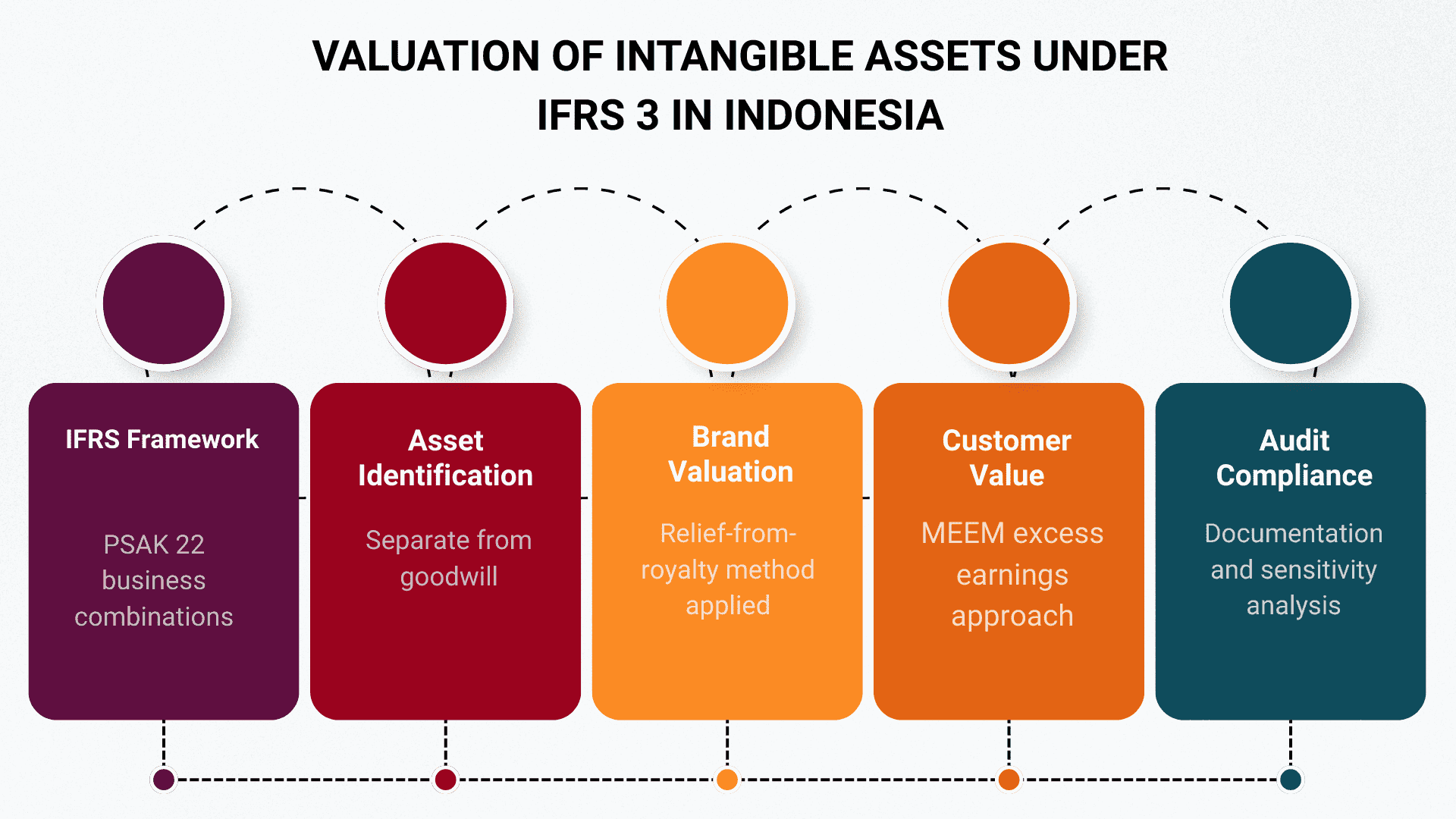
Some of the Intangible Assets that are recognised in Indonesia
Under the Indonesian IFRS-compliant financial reporting, intangible assets that are recognized in a business combination are usually classified into some broad but extremely-nuanced categories, each which must then be subject to a different valuation treatment depending on the economic nature, the risk exposure, and the useful life presumptions that apply to the particular asset group in question. The intangible resources relating to marketing are trade marks, trade names, brand names, internet domain names, proprietary packaging designs, and non-compete agreements, which can have significant economic values in consumer-oriented business environments where brand recognition can have a significant impact on purchasing behaviour, price elasticity, customer loyalty, as well as distribution leverage in the geographically diversified markets of Indonesia. Local Indonesian brands which have established a high degree of cultural resonance, distribution strengths operating nationwide and ongoing advertising presence across all major metropolitan regions are frequently subject to important premiums that must be calculated thoughtfully with recognised assessment techniques and argueable market-based assumptions.
The other important category of intangible assets is customer related and often has a large share of purchase price allocations in service businesses which include things such as customer lists, contractual relationships, order backlogs, subscription agreements, and long-term client relationships which provide predictable recurring revenue streams. Customer Relationship Valuation is of critical concern specifically in those industries, which are characterized by telecommunications, banking, insurance, digital platforms, and business-to-business distribution, customer retention, churn behaviour, cross-selling potential, and contractual enforceability are the primary determinants of long-term cash flow generation and enterprise sustainability.
Intangible assets related to technology, such as patented technologies, proprietary manufacturing processes, internally developed software platform, data analytics systems, and research and development pipeline are also becoming more pronounced in Indonesian acquisitions related to technology startups, industrial automation vendors, pharmaceutical firms, and digital commerce platforms. Also, intangible assets that are contract based like licensing agreements, franchise agreements, supply contracts, lease contracts, and government concessions can be separately recognized when they offer enforceable economic benefits that are not related to goodwill. All these types demand close evaluation of legal rights, economical life, risk of technological obsolescence, regulatory provisions and pressures of any competition in dynamic Indonesian market environment and a full observation of IFRS 3 measurement guidelines and principles of fair value.
Royalty Relief Method Explained
Relief-from-Royalty (RFR) technique is one of the best executed and conceptual sound methods of valuation applied in Brand Valuation Indonesia, especially in case of trademarks and trade names, which generate economic value due to improved pricing power, consumer confidence, market uniqueness, and long-term marketing investment. The theoretical basis of the RFR approach is based on the assumption that in the event the acquiring organization did not have full possession of the brand, it would be obliged to license the brand to a third party and to make arm-length royalty payments on the use of the brand, so the economic value of the brand could be estimated by estimating the value of the hypothetical royalty payments that the organization would otherwise have to pay.
The RFR method practicum entails a systematic and data-driven modelling procedure that commences with the forecasting of future revenues that could be attributed to branded goods or services in the Indonesian market based on historical financial performance, the approved budgets by the management, forecasts of the industry development, macroeconomic factors, demographic factors, and the competitive positioning. An appropriate royalty rate based on the similar licensing deals, royalty databases in the industry, publicly-reported deals and industry standards is then calculated and then adjusted to include brand-specific factors like market share, profitability levels, geographic reach, advertising intensity, and brand strength measures. The estimated royalty savings are taxed to show after-tax economic savings and discounted to present value with an acceptable discount rate reflecting risk profile of the brand in terms of business risk, market volatility and Indonesia-specific economic factors. The output of valuation is generally sensitive to the analysis to determine the effect of variation in royalty rates, assumptions on revenue growth and discount rates, which will increase transparency and audit defensibility.
Multi-Period Excess Earnings Method (MEEM)
Multi-Period Excess Earnings Method (MEEM) is widely used as a Customer Relationship Valuation engagement, especially in the valuation of contractual or non-contractual customer relationships producing recurring revenues across identifiable periods and is considered to be one of the most analytically rigorous income-based valuation methods in IFRS. MEEM works on the principle of isolating the cash flows that are directly related to customer relationship after the deductions of contributory asset charges that reflect the required returns on other assets that contribute to revenue generation, which includes working capital, fixed assets, assembled workforce and brand value.
Within the methodology, the projected revenues of the current customers are predicted during their remaining useful life, with the assumptions that relate to attrition rates, renewal chances, price changes, upselling chances, and changes in the competitive environment in the Indonesian industry environment. The operating expenses and contributory asset charges are subtracted to calculate excess earnings solely due to customer relationships that are discounted to the present value by applying a risk-adjusted discount rate that may be high compared to the total weighted average cost of capital because of concentration risks or uncertainty about customer retention. In Indonesia, modelling assumptions should address the exposure to credit risks, the enforceability of the contract by the local law, the regulatory supervision in the financial services industries and the responsiveness to the macroeconomic variations.
Further Reflecting in the Indonesian contexts
In addition to the choice of methods, valuation of intangible assets in Indonesia needs to be paid more attention to macroeconomic factors, regulatory trends, and the level of maturity of markets that can be much lower than developed capital markets. The volatility of exchange rates, changing taxation policies, the policies of the regional decentralisation, and the licensing frameworks that are specific to a particular sector can have a significant impact on the estimated cash flows, useful life analysis, and estimation of discount rates. In addition, the speedy Indonesian business digitalisation has brought new types of data-driven intangible assets such as proprietary algorithms, user databases, and platform ecosystems, which need advanced modelling approaches and a close differentiation between identifiable assets and goodwill left over.
There is a growing demand by auditors and regulators that there should be strong documentation, a reconciliation of the valuation models and the strategic forecasts and full disclosure of the important unobservable inputs, especially when the valuations have a significant impact on the reported earnings or equity balances. The use of sensitivity analysis, scenario modelling and cross-validation with market transactions are becoming the norm in larger Indonesian M & A transaction.
Frequently Answered Questions (FAQs)
- What does the difference between under IFRS between goodwill and identifiable intangible assets do?
The goodwill is the remaining value of purchase consideration on the recognition of all identifiable tangible and intangible assets and liabilities, which are only at fair value, at the acquisition date; identifiable intangibles are those items satisfying the separability or contractual-legal condition and capable of measurement; hence, goodwill reflects on synergies, assembled workforce, and other benefits that cannot be recognised separately. - Do internally generated brands exist as an intangible asset in Indonesia?
Through the principles of IFRS as embraced by PSAK 22 and PSAK 19, internally generated brands are typically not recognised on the balance sheet since the cost of them cannot be reliably separated on top of the total business development expenditures, however when a business combination is taking place then such brands are to be recognised at fair value by a special exercise called Brand Valuation Indonesia. - What is the useful life of an intangible asset?
The useful life is calculated with regard to the anticipated economic benefit periods, term under legal or contractual protection, competition, technological obsolescence risks, and industry conditions in Indonesia, and can be finite (amortised) or indefinite (not amortised and subjected to annual impairment test) to the expected benefit. - Does all recognised intangible assets need amortisation?
No, amortisation of intangible assets that have finite useful lives is based upon the estimated economic life of the asset, and intangible assets that have been determined to have indefinite useful lives (e.g. certain strong brands) are not amortised, but are subjected to an annual test of impairment in accordance with applicable accounting standards. - What is the discount rate to apply in the calculation of intangible assets?
The discounting rate must match the risk profile of the projected cash flows of the particular intangible asset and must also take into consideration the Indonesian market data including government bond yields, equity market risk premiums, beta coefficients, entity-specific risks, and sector volatility, which implies that it should align with the assumptions of market participants and not with the expectations of the entity. - Why is Customer Relationship valuation usually complicated in Indonesia?
Customer Relationship Valuation is a complicated concept since the rates of attrition, rates of renewal, cross-selling potentials, exposure to credit risk, and regulatory constraints tend to be vastly different depending on the industry like banking, telecommunications, insurance, and digital services in Indonesia dynamic economic environment. - In which cases is the Relief-from-Royalty method better than other valuation methods?
Relief-from-Royalty method is usually chosen in order to value trademarks and trade names since it directly correlates the value of the brand with its ability to generate income and with licensing practices that can be seen and observed, and thus it is specifically being used in Brand Valuation Indonesia assignments with consumer-facing companies whose market recognition can be quantified. - Should intangible assets be revaluated following acquisition?
After recognition of the intangible assets at fair value on the acquisition date, the assets are then subsequently measured at cost less amortisation and impairment (except where other model is allowed) however, impairment tests may need new valuation testing when there are signs of depreciation of value or when the useful life of the asset is indefinite. - What is the way auditors assess the valuations of intangible assets?
The auditors evaluate whether the valuation methodologies used are appropriate, whether assumptions used are reasonable and backed by evidence, whether models used are mathematically correct, and whether disclosures give sufficient descriptions of material unobservable inputs, sensitivity analysis as well as estimation uncertainties in accordance with the IFRS disclosures requirements. - In which instances should a company hire the services of an independent professional valuer?
Engaging an independent professional valuer should be a strong consideration of a company when the relevant intangible assets are material to the transaction, valuation requires a complex methodology such as Multi-Period Excess Earnings Method, insufficient expertise in the company, or because external auditors or regulators need to be encouraged to improve financial statement credibility and governance practices by having the independent professional valuer.
Professional Valuation of Financial Reporting
It is highly recommended that professional valuation experts should be engaged when intangible assets are material, the modeling complexity surpasses the ability to do so internally or when the support of independent practitioners is needed to stand the test of regulatory and audit scrutiny. Seasoned professionals in Brand Valuation, Indonesia and Customer relationship Valuation deliver methodological, proprietary database, and real world experience in balancing assumptions in valuation with the IFRS requirement and Indonesian market realities.
The early access of the valuation practitioners in the highly competitive and interconnected global M&A world of Indonesia simplifies the acquisition price allocation processes, reduces the chances of post-acquisition adjustments, and raises the value of the financial reporting submitted to investors, lenders, and other parties. Through strict valuation models, transparent modelling policies, and comprehensive documentation requirements, the Indonesian companies have a chance to make sure that recognition of intangible assets does not only meet IFRS, but also gives a valuable idea on the economic drivers that the long-term enterprise value creation is based on.
Intangible assets are identifiable non-physical assets such as trademarks, patents, software, customer relationships, and proprietary technology that generate future economic benefits.
Valuation supports financial reporting, business acquisitions, licensing, taxation, litigation, and strategic business planning.
Professional valuers commonly apply the Income Approach, Market Approach, or Cost Approach based on the characteristics of the intangible asset.
Businesses, investors, auditors, accountants, legal professionals, and valuation specialists commonly require independent intangible asset valuations.
Professional valuation ensures intangible assets are measured using recognised methodologies and reported in accordance with IFRS and PSAK standards.