
IFRS 3 Purchase Price Allocation (PPA) in
Indonesia – Practical Guide
Summary of IFRS 3 PPA Valuation Indonesia
Reporting of business combination under accounting model of business combination under the IFRS 3 offers a holistic and principle-based approach to the recognition and measurement of assets, liabilities and goodwill of an acquisition As the merger and acquisition process will still continue to expand in manufacturing, infrastructure, consumer goods, natural resource, medical services, financial services and technology oriented, the use of PPA Indonesia has become more refined and is still more technical in nature not just in expertise of technical skills of accounting, but also in the sophisticated valuation and deeper understanding of the current economic and regulatory environment within Indonesia.
The presence of a long-term history of domestic consumption, government infrastructure projects, digital transformation, foreign direct investment inflows, and strategic consolidation of family-owned conglomerates and regional corporate groups, in combination, has influenced M&A in Indonesia into more complex transaction structures based upon cross-border holding entities, layered financing structure, earn-out structure and multi-phase acquisitions. It is in this environment that an effectively performed IFRS 3 valuation Jakarta engagement is no longer considered as an ordinary post transaction compliance exercise, but as a very important financial reporting exercise directly affecting reported profitability, amortisation expense profiles, deferred tax positions, goodwill balances and long term impairment risk which are highly examined by auditors, regulators, lenders and investors.
In addition, since purchase price allocation results influence the future volatility of earnings via intangible asset amortisation, and, under IAS 36, goodwill impairments, it is important to the management teams to approach the PPA with a prospective mindset and ensure that the assumptions on valuation are well aligned with the strategic forecasts on the future, integration of operations and realistic expectations of the market so as to avoid the unwanted financial reporting implications in future reporting periods.
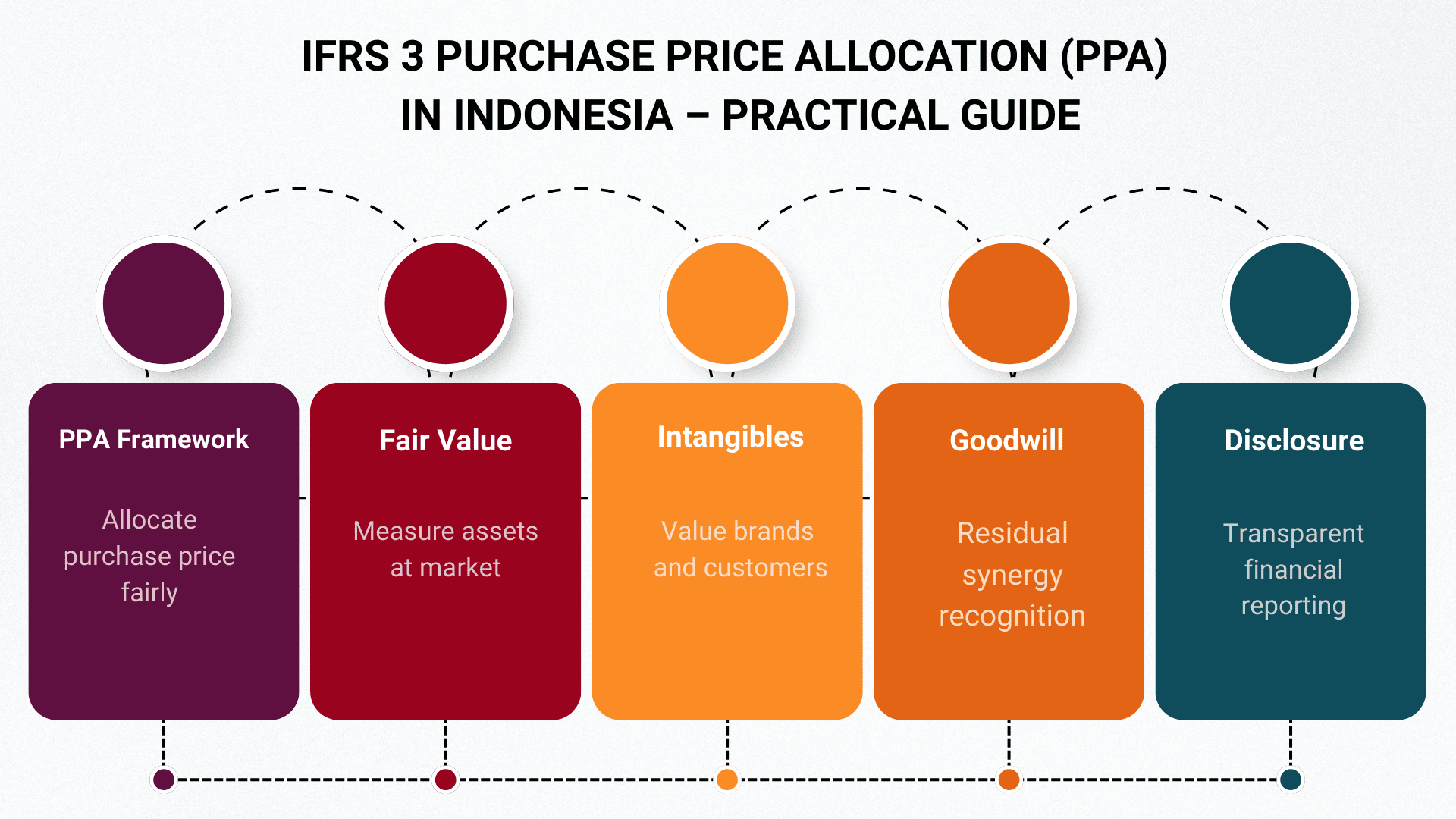
Step-by-Step PPA Process
The methodology under IFRS 3 in the Purchase Price Allocation process is structured and sequential and to give a clear and economical representation of the transaction, the total purchase consideration is systematically allocated to identifiable assets and liabilities at fair value as of the date of acquisition and the remaining value is recognisable as goodwill or very rare cases as a bargain purchase gain.
Determine Transfer of consideration
The initial step in an engagement of PPA Indonesia is to calculate total consideration transferred to acquire control over target at fair value as of the date of acquisition and not necessarily based on contractual amounts. Consideration can take the form of cash payments (immediate or deferral), shares issues, performance based contingent payments, and payment of preexisting relationships.
=
Earn-out arrangements are typical of Indonesian and cross-border deals, especially those of founder-based companies, exit by private equity, and foreign acquisitions. The contingent consideration should be valuated by the use of probability-weighted cash flow models and adjusted to the present value with a risk-adjusted rate bearing a reasonable assumption and analysis of the scenarios to survive an audit examination.
It is also necessary to highlight that the transaction-related costs, such as advisory fees, legal expenses, due diligence costs, and financing arrangement costs, are not part of the consideration conveyed under the IFRS 3, but rather expensed as incurred, and the inability to appropriately distinguish these aspects can lead to the occurrence of material misstatements in the goodwill calculations and further impairment testing.
Identify Recognisable Assets
After establishing the total consideration transferred, the acquirer has to identify and recognise all the assets acquired and liabilities assumed that satisfy the definition and recognition criteria of IFRS and measure each such item at fair value as of the acquisition date irrespective of whether such items were previously recognised in the standalone financial statements of the target. An asset is identifiable when it is separable, that is, when it is sellable, transferable, licensable, rentable, or exchangeable or when it results due to a contractual or legal right, although that right is not transferable.
Under local accounting standards, such a step will often lead to the recognition of intangible assets previously uncapitalised under local accounting, especially in privately owned companies where internally generated brands, proprietary technologies, customer acquisition expenditure and operational know-how may have been expensed in the past. In a formal IFRS 3 valuation Jakarta exercise, the valuation specialists perform comprehensive analysis of customer contracts, distribution agreements, licensing rights, trademarks, patents, non-compete agreements, supplier relationship and regulatory permits to conclude whether they are satisfied with the recognition criteria, as well as they have measurable economic value.
Along with the recognition of assets, liabilities should also be measured at fair value, and contingent liabilities need to be associated with the past occurrences which can be easily estimated, like the pending litigation, environmental remediation liabilities, warranty liability, employee benefit liability or tax liability, which have to be carefully considered to make the opening balance sheet to show a complete and fair picture of the acquired business.
Measure Intangible Assets
Intangible asset valuation at fair value is one of the elements in a PPA Indonesia engagement that are technically challenging: such assets are often not priced in the market, and thus they would need to apply sophisticated valuation techniques based on financial modelling, benchmarking, and economic analysis. Intangible assets unlike tangible ones e.g., land, buildings and machinery which may have easily comparable counterparts in the market are based on future economic benefits and in such an instance, identifying those benefits requires a keen identification of asset specific cash flows and contributory asset charges.
As an illustration case, the Multi-Period Excess Earnings Method is one of the approaches normally employed to value customer relationships by estimating the present value of the cash flows that can only be linked to current customer agreements after taking away the returns that are supposed to be earned on other supporting assets such as the working capital, fixed assets, and assembled workforce. Trademarks and brands are typically valued based on the Relief-from-Royalty method which approximates the amount that would have been paid in royalty payments had the trademark been licensed by an independent third party and converts the future revenues into a royalty savings stream, discounted to the present value.
The decision of the correct useful lives, terminal growth factors and discount rates shall be based on realistic expectation based on the past performance, positioning factors, industry factors and macroeconomic factors in Indonesia especially considering that the currency exchange rates, commodity prices and regulations may change greatly over the long-term profitability.
Calculate Goodwill
Once all identifiable assets and liabilities were allocated at their fair value, any net balance is recognised as goodwill which is the residual value assigned to anticipated synergies, assembled workforce benefits, strategic advantages, market expansion opportunities and other future economic benefits which fail to satisfy individual recognition requirements. Goodwill in Indonesian acquisitions is often based on expected acquisitions cost savings, vertical integration economies, expansion of distribution network, increased bargaining power with suppliers, and the fact that it is able to cross sell products or services to a larger number of customers.
Goodwill should also be determined based on the fair value of any non controlling interest and any equity interest that had been previously held in the case of a step acquisition in which the value of the resulting consolidated financial statements of the business being acquired will reflect the true consolidated values of the business. Since goodwill is not amortised, but rather to be tested with respect to impairment on an annual basis as required by IAS 36, a high or unsupportable balance of goodwill can pose a substantial financial reporting risk in the future, especially in cases where the marketing-related synergies have not yet materialised, or where the market conditions have worsened.
Intangible Assets Valuation Methods
PPA Indonesia assignments have normally allowed valuation professionals to use three major valuation techniques: the income method, the market method and the cost method all of which should be chosen and implemented depending on the asset type, presence of data, and forecast validity. The most common method is the income approach, which directly relates asset value with future economic benefits which are anticipated and involves the Multi-Period Excess Earnings Method, the Relief-from-Royalty method and the With-and-Without method, the latter requires elaborate forecasting and discounting methods.
The market strategy is conceptually simple but very much relies on the presence of similar transactions or royalty rate references which in the Indonesian market might be scarce because of the privacy of the majority of the transactions and access to their financial details. However, where good data exists, market multiples can be a good back-up to industrialize income based valuations.
The cost approach which approximates the replacement or reproduction cost of an asset with consideration of the obsolescence is usually used in the case of internally developed software or operational systems that enable the processes of the business, but do not create identifiable streams of revenue on their own.
Case Study -acquisition of Indonesian Manufacturing Company
As an example of a practical application of a comprehensive IFRS 3 valuation Jakarta exercise, we will assume that a mid-sized Indonesian manufacturing company has been acquired at a total consideration of IDR 700 billion comprised of IDR 650 billion cash and IDR 50 billion contingent earn-out payments based on future operating performance. The net book value of assets of the target before fair value adjustments stands at IDR 400 billion.
In the PPA Indonesia process, valuation experts recognise valuation of customer relationships of IDR 120 billion, registered trademark worth IDR 80 billion, proprietary production technology worth IDR 60 billion, and fair value uplift on the property plant and equipment worth IDR 40 billion, and deferred tax liability of IDR 60 billion as the result of temporary differences due to the fair value adjustments. This means that the fair value of the net identifiable asset is determined as:
400 + 120 + 80 + 60 + 40 – 60 = IDR 640 billion
Accordingly, the amount of goodwill is computed as:
700 – 640 = IDR 60 billion
Such a goodwill balance includes projectable synergies in operations, cost-efficiencies, increase in production capacity, and market positioning in the competitive manufacturing industry of Indonesia.
Typical Issues in the Indonesian PPA Engagement
Some common pitfalls in PPA Indonesia deals include transactions involving privately held or family owned businesses where a financial reporting system might not have the finer historical detail that can be easily used to perform a strong valuation modelling. Scarcity of customer attrition rates, segmented revenue rates, and recorded future projections may make it difficult to implement income-based valuation techniques and may require more management interviews and analysis.
The unpredictability of the macroeconomy, exchange rates, regulatory changes, and the commodity price cycles also make the reliability of the forecast even more difficult, and sensitivity analysis and scenario modelling would have to ensure that even under the alternative assumptions that are reasonable, the valuation results can be defended. Moreover, the deferred tax implications in respect of fair value adjustments should be properly estimated and reconciled to eliminate the discrepancies between the accounting and tax reporting models.
Lastly, the need to increase audit scrutiny especially of publicly listed firms in Jakarta requires comprehensive documentation of major assumptions, alignment to board-approved budgets, benchmarking of discount rates, and alignment between impairment models and publicly announced strategic plans.
Disclosure Requirements on IFRS
The IFRS 3 requires full disclosure of nature and financial impact of business combination and therefore it requires that they disclose both the qualitative and quantitative information that will allow users of financial statements to appraise the transaction. Disclosure should contain description of the business acquired, date of acquisition, the major reasons that have caused the acquisition, fair value of consideration transferred, recognisable amounts of major classes of assets and liabilities, and qualitative description of goodwill recognised.
Also, entities should disclose revenue contributions and profit contributions, of the business acquired because the date of acquisition, and the pro forma information as it would have been had the acquisition been effected on the first date of the reporting period, where practicable. In case provisional accounting is used because of unavailable information on reporting date, then entities need to reveal this fact and later transfer amounts in the measurement period of up to twelve months.
FAQs on PPA in Indonesia
- Are all acquisitions obligatory to be PPA?
Yes, the entities that use IFRS-converged standards should adhere to the IFRS 3 when it comes to business combinations. - What is the approximate duration in a PPA engagement?
Most engagements take four to ten weeks depending on the complexity of transactions and availability of data. - Who is supposed to do the valuation?
The objectivity and audit defensibility is normally obtained by hiring independent experts with knowledge on PPA Indonesia and IFRS 3 valuation Jakarta assignments. - Does goodwill get amortised?
No, goodwill is tested under IAS 36 of impairment annually, instead of testing amortisation. - Will PPA have an effect on future earnings volatility?
Yes, the amortisation of the recognised intangible assets and the possible impairment of the potential goodwill may have a great impact on the trends of post-acquisition profitability.
Conclusion
The IFRS 3 Purchase Price Allocation in Indonesia is a technically demanding and strategically important exercise which goes far beyond mere compliance and has far-reaching impacts on financial performance indicators, investor confidence and long-term reporting stabilization. Organizing a properly implemented and well-documented PPA Indonesia exercise with the help of justifiable IFRS 3-based Jakarta valuations can help the companies to make certain that acquired assets and liabilities, goodwill measure, and disclosure are properly recognized, which in turn enhances good corporate governance and prevents losing credibility among auditors, regulators, and capital market participants.
IFRS 3 Purchase Price Allocation allocates the purchase price of an acquired business to identifiable assets, liabilities, and goodwill based on their fair values.
PPA ensures acquired assets and liabilities are recognised correctly, supporting compliance with IFRS 3 and accurate financial reporting.
Assets may include property, equipment, customer relationships, trademarks, patents, technology, contracts, and other identifiable intangible assets.
Companies involved in mergers, acquisitions, corporate restructuring, and financial reporting under IFRS or PSAK standards commonly require PPA valuations.
Professional valuation improves financial reporting accuracy, supports compliance, and provides reliable fair value assessments for acquired assets and liabilities.