
Case Study: Brand Valuation Supporting Strategic Management and Financial Reporting
Background on Master Brand Valuation Case Study
A consumer-oriented business that has been in the market long enough had made a substantial investment in developing brand equity, customer loyalty and market differentiation. Although the brand was overall considered to be one of the reasons of commercial success, its value was never quantified separately. When the business was at a new stage of strategic planning, the management saw the necessity to know the economic value of the brand and what it could add to the overall enterprise value.
The brand valuation had to endorse various goals such as strategic decision-making, internal performance and financial reporting. Due to the significance of the brand as one of the key intangible assets, the management has contracted our valuation team to present an independent and systematic brand valuation in line with the accepted valuation principles.
 Issues and Challenges
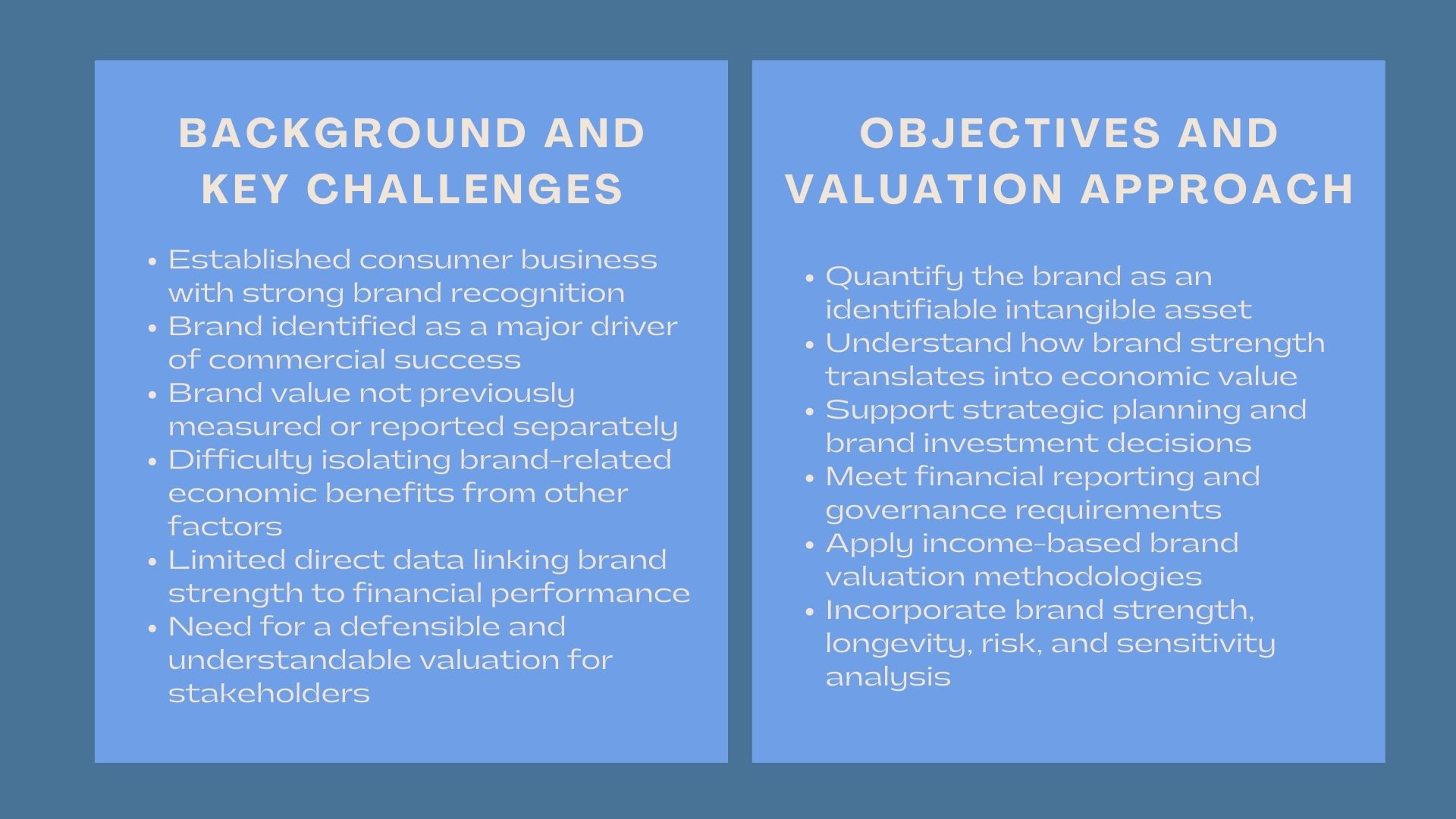
The importance of brand valuation is a challenging issue, and brand value, as such, is rather abstract and closely tied to the perception of the consumers, their behavior and the forces of the market. Although the company was well-known in terms of its brand, distinguishing between the particular economic gains that could be attributed to the brand, without considering other aspects of the brand, including quality of products, distribution, and prices, was delicate.
Other problems associated with data availability and reliability. Such benefits associated with brands are usually indirectly observed in premiums in terms of pricing, retaining customers and market share as opposed to direct financial lines. Measuring these benefits had to be a mix of financial analysis and market insight with a touch of professional judgment.
Besides this the business also existed in a competitive environment where brand strength was a factor that affected the purchasing decisions but was also prone to erosion caused by the changing consumer preferences and competitive moves. The valuation had to consider the brand longevity, risk and the possibility of continuing to invest in the brand.
Last but not least, the management needed a technically sound valuation result which could easily be comprehended by non-technical stakeholders, such as senior management and auditors.
Objectives
The main goal of the engagement was to calculate the fair value of the brand as an identifiable intangible asset, which would give an objective and justifiable estimate of its economic contribution.
Particularly, the client was interested in:
- Measure the brand financial value.
- Learn how brand strength was converted into economic gains.
- Strategic planning and brand investment.
- Fulfill financial reporting and control demands.
- Enhance visibility on the drivers of intangible value.
The brand valuation was to be more of a strategy and analytical instrument and not a strictly theoretical one.
How We Helped
We took a systematic and global accepted brand valuation methodology, depending on the business model and market situation of the client. We started our work with a thorough appreciation of the position of the brand in the general value chain, the effects of the brand on customer acquisition, retention and pricing.
The strength of the brands was measured through the framework of analyzing: the position of the brand, customer loyalty, competitive difference, and the uniformity of the brand message. This qualitative measurement was used to develop quantitative assumptions in the valuation model.
To value it, we used an income-based method, which is normally applied in valuing a brand that relies on the incremental economic benefits that one can attribute to the brand. This was through future revenue estimations, setting the right royalty or brand-related earnings, and use of risk-adjusted discount rates that represent brand-related risks.
We also evaluated the projected economic life of the brand and the amount of continued investment we needed to uphold the brand value. Sensitivity analyses have also been done to demonstrate the effects of change in the main assumptions on the valuation results.
During the engagement, we collaborated with the management to create harmony on the assumptions but retained the independence of valuation. We have clearly recorded our findings and methods to facilitate the audit examination and communication to the stakeholders.
Value Delivered
Such interaction revealed the potential that the professional brand valuation services have in converting not measurable perceptions into quantifiable economic value. Through effective valuation practices and effective communication we assisted the client to understand, manage and preserve better one of its most valuable assets.
The services offered under our Brand Valuation proceeded to provide the client with clarity, transparency, and improved governance that allowed him to make better judgments regarding brand investment and long-term value creation, while helping the management Build Strategic Brand Valuation Skills to support informed decision-making and sustainable business growth.
Brand valuation estimates the financial value of a company's brand by assessing its market recognition, customer loyalty, competitive strength, and future earning potential.
Brand valuation supports licensing, mergers, acquisitions, financial reporting, strategic planning, and intellectual property management.
The case study shows how recognised valuation approaches are applied to estimate brand value using practical business and market information.
Business owners, marketers, investors, valuation professionals, consultants, and intellectual property specialists benefit from understanding brand valuation.
Participants learn how to evaluate brand performance, apply valuation methodologies, and assess the commercial value of brand-related intangible assets.