
Case Study: M&A Valuation Supporting a Strategic Acquisition in Singapore
Background MA Valuation Case Study
One of the corporate groups based in Singapore was considering acquiring a privately held company as part of its expansion strategy regionally. The deal was meant to consolidate the position of the group in the market, increase its services and generate a long term shareholder value. Although preliminary negotiations indicated strategic alignment, the client recognized that a strong and independent valuation was essential before proceeding, consistent with insights from Learn M&A Program Fundamentals Practically.
The transaction was complicated and the Singapore M&A market environment is quite competitive and the management needed valuation beyond the headline financial measures. The valuation should be such as to capture the underlying fundamentals of the target, its growth prospects, and its risk profile as well as facilitate informed decision-making, negotiation strategy, and approvals of its internal governance. To meet these requirements, the client engaged our Singapore-based M&A valuation team to deliver independent, transaction-oriented valuation services grounded in Master M&A Program Financial Modeling.
Issues and Challenges
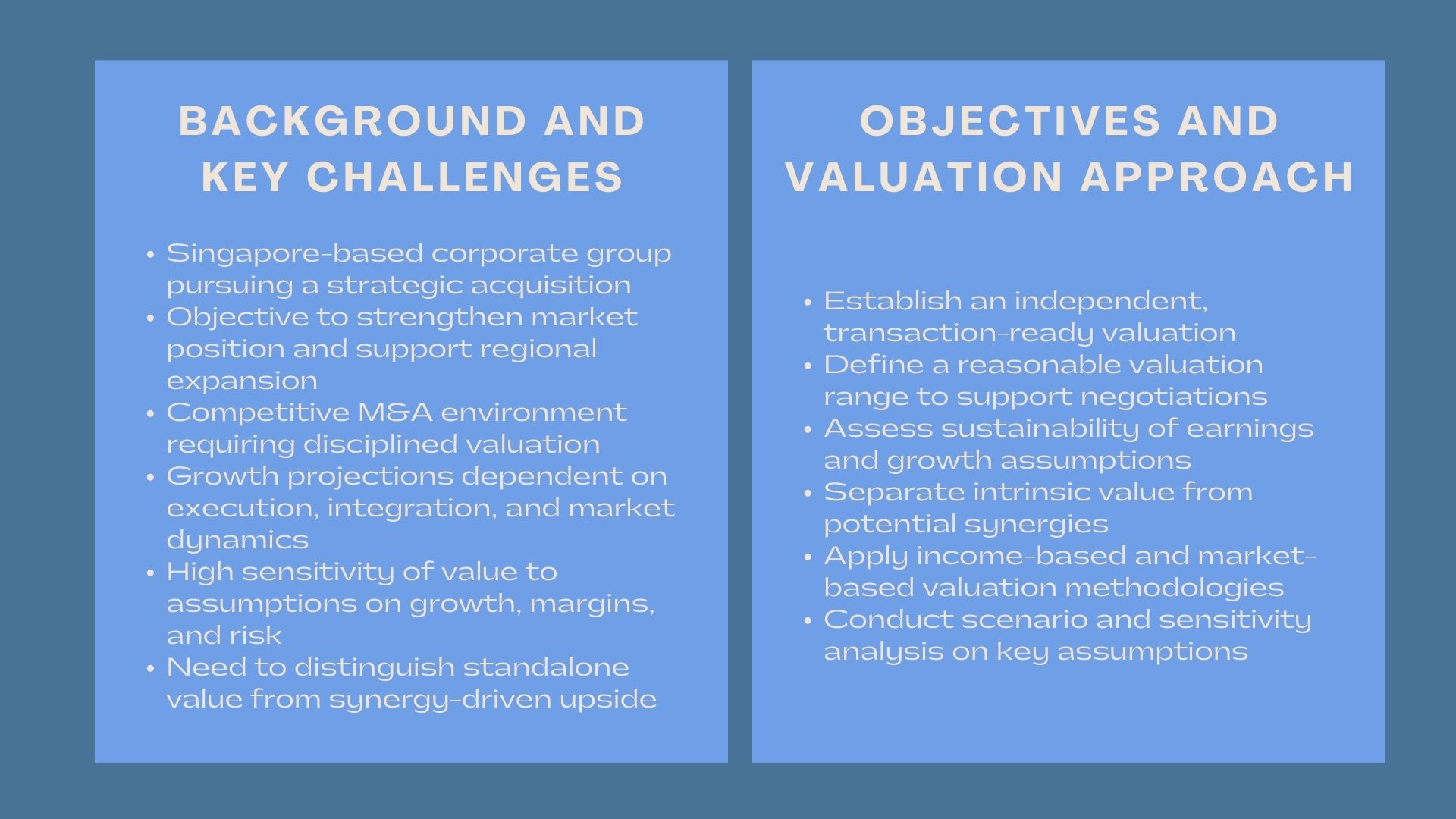
The client experienced a number of problems that are usually experienced in mergers and acquisitions. Although the target business has had stable business performance, the growth projections were pegged on market expansion, operation implementation and integration success. The appraisal of the sustainability of earnings and the accuracy of the management projections had to be scrutinised.
Also, the target was functioning in a competitive and volatile market environment. Assumptions in valuation which involved growth rates, margins and capital investment were sensitive to market conditions, customer behavior, and regulatory dynamics alterations. The client was required to understand the relation of these factors to value in diverse conditions.
The other major issue was associated with standalone value and strategic value. The acquisition rationale also comprised possible synergies although there were chances of over paying when synergies are not explicitly defined, measured and evaluated on their feasibility. The management needed the objective perspective of what share of value could be reasonably allocated to synergies as compared to the target performance.
Lastly, the valuation had to be stable to internal examination by the investment committee and like other market predictions in the Singapore disciplined deal making market. There was a need to have a justifiable, open, and documented valuation.
Objectives
The main aim of the engagement was to make it independent and be ready to undertake a transaction valuation of the target business to assist in the acquisition decision-making. The client was interested in having a clear picture of value in various situations, which would allow having more knowledge with respect to negotiations and an austere allocation of capital.
In particular, the client wanted to:
- Establish a reasonable price range of the target company.
- Evaluate the growth and earnings sustainability assumptions.
- Draw the line between standalone value and synergy driven value.
- Approval processes and strategy of support negotiation.
- Minimize the danger of acquiring the company at an overprice.
The valuation had to be not only technically sound, but also practical to use by the senior management.
How We Helped
We have employed a systematic and transactional valuation model that suits the Singapore M&A environment and client strategic goals. We started by having a good grasp of the business model, financial performance, competitive positioning and growth strategy of the target.
We have also analyzed historical financial data in order to determine the quality of earnings, margin maintenance and cash flow generation. Where the need arose, there was a reposition to bring earnings to a normalized level so as to represent the real operating performance of the target.
Triangulation of value was done using multiple valuation methodologies to give a balanced point of view. These were not only income-based methods based on future cash flow forecasting, but also market-based benchmarking based on the relevant transactions, and similar companies. All the methodologies were properly calibrated to capture the risk profile and the stage of growth of the target.
We have also conducted a scenario and sensitivity analysis, to demonstrate how alterations in the major assumptions, e.g. growth rates, margins, and discount rates, would affect the results of the valuation. The potential synergies were evaluated on an individual basis to bring out clarity between the intrinsic value and the strategic upside.
During the engagement, we collaborated with the management team of the client offering interim advice and valuation implications as part of the negotiation strategy and deal structuring. This participative style made sure that there was a sense of coordination and decision-making at the right time.
Value Delivered
This involvement showed the importance of independent M&A valuation in the successful transactions in the competitive market in Singapore. Our M&A Valuation Singapore services ensured that the client minimized the risk of uncertainty, enhanced the negotiation positions, and preserved shareholder value.
What we did was that valuation as a concept was not an abstract form of exercise, but a strategic instrument that allowed us to make sound decisions, be disciplined in how we deploy capital and long term value creation.
Mergers and acquisitions (M&A) valuation determines the fair value of a business to support acquisition pricing, negotiations, and strategic investment decisions.
Accurate valuation helps buyers and sellers determine fair transaction values, identify synergies, and reduce financial risks during acquisitions.
The case study demonstrates valuation methodologies, financial analysis, due diligence considerations, synergy assessments, and transaction pricing techniques.
Corporate finance professionals, investment bankers, business owners, investors, accountants, and valuation specialists benefit from M&A valuation knowledge.
Participants gain practical experience in analysing acquisition opportunities, applying valuation techniques, and supporting strategic transaction decisions.