
Case Study: Startup Valuation Supporting Fundraising, Governance, and Strategic Decision-Making
Background on Startup Valuation Case Study
It was a company with a scalable business model that was at its early stages and about to reach a major milestone of the development path. After development and initial commercial momentum, the startup was getting into negotiations with prospective investors to get funding to develop its product, grow the market and develop the team. Although the management possessed a high vision and operational momentum, it did not have a clear and autonomous valuation system that could be used to negotiate with investors and make decisions internally.
Since no long operating history and minimal financial data, business valuation was to be done with keen consideration of the potential in the future and not in the past. In order to create credibility and transparency, the startup added the services of our valuation team to get an independent valuation that can be used as a tool in the fund-raising decision and governance discussions and strategic planning, aligning with insights from Master Business Valuation Course Singapore.
Issues and Challenges
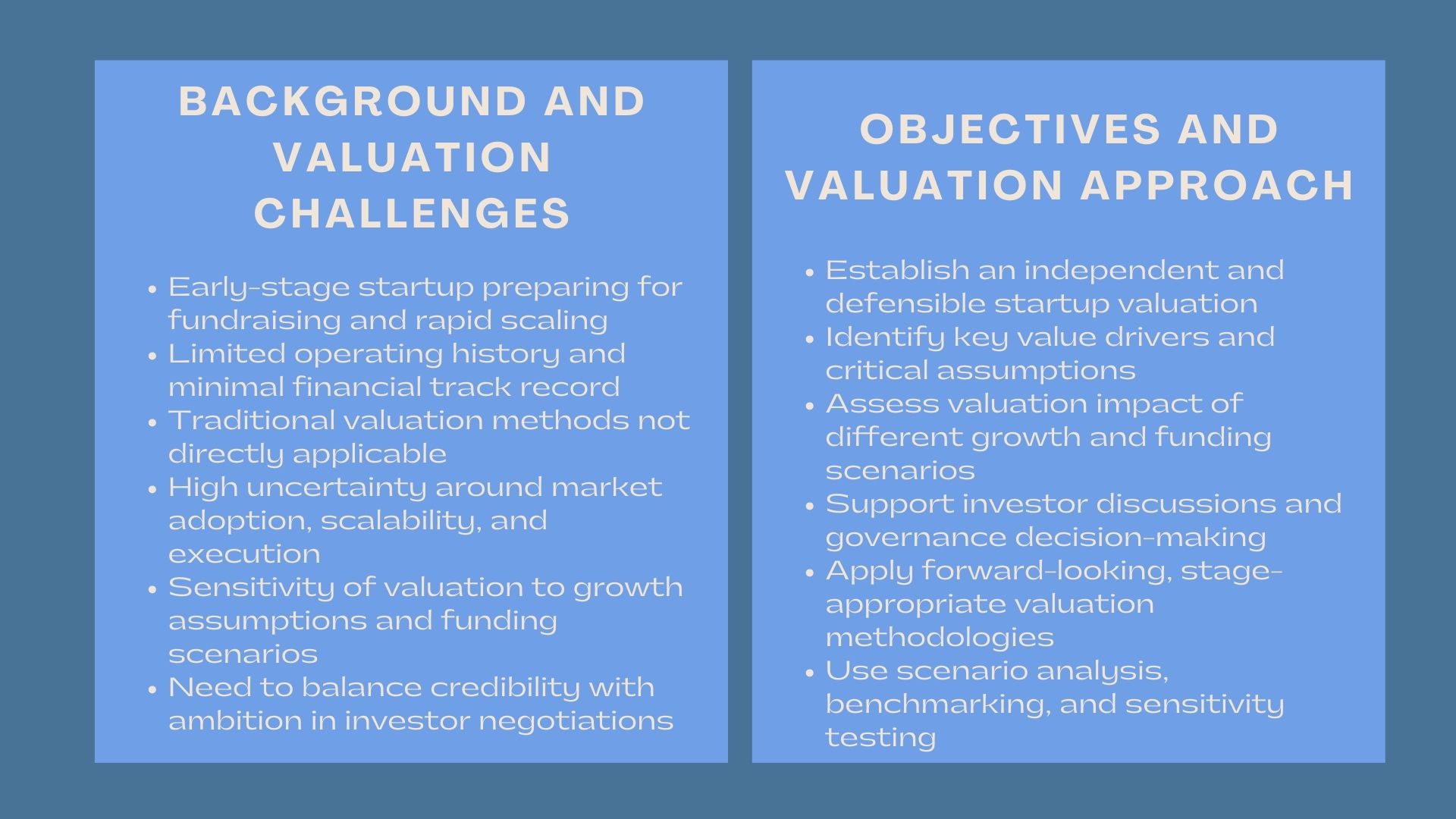
Valuation of a startup is a different issue than with mature businesses. The historical financial performance of the company was low and traditional valuation approaches which relied on earnings or cash flows could not be easily used without major assumptions. The revenue was yet to reach maturity, cost structures were evolving and no profitability was anticipated in the near future.
Furthermore, the startup was functioning in a dynamic and competitive market that brought uncertainty on the market adoption, scalability, and execution risk. The management forecasts were bold yet had to be evaluated independently to give the company internal consistency and correspondence with the realistic market trends.
The capital structure of the company was also fairly straightforward and developing, as there was founder equity, the presence of early investors, and future financing rounds are possible. The implication of valuation into dilution of ownership and adoption of control was a major issue to the founders and potential investors.
Lastly, the startup had to be valued in a way that would be optimistic and credible at the same time. A highly aggressive valuation would hurt the investor confidence whereas a low valuation would thin out the founders unnecessarily. It was essential to balance this.
Objectives
The main goal of the engagement was to arrive at a reasonable and justifiable valuation of the startup that would capture its present standing and potential of growth. Valuation had to sustain positive fundraising communications as well as giving transparency to the current stakeholders, while incorporating insights from Learn Strategic Fund Raising Techniques to ensure an effective and professional approach to capital acquisition.
In particular, the client was interested in:
- Set up an autonomous and reputable standard of value measurement.
- Know important value drivers and assumptions on valuation.
- Evaluate the effectiveness of various growth and funding conditions.
- Negotiating support with prospective investors.
- Enhance internal control and decision making discipline.
The valuation was to be used as a tool of support of the transaction as well as a strategic reference.
How We Helped
This was a systematic and stage-suited valuation strategy that fits the nature of early-stage corporations. We started by getting a solid grasp of the business model of the startup, technology, target market and expansion plan. We approached the management closely so as to get to know the major assumptions and plans of implementation.
As the startup only has a short history of operations, we used several valuation methods to triangulate the value. They were forward-looking income-based approaches, scenario analysis, and benchmarking based on similar businesses at the early stage. All of the methods were properly scaled to the risk profile and development phase of the startup.
Our special focus was on defining and describing value drivers of high importance, including customer acquisition, unit economics, scalability and market size. Stress testing of assumptions and sensitivity analysis were conducted to show how the values would change depending on the change in the inputs that are important.
During the engagement, we converted technical concepts of valuation to understandable and practical concepts. This guaranteed that the founders and non-technical stakeholders were able to know the foundation of the valuation and its consequences.
Value Delivered
This interaction showed that professional startup valuation services can be effective in both transactional and strategic win goals. Through strict methodology and effective communication, we assisted the client to find the balance between ambition and credibility, minimize uncertainty level, and build investor confidence.
The Startup Valuation services offered by us gave the company a strong platform to raise funds, establish effective governance, and create value in the long run, to proceed with a clear and confident step.
Startup valuation estimates the value of an early-stage business by considering factors such as growth potential, innovation, market opportunity, and future financial performance.
Many startups have limited financial history, so valuation also considers qualitative factors such as technology, management capability, customer traction, and scalability.
The case study illustrates how different valuation methods are applied to estimate startup value using practical assumptions and real-world business scenarios.
Startup founders, investors, venture capital professionals, finance specialists, and business consultants benefit from understanding startup valuation techniques.
Participants learn how to evaluate startup potential, apply recognised valuation methods, and support fundraising or investment decisions with greater confidence.