
Case Study: Independent Valuation of Convertible Instruments Supporting Financial Reporting and Strategic Decision-Making
Background on Convertible Instruments Case Study
This was a developing, privately owned company that was undertaking the process of building up its capital base after several rounds of capital raising. The company had over the years issued a mix of convertible instruments such as convertible notes and preference shares that had conversion and redemption features. The instruments were very important in growth in terms of funding and offered protection to the downside and participation to the upside to the investors.
As the company grew, the management had more requirements to have correct and defensible valuation of these convertible instruments. Accurate financial reporting, enhanced stakeholder transparency, and Build Strategic Decision Making Confidence around future fundraising plans and potential exit scenarios all depended on reliable valuations. Given the complexity of these instruments and the absence of observable market prices, the company engaged our valuation team to deliver an independent, robust, and technically sound evaluation that could support both compliance and long-term strategic objectives.
Issues and Challenges
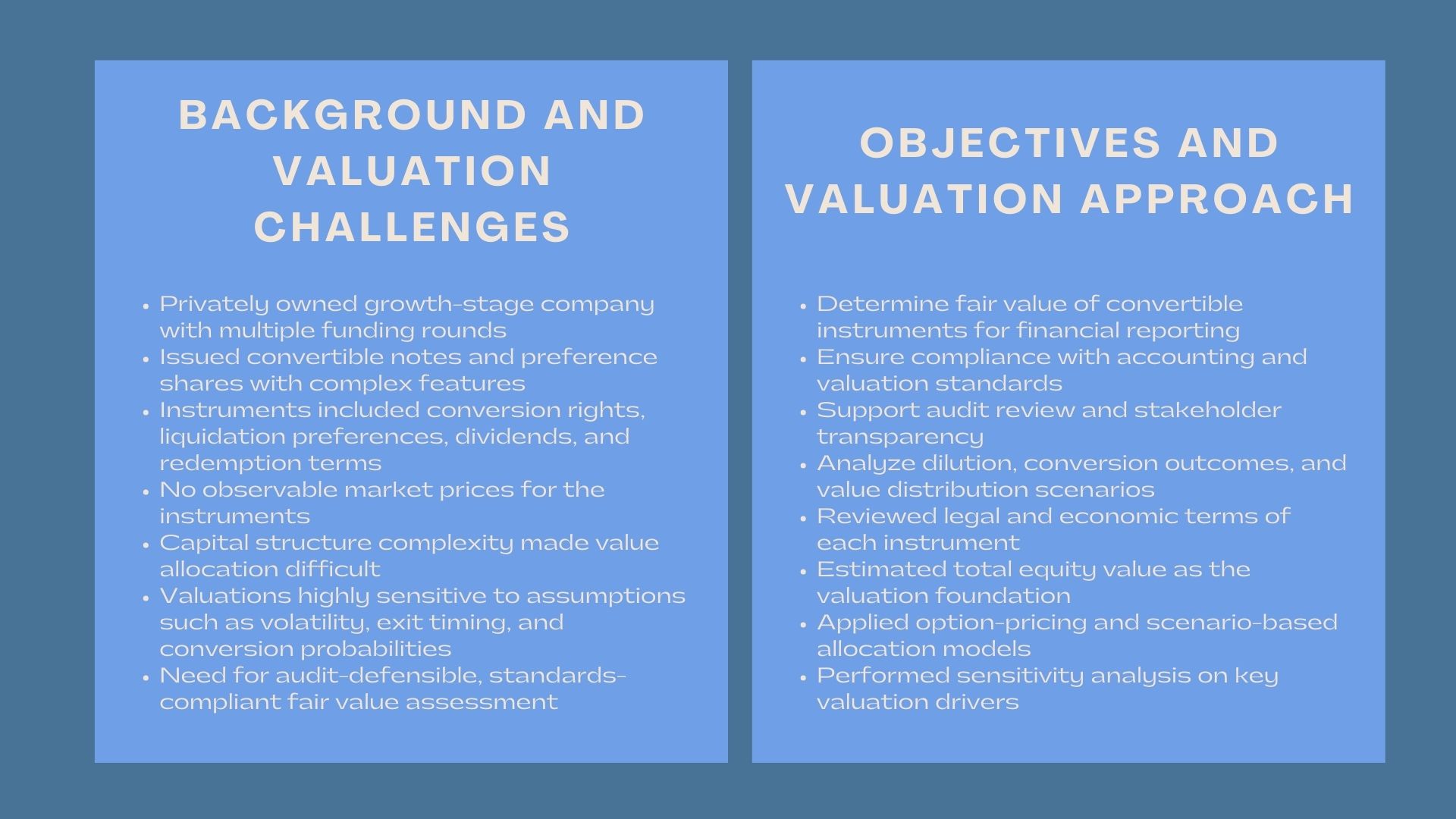
There were some technical and practical issues in valuing convertible instruments. The instruments had several inbuilt features such as conversion features, liquidation preferences, dividend entitlement, as well as redemption features in certain cases. All these added optionality and non-linearity to the valuation and thus simple equity valuation methods were inadequate.
Secondly, the capital structure of the company had been transformed by the repeated financing rounds, and the company had several classes of shares with varying rights and priorities. This complexity ensured that it was hard to estimate the levels of value that would be distributed among the stakeholders in different situations, including conversion at maturity, a qualified financing event or a liquidity event.
The other problem is associated with the sensitivity of valuations to major assumptions. Volatility, discount rates, probability of conversion, exit timing and expected future equity value were important inputs that had a great impact on the valuation outcome. The management and auditors needed to ensure that these assumptions were reasonable, consistent and supportable.
Lastly, the absence of active market transactions of similar instruments was another factor that augmented the use of valuation models and professional judgment. The client would require a technically sound valuation that would be well documented and defendable both in audit and governance grounds.
Objectives
The only aim of the engagement was to estimate the fair value of the convertible instruments of the company in a way that was in compliance with the relevant accounting and valuation standards. The client wanted a clear and well-substantiated valuation to be dependent on to report on their financial and subjected to an external audit.
Moreover, the management wanted to gain a better insight on the economic effect of the convertible instruments such as possibilities of dilution, conversion results and a distribution of value to the stakeholders under various circumstances. This valuation was also expected to support strategic conversation of capital raising and capital structure optimization in future.
How We Helped
Our valuation strategy was organized and strict according to the peculiarities of convertible instruments and the capital structure of the company. We started our interaction by carefully examining the legal and economic conditions of every tool, in order to make sure that we understood how conversion works, preferences, and contingencies.
We have then determined the total equity value of the company depending on adequate methods of valuation considering its level of development, financial performance and growth opportunities. This equity value was the basis of determining the value of the different securities in the capital structure.
We utilized developed valuation techniques typically applied to complex capital structures in order to specify the optionality inherent in the convertible instruments, including option-pricing and scenario-based allocation models. These methods have enabled us to explicitly model various outcomes such as conversion at maturity, conversion at a liquidity event, and downside outcomes, which would result in preference features taking over.
The main assumptions were created based on the mixture of quantitative analysis, benchmarking, and professional judgment. Sensitivity analyses were also done to demonstrate the impact of variations in key inputs on the results of the valuation, which will give the management a better understanding of the key drivers of value.
In the process, we have collaborated with the management and auditors, discussing methods of approach, assumptions and findings in a straightforward non-technical manner. The joint mechanism helped in keeping everyone on track and reduced doubts when conducting the audit.
Value Delivered
This activity showed how much specialist valuation expertise is needed with regard to the difficulties of convertible instruments. Through the use of strict methodologies and effective communication, we were able to ensure that the client was able to gain transparency, confidence in auditing, and enhanced strategic comprehension.
The complexity arising in the case at hand was effectively overcome using our Convertible Instruments Valuation services, as the valuation calculations achieved technical soundness, defendability, and consistency with reporting requirements, while also helping stakeholders build financial statement decision making confidence aligned with long-term business objectives.
Convertible instruments are financial securities, such as convertible bonds or notes, that can be converted into equity shares under specified terms and conditions.
Valuation determines the fair value of both debt and equity components, supporting accurate financial reporting and investment decision-making.
The case study demonstrates how valuation models are applied to assess convertible securities while considering conversion features, market conditions, and accounting requirements.
Finance professionals, accountants, auditors, investors, valuation specialists, and corporate finance teams can benefit from understanding convertible instrument valuation.
The case study provides practical examples that help participants apply valuation techniques and understand real-world financial reporting scenarios.